

There will be war volume.., p.1
There Will Be War Volume I, page 1


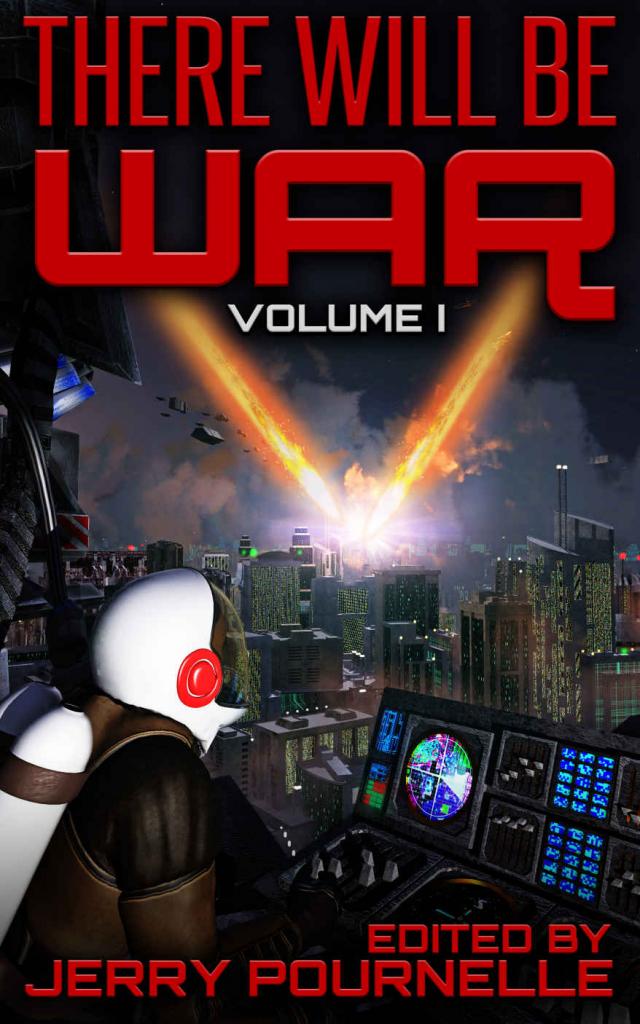
There Will Be War
Volume I
edited by Jerry Pournelle and John F. Carr
Published by Castalia House
Kouvola, Finland
www.castaliahouse.com
First published by Tom Doherty Associates, Inc. (1983)
This book or parts thereof may not be reproduced in any form, stored in a retrieval system, or transmitted in any form by any means—electronic, mechanical, photocopy, recording, or otherwise—without prior written permission of the publisher, except as provided by Finnish copyright law.
The stories in this collection are works of fiction. Names, characters, places, and incidents are products of the author’s imagination or are used in a fictitious manner. Any similarity to actual people, organizations, and/or events is purely coincidental.
Editor: Jerry Pournelle
Associate Editor: John F. Carr
Technical Editor, 2015 Edition: Eric Pobirs
Cover Image: Lars Braad Andersen
Version 001
Copyright © 1983, 2015 by Jerry Pournelle
All rights reserved
The stories contained herein were first published and copyrighted as follows:
REFLEX by Larry Niven and Jerry Pournelle has never been previously published. Printed by arrangement with the authors and the authors’ agent, Blassingame, McCauley, and Wood. Copyright©1982 by Niven and Pournelle.
SPANISH MAN’S GRAVE by James Warner Bellah was first published in The Saturday Evening Post in 1947. It is reprinted by special permission of the James Warner Bellah Estate. Copyright©1947 by The Curtis Publishing Company.
MARIUS by Poul Anderson is copyright©1957 by Street & Smith Publications, Inc. Originally published in the March 1957 issue of Astounding Science Fiction. Reprinted by special permission of the author.
THE THREAT by the Committee on Space War of the Citizens’ Advisory Council on National Space Policy. Copyright©1981 by the L-5 Society. Published by special arrangement with the officers of the L-5 Society.
ENDER’S GAME by Orson Scott Card was first published in the August 1977 issue of Analog Science Fiction/Fact Magazine. Copyright©1977 by Conde Nast Publications, Inc.
A DEATH IN REALTIME by Richard Sean McEnroe appeared in DESTINIES. Published by permission of the author. Copyright©1981 by Richard Sean McEnroe.
OVERDOSE by Spider Robinson was previously published in Galaxy, September 1975 issue. Copyright©1975 by UPD Publishing Corporation. Included by special arrangement with the author.
SAUL’S DEATH by Joe Haldeman is published by permission of the author. Copyright©1982 by Joe Haldeman.
THE GOOD NEWS OF HIGH FRONTIER by Robert A. Heinlein is published by special arrangement with the author and author’s agent, Blassingame, McCauley, and Wood. First appeared in Survive. Copyright© 1982 by Robert A. Heinlein.
PROJECT HIGH FRONTIER by Lt. General Daniel O. Graham was first published in Survive. Reprinted by arrangement with the author. Copyright©1982 by Survive Publications, Inc.
TWO POEMS: CITY KILLER AND GROUND ZERO by Jon Post appears here for the first time. Copyright©1982 by Jon Post.
DIASPORAH by W. R. Yates has not been previously published. Copyright©1982 by W. R. Yates.
HIS TRUTH GOES MARCHING ON by Jerry Pournelle first appeared in COMBAT SF edited by Gordon R. Dickson. Copy right©"! 975 by J.E. Pournelle. Published by arrangement of the author and author’s agent, Blassingame, McCauley, and Wood.
THOR: ORBITAL WEAPON SYSTEM by the Weapons Committee of the Citizens’ Advisory Council on National Space Policy. Copyright©1981 by the L-5 Society. Reprinted with the permission of the officers of the L-5 Society.
THE DEFENDERS by Philip K. Dick appeared in the January 1953 issue of Galaxy. Copyright©1953 by Galaxy Publishing Company. This work appears by the special arrangement of Russell Galen of the Scott Meredith Literary Agency, Inc., agents for Philip K. Dick.
UNLIMITED WARFARE by Hayford Peirce appeared in Analog Science Fiction/Fact in the November issue of 1974. Copyright©1974 by Conde Nast Publications, Inc. Reprinted by permission of the author.
THE BATTLE by Robert Sheckley is reprinted by special permission of the author’s representative, Abby Sheckley. Copyright©1954 by Quinn Publishing Co.
THE WIDOW’S PARTY by Rudyard Kipling is public domain.
MERCENARIES AND MILITARY VIRTUE by Jerry Pournelle first appeared in HAMMER’S SLAMMERS by David Drake as the introduction. This is a substantially different version. Copyright©1980 and 1982 by J. E. Pournelle.
RANKS OF BRONZE by David Drake was previously published in the August 1975 issue of Galaxy. Copyright©1975 by U.P.D. Published by arrangement of the author.
I AM NOTHING by Eric Frank Russell appeared in Astounding Science Fiction, July 1952. Copyright©1952 by Street & Smith Publications, Inc. Published with the arrangement of the Scott Meredith Literary Agency, Inc.
CALL HIM LORD by Gordon R. Dickson is Copyright©1966 by Conde Nast Publications, Inc. First appeared in Analog Science Fiction/Fact in 1966. Published by permission of the author.
QUIET VILLAGE by David McDaniel first appeared in Analog Science Fiction/Fact. Published by arrangement with the author’s estate. Copyright ©1970.
THE STRATEGY OF TECHNOLOGY by Jerry Pournelle was published in Analog Science Fiction/Fact in 1982. Published by arrangement with the author and author’s agent Blassingame, McCauley, and Wood. Copyright©1982 by J. E. Pournelle.
For the Men and Women of the Armed Forces of the United States;
in appreciation.
TABLE OF CONTENTS
Cover
Preface
Preface 2015
Reflex, Larry Niven and Jerry Pournelle
Spanish Man's Grave, James Warner Bellah
Marius, Poul Anderson
The Soviet Strategic Threat From Space, Citizens Advisory Council on National Space Policy
Ender's Game, Orson Scott Card
A Death in Realtime, Richard Sean McEnroe
Overdose, Spider Robinson
Saul's Death: Two Sestinas, Joe Haldeman
Project High Frontier, Robert A. Heinlein and Lt. Gen. Daniel O. Graham USA (Ret.)
Two Poems, Jon Post
Diasporah: A Prologue, W.R. Yates
His Truth Goes Marching On, Jerry Pournelle
THOR: Orbital Weapon System, Citizens Advisory Council on National Space Policy
The Defenders, Philip K. Dick
Unlimited Warfare, Hayford Peirce
The Battle, Robert Sheckley
Mercenaries and Military Virtue, Jerry Pournelle
Ranks of Bronze, David Drake
I Am Nothing, Eric Frank Russell
Call Him Lord, Gordon R. Dickson
Quiet Village, David McDaniel
The Strategy of Technology, Jerry Pournelle
The Widow’s Party, Rudyard Kipling
There Will Be War Vol. II ed. Jerry Pournelle
Riding the Red Horse ed. Tom Kratman and Vox Day
A History of Strategy Martin van Creveld
Books by Jerry Pournelle
Castalia House
New Releases
Preface
Everyone desires peace; but there have been few generations free of war. Paradoxically, the few eras of peace were times when men of war had high influence. The Pax Romana, was enforced by Caesar’s Legions. The Pax Britannica was enforced by the Royal Navy and His Majesty’s Forces. The era of (comparative) peace since 1945 has been marked by deployment of the most powerful weapons in history.
The Swiss Republic has long enjoyed peace; but ruthlessly enforces universal manhood conscription and military training.
Historically, peace has only been bought by men of war. We may, in future, be able to change that. It may be, as some say, that we have no choice. It may be that peace can and must be bought with some coin other than the blood of good soldiers; but there is no evidence to show that the day of jubilee has yet come.
In war, Clausewitz says, everything is very simple, but the simplest things are very difficult. Indeed, the simple truths of war are difficult to understand. The study of war is a study in contradictions. Men of war must, to be successful, be willing to risk death. An army not willing to die is an army that wins few victories. But why will they risk their lives?
It is fashionable to say there are as many reasons as there are soldiers, but in fact that is not so. There are not so very many reasons why soldiers will stand and face the enemy. Sometimes the reasons are very simple, and easily understood.
When you enter West Point, you find that the Army doesn’t care a hang about the first verses of the Star Spangled Banner. It’s the third verse that you must learn. It goes:
Oh thus be it ever when free men shall stand,
Between their loved homes and the war’s desolation!
Blest with victory and peace, may the heaven rescued land,
Praise the Power that hath made and preserved us a nation.
Then conquer we must, When our cause it is just,
And this be our motto: ‘In God is our trust!’
And the star spangled banner in triumph shall wave
O’er the land of the free and the home of the brave!
To stand between one’s home and war’s desolation is an ancient and glorious military tradition, and certainly one reason why men fight.
There are others. When the Black Company marched during the German Peasant Wars of 1525, they sang:
When Adam delved and Eve span,
Kyrie Eleison
Who then was the gentleman?
Kyrie Eleison
Lower pikes, onward go!
Set the red rooster on the cloister roof!
To set the red rooster on a thatch roof is to set fire to it; the Black Company and other peasant military units were so thoroughly successful at destroying religious establishments that Martin Luther turned to the princes of Germany, bidding them to burn and slay and kill. Yet the Black Company was certain that it did the Lord’s work in liberating the lower classes from domination by the nobility.
Not all warriors have the excuses of the Black Company. There was once recorded a remarkable conversation between Genghis Khan and one of his soldiers. The Kha Khan asked a guard officer what, in all this world, could bring the greatest happiness.
“The open steppe, a clear day, and a swift horse,” said the officer. “And a falcon at your wrist to start up the hares.”
“Not so,” replied the Khan. “To crush your enemy, to possess his wife as he watches, to see enemies fall at your feet. To take their horses and goods and hear the lamentations of their women. That is best.”
Mephistopheles tempts Faust: “Is it not pleasant, to be a king, and ride in blood to Samarkand?”
Some soldiers fight for money. Scottish troops have often fought for pay; in the words of the song, “Not for country, not for king, but for my Mary Jane,” which is to say, for enough to buy a crofter’s hut and support a wife and family. Yet surely no one dies for a standard of living? Why, then, have some paid soldiers been feared and admired, while others, equally well trained, have merely been despised?
There are also the legions of the damned, who have often been responsible for deeds thought glorious; men who marched into battles for nothing more than the honor of the regiment. The best known of these is the French Foreign Legion, whose marching song, stirring as its music may be, glorifies nothing more glamorous than blood sausages.
It is no easy thing to determine why men fight. For those who live in free lands, it may be enough to rejoice: until now, at least, we have always found enough defenders, even if we have not always appreciated them.
History shows another strong trend: when soldiers have succeeded in eliminating war, or at least in keeping the battles far from home, small in scope, and confined largely to soldiers; when, in other words, they have done what one might have thought they were supposed to do; it is then that their masters generally despise them.
This too is an established tradition, old when Kipling wrote of it:
Yes, makin’ mock o’ uniforms that guard you while you sleep
Is cheaper than them uniforms, and they’re starvation cheap;
An’ hustlin’ drunken soldiers when they’re goin’ large a bit
Is five times better business than paradin’ in full kit.
Then it’s Tommy this, and Tommy that, and “Tommy, ow’s yer soul?”
But it’s “Thin red line of ‘eroes when the drums begin to roll—
The drums begin to roll, my boys, the drums begin to roll,
O it’s “Thin red line of ‘eroes” when the drums begin to roll.
It may be that in this Century of Grace the drums will not again roll. It may be that we have seen the last of war.
It may be that we will not; that it will not be long before we in the United States, like the Israelis and the Afghanis, must again turn to warriors for protection; for that is the oldest tradition of all.
While it’s Tommy this, and Tommy that, an’ “Tommy fall be’ind,”
But it’s “Please to walk in front sir,” when there’s trouble in the wind—
Jerry Pournelle
Hollywood, 1982
Preface to the 2015 Reissue
When Volume One of There Will Be War was originally published the Cold War was upon us, and many assumed that Communism would eventually prevail in the global conflict; but even if the Communist World was not victorious most assumed that the best we could expect was stalemate. Henry Kissinger thought that détente—an accommodation with the USSR—was the best we could expect, and convinced President Nixon. I had conceived of the CoDominium, an uneasy alliance between Russia and the United States, avoiding central nuclear war but allowing war on the periphery as one possible end of that strategy.
When this book was first published, people were still building fall-out shelters, and when Ronald Reagan scrapped détente for a more aggressive approach based on economic realism, many were certain that the Soviet Union would not collapse without violence, with millions killed in the death spasm. When the USSR fell quietly the effect was startling. Few had expected it to be so sudden. The Guards Regiments had their tanks surrounding, and threatening, the Capitol Building of the Russian Soviet Republic (the White Palace) and its president, Boris Yeltsin. Junior officers of the USSR Guards persuaded their colonel to go inside and meet President Yeltsin. When he emerged, the tanks rotated 180 degrees to face away from the building, protecting it rather than threatening it, and the USSR was quietly ended.
Western intellectuals rejoiced, and published nonsense proclaiming the end of history. World Peace was upon us. The There Will Be War anthology series ended after nine volumes despite its surprisingly large sales. And the United States engaged in wars in the Middle East and the Balkans, at one point confronting Russia, historic protector of the Slavs, by taking the side of the Albanian and Bosnian Moslems. The First Gulf War ended well, but the precedent was established. A decade later the US engaged in the longest war in her history. It is not ended as I write this. The Second Gulf War has not ended, and the collapse of Hussein’s Baathist Iraq has spawned a new candidate to proclaim itself The Caliphate.
The People’s Republic of China is building a blue water navy, and its operatives move in both Chinese and Russian Turkestan. Current negotiations appear to make inevitable the Iranian acquisition of nuclear weapons. The millennium long war between Shiite and Sunni Moslems flares up again.
There Will Be War.
Jerry Pournelle
Hollywood, 2015
Editor's Introduction to:
REFLEX
by Larry Niven and Jerry Pournelle
My partner Larry Niven and I have written five novels in collaboration. Whenever we go to conventions, we are inevitably asked “How do you two work together?”
We always answer in unison: “Superbly.”
The first book Larry Niven and I wrote together was called MOTELIGHT. It opened with a battle between rebels and Imperial troops.
It was quite a good battle; the problem was that the battle wasn’t really relevant to the main theme of the novel, and the book was more than long enough already. Eventually we solved the problem: we cut about 60,000 words out of MOTELIGHT. We also changed the name to THE MOTE IN GOD’S EYE, under which title the book has done very well indeed.
Scenes chopped from a novel don’t usually make a story; but among the scenes we cut was that introductory battle, which was a complete story all by itself. The novel assumes that the battle happened as originally presented; but the actual story has never been published until now.
The tradition of military honor is very old and very strong, and with good reason. Total war is seldom just war; while a just cause has considerable military value to inspire the army and populace.
Query: can military honor be more important than the cause you fight for?


