

Its not you its me, p.1
It's Not You, It's Me, page 1


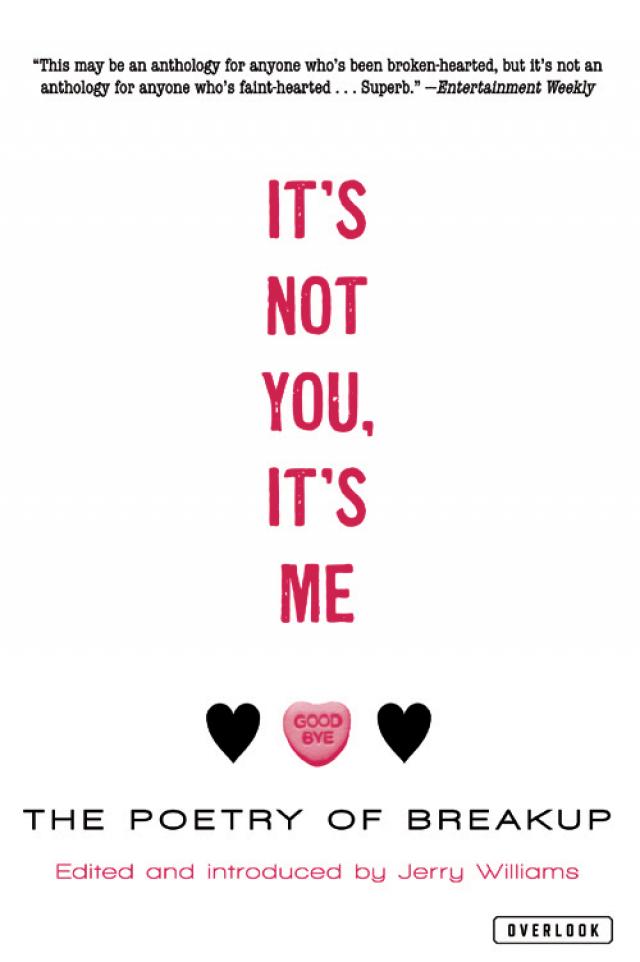
for Jenni Ferrari-Adler, Juliet Grames,
Leslie Brandon, and Stephanie Gorton
and in memory of Ai and Steve Orlen
Copyright
This edition first published in paperback in the United States in 2012 by
The Overlook Press, Peter Mayer Publishers, Inc.
141 Wooster Street
New York, NY 10012
www.overlookpress.com
For bulk and special sales, please contact sales@overlookny.com
Copyright © 2010 by Jerry Williams
All rights reserved. No part of this publication may be reproduced or transmitted in any form or by any means, electronic or mechanical, including photocopy, recording, or any information storage and retrieval system now known or to be invented, without permission in writing from the publisher, except by a reviewer who wishes to quote brief passages in connection with a review written for inclusion in a magazine, newspaper, or broadcast.
ISBN 978-1-46830-433-6
Contents
Dedication
Copyright
INTRODUCTION
I: ONE FOOT OUT THE DOOR
Privilege of Being
Sweet Ruin
Tell Me, Black Heart
I Want to Tell you Why Husbands Stop Loving Wives
Curse Four: Orders for the End of Time
Divorce Dream
Intimacy
Ex-Wife: Infatuation
Bournehurst-On-The-Canal
When a Woman Loves a Man
Intimations of Infidelity
Cross-Country
Walking Home Across the Island
The Night Before Leaving
Self-Improvement
Deep River Motor Inn
After Summer Fell Apart
Home Together
Ex-Wife: Homesickness
Reunions with a Ghost
Coda
Terrible Love
Giving Myself Up
II: IN THE MIDDLE OF THE STORM
Listene
Slowly
Adam and Eve
Finished
Minneapolis
The Story
The Pure Loneliness
Song of An X
Their Divorce
The Monarchs: 44
The Sporting Life
Dancer Holding Still
Separated Father
Fuck You Poem #45
So Long Lonely Avenue
Through the Glass
5:14 From Chicago
Breakdown
You
The End of the Affair
Penis Envy
After Mayakovsky
Post-Thalamion
Ghost
Just That Empty
Why I Will not Get out of Bed
III: THE AFTERMATH
Ex-Boyfriends
Divorced Fathers and Pizza Crusts
Lover Release Agreement
The Chair
A Man Alone
Dusk
One Melody
After
What to Wear for Divorce
Green Couch
Beginning with His Body and Ending in a Small Town
Talking Richard Wilson Blues, by Richard Clay Wilson
Longing
Divorce
The Monarchs: 47
Excavating the Ruins of Miami Beach
Approach
Heavy Trash
Equitable Distribution
A May-December Romance
Straight Boyfriend
Annulment
The Gift
All the Way from There to Here Jack Gilbert
Lessening
Spider Plant
The Monarchs: 43
Half-Life
Charades
More or Less a Sorrow Jane Miller
Sway
The Monarchs: 20
Looking Down the Barrel
Goodbye
Blue Vase
Part of Me Wanting Everything to Live
At the End of the Affair
Landscape with a Woman
PERMISSIONS
ACKNOWLEDGMENTS
ABOUT THE CONTRIBUTORS
From It’s Not You, It’s Me
Introduction
POETRY IS MY FAVORITE FORM OF HUMAN EXPRESSION ON EARTH. BREAKUPS ARE my least favorite. So why am I introducing a book that intermingles both splendor and ruin? Let me try to explain.
I have endured four major breakups in my life. Each one nearly killed me. Without a two-month grief regimen of inspiring poetry, unintentional dieting, weightlifting, sofa catatonia, and the potentially detrimental miracle of antidepressant and anti-anxiety medication, I might never have survived. What’s more, a number of lesser disintegrations have compromised my brittle nervous system. By now, I’ve spent so much time in the throes of dissolution that I must certainly have achieved a keener understanding of the process, if not an advanced degree of expertise.
When I see a breakup on the horizon, I grease myself down for the inevitable descent into hell. I quickly arrange for a therapist and pills. I warn my friends. I stock up on bananas and peanut butter, and I place the elegant volumes of, say, Mark Strand and the poet Ai on the nightstand. I post the gym hours on the refrigerator. When I’m inside a breakup the business of life slows to a crawl, and the thought of one person occupies my entire imagination. I doubt the ragged wisdom I’ve accrued is worth the mental and physical toll exacted by the experience. It’s like saying you’re really good at getting struck by lightning.
Biographically speaking, Debra came first. We met in high school in Dayton, Ohio. We treated each other sweetly for a long time, but she grew to resent my weirdo literary aspirations, and the relationship turned gory. She started cheating on me with two different guys, and instead of getting rid of me she kept me around as a witness to her infinite need to feel wanted. I can remember lying on the floor with my ear to the telephone, consumed by jealousy and shaking like a condemned prisoner, as she recounted the prurient details of her betrayal. At the time, my parents were howling through a divorce. My father had gone bankrupt, and my mother and I moved into a one-bedroom apartment with my two older sisters and my three-year-old niece. My father ended up living in his car.
Around Christmas, the distaff side of my family kicked me out of the apartment, and I moved in with a friend. The depression that resulted from converging misfortunes brought me to my knees. I couldn’t get out of bed. I couldn’t eat. I couldn’t breathe. I felt as though I’d developed a psychic tumor. I wanted to throw myself under a bus in order to annihilate the vessel that offered shelter to such unrelenting pain. Luckily, I’d been in trouble with the police (thievery, vandalism), and my court-appointed therapist put me on an anti-depressant that gave me cottonmouth and made my lower back hurt. The drug saved me from complete collapse, and I avoided the state mental ward, but the way I would now live in the world changed forever. Anguish had taken up residence in a dim, airless room just down the hall, and the door could fly open at any moment and suck my fragile life inside.
Debra haunted the fringes for a few more years—better the devil you know, I suppose—then she pirated off into her own separate future. I read a fair amount of poetry during this period, the only communication that could touch my panic and melancholy. I virtually inhabited Stephen Berg’s poem “Listener,” in which a man and woman end their relationship over the phone. The narrator’s frantic reaction to the facts rings true. His unraveling culminates in the contemplation of advancing shock troops and birdsong. Amy Gerstler’s “Fuck You Poem #45” reflected my rage. The precision of her language slashes her rival to ribbons. And Denis Johnson’s poem “After Mayakovsky” nearly gave me the strength “to address / the ages and history and the universe” and say to Debra, “I swear you’ll never see my face again.”
At the University of Dayton, I met Amanda, a political science major. We dated for a total of five years—nine months of which we lived together in Los Angeles. Much of the relationship was a disaster. I lied and cheated and punched walls, and I drank like a billy goat eats. We broke up three times, once in a parking lot in Las Vegas, once or twice through the mail during an interval of geographic separation. I kept telling myself that something was waiting for me around the bend or over the next ridge and when I found it I needed to be alone. Somehow, I followed Amanda to New Jersey when she got accepted to graduate school at Princeton.
Soon after we arrived, I found myself browsing the faintly-lit stacks at the university library and came across Robert Kelly’s book Under Words. The poem “I want to tell you why husbands stop loving wives” jumped off the page, grabbed me by the throat, and forced me to confess that Amanda and I needed to “die to each other and live.” I provoked the final disconnection as we sat in her car one evening, right around the corner from the library where I had recently taken a job searching for lost books. Three weeks later I tried to retract the pronouncement, but she was already seeing someone else. I cried and pleaded and confessed all my sins in a convulsion of jealousy—to no avail. Clearly, I got what I deserved: two years of isolation and celibacy. In his poem “The Pure Loneliness,” Michael Ryan describes, in his own blood, the nemesis I would face: “Late at night when you’re so lonely, / your shoulders curl toward the center of your body, / you call no one and you don’t call out. // This is dignity. This is the pure loneliness / that made Christ think he was God.”
When Amanda cut off all contact, I dug a hide against depressionâ
My therapist reasoned that breakups tapped into the privation of my childhood and triggered the mania, but awareness of this diagnosis only made the pain worse—because after a breakup or divorce knowledge is powerlessness. Rationality starves. At such times, poetry might be the only music we can hear. Each poem leads us out beyond our afflictions and sends us back to ourselves less saturated with fear.
In his lyric “Heavy Trash,” Mark Halliday suggests that “some endings never end.” The memento set ablaze in the kitchen sink goes on burning forever. On the other hand, the body will often allow the mind to heal, time being the only effective cure for a depressive illness. Consequently, I recovered. I made a list and mounted a belated effort to transform my life. I’d flunked out of the University of Dayton and if I didn’t want to labor at menial jobs for the next forty years, I had to return to school. Fortunately, Vermont College offered a low-residency undergraduate degree, so I boarded a train at Penn Station in the middle of January, bound for Montpelier and a vital second chance. Within two years, the college presented me with a diploma and a girlfriend, my dear Annie, the most beautiful person I had ever met.
After six brooding months of long-distance courtship, we decided to move in together. We took up residence in my perilously tiny apartment in a converted Victorian house in Princeton. She found work as a nanny, and I continued slaving away at the library. Crushing immaturity and an inability to communicate endangered the relationship almost immediately. Nevertheless, we lived together for nine months. The apartment walls started closing in, and no amount of occupying the space in shifts could alleviate the tension. Mistakes were made, as the politician says. When the University of Arizona admitted me to the M.F.A. program, I sent Annie back to her hometown of Lowell, Massachusetts. I couldn’t bear dragging her westward for the sake of an ailing union. Ultimately, though, I regretted having made this choice, and I spent the next decade trying to recant and reclaim the first real love of my life—again, to no avail.
Getting ready for relocation to Arizona meant packing my belongings in the back of a used Ford Ranger and bungee-cording the mass of objects beneath a sea-green tarp. Pretending to adulthood, I included as many of my possessions as possible. Then, emotionally and physically worn out from all the lifting and dragging, I returned to the apartment one last time to take a quick shower and make sure I hadn’t overlooked anything. In the corner of the bathroom, a pair of Annie’s empty little running shoes set off a spasm of nostalgia, and I promptly lunged for the toilet and threw up. At that moment, I came to the realization that I would never survive the trip alone, so I invited my friend Alex Blare to join me and help keep me sane. Thankfully, he agreed. After the expedition, he planned to fly back to the east coast and finish work on his second novel.
I collected Alex at his parents’ house in northern New Jersey, where he’d been staying for the past few months. Once he stowed his backpack in the space I created under the tarp, we headed straight for Interstate 87; merged onto I-78; traversed the Pennsylvania Turnpike; and then picked up I-70, which would take us all the way to my long-lost mother’s government-subsidized apartment in Dayton, Ohio. We spent the night there and woke the next morning to heaping plates of homemade gravy and biscuits, a wonderful southern delicacy that reminded me of the anomalous pleasant expression of my childhood. After breakfast, Alex and I climbed into my royal blue truck and followed the recently constructed interchange to I-70. I started feeling agitated around Terre Haute,
Indiana; despondent in Decatur, Illinois; and completely wretched when the truck ran aground on the outskirts of St. Louis during a violent rainstorm. We disembarked at the first motel we could find.
That night, as my friend slept soundly in his bed, I lay awake and thin-skinned in mine. The closing lines of Kim Addonizio’s poem “Ex-Boyfriends” captured the expansiveness of my desolation. With burning eyes, I watched the grimy walls absorb “the faint restless arcs / of headlights from the freeway’s passing trucks, // the big rigs that travel and travel, / hauling their loads between cities, warehouses, / following the familiar routes of their loneliness.” The loss of a loved one hurts differently when you’re on the road. The scenery moves by so fast you can barely tell one shape from another. When you finally drop anchor and look at the living world up close, everything seems as bereft as you are.
Alex had hoped to do some sightseeing during our crossing, so I made an effort to act the part of the adventurous companion, but an inner tremor and slack facial muscles gave me away. Despite the medication I dutifully consumed, a frenzied despair took hold of my tender physiognomy. I was sucking all the air out of the cab of the truck without even breathing. Poor Alex did his best to distract me, but misery mixed with transience turns out a mean cocktail. Regardless, we paused at some sort of Elvis Presley Museum in Missouri and later waded through an ocean of tall green grass in Kansas. At every possible stop, I rooted out the nearest payphone and called Annie collect. In the single greatest act of selfless compassion I have ever witnessed, she would stay on the phone for as long as I needed, devoid of spite or uncertainty, even though I had pulled up stakes without “the proper handling / of goodbye,” to borrow a phrase from Linda Gregg’s poem “The Night Before Leaving.” The pain of that memory is so perfectly and beautifully intact I cannot fight off a crying jag as I watch these words appear on my computer screen. No joke—Annie belongs in the Breakup Hall of Fame: the woman who offered comfort to a man who almost destroyed her happiness.
Interstate 70 led us to Boulder, Colorado, where we spent the night at a mutual friend’s house. In the morning, we crusaded west into Utah. Alex seemed so excited to see the unearthly terrain of the Beehive State, which I had described to him during a rare patch of clarity, having myself experienced the grandeur of the many canyons and salt flats on a previous cross-country drive. As we approached the Utah state line, my ass started to itch. I tried to ignore the irritation, but the itching evolved into stinging and the stinging into torment. I asked Alex to pull into a gas station around Fruita, Colorado, and I ran to the restroom, locked the door, climbed up on the sink, and inspected my posterior in the mirror. Both cheeks were inflamed and erupting. In my fog of sorrow, I assumed the worst: gangrene, leprosy, that flesh-eating disease everyone was talking about.
I toddled back to the truck in the blazing sun and informed Alex that I might need to go to the hospital. He suggested I call Annie, so I seized the payphone near the ice dispenser and jabbed in the numbers. She said, “Honey, it’s only a heat rash. Don’t be upset. Go to the closest pharmacy and buy some Desitin. Now, that’s for diaper rash, but you’ve got the same thing, essentially. And if you have a pair of loose-fitting shorts, put those on, and change your underwear.” Alex located a K-Mart in Fruita, and I grimaced through the main entrance and bought extra large sweat pants, boxer shorts, and a tube of Desitin. I retired to a bathroom stall in the rear of the store and applied cream to rump. Then I put on the boxers and sweats and tossed my old underwear in the trash. Standing next to the pickup in the parking lot, Alex maintained an appropriately solemn countenance. “I’ve finally hit bottom,” I said, “full-blown infantilization,” which made it okay to laugh because neither of us could have invented a more fitting comeuppance for our fleeing narrator.
Surprisingly, we did wind up visiting the high desert of Arches National Park. We listened to the overwhelming silence of Natural Bridges National Monument. We gaped at the enormous, isolated sandstone rocks rising above the Valley of the Gods. We purchased handmade jewelry on the Navajo Nation Indian Reservation in Arizona. Although I remember feeling unable to experience this magnificence with anything approaching gusto, perhaps I’m a better man for not having bailed out altogether. Alex drove most of the way down the span of Interstate 10, and when we spotted Tucson in the distance the sensation of coming to the end of the world, the end of America anyway, threw my stomach on its side. I let myself surrender.





