

Trick of time, p.1
Trick of Time, page 1


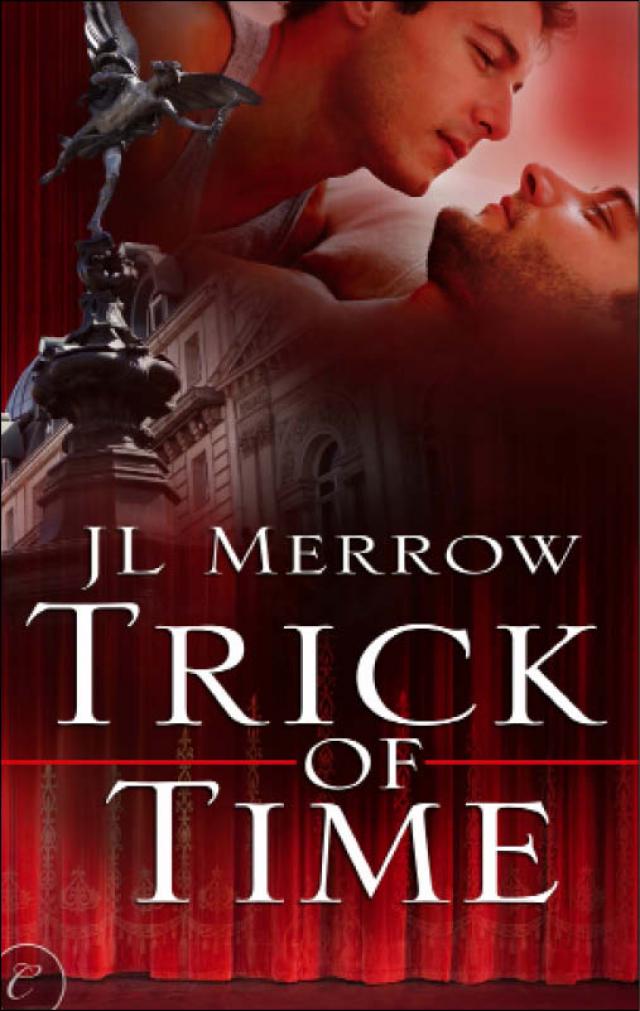
Trick of Time
By JL Merrow
A lover from another time
When Ted Ennis steps out the doors of the Criterion Theatre for a cigarette and finds himself in Victorian London, he begins to doubt his sanity. At first he thinks it’s all a film set, and is sure that the strikingly handsome young man leaning against a lamppost must be the leading man…
What starts as a sordid transaction with a beautiful rent boy quickly turns into something much deeper, drawing him back again and again as he gets to know Jem and craves meaningful encounters with him.
But Ted doesn’t understand the exact conditions necessary for his trips through time—and for Jem, time may actually be running out. Now Ted has one last shot to get back to Jem and save their relationship, before it’s too late…
27,000 words
Dear Reader,
In the world of publishing, January is an intimidating month. Mostly because we’re thinking about 2013 long before we want to be. In fact, conversations about 2014 have long since started. How’s that for intimidating? January is also intimidating because we’re expected to set goals and promise great things for the year ahead. That, Carina Press can handle.
This year, our goal is not only to continue to provide readers with excellent editorial, but also to add a new category of New Adult to our romance line, in order to increase the number of mystery, science-fiction and fantasy titles we publish; to publish returning authors with connected books; and to grow our romance subgenres such as historical romance, GLBT, romantic suspense and erotic romance. You can look forward to all of that happening in 2013!
In January, we start the year by finishing up Shannon Stacey’s second Kowalski family trilogy with the highly anticipated story of Josh and Katie’s romance, All He Ever Dreamed. If you haven’t read Shannon’s books, you can check out the original Kowalski trilogy for only $4.99 per novel. We also enter 2013 with the paperback release of Fiona Lowe’s 2012 RITA® award-winning contemporary romance, Boomerang Bride.
Other contemporary romance authors joining Shannon in January include Rachael Johns, kicking off a new contemporary series set in Hollywood with Stand-In Star, and Liz Flaherty with Jar of Dreams. Liz’s debut romance, One More Summer, was described by reviewers as “compelling and addictive” and “one incredible story.”
On the other end of the romance spectrum are several paranormal, urban fantasy and steampunk romance releases this month. Coleen Kwan returns with the sequel to her fun steampunk romance Asher’s Invention. Asher’s Dilemma brings you the continued romance of Asher and Minerva in a clockwork world.
Two other continuing series return with fantastic installments. Claws Bared by Sheryl Nantus is the next story in her Blood of the Pride series. And Sandy James offers up The Impetuous Amazon, the second book in the Alliance of the Amazons series. Meanwhile, a new paranormal trilogy begins with Stacy Gail’s Nobody’s Angel, which brings us a tale of Nephilim and sassy heroines. Look for the second book, Savage Angel, in February.
Cathy Pegau takes us into space with her newest science-fiction romance, Caught in Amber, while Eleri Stone takes us to a world steeped in fantasy and wrapped with pleasure in Threads of Desire, her erotic fantasy romance. Keeping us in the here and now, with more erotic sexy-times, is Callie Croix’s newest erotic contemporary romance, Covert Seduction.
We’re pleased to welcome mystery author Wendy Roberts to Carina Press with her newest mystery, Grounds to Kill. We’re also pleased that Julie Moffett has chosen to reissue her Scottish historical romance, The Thorn & the Thistle, with us in January.
Last, to start off 2013, I’m excited to introduce you to our two debut authors. JL Merrow offers up a compelling tale of love through the ages with the male/male historical time travel Trick of Time. Romantic suspense author Ana Barrons will blow away fans of suspense and romance with her debut novel, Wrongfully Accused. Please join me in giving these two authors a warm welcome to Carina Press (by buying their books, of course!).
I hope you’ll join me for another excellent year of books at Carina Press. Our 2013 schedule is shaping up to be full of books our team loves and can’t wait to get into readers’ hands, including a new trilogy from Fiona Lowe; a compulsively readable new adult romance, Rush Me, from debut author Alison Parr; the last two parts of Jax Garren’s dark Beauty and the Beast retelling; more contemporary romance novels from up-and-coming author Christi Barth; the kickoff of a thrilling urban fantasy series from debut author Steve Vera; more erotic romance compliments of Lynda Aicher; a series of erotic Love Letters from a collection of authors; noir historical mystery Die on Your Feet by debut author S.G. Wong; and another installment of Marie Force’s romantic suspense series.
This is only a small portion of the amazing books we have coming up in 2013, so please look for these and more from the awesomely talented Carina Press authors.
We love to hear from readers, and you can email us your thoughts, comments and questions to generalinquiries@carinapress.com. You can also interact with Carina Press staff and authors on our blog, Twitter stream and Facebook fan page.
Happy reading!
~Angela James
Executive Editor, Carina Press
www.carinapress.com
www.twitter.com/carinapress
www.facebook.com/carinapress
Love’s not Time’s fool
Though rosy lips and cheeks
Within his bending sickle’s compass come
—William Shakespeare
Contents
Chapter One
Chapter Two
Chapter Three
Chapter Four
Chapter Five
Chapter Six
Chapter Seven
Chapter Eight
Epilogue
About the Author
Copyright
Chapter One
God, I needed a cigarette.
We’d had trouble with the props—Dick Buskin and Jack Rover had been larking about before curtain playing at swordfights, and one of the idiots had broken Thunder’s cane. If it hadn’t been for the old lady in row C being a game old dear who let me borrow her walking stick, he’d have been left to bluster without it. When the curtain finally went up, I breathed a sigh of relief, and reached shakily for the cigarette packet in my pocket.
One of these years, I’d give it up, I promised myself. Probably not while I worked in the theatre, though.
I had to smile, because even on days like this, I couldn’t imagine wanting to leave, now I’d found my place here. I’d spent most of my twenties working in a bank, trying to please my parents. But that was before the accident that left me an orphan and a widower in a screech of twisted metal and broken lives... I took a deep breath and leaned against the cool, tiled wall, drawing strength from its solidity and permanence.
The Criterion Theatre was an oasis of old-fashioned elegance set in—or more precisely, underneath—bustling Piccadilly Circus, with its hordes of language students, day-trippers and city folk out west to dip their toes in the decadence of Soho. I’d been a bit effusive about the Cri the day I started working here as a theatre assistant. It was a not particularly glorified euphemism for general dogsbody, and yes, I was too old for the job. But Rob, the house manager, was a friend. A good friend, willing to give me a chance when half the world looked on me as unemployable, what with the tremors in my hand, the dizzy spells and the often-slurred speech that only got worse under pressure. There were a fair few days when I agreed with them.
Rob had raised a world-weary eyebrow at my raptures about the place. “Theatres? They’re all much of a muchness, really.”
Not this place. The Cri was different, from the pink plush of the auditorium to the ornate Art Deco styling of the box office. I took the stairs two at a time, past the walls tiled in sepia and green, each panel framing the name of a composer of days gone by. The Criterion had been planned as a concert hall but repurposed as a theatre before opening night. Maybe this was why I liked the Cri so much—like me, she was a leopard who’d changed her spots.
Cherubs smiled down at me from where they frolicked on the ceiling, and Terpsichore played her lyre with silent serenity as I passed. I resisted the urge to run my fingers along the ornate tiles—Rob was watching from the box office.
“Going out for a smoke, Ted?” he asked with a knowing smile. “You know, you’re not getting paid to sort out the props. Let Miri sweat it next time.”
I shrugged and patted my back pocket, reassuring myself my cigarettes hadn’t jumped out when I wasn’t looking. If it’d been half an hour earlier in the evening, I’d have managed without a smoke, but anyone arriving this late for the show would have more to worry about than me smoking outside the theatre and making the place look untidy. I shouldered through the heavy front door, popping a cigarette in my mouth and fumbling in my pockets for my matches...and found Piccadilly Circus full of ghosts.
I stared, the cigarette almost dropping out of my mouth in amazement. I’d always thought there ought to be something more, something beyond this shallow world of fragile lives and shattered dreams. But to see it confirmed was like being hit with a tsunami in the bathtub.
Gone were the garish neon signs, the buses, the endless ravening packs of tourists. Even Eros no longer pranced naked on his plinth, ready to shoot his poisoned darts of lo
It was dark—far darker than normal. The streetlamps were lit but they were short, stubby, quaint little things, giving only a feeble yellow glow, not their usual chilly bright whiteness. The buildings, too, were dark—where were the plate glass windows spilling out light to entice passers-by into shops and restaurants?
Despite the gloom, I could still make out the strange attire of the people who strolled around the Circus. They looked like they’d stepped out of the pages of a Charles Dickens novel—top hats on the gents, flat caps on the working-class lads and bonnets on the few ladies I saw, their full skirts brushing the ground as they walked. And the smell... Could hauntings have smells? This one reeked of horse shit and coal smoke, not the petrol fumes and pungent fast-food aromas I was used to. I took a drag on the cigarette I’d been so desperate to get outside for then yanked it out of my mouth to stare at it suspiciously.
It still looked like a Gauloise. It even tasted like one.
I ground it out beneath my heel for safety and took a wary step forward. Caution was definitely required. Horse-drawn carriages clattered around the Circus, leaving their bucolic pollution in the streets. As I left the shelter of the building, my gaze was drawn to a tall young man leaning against the nearest lamppost. He stood gilded by its shallow pool of light, his face absurdly beautiful in profile, as if Eros had sprung to life and leapt from his plinth.
My breath caught. Perhaps he heard it for he looked up, directly at me. Could he see me? Could ghosts see real people?
No, this was madness. They must be filming here or something, and I simply hadn’t heard. Rob was probably laughing himself silly at the thought of me walking out here unwarned. I wondered, trying not to cringe at my own gullibility, what sort of production it was and why I couldn’t see the crew.
The young man straightened and stepped forward. He was dressed in clothes far more formal than any I’d worn since my days of college and May Balls—or the day Alasdair and I stood up to announce our commitment to the world. I took a deep breath. Enough of ghosts.
My present companion had on a single-breasted jacket that was open to display a dark waistcoat and a sort of white cravat. His clothes suited the scene a damned sight better than my jeans and T-shirt—suited the temperature better too; I shivered and wrapped my arms about myself. He had dark hair, slightly curly, and a full mouth, bringing to mind the cherubs from the Cri’s ceilings. His features, though, were far finer than theirs, his elegant cheekbones starkly visible, not hidden by a layer of puppy fat. He was a pared-down Lord Alfred Douglas, the highborn beauty who’d brought a playwright to his knees.
My lip quirked in a self-mocking smile. I was no Oscar Wilde, that was for sure.
The lad looked me up and down slowly then smiled without warmth, showing crooked teeth that were disconcertingly engaging—a touch of flawed humanity in that perfect face.
Then he spoke. “Oi, piss off, will yer? This is my patch.”
There was a moment of disconnect, his gutter tones jarring with the elegance of his clothes. Then it hit me how threadbare the jacket was on close inspection, how his trousers showed signs of sagging at the knees; the neck cloth, washed-out stains—and it all came together. I laughed self-consciously. “Sorry, I honestly didn’t know. No one told me. But well done for staying in character. You’re a rent boy, right?”
Piccadilly had been a prime spot for that kind of trade, back in Victorian times. Even Time Out will tell you that.
Alarm flared in the lad’s eyes and he glanced around furtively before stepping up close. “Shut yer bleeding mouth, will you? You want to get the rozzers down on us?”
I backed off, holding up my hands. “Sorry. I’ll disappear, all right? Don’t want to mess up the shoot.”
His eyes narrowed. “You’re cracked, you are.”
“Sorry,” I said again and turned, although I was reluctant to leave him despite his unfriendliness. Maybe I could catch a word with him during a break in filming? Find out more about the film they were shooting. About him.
Glancing at the Criterion’s frontage, I marvelled at the change that had been wrought in barely more than an hour since I’d last been outside. The awning over the entrance was now square, not semi-circular. Our “retro” 1940s-style posters for tonight’s production, John O’Keefe’s Wild Oats, had been replaced by something even more retro, although at least they were for the same play—there were no pictures on the posters, and I wondered how our actors would feel about having their names replaced with, presumably, more period-appropriate ones. The whole theatre frontage seemed subtly different than usual, in ways I couldn’t immediately catalogue. How often had I ever really looked at the front of the building I worked in?
I pushed back through the door into the welcome warmth of the foyer, shaking my head in disbelief. Whatever was being filmed out there, it had to have a sky-high budget. I couldn’t even begin to imagine how much it must have cost to close down Piccadilly Circus at this time of the evening. I certainly couldn’t think how they’d managed to give the place such a thorough makeover in so short a time.
“You were quick,” Rob commented through the open door of the box office.
“Well, you might have warned me. I thought I’d stepped into some kind of time warp!”
Rob frowned. “You what?”
I jerked my head in the direction of the door. “All that out there. What is it, anyway? Another BBC Dickens revival?”
He shrugged and shifted from his seat to come stand in the lobby with me. “Don’t know what you’re on about. No one told me about anything. So what are they up to?”
“Well, just look,” I said and opened the door to show him.
Rob peered out. “What am I supposed to be looking at?”
I looked over his shoulder. For the second time tonight, I stood there open-mouthed.
Piccadilly Circus was back to normal. A crowd of excitable teenagers in skinny jeans and parkas thronged the steps up to Eros’s plinth, from which he once more mooned cynically at us poor mortals.
“Nothing,” I said quickly. “I...made a mistake.” I ran a hand through my hair, baffled and mortified.
Rob gave me a searching look. “Are you all right?”
He knew all about the accident, of course—and its aftermath. Even if he hadn’t been a mate, as my boss I’d have had to tell him—the doctors hadn’t been able to guarantee the fits were gone for good, although so far I’d been spared the indignity of collapsing at work and thrashing around on the floor like some inmate of Bedlam displaying himself for the amusement of the gentry.
“Fine,” I said with emphasis. “I’d better go. Make sure we’re set up for the interval.”
I could feel his eyes on the back of my head as I hurried down the stairs. He couldn’t see the scars, I reminded myself firmly. My hair easily covered them these days.
He still knew they were there, though.
* * *
I didn’t dare poke my face outside again until the second half was in full swing. I don’t know that I’d have gone out even then, but the nicotine cravings had redoubled since my abortive attempt to satisfy them earlier. And maybe there were other reasons I needed to take a second look, too.
Mindful of the cold, I grabbed my jacket this time before pushing through the door. I’m not sure what I expected to see. Probably whatever I saw would have unsettled me, but it was almost a relief to be confronted with the ghost of Victorian London once again.
At least if I was hallucinating, or dreaming, there was some consistency in it.
The young man was there still—perhaps it was too early for pickings to be good. Or perhaps he’d had a client or two while I’d been hiding in the theatre. I frowned at the thought. If he was just a delusion, why was I thinking about him as if he had a life outside my head?
If you forget your dreams on waking, does that mean they never happened? That the people in them never existed?
I walked straight up to the compelling product of my fevered subconscious—or my id. He turned to face me with a resigned air.





