

Artfully yours, p.1
Artfully Yours, page 1


Praise for Joanna Lowell and Her Novels
“My readers will love Joanna Lowell’s writing!”
—Eloisa James, New York Times bestselling author of My Last Duchess
“Compelling and exquisitely crafted, The Runaway Duchess is a beautiful romance that enchants from the very first page. Lowell’s wit, sumptuous imagery, and vivid, endearing characters combine to make this a swooningly gorgeous read. Highly recommended.”
—India Holton, author of The Wisteria Society of Lady Scoundrels
“A beautiful blend of seductive suspense and heart-tugging romance that I could not put down. Romance fans should make room for this author on their keeper shelves!”
—Lyssa Kay Adams, national bestselling author of Crazy Stupid Bromance
“Joanna Lowell’s skillful storytelling and dazzling characters create one of the most exciting new voices in historical romance today.”
—Julia London, New York Times bestselling author of A Princess by Christmas
“A charming romance with an atypical heroine and a to-die-for (and hot!) hero in this unique tale of a duke and a struggling artist in Victorian London.”
—Jennifer Ashley, New York Times bestselling author of The Stolen Mackenzie Bride
“I really loved this book—in fact, I couldn’t put it down. It’s a fabulous feast of a story that plunges you into the Victorian era with all its levels and complications. . . . There’s tension, adventure, derring-do, a fight against corruption on several levels, a rich cast of characters, and a hero and heroine to admire and cheer for. All in all, a rich and heartwarming historical romance.”
—Anne Gracie, national bestselling author of The Scoundrel’s Daughter
“Lowell’s finely wrought characters don’t have it easy when it comes to navigating restrictive Victorian society, but even their most outrageous actions ring true. Readers will be swept away by this entrancing, intelligent romance.”
—Publishers Weekly (starred review)
“It’s a lush, sensual, and outstanding romance that makes the heart ache in the very best way.”
—BookPage (starred review)
“Impeccably researched, Lowell’s latest emphasizes justice. This love story tackles weighty issues but remains suspenseful and spellbinding.”
—Library Journal (starred review)
“Lowell’s prose is vivid and evocative, and issues such as class inequity, women’s rights, and alcohol addiction complement the intense on-page evolution of the love story. . . . Those looking for a happy ever after for complex and passionate characters will be very satisfied here. A new voice in historical romance that will keep readers riveted.”
—Kirkus Reviews
Titles by Joanna Lowell
the duke undone
the runaway duchess
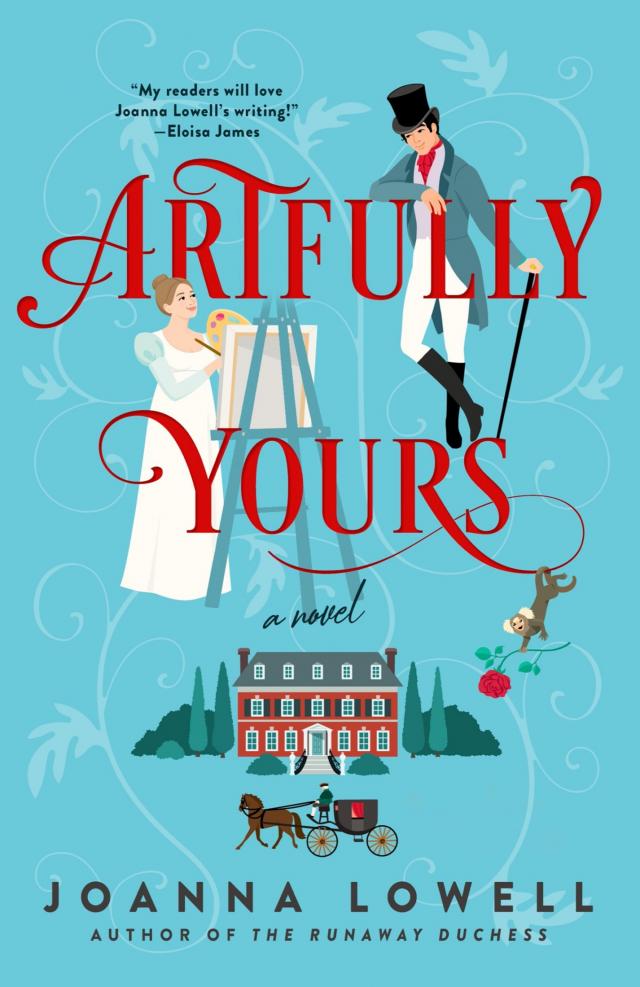
artfully yours
Berkley Romance
Published by Berkley
An imprint of Penguin Random House LLC
penguinrandomhouse.com
Copyright © 2023 by Joanna Ruocco
Readers Guide copyright © 2023 by Joanna Ruocco
Penguin Random House supports copyright. Copyright fuels creativity, encourages diverse voices, promotes free speech, and creates a vibrant culture. Thank you for buying an authorized edition of this book and for complying with copyright laws by not reproducing, scanning, or distributing any part of it in any form without permission. You are supporting writers and allowing Penguin Random House to continue to publish books for every reader.
BERKLEY and the BERKLEY and B colophon are registered trademarks of Penguin Random House LLC.
Library of Congress Cataloging-in-Publication Data
Names: Lowell, Joanna, author.
Title: Artfully yours / Joanna Lowell.
Description: First edition. | New York: Berkley Romance, 2023.
Identifiers: LCCN 2022025638 (print) | LCCN 2022025639 (ebook) | ISBN 9780593198322 (trade paperback) | ISBN 9780593198339 (ebook)
Subjects: LCGFT: Romance fiction. | Novels.
Classification: LCC PS3618.U568 A89 2023 (print) | LCC PS3618.U568 (ebook) | DDC 813/.6—dc23/eng/20220602
LC record available at https://lccn.loc.gov/2022025638
LC ebook record available at https://lccn.loc.gov/2022025639
First Edition: February 2023
Cover design by Rita Frangie
Cover illustration by Monika Roe
Adapted for ebook by Molly Jeszke
This is a work of fiction. Names, characters, places, and incidents either are the product of the author’s imagination or are used fictitiously, and any resemblance to actual persons, living or dead, business establishments, events, or locales is entirely coincidental.
pid_prh_6.0_142492537_c0_r0
Contents
Cover
Praise for Joanna Lowell and Her Novels
Titles by Joanna Lowell
Title Page
Copyright
Dedication
Chapter One
Chapter Two
Chapter Three
Chapter Four
Chapter Five
Chapter Six
Chapter Seven
Chapter Eight
Chapter Nine
Chapter Ten
Chapter Eleven
Chapter Twelve
Chapter Thirteen
Chapter Fourteen
Chapter Fifteen
Chapter Sixteen
Chapter Seventeen
Chapter Eighteen
Chapter Nineteen
Chapter Twenty
Chapter Twenty-one
Chapter Twenty-two
Chapter Twenty-three
Chapter Twenty-four
Chapter Twenty-five
Chapter Twenty-six
Chapter Twenty-seven
Chapter Twenty-eight
Chapter Twenty-nine
Chapter Thirty
Chapter Thirty-one
Epilogue
Author’s Note
Acknowledgments
Reader's Guide
Questions for Discussion
About the Author
_142492537_
For Frankie anyway.
Chapter One
May 1885
Alan pointed to the painting on the drawing room wall.
“Fake,” he said. The maid dropped the tea tray with a crash, so he repeated himself, in case his brother hadn’t heard.
“That painting. It’s a fake, not a Rembrandt. It’s no more Dutch than the devil. Or perhaps the devil is Dutch.” He shrugged. “I’ve always pictured him as an English aristocrat. Better the devil you know, as they say.”
“Your devilry is my only concern of the moment.” Geoffrey sat rigid in his chair, face as starched as his collar. “Lord Death.”
“De’Ath,” corrected Alan absently, still eyeing the picture. He’d adopted his nom de plume thirteen years ago while a student at Oxford, the same summer their father died and Geoffrey himself assumed a new name. Duke of Umfreville.
All of Alan’s enemies called him Lord Death. Geoffrey was as original as . . . well, that bloody Rembrandt.
A ringing thud. The maid had fetched up the silver sugar pot only to let it slip again. Judging from the sound and the sugar pot’s location on the floor, Alan surmised that it had struck the edge of the marble tabletop on the way down.
“Leave that alone,” barked Geoffrey. The maid was on her knees, scooping the sugar back into the pot. She scrambled up. All around her feet, the Turkish carpet glittered with crystals.
“Send a competent parlormaid to clean up,” said Geoffrey. “And see that she brings a fresh tray.”
Alan leaned over the curved arm of the settee and felt for the teacup he’d seen bounce toward the flower stand. He hooked the bone china handle with his finger, set the cup on the table, and smiled at the maid.
“Don’t mind him.” He tipped his head toward Geoffrey. “His dander’s up about his sham masterpiece.”
Among other things, none of which pertained to a bumbled tea tray.
Upon inspection, the maid appeared less mortified than Alan had expected. She was staring at Geoffrey with open hostility. She had the sort of round, short-nosed face associated with angelic sweetness. And yet her expression left no doubt. There was more than one devil in the room.
“Now,” said Geoffrey, and the maid wiped her sugar-coated hands on her tea-splashed apron, turned on her heel, and marched out.
“She’s new.” Geoffrey inspected his cuff as though his very proximity to the mess might have left a smudge. “She won’t last long.”
“I’m sure she won’t,” murmured Alan. Geoffrey and his wife, Fanny, went through maids and footmen faster than they went through flower arrangements.
“In any case.” Geoffrey lowered his hand with a frown. “You didn’t call to discuss my domestics. Or my art.”
“It’s not art,” said Alan automatically. “Your Rembrandt is a forgery, which, in fact, degrades art.”
He’d called to discuss money. But presented with such an opportunity, Alan couldn’t resist.
He unfolded himself from the settee and crossed to the painting, avoiding the scattered saucers and
Alan De’Ath. The consummate persona. His performance was finer than most he saw upon the stage.
“Behold.” He whipped up his cane, hovering the ferrule an inch from the painted panel. “No glaring errors. Plausible wood. Plausible subject. Too plausible, perhaps. Introspective old man is the lowest common denominator of Rembrandts. But never mind that.” He glanced at Geoffrey and back at the panel. “Look closely. The brushstrokes are too smooth. The drawing itself is too blurry. Rembrandt was rough, but Rembrandt was precise. That was his particular paradoxical magic. This picture has no magic whatsoever. Because the forger, however talented a draftsman, painted to order, without a trace of vision.”
Geoffrey laughed. “Alan De’Ath.” He spread his arms and addressed an imaginary audience. “He even criticizes Rembrandt for being too much like Rembrandt.” He stood and strode to Alan’s side, pushing down the cane, fixing the picture with his ice blue gaze. After a moment, he gave a sage shake of his head.
“Authentic,” he pronounced.
“Ah.” Alan smiled with mock deference and sketched a bow. “So you’re the expert now?”
“I don’t need to be an expert.” Geoffrey bristled. “I bought it from Chips Sleaford, a highly reputable dealer. He represents a reclusive collector, in Friesland. Sells the finest golden-age pictures on the market.”
“Reclusive collector,” echoed Alan, and brightened his smile. “The lowest common denominator of provenances.”
“The provenance is impeccable.” Geoffrey wheeled about to face him. They were inches apart. Alan could smell his brother’s cologne, mixed with another odor, rank and gamy. Male anger.
“I could show you documents attesting to that picture’s history,” said Geoffrey. “Every sale, from Rembrandt’s workshop to this drawing room.” He had to look up at Alan, who topped him by half a head.
Alan kept smiling. “Please do.”
Geoffrey’s nose was a touch longer than Alan’s, his lips thinner, but the set of his eyes was the same, as was the angle of his jaw. They resembled each other. Although—who could ever have guessed?—Alan the invalid had become the larger man, taller, more heavily muscled, more vital.
Perhaps Geoffrey, too, was drawing comparisons. He stalked away, kicking at the teapot, which the maid had righted. The pot tipped. He kept going and flung himself onto a sofa. In Parliament, he’d cultivated a reputation for sangfroid. In his household, and in his dealings with Alan, he reverted to a child.
“Sleaford’s pictures are genuine.” He bit out the words. “Even Lloyd Syme goes to Sleaford. He acquired a Rembrandt, a Brueghel, a . . . a . . .”
Alan raised his brows as Geoffrey cast about for the names of old masters.
“Shall I list possible candidates?” he inquired.
Geoffrey scowled. “It’s whoever you’d think. All the greats. For the art collection at the South Kensington Museum.”
“Syme’s judgment is flawed. Clouded by ambition and animosity.” Alan felt the dampness beneath his boot as he returned to the settee. Tea was still seeping into the carpet, staining it with an irregular rosette. He felt the urge to halt the flow, to stand the teapot on the tray, for the sake of the servants. But he wouldn’t kneel in front of his brother.
“He looks like a wise old owl, but he has an ophidian heart. Ophidian means snakelike.” He sat, throwing his arm across the settee’s back in a casual pose. “How many pictures did you acquire?” he asked. “If you want to build your collection, I can introduce you to the best artists of our age. You can buy a painting wet from the easel.”
“Stuff your advice.” Geoffrey spoke through gritted teeth. “That’s an order. I’ve had enough of your opinionating, and so has the rest of society.”
“So has Count Davanzo, you mean.” Alan sighed. “It’s not my fault if your cronies produce abysmal operas. If you so dislike my opinions, don’t read my reviews.”
“The bloody review in question took up a full page of yesterday’s Times. It was deuced difficult to avoid. And Davanzo found it horribly insulting.” Geoffrey leaned forward. The tea table interposed between the sofa and the settee, and he looked poised to lunge across it. “By God, he’s the Italian ambassador. Central to the efforts of the Home Office to protect the nation from foreign terrorists.”
“So I should flatter him?” Alan shook his head. “He perpetuated a musical atrocity on our nation. What of that? I’ve yet to meet an anarchist who’s done worse.”
“Ha.” Geoffrey snorted, then drew a sharp breath. “Let’s come to the point, shall we? You’re here because I closed your bank account.”
“Not exactly.” Alan smiled. “I’m here to make you open it.”
“I will open it, and return the funds.” Geoffrey smiled back unpleasantly. “When you learn to comport yourself. When you resume use of your family name. And when you stop dipping your pen in poison.”
“It has come to this.” Slowly, Alan removed his spectacles and polished the lenses on his sleeve. Window-glass lenses. His vision was perfect. Better than perfect.
He met Geoffrey’s eyes. They’d never been close, but they’d made, on several occasions, a fragile peace. Every time, the peace fractured, due to pressure from beneath, the bubbling up of what they’d covered over to achieve the semblance of fraternity.
The secrets. The rancor.
Their latest peace—such as it was—had ended.
“If you won’t honor our arrangement, I won’t either.” Alan replaced his spectacles on his nose. “Perhaps you don’t remember? I inherited everything dispensable.” Not only the properties in fee simple, which he’d sold immediately, investing the sum in railways, shipbuilding, and steel, but the books in the libraries, the portraits in the galleries, the silver plate, the very settee upon which he sat.
A muscle flexed in Geoffrey’s jaw. Of course he remembered. That final proof of parental preference had put the seal on his brother’s resentment. No matter that Alan had presented him with the investment portfolio, given him control of the capital he’d needed to resuscitate the dukedom. To avoid a loveless marriage, if he’d been willing to forgo extravagances, live more reasonably; that was, like less of an Umfreville.
He hadn’t been willing, in the end. He’d married Fanny, about whom Alan had, to date, heard him utter only one approving statement: At least she’s not American.
“Open the account,” Alan said. “Or I’ll sell every stick.” Starting with anything to which Geoffrey attached a sentimental value. Let him buy it all back at auction.
“The portrait of Great-Great-Grandmama is a Gainsborough,” Alan mused aloud. “It’s certainly worth more than your Rembrandt.” He tilted his chin toward the forgery.
Geoffrey gave a strangled cough. He looked, for an instant, overcharged, like his twenty-five-year-old self, reeling from their father’s death, and from his crushing patrimony. The estates had been so encumbered he couldn’t borrow enough to pay the interest due on the preexisting loans. The night before the funeral, he and Alan had talked until dawn, drinking straight from the bottle. That was the closest they’d ever come to each other. The first and only time they’d shared confidences. It was the night Alan had learned of Geoffrey’s desperate, doomed love for Lady Patricia Kempe, third daughter of the penniless Duke of Harewood. It was the night Alan had revealed his darkest suspicions about their mother.
Sometimes, Alan recalled those impassioned, drunken hours and imagined doing them over, saying something different, something that would have made Geoffrey believe him, that could have changed the whole course of their adult relationship.
“You haven’t asked after Claud,” said Geoffrey, his tone suddenly slippery. “He was poorly after his swimming lesson.”
“I’m sorry to hear he was poorly.” Last Friday, Alan had spent an hour with Claud in the Serpentine, his nephew’s first time in the lake since last September.


