Muddle earth, p.2
MUDDLE EARTH, page 2
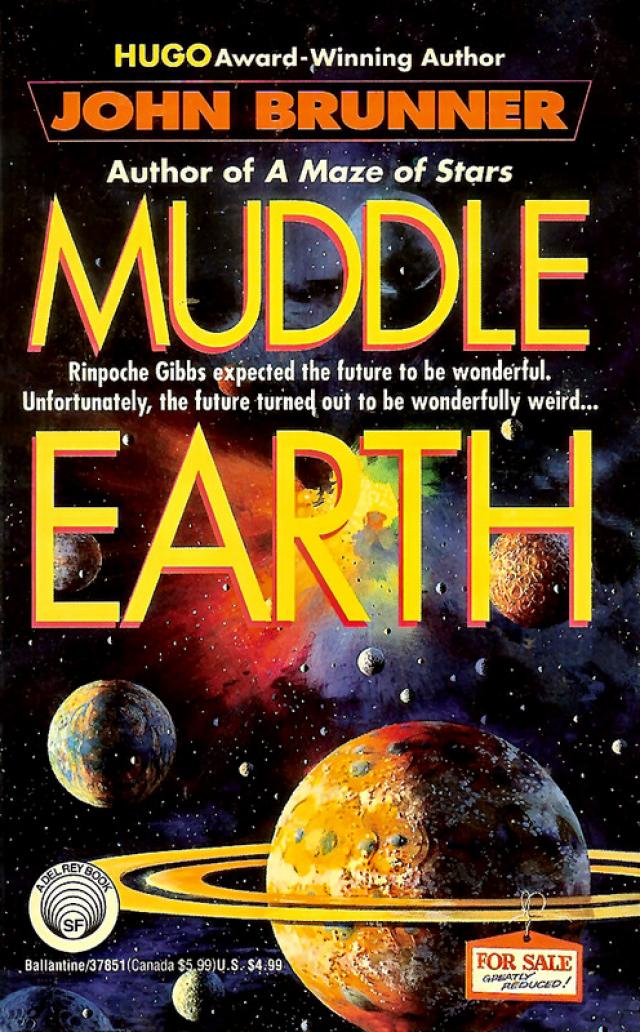


Well, it wasn’t quite as disturbing as the creature in plain sight, but it was well along the way. Rinpoche was glad when the visual camouflage restored itself.
“So let’s discuss this like rational beings,” Ghoulart went on in a soothing tone, “bearing in mind that chattel slavery is illegal on this planet except in certain yet-to-be-approved re-enactment zones. May that be stipulated?”
There were reluctant nods from all save the alien, who merely waved an impatient tentacle.
“Very well. Don Marco”—to the leader of those in black. “You assert a claim on the person of this resurrectee”—oh, of course!—“based not merely on having paid his debts in full but on a blood relationship: that’s to say, you addressed him as nonno, which in Italian means male progenitor of one’s own male or female progenitor. I hope that’s right; as you know, we have no counterpart of sex.”
Rinpoche struggled to digest the implications of those words, with minimal success.
“Oh, he is not merely our grandfather, but our four-times-great-grandfather!” cried the black-garbed girl.
“Yes!” affirmed Don Marco. “And don’t worry, nonno! Even if we have to shoot our way out, we’ll convey you to a place of safety!”
“And there,” said the third of them, who had sleepy low-lidded eyes and a mustache not much thicker than a pencil line, “we shall find out what became of the mazuma from the Continental Scam. We know it’s not on Earth because at eight percent per annum compound it would have become the biggest fortune in the world by now, and it hasn’t. So it must be in space. Where in space? Do you feel like telling us at once, or do you prefer the slow and painful way?”
“Consigliere!” said the girl, shocked. “Is it polite to talk so to our great-great-great-great-grandfather? Especially when he’s only just woken up.”
Meantime the thing with teeth had been whispering, or rather hissing softly, to the fat man. Who unexpectedly burst out laughing.
“Ah! I see! You think he’s the notorious Guido Sansepolcro Verdi, don’t you?”
The trio in black were visibly at a loss. Uncertainly Don Marco said, “Of course he is. That’s why we paid his revival costs—”
“So how come you don’t know Guido faked his death? His henchmen put in his vault someone else who had really died on the same day!”
The girl plucked at Don Marco’s coat sleeve. “He doesn’t look much like those old home movies, does he?” she muttered. “What do you think, consigliere?”
“Ah…” With much rubbing of his chin. “Well… Well, what I want to know”—a sudden flare of spirit—“is how come you two claim to be so well informed about this matter! Why should you be interested in the fate of an obscure mafioso and petty racketeer who died long ago and—well, not very far away, but at any rate in Nevada?”
“The hell he did! If he’s dead at all, which he very well may not be since he got away with such a planetoid of loot, he was laid to rest far out in space.” The bulky man stumped toward the three in black, leering. “I told you: he faked his death and cryostasis! That’s how my friend and I got involved.”
He gave a mocking bow, as best he could for the size of his belly. “Permit me to present ourselves: I am Horace Saketori-Shang, the greatest gourmet of the planet Dahlia and arguably of our entire species, and my friend is Leuyunk-Lun, of equal distinction among his own race. Together we have quested across the light-years for the rarest, most remarkable, most memorable foods. We form a perfect team, for our metabolisms are incompatible, yet we can mind-bind flawlessly. The upshot is that each of us can taste with amazing fidelity dishes that, were we to physically ingest them, would upset or even kill us.
“There is, however, one compliment Leuyunk-Lun paid me, years ago, which I have not so far managed to return. He enabled me to learn how the flesh of his own species tastes. To him the sacrifice of a limb is no great matter, for it will quickly regenerate. My attempts to enlighten him as to the flavor of humans, however, have met with failure. No matter how my robochef prepares tissue cultivated from my cells, there always seems to be something lacking. I have been driven to the conclusion that only a complete body, with all its interacting organs, can display that subtle, that unique, that addictive flavor of which the quality is attested in the memoirs of countless South Sea explorers, and indeed in the folklore of the people that they went among.
“But how to obtain a complete human being for gustatory evaluation? Where goes without saying; the supreme, the unmatchable flavor can a priori be found only on the birth world of our species. Why, here are millions of them, totally unspoiled by the freezing process, as is proved by the fact that they can be reanimated. So we instituted a search for a body wrongly labeled, or misfiled, or for some other reason of no value to itself or anyone.
“In due course, we established that the vault said to contain Guido Sansepolcro Verdi could not possibly do so, for we found proof he had survived his alleged demise. Pooling our resources, we transferred to Earth sufficient credit to have the impostor thawed, and it was only by ill luck that we arrived here fractionally too late to lay claim to him before his resurrection.” With a scowl at Ghoulart: “But we think it was disgraceful of you to accept a double payment from these—these interlopers!”
“And I have been looking forward to my taste of human for so long!” buzzed Leuyunk-Lun. The voice was nearly, if not quite, the worst part of him. Or possibly it. However, much though Rinpoche wanted to shudder, he failed. How long was this emotional numbness going to last?
“Never mind that,” snapped the consigliere. “As far as I can make out, you, Ghoulart, permitted my clients to make a nonreturnable payment in respect of the debts incurred by Mr. Verdi despite their already having been paid by another party!”
The sign on the front of Ghoulart’s desk had altered. Now it read:
COUNT YOUR CHANGE—NO REFUNDS
“But the debts weren’t incurred by nonno Guido!” interrupted the woman. “It wasn’t him in the vault after all! Now what’s happened to your brilliant idea about gaining control of all those quadrillions? What you’ve done is squander our entire savings—and your own!—on reviving someone who can’t possibly tell us anything about the Continental Scam!”
“What’s more, a person rights to whom had already been purchased by us!” bellowed Horace Saketori-Shang.
“Now look here!”
“No, you listen to me!”
“Oh, shut up!”
“Shut up yourself!”
“I’ll sue you for every crunit you’ve got!”
“You should live so long! My seconds will wait on you tomorrow!”
“Gentlebeings, please, please!”
No one seemed to be paying much attention to Rinpoche at the moment, not even Ghoulart. Concluding that it made sense to sneak away before someone decided he did owe billions of crunits after all, he sidled across the resilient floor of the hall toward the nearest exit door. Obligingly, it slid open at his approach. He took to his heels.
“The computers suggest that we do WHAT?”
TWO
UNITED WE STAND, BUT NOT NECESSARILY EACH OTHER
“Damia i gospoda, I have some good news and some bad news. The good news is that the Yelignese have finally agreed to include Moscow among the cities to be reconstructed as they used to be, along with New York, Paris, London, and the rest, so as to attract tourism.”
After the cheering subsided, from the far end of the council table a voice called, “So what’s the bad news?”
“The Moscow that they’ve chosen is in Idaho.”
So unpleasant had Rinpoche found the prospect of being eaten, it had evoked a semblance of fear in him. Accordingly he kept on running until he was nearly out of sight of his point of departure, or, putting it another way, arrival. When he glanced back, he could no longer discern the doors through which he had made his unceremonious exit, since the bulk of the cryonut vault was concealed below a grassy hillock and the surrounding area was planted with flowering shrubs—for the most part, pink and blue hydrangeas. The only indication of the vault’s location was a discreet sign pointing to The James White Resuscitation, Reanimation, and Rag Trade Facility.
Despite the hastiness of his flight, he must still be under the influence of tranquilizers. At any rate he was able to consider with remarkable detachment, rather than the gibbering terror that he felt would have been more apt, the predicament wherein he found himself: completely alone, completely friendless, an unknown period into the future, in a society that still used money (of which he had none) and might at any moment conclude that he was enormously in debt, and into the bargain ignorant of where he was and what might happen.
What in the world was he to do?
Such rational analysis as he was yet capable of informed him that there was no more sensible course than to put maximal distance between himself and that pair of cannibals… No, that wasn’t right. Only bulky Horace could be termed a cannibal, since the other creature would be eating flesh of a different species. Just a moment, though: it had eaten its own limb so that Horace whatever-his-name might vicariously enjoy the taste, therefore it had been guilty of the counterpart of cannibalism in respect of its own kind… Or perhaps not. Did cannibalism not imply some element of noncooperation on the part of the person being eaten? Certainly in his own case it would have done—he would have had to be borne kicking and screaming to the cauldron, or oven, or whatever the chosen means of preparation might be, regardless of being tranquilized. But a person’s own limb could scarcely be regarded as an unwilling party to consumption by its owner… Speculation along those lines, however, promised to be fruitless. Rinpoche composed himself, drawing a deep breath, and took stock of his surroundings.
It was, he judged, early on a spring morning. Trees nearby were newly into leaf. (But what about those hydrangeas? He took a second look. Oh. Plastic.) Part of the sky was blue, although the sun was veiled by shreds of grayish cloud. The air was mild, but a breeze bore a smoky tang that made his eyes water. Shading them with his hand, he stared around for signs of habitation and spotted one at once, in the shape of a board reading:
WELCOME TO
SUBURBIA
POP. 128
Vacancies
Beyond it lay just such a residential street as he had seen by the thousand in his former life, lined on either side with houses all of basically the same design but ingeniously personalized with trelliswork, bolt-on conservatories, additional carports, and machicolated battlements of extruded plastic textured to resemble weathered stone.
And he was definitely right about the time of day, for men in gray suits and gray snap-brim hats, carrying briefcases, were emerging from their front doors, kissing wives in pretty print frocks, and entering cars of which one was parked in front of or alongside each house.
All bar two of them, neighbors, who paused awhile to chat and pencil notes in pocket diaries.
A twinge of puzzlement afflicted Rinpoche. Diaries? Pencils? Cars that obviously ran on gasoline, that were in fact gas-guzzlers? He saw a Packard, a Cord, a Studebaker, a Mercedes… How could this be the distant future? Besides, there seemed to be something wrong with the names. Mercedes Impala? Packard Stingray? Cord Fourteener?
However, here he was incontestably cured of what had ailed him—and if the creature that wanted to eat him wasn’t from another planet, where could it hail from?—and debts were calculated in crunits, which he was now able to dissect as “credit” plus “unit,” and his feet had borne him to a flagstoned footpath fronting the homes of the two men, by this time putting their diaries away.
“All right, all right,” the taller of them muttered, settling his hat squarely on his head and turning toward his car, which described itself as a Cadillac Rabbit. “But you can’t grudge us the time we need to organize our monthly wife-swapping party! It’s about the only thing that makes life worth living!”
Slamming his door, he drove away in the wake of the dozen or so other cars that had set off during the past few minutes, leaving Rinpoche and the shorter man by themselves.
After a pause the latter said, “My friend mistook you for a Yelignese authenticity inspector. But you’re not one, are you?”
Unwilling to trust his voice, Rinpoche shook his head.
“I thought not,” the other said, tipping back his hat with a quizzical expression. “To me you look like a regular wreck.”
Rinpoche almost said, “Huh?” In the nick of time he remembered: wreck—resurreck—resurrectee. He cogitated for a moment. “I guess so,” he admitted at last. “It’s just I’m not used to the idea yet. They only woke me up about a half-hour ago.”
“And turned you loose, just like that?” A snap of the fingers. “Man! You must have had more than just considerable foresight! What bought you out? Was it old money, or were you Mafia? Triad? Yakuza? You certainly don’t look Arabic.”
Odd! Rinpoche’s attention was, if not jolted, then at least diverted out of neutral. That sounded like another person speaking, though the words had emerged from the same mouth. Now he looked more closely at his new acquaintance, he detected a difference between the left and right sides of his face. One eye was brown, the other dark blue. Also the hair on one side was mousy, on the other black.
He wasn’t sure that the last question required an answer, but this person being so much out of the ordinary it seemed advisable to provide one. “No, I’m not Oriental or Arabic. And I’m not Mafia either. I met some people who seem to think I am, but they got in an argument with a fat man and a—a creature that both wanted him to eat me, so I decided not to stick around.”
The man clicked his tongue against his palate. “Eat you, hmm? That’s rough. So what do you plan to do now?”
“Mainly, I’d like to get the hell out of here.”
“Okay, you can ride into the city with me. I like helping people—do it every chance I get because it fits my name so well. Now just an everlovin’ moment! Two bodies in the car you lose the smog bonus! You know the rules as well as I do! What difference does one extra rider in one car make? It means we lose the smog bonus, how often do you have to repeat myself? Even if the passenger doesn’t own a car? You don’t, do you? I thought not. Though they’re bound to issue you one because they’re so short of commuters—wait a second, you said they turned you loose, so you’re one of the lucky ones—all right, all right, argue the toss if you must because we’re late already and if you delay us any longer, we won’t get in our contribution to the smog quota at all, so why don’t you run round the other side and jump in? I don’t see how they can object to someone who isn’t neglecting to use his own vehicle. Oh, get the hell in, will you?”
Rinpoche did so—the vehicle was a pink and yellow Oldsmobile Maverick—and moments later they were high-tailing it after the rest of the commuters from this suburb.
Or, as it turned out, more sort of from this block.
“Uh… Thanks very much for your help. By the way, I’m Rinpoche Gibbs. Please call me Rin if it’s easier.”
“Glad to meet you, Rin. I’m Sal Munday. Don’t give me that! I have the right because I’m dominant today, so stop interfering. It’s not Sal as in Sally, it’s short for Salvador, which is a common Hispanic given name—and simply doesn’t go with a fine old patronymic like Munday, which actually it does because the hell with it I won’t have you trying to take over my day! But it isn’t Monday. That wasn’t even funny the first time. Why don’t you shut up and give my tongue a rest? What d’you mean, your tongue?”
Rendered uneasy by the dialogue his companion was having with himself, all the more so since the highway they had reached was cracked and potholed and beset with fallen branches, Rinpoche tried to distract himself by surveying the environs. They were far from reassuring. He saw no more houses, only tumbledown ruins interspersed with hummocks.
Shortly the state of the road grew even worse. After crossing a bridge where concrete was falling away in great slabs from rusty reinforcing bars and the parapets were rife with ampelopsis, by which stage the air was almost unbreathably foul even though the windows were shut and a lever labeled “Air Conditioning” was pushed over to maximum, Sal swung the car down an access ramp at the end of which a stoplight was permanently set to green.
Beyond, on one side of an eight-lane freeway, a few straggling cars were striving to catch up with others in the distance. A sign on an overhead gantry warned, with many missing letters and figures, of a 50-meter snarlup 17 km ahead.
The other half of the freeway was vacant except for a Conestoga wagon with slogans painted on it, hauled by a team of mules. Their shape was more or less okay but there was something wrong about their color, which was a sort of olive green. Along the median a pack of wild dogs—well, they must be, given that they clearly mingled everything from dachshund to Great Dane—stalked them from bush to shrub to clump of grass as the best available substitute for buffalo. Aboard the wagon four or five gloomy-visaged people were taking it in turns to recite through a megaphone the same words as were written on the visible side of the canvas:
“Support our campaign to make the Donner Pass a Re-enactment Zone!”
They didn’t look as though they were expecting a very enthusiastic response.
“There’s no need to worry about a low smog reading today,” Sal said, sniffing with audible satisfaction. “Count myself lucky! I could have been given another ten years! Oh, don’t be ridiculous! Ridiculous myself! And slow down! We’ve got to spend at least an hour in the car, remember!”
Rinpoche coughed discreetly—which, given the filthiness of the air, was quite difficult.
“You’re—uh—on your way to work in the city?”
“I’m working already,” was the sharp retort. “Wouldn’t expect anyone to do this without being paid, would you? But yes, when I get there I do have a job of sorts. I work for Napoleon Halfanour, the publisher. He puts out this mag here.” He tapped a finger on a pile of bedsheet-sized periodicals lying between them on the bench seat. Its title, in bulging red letters, was Raunch Romances. The top one was stated to be the June issue, and the lead story was “I Screwed Up—and How!” by Caresse Cox and Peter Standwell.