Galactic storm, p.8
Galactic Storm, page 8
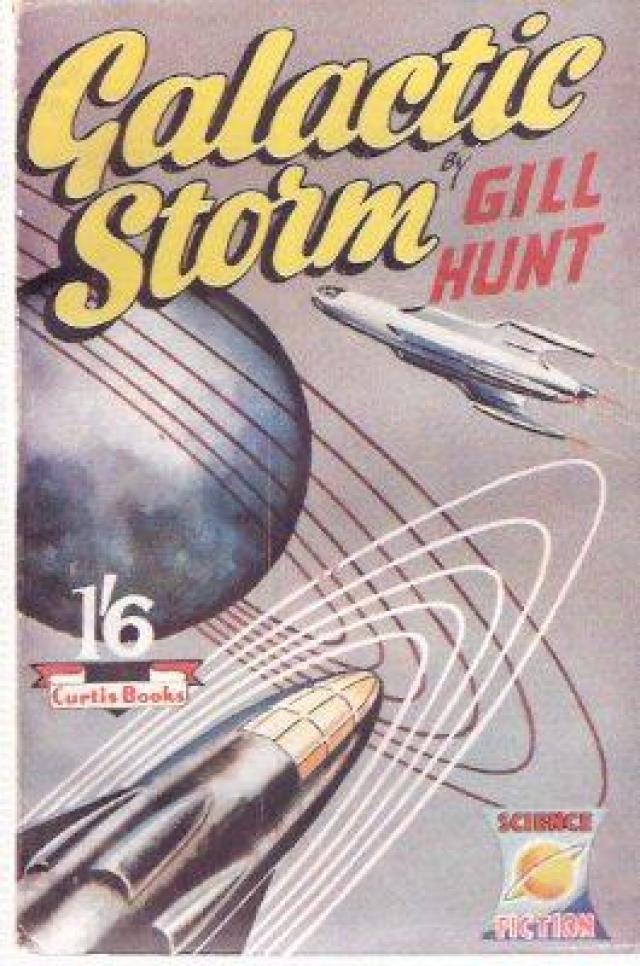


We entered the dark flume. By a fortunate chance and a little experiment, I found which of the switches on a board at the side controlled the lights, and a bluish gleam lit up the way before us. Sharp jockeyed us neatly along, until a red glow ahead revealed the furnace at the top of the volcano. We hung on grimly as the saucer leapt a hundred feet in the updraft, and then we were clear.
Sharp said, "Where do we go from here?"
Honey took out the little compass he made a habit of carrying, just as I always carried a magnifying glass; the needle was going gently round in slow circles.
"Of course," Sharp muttered. "The whole ship's one big magnetic backwater. Well, there's the ocean. Look!"
He extended his arm, drove the saucer in a wide, sweeping circle. What had made it clear where the sea was one of the biggest waterspouts I have ever seen, and since then I have seen many. We headed for the ocean at what must have approached eight hundred m.p.h.
Then the first of the pursuers leapt up from the crest of the volcano, and I cursed. Sharp glanced back. There was no question that the very small saucers which now appeared had not the legs of us; they grew in size almost at once. One of them came up beside us, and I jammed down the catch on the photon gun. At once it sheered off, seemingly out of control. But not for long. The next one came sliding up—with the roof opaque! They were flying on instruments alone. I admired their courage, but Sharp swore, and I wondered what was their technique of attack.
Three came up around us together, and suddenly converged on our roof. They landed on top of us—and at once we began to go down. In a hurry, too!
Sharp yelled, "Hold on!" We grabbed the nearest supports. He tilted the saucer up on its side and then over, and back upright, while the three attackers fell away with surprising rapidity.
This happened twice more, and by then we were well out to sea. The next stage of the battle developed almost at once. It took the form of a racing saucer that circled us very fast and came in from our seaward side, flinging tiny green-tailed rockets at us. Sharp took violent evasive action. The rockets burst in bright green and vicious-looking flashes, well clear of our saucer. But we had to get back in the direction of the volcano to elude the whole squadron of them that eventually approached us from the north, and Sharp made for the waterspout. He arced around it, and hung waiting, while the squadron came on.
"What's the idea?" I demanded.
"Venus has no axial rotation and no water," he said past his oxygen mask. "Hence—no waterspouts. There's a chance they won't realise what it is and attempt to fly right through it. Ah—here they go!" And he swung around the spouter again, just in time to see the last of nine saucers go literally up the spout. And raced away out to sea.
That didn't give us much respite. The second squadron came up at a hell of a clip, and hit our saucer twice. Hard; and that was that. They moved up around us and bore up the crippled ship.
So we went back down that crater with considerably more ease than we came up. The furnace had been turned off for our benefit, and the supporting saucers let us into the hall again, dropped us maybe ten feet unsupported on to a ramp. We, still wearing our oxygen masks, got out wearily. The other saucers put down, too, and then Sharp yelled. He pointed dramatically at the floor. It was a mass of green leaves and brilliant white blossoms. The air was pure enough to breathe, and full of a heady, sweet scent.
"The seeds you spilt!" I exclaimed.
Sharp nodded jubilantly. Then he indicated the saucers that came down. Each opened its door. The Venusians inside got out, wearily, under the effect of terrestrial gravity, pulled off their breathing apparatus—and made the horrifying discovery that the air in the hall was oxygen rich. Several of them collapsed instantly, I upped with the photon beam, just to improve matters, and let them have it. They were almost knocked down by it. So were we, but not so badly. They had no way of protecting themselves.
Sharp grabbed a six-foot bar of heavy duty plastic and jumped down from the ramp. Running across the intervening space, he let fly with it, and split the exoskeleton of one of the Venusians with a hefty blow. In seconds the soft and rather repulsive flesh inside had oxydized. The stench was appalling, but we couldn't have cared less. We all laid into them, but what wouldn't we have given for a good terrestrial axe!
Our prayers were almost answered by Honey's discovery, after we had killed every Venusian present, and the stink was being supplanted by the sweet scent of the blossoms, that there was a big supply of heavy knives, something like machetes, in good solid, honest-to- God steel. We wreaked a bit of extra havoc among the flying saucers with those, wondering as we did so what Holda would do if he found out. Or did he know already?
But before we had ruined all the saucers (fortunately, as it later turned out), we made an alarming discovery. The flowers were growing as we watched. The corpses of the Venusians were covered in green shoots after a couple of minutes.
"I never saw plants grow this way before, Shane," I told Sharp. "How come?"
"Mutated by the conditions," he replied shortly. "The question is what do we do now? I've no wish to die in the clutches of a pile of plants, like those two greybeards in Ashton Smith's 'Voyage to Sfanomoe'. Can we get to hell out?"
"Grab another saucer," I suggested. "We've, wrecked their chances of pursuit."
"How many came down with us, of the squadron who brought us back?" he demanded. "Answer—three out of nine. There are still six little saucers sitting up aloft to make sure we don't come back up the chimney. It looks as if this confounded plant has saved our lives, only to smother us with affection now."
"Affection's good," said Honey shortly. He was over by the door, which was closed by one of those blasted ubiquitous glass screens. "Paul, can you do anything with this door? Think at it, or something?"
I glanced down. My foot was being lifted. One of the stalks from the plant had swollen under it with such speed and force that I was shocked. I stood on the stalk. It was like hard rubber, and lifted me as I stood. Bending down, I tried to cut it. The blade of my machete bounced twice before I made an incision.
"Can we bore under that door?" I demanded.
Sharp glanced at it. It was founded on a ledge of soft pumice, like the wall of the hall itself, but actually rested directly on a layer of plastic, maybe an inch thick. He said dubiously, "We can't wriggle under it, if that's what you mean."
"No, goon," I said. "But suppose we let a tendril of this plant grow through, and see if it swells enough to break the glass." I hit the stem with my machete. It bounced. "At the least, it will poison the air for the Venusians the other side." The fetid smell was heavier now, and we decided to try it.
We got through under the glass comparatively easily. Our next headache was getting a shoot to grow in the right direction, but the draught of warm CO2 was like a magnet to it, and it grew straight through, while we tried to crack the glass with our machetes.
Soon there was a splitting noise, and the glass starred. The stem was swelling like a balloon. We hammered at the crack wildly. Then I had an idea. Photosynthesis helps a plant to grow. Dammit, it makes it grow. Lots of photo, lots of synthesis. So I reasoned. It might work.
I tried it—Bacon's empirical method. I dismounted the photon beam and shone it on the leaves at about thirty per cent strength. That was about as bright as an electric arc. A hundred per cent, as you probably know, comes closest of anything to duplicating the light of the sun in free space, but without heat. The result was startling. It turned a vivid green where it had been just plain green, and swole up to twice its diameter in no time.
And the glass fell in shards.
The air beyond was already breathable when we got through, except for several clouds of sticky formaldehyde compounds. The plant was growing frantically. I had to keep the photon beam on at ten per cent, or so to give us illumination, and the stuff grew so fast we couldn't overtake it by running. Further, we had no idea where we were going.
The tunnel led back, of course, to the main hall, but our lives were worth precisely nothing now. There was a chance that we had wrecked the Venusians' whole scheme, but it was a pretty slim one. We knew a little too much about their science honestly to believe that.
We made the end of the tunnel. As we burst out—the end was still open, owing, I guessed, to a failure in the glass, maybe, or somebody having forgotten the combination—I let the photon beam go full for a couple of seconds, but on looking round I found there was no one in the hall at all.
That, we reasoned, meant trouble. The trucks still ran in that inhumanly perfect way, entering their tunnels, but one or two lay overturned beside the shafts, and there was no one to set them right. Further, the other glass doors were intact. Behind them—Holda?
I looked around. Something smelt. Not literally.
Not literally? Not—
Where the hell was that plant?
Chapter Ten
"Critical Mass"
THAT GAVE me the answer. Nothing smelt literally. The heady perfume of the plant was missing.
Not for long. It came to me almost at once. And the plant, too, but it was a piece of insane carelessness on the part of the Venusian operators. One second it wasn't there—next it was growing round my feet.
Illusion!
Somewhere, at the end of the tunnel was my guess, our minds—or only my mind?—had been picked up by Venusian operators, and filled with illusion. The hall was not real, I hadn't really dosed the hall with photons. Then—what the hell was I really doing?
The fact that I hadn't noticed the actual transfer made me angry. I thought at the operators who had me under the influence, and, by God, I broke their hold. I came back. I was lying in the tunnel, covered by the stems of the plant, one of which was swelling perceptibly around my neck. And choking me.
I sawed at it with my machete, cut myself free. It was as well that my arms were still loose. I picked up the photon beam again, looked for Sharp and Honey. They were unconscious. I cut them clear, dragged them away from the plant into the hall—the real hall, this time. I sniffed the air. The plant was already in charge here, and it was breathable near the ground. Then I tried to rouse Sharp and Honey.
Nil result.
Obviously, their minds were still under the same operators who had overcome me. Where could they be? I reckoned in the screen room where Serag had seen us, where most of the telepathic business was handled.
What the hell could I do about it? My own unamplified thoughts were useless. It had taken three of us plus the amplifier to kill Serag. Physical violence was essential. And I couldn't get through the glass.
Oh ho! The trucks full of californium! At least six of them lay near me, bound fast by the ever-growing stalks of the plant. Californium—two critical masses! The lower one produced heat only—
I dragged two trucks over to the door of Serag's tunnel—I'll call it that for convenience—and piled their contents, immensely heavy though they were, against it. At once there came a reaction. The door fused into a heap of slag, and I jumped over the hot residue and fled down the tunnel, breathing in gasps from my mask.
It was a very long way to the telepathic room, and I had no idea what I was going to do when I got there. But I soon found out!
The barrier was still transparent when I came in. In my hands were the machete and the six-foot bar of plastic I had used in the saucer hangar to smash the crews. I stormed in, and before the techs could move, I swept the bar along a row of fragile plastic lamps. All the light went out. I shut my eyes and turned on the photon beam full. Then I turned it down to ten per cent, and found an open box that looked vaguely like a resistance, only in plastic, not metal. I plugged the bar I was carrying into it. There was a pale blue flash, and a satisfactory string of sparks began to fly at the back of the room.
In Serag's seat was another big ugly Venusian, blindly gaping. I guessed at Holda, swiped at his body with my machete and split it down the front. I made sure it would take more than a bath in formaldehyde to cure him, and then left quicker than I had come.
The plant apparently couldn't pass the heap of glowing slag at the entrance. I very nearly couldn't either, but I was rewarded to find Sharp and Honey conscious and worried. In a few brief words I explained to them why the scene had changed so abruptly for them. The problem remained. What next?
First, however, we dragged truckloads of californium over to the glass doors, and melted them all into slag. That left them all open; but something had me worried. Very worried indeed. The trucks were still coming up from wherever, and were piling up on each other. I yelled at Sharp, and he began frantically helping me to drag them apart. It was going to be a full-time job! It we once let the trucks pile up and one of them spilled, there would be first a gentle heat reaction and then the helluva big bang!
"Let's get down there and stop 'em," Honey suggested.
"Easier said than done," Sharp grunted, "but we can try."
So we started off down the rails.
It never struck us as surprising to do all this unmolested. Doubtless it would have done had we had time to reflect. We just didn't have. Now that the Venusians no longer had us registering on our mental screens, though, they could not locate us. It would take time for them to iron the mess out of their telepathic gear, I reckoned, and Holda hadn't looked healthy last time I got through with him. And there were miles, literally, of shaft and cave and tunnel for them to hunt through.
Anyway, down the shaft we went. It was quite wide and almost straight. Whenever we came to a truck drifting on its way to the hall, we simply tilted it sideways off the track and left it to lie there. It was impossible to block the line without the chance of an accidental buildup to critical mass.
After we'd been in the tunnel about ten minutes, walking like Agag delicately, and shining the photon beam ahead of us, we came to a very narrow but brilliantly lit hole in an otherwise blank wall that stretched the width of the tunnel. From it trucks were being extruded at the rate of about two a minute, full of californium. That allowed us practically no time for observation.
However, Sharp looked in and found another of those blasted halls, about the size of the one where Serag had been and like that one lit with blue light. Here there lay an atomic converter of the type familiar to everyone nowadays, busy building californium from carbon to the accompaniment of a loud noise and much activity from the attendant techs. They seemed as yet to have no inkling of the way the plant had blocked the rails in the main hall. There appeared to be almost no communication between the Venusians now. Later we realised that their un-amplified thoughts could no more penetrate the solid rock than could our unaided voices, and it was their custom to relay everything through the central amplifier, which I had wrecked in no uncertain manner. Hence no part of the undertaking could get to any other part except through the oxygen rich air of the hall, and there was only a limited supply of breathing apparatus.
Query—what do we do now? We could hardly get into the hall. Yet, if we did not do so, and quickly, there would be a big blow-up in about no time. Sharp did some quick thinking and came up with the only possible solution.
"Next truck that comes through, grab hold of and shove straight back," he suggested. "That should make 'em shut off the converter and come over to see what's wrong. If, while the converter's off, we can jam a couple of trucks across this side of the opening—back to back so's the californium is insulated by plenty of plastic—we should be able to shut them inside. They're working under heavy gravity, and probably they couldn't shift two of these trucks, full."
In the end, we let a couple more come through before we shoved one back, and then blocked the track with no less than five trucks turned sideways on to the direction of the rails, very carefully arranged so that none of the californium was spilt, and were rewarded by the cessation of noise and a good many confused thoughts from the other side of the barrier. I poked the snout of the photon beam through what was left of the hole, and turned it up for twenty seconds.
"Honey!" said Sharp urgently. "Scat back up the tunnel and see if that plant has grown any seeds yet. If it has, bring some here." Honey nodded, hefted his machete and made off at a fast trot.
We waited breathlessly for five minutes or so in perfect silence, except once when I asked Sharp where he reckoned the plant was getting its water from. He guessed it had made a way to the outside for itself, and was using snow.
It was now pretty plain to us that we couldn't get clear of here unless we wrecked the project beyond hope of restoration, and if we did pull that off we were liable to go up with it. The plant, unaided, could do a lot, but not everything. They still had a certain amount of breathing apparatus.
We went on waiting. After a bit, I gave the techs another dose of the photon beam, but almost immediately the noise of the converter started up again. "What the hell?" said Sharp. "Don't they know about this barrier?"
I strained my mind to catch the stray thoughts again. One came through loud, clear and forceful. They had gotten the amplifier going again. This was Holda. He was dying, but he was alive enough to give orders. The order was this: that the crater of the volcano, the only way out of the setup, was to be roofed over, quickly and strongly. The converter was to be left on. All other doors inside the volcano were to be opened, and as soon as the californium reached critical mass, there would be a flow of lava that would slowly fill the shafts heating the earth. The converter was almost indestructible, and would continue to function till the heat and pressure generated blasted the weight of rock off the underground passages. The result would be, first, a leakage of heat that would melt the icecap for miles around, the lava issuing out being enough to boil the nearer reaches of the sea; and second, rifts in the earth's crust enough to let the inner molten mass of the earth, here at the pole very close to the surface, seep up and continue the process. In destroying themselves, the Venusians hoped to achieve their object.