Warriors of gor gorean s.., p.1
Warriors of Gor (Gorean Saga), page 1


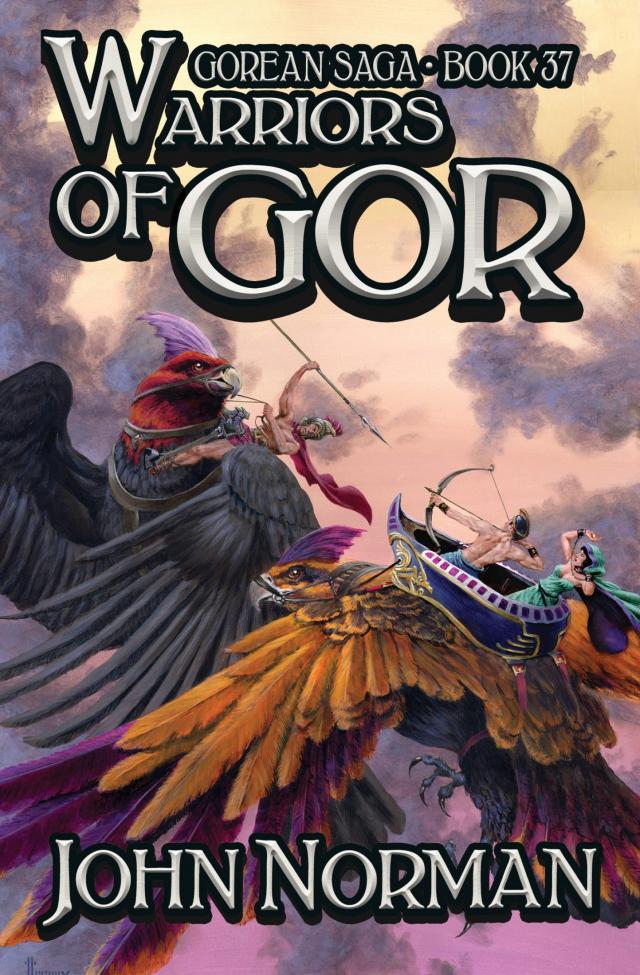
Warriors of Gor
GOREAN SAGA * BOOK 37
John Norman
The point of law is not law, but good. But there are many goods, and what may be good for one may not be good for another. And what is perceived as good may be good but may not be good.
—Saying, from the Codes of Scribes
Chapter One
“To your cage!” snapped Samos, First Slaver of Port Kar, senior captain of the Council of Captains, that body sovereign in Port Kar.
In a flash of silk and a jangle of bells the dancer, barefoot, scurried away, speeding over the colorful, smooth tiles of the great map floor in the conference hall of Samos.
I thrust back the mug of paga on the low, square, small table behind which I sat, cross-legged.
The musicians, now, following the rising of the czehar player, too, took their departure, two flutists, a kalika player and a drummer, with his double tabor.
I turned, and, with a tiny gesture of my head, dismissed the girl who had been kneeling a few feet behind me and to my left, in attendance, lest I might wish aught. Such as she are unobtrusively present, but clearly present, waiting to serve. She, like the dancer, was barefoot. Her single garment was a slight scarlet camisk. Women such as she, loathed and despised by free women, are dressed, if dressed, for the delectation of men. She looked at me, pressed her lips to the flask of paga, quickly, fervently, and then, head down, rose to her feet, backed away a few feet, and then turned and sped from the large low-ceilinged room, dimly lit by dangling, tharlarion-oil lamps. To one side of the dining area was a scattering of wide, soft cushions.
Samos, with his short-cropped, white hair, sprang angrily to his feet¸ and spun to face me.
“You are mad!” he said. “Speak no further of the matter!”
“I have said very little,” I said.
“So,” he said, “a word spoken is a sentence not said, and a sentence not said is a paragraph unexpressed.”
“I did not request this meeting,” I said. “And time is precious.”
“Not so precious as you think,” he said. “The matter is likely to be protracted. Justice, policy, theater, demand it.”
“And how am I to understand what you are saying?” I asked.
“I am not a fool,” said Samos. “And you feign clumsily.”
I was silent, looking down.
“You are a poor liar,” he said. “You lack deviousness, and subtlety. A draft tharlarion could tread through a crowded bazaar at noon more delicately, less noticed.”
“I trust that is not so,” I said.
“I asked you here because I could not credit what I have heard hinted,” said Samos. “It is too preposterous. It bespeaks unbelievable absurdity.”
“Then do not believe it,” I suggested.
“I called you here,” said Samos, “to convince myself of the emptiness of rumors.”
“It is not unusual for a rumor to be empty,” I said.
“Sometimes truth wears the cloak of falsity,” said Samos.
“You cannot expect me to deny a rumor I have not heard,” I said.
“Who speaks rumor to the subject of rumor?” asked Samos.
“And does this rumor go about boldly in the taverns, in the marketplaces, in the arsenal, at the piers?”
“No,” he said, “it is far more subtle, more private, more guarded, than that.”
“It seems you have keen, well-placed spies,” I said.
“In this case,” said he, “not spies but friends, your friends and mine.”
“And you have heard suspicions, whispers, and fears?” I said.
“Do not do it,” he said.
“I must,” I said.
“It is bereft of any hope of success,” he said. “It courts doom. It is worse than ill-considered. It is no more than a venture into the corridors of madness, an act of blatant insanity. Better to have yourself bound and cast into a foliage of leach plants, better to lock yourself in a pen with starving sleen.”
“I intend to leave in the morning,” I said.
“Then it is true!” he said.
“What?” I asked.
“Take with you a thousand men,” said Samos. “I can furnish them.”
“So, too, could I,” I said, “but I must go alone.”
“Two thousand men!” said Samos.
“Ten times that much and a dozen cities,” I said, “could not match the might of Ar.”
“You lost your match,” he said. “You were outplayed.”
“So, too,” I said, “upon occasion are Centius of Cos and Scormus of Ar.”
“It was a game you should not have begun,” said Samos.
“I had no choice,” I said.
“She is not worth it,” said Samos.
“That,” I said, “does not enter into the issue.”
“You know she is not worth it,” said Samos.
“That,” I said, “does not enter into the issue.”
“It should,” said Samos.
“I leave in the morning,” I said.
“Secretly?” he said.
“Of course,” I said.
“You are a fool,” he said.
“I wish you well,” I said.
“Abandon her,” said Samos. “She is now, as she should be, long months after her treason, her cruelty and crimes, in custody. Betrayed by her former ally, Lurius of Jad, who deceived her, promising her safety, refuge, and honor, she is currently, doubtless, being conveyed from Cos to Ar, there to face the justice of the city she so unconscionably and grievously outraged. Let her savor the dreadful potion she thoughtlessly prepared for herself. Choices entail consequences. What is done cannot be undone. Belated justice is at last afoot. A polity hungers for retribution. Ar thirsts for blood. The trumpets of vengeance stab the skies.”
I rose to my feet.
“Be pleased it is over,” said Samos.
“That is my fear,” I said, “that it is over.”
“It is over,” said Samos, “though many do not know it. Indeed, as soon as her capture becomes common knowledge, no longer will bounty hunters, and gangs of bounty hunters, in their hundreds, with swords and flaming brands, scour towns, cities, villages, and camps for the elusive Talena of Ar. No longer then will dozens of innocent women be brought naked and chained to Ar, either on the pretense that, or in the hope that, they were the fugitive Ubara. When it is realized that Talena has been taken, thousands of beautiful women, free or slave, women who might have feared they bore the slightest resemblance to Talena of Ar, or might have even the trace of an accent of Ar, will rest easily.”
“She was once my companion,” I said.
“The companionship should never have existed,” said Samos. “She was unworthy. Put it from your mind. She was a petty, selfish, cruel, vain woman.”
“It did exist,” I said.
“It was never renewed,” said Samos. “It lapsed. It no longer exists. It is as though it had never been.”
“That is true,” I said. “It is as though it had never been.”
“You did not even share the Home Stone she betrayed,” he said.
“That is true,” I said.
“You owe nothing in this matter,” he said. “This is something with which you have nothing to do. There is nothing here in which you are involved. It is all apart from you. In this matter you have no command of honor, no obligation, no duty, no service expected or due.”
“I know,” I said.
“Do you understand the gravity of betraying a Home Stone?” he asked.
“Yes,” I said.
“She betrayed hers,” he said. “She conspired with Tyros and Cos, she opened the gates of her city to enemies, she presided over the destruction of its walls, she ruled as a puppet Ubara, with arrogance and cruelty, over looted and occupied Ar, until the surprising return and sudden restoration to power of the rightful Ubar, Marlenus. Now, let her be returned to Ar, and face its justice.”
“Would that I had my hands on the throat of Lurius of Jad,” I said, suddenly.
“Rather, rejoice,” said Samos, “that he apprehended a much-sought fugitive, and thus served the ends of justice.”
“The justice of a Marlenus of Ar,” I said.
“Naturally,” said Samos.
“I fear the justice of a Marlenus of Ar is a dark and terrible thing,” I said.
“Commensurate with dark and terrible crimes,” said Samos.
“The reward for the capture of Talena,” I said, “was enormous, ten thousand tarns of gold, tarn disks of double weight.”
“Enough to suborn cities, to build fleets, to recruit armies,” said Samos.
“It doubtless constituted something of an inducement to Lurius of Jad,” I said.
“That is possible,” said Samos.
I had managed to acquire Talena at the World’s End, far beyond even the Farther Islands, Thera, Chios, and Daphna, across Thassa, the Sea, herself. I had then returned her, incognito, to the great port of Brundisium, to the south, from which I had had her purchased and transported to Port Kar, where I had had her placed as a lowly tavern slave in the Golden Chain, on Palace Street, an establishment whose proprietor was Ho-Tosk, a friend. Port Kar was far from Ar and the major cities of Gor; it was also a polity whi ch retained something of its former reputation as a dangerous den of pirates and thieves; might not a stranger then, say, a bounty hunter, find himself at risk in such a place; too, surely it would seem an unlikely place in which to seek the proud, regal Talena of Ar; too, who would suspect that a common, even if unusually beautiful, tavern girl, one so publicly displayed to the frank, lustful scrutiny accorded to such properties, might be identical with so desiderated a prize? Beyond such considerations was the fact that few ordinary individuals would be likely to be personally acquainted with the features of the former Ubara, that given the veiling common amongst Gorean free women in public. I had thought that I had planned well. Surely a mysteriously concealed woman, in a fine house, a keep or castle, might spur unwanted curiosity.
I rose to my feet.
Samos was silent.
But, ela, Talena, even at the World’s End, had been recognized by one of the most tenacious of her pursuers, fierce, skilled Seremides, a master of the sword, formerly First Captain in the Taurentian guard, the pledged police of the Central Cylinder in Ar, who had been a colleague in her treason, and an abettor of her crimes, himself now, too, a fugitive from the justice of Ar. The attempt of Seremides to capture Talena later, after her return from the World’s End, in Brundisium, had failed, but he had managed to trace her to Port Kar, within the canaled precincts of which it seemed likely he would eventually discover her whereabouts. He was recognized in Port Kar by a slave who had encountered him in Brundisium. At that point, some of my men, in my absence, removed Talena from the Golden Chain, transporting her to my holding for safekeeping. Unbeknownst to my men, or to Seremides at that time, other bounty hunters, including bestial Kurii, were attempting to locate Talena by means of tracking Seremides. Given what later occurred, it seems clear that the efforts of Seremides were being funded and supported by Lurius of Jad, who himself doubtless coveted the reward for the apprehension of Talena. Apparently, when it became likely that Talena was somewhere in Port Kar, Lurius deemed it judicious, lest I somehow manage to confound his plans, to lure me away from Port Kar by the extensive and bloody ruse of sacking and burning villages in the Farther Islands in my name. Given the enmity between Port Kar and Cos, I did not connect the depredations on the Farther Islands, wrought in my name, with the possible fate of Talena, who, as far as I knew when I departed Port Kar, was safe in the Golden Chain. I later realized, to my rage and misery, how completely and successfully I had been tricked. On the other hand, even had I suspected the hoax, I would surely have attempted to put an end to the devastation being inflicted in my name. The kaissa of Lurius of Jad was well played. As Samos had said, I was outplayed. Yet, what else, in honor, could I have done? Some moves, it seems, are forced. I later learned that a massive attack was mounted on my holding in my absence, to obtain Talena, but the attack, by my men, and by the intervention of the irate citizens of Port Kar, was turned back, with great losses to the foe. In the confusion and chaos, however, Seremides, with Talena, was able to flee from the city and keep a rendezvous with a Cosian ship at the nearby Skerry of Lars. All indications are that Talena accompanied him willingly, presumably having been assured of an end to her alarms and terrors as a fugitive, and having been promised not only honor, safety, and comfort, but a cordial state reception, one befitting a visiting Ubara.
“Consider maps,” I said, “what they show, and what they do not show.”
Samos regarded me, I fear, puzzled.
I turned up one of the dangling lamps, a little, in the dim light, enlarging the flame, to better illuminate the floor, with its variegated shapes and colors, a broad map of known Gor. Shortly before a lovely, belled, barefoot slave, had danced on that surface, on the smooth, colored tiles.
“Even a child must wonder,” I said, “what lies beyond the edges of a map.”
“The World’s End,” said Samos. “When we know more, I shall include it.”
“We know little of what is east of the Barrens, what is west of the islands of the World’s End.”
“When we know more, I shall include it,” said Samos.
Much of Gor was terra incognita.
“A map is surface,” I said.
“It need be no more,” he said. “It need not portray the sky, clouds, the moons, stars. It need not portray strata, molten stone, diamonds, then sky again.”
“I think,” I said, “there are countries on no map, countries of possibility, countries of the heart, countries very real, which we will never understand.”
“Seize reality,” he said. “That is enough.”
“Few,” I said, “would grant that that is enough. What point is there in seizing reality unless it be to change it, to remake it, to fashion it closer to your vision, your ambition and desire?”
“The sail,” he said, “does not make the wind.”
“The sail is cunning,” I said. “It surrenders to the wind, and then uses it to go its own way.”
“Do not venture forth,” he said, “not on a mission so mindlessly mad.”
“I must,” I said.
“I do not understand you,” said Samos.
“I do not understand myself,” I said. “Why then should it be easy for you to do so?”
“Abandon her,” said Samos. “Leave her to the fate she so richly deserves, that which by treason and perfidy she contrived for herself.”
I gazed at the map, in the lamp light.
“You look upon the map,” said Samos. “Learn from it. Let it dissuade you. Behold it. A pace here is a hundred pasangs there. Consider distances and dangers, time and space, storms and beasts, guardsmen and brigands. The map itself proclaims the inanity of your intentions.”
“You agree,” I asked, “that the map is surface?”
“Of course,” he said, angrily.
“Men are not,” I said.
“Do you think Marlenus is your friend?”
“No,” I said.
“As soon as you crossed the pomerium of Ar,” said Samos, “did he, or even his most subordinate officer, harbor the least suspicion that you might entertain even a modicum of sympathy for the former treasonous Ubara, you would be seized and placed under arrest.”
“I once,” I said, “long ago, in the time of the Horde of Pa-Kur, Master Assassin, rendered aid to a beleaguered Ubar.”
“I know,” said Samos. “Who has not heard the songs, and the tale of the mysterious Tarl of Bristol?”
“Few know he was I,” I said.
“True,” he said.
“Might that not count for something?” I asked.
“Surely,” said Samos. “Thus, were you so fortunate, you might merely be denied bread, fire, and salt, and be banished from Ar, ordered never to return.”
“Or slain swiftly, mercifully, at the foot of a throne,” I said.
“Possibly,” said Samos. “Ubars often fear men such as you, strong, resourceful, powerful men, and it is a dangerous thing to be feared by a Ubar.”
“I do not think Talena is now in Ar,” I said.
“No,” said Samos. “The city, by report, is not now beribboned nor covered with the petals of strewn flowers, to welcome the return of so august a prisoner as a treasonous Ubara.”
“Might there not be hope then,” I asked, “at least until the gates of Ar have closed behind her?”
“There is no hope,” said Samos.
“The way between Cos and Ar is long,” I said.
“And dangerous,” said Samos.
“True,” I said.
“And more dangerous than you might suspect,” said Samos.
“How so?” I said.
“You are not alone in this matter,” he said. “Consider the reward for the return of Talena. Not all might surrender that guerdon uncontested to Cos.”
“The wrath of Cos is much to be feared,” I said.
“True,” said Samos, “but arguments of gold are seldom examined for cogency. Too, a starving urt will attack a larl for a crumb of cheese.”
I reduced the flame in the lamp, and it swung once more, dimly lit, on its short chain.
“Do not go,” he said.
“I wish you well,” I said.
“I wish you well,” he said.
I then withdrew from the chamber.
Chapter Two