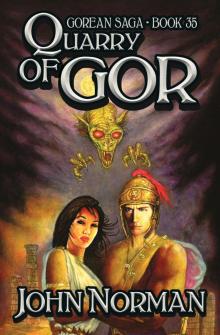
Quarry of gor, p.33
Quarry of Gor, page 33


Then suddenly, there was a sharp, loud, splintering crash as the door was kicked open. I jerked back, in my bonds. I could not well see the figure outside.
Then Addison Steele stepped into the room.
“As I recall,” he said, “there is no point in warning you to silence.” Then he said, “Are you not in the presence of a free man?”
I squirmed, trying to get to my knees.
He lifted me to my knees before him. His proximity made me uneasy.
I put my head down.
“Look up,” he said. “I will read the subtlest expression on your face, the least movement of your body.”
My former world had not prepared me for the intentness and care with which a Gorean male can look upon a woman. How few women on my former world, I thought, have been truly seen by a man. I did not think the men of my former world, as a whole, no matter how much they might look at a woman, really saw a woman.
I lifted my head but I dared not meet his eyes.
I felt his fingers touch the side of my throat, gently, above the collar, and then he withdrew his hand, and straightened up, and backed away.
I still could not speak.
His touch, as light as it was, had made me very much aware of him.
“You have become kajira,” he said. “It is an incredible and marvelous improvement in a woman. I suppose it goes with the mark and collar, the whip and chains, and learning you are a woman.”
I looked down.
“You are where you belong,” he said.
I kept my head down.
“Look up,” he said.
I again lifted my head.
“I was present,” he said, “when silence was imposed upon you. You were unconscious, and yet, in a way, conscious. You seemed to understand, in some vacant, abstract way. I have some sense as to how it was done, and yet have little understanding of the mechanics involved. Others, doubtless, would know more. I do have some sense as to how speech could be restored to you, that is, under what conditions it could be restored to you, but, again, I understand very little of the mechanics involved.”
I understood very little of what he was saying.
Yet I was profoundly excited to hear that I might once again be able to speak. I recalled the powders and fumes of the apartment of Dorna of Tharna. Perhaps there were other powders and fumes, a vial of chemicals, a restorative drug, or such?
“You will note,” he said, “I have entered unannounced, and, I suspect, unanticipated. I have damaged the door. It is splintered, it hangs awry. I find that suitable. There is a reason for this unusual ingress. Doubtless you are curious. I will tell you a little, but not enough for you to understand. It is better that you do not understand. If you did, your life would be in greater jeopardy than it is now. I wonder if you realize your life is in jeopardy? You do remember, I am sure, that I was instructed to cast you from the delta wall to tharlarion but neglected to do so. Why should one waste a slave, even one as miserable and worthless as you, a shallow creature extracted from a desecrated, unloved world? I have broken in, rudely, leaving blatant evidence of a forced entry, in order to convey to Bruno of Torcadino the impression that his premises have been violated by a thief, presumably a slave thief, a thief of slaves, that, as I shall not rifle or disturb the room. Surely many must have noticed you in his keeping, here and there, on the walkways, and so on. Would it not be simple to steal from a cripple, thus to secure an easy acquisition, even if the quality of the loot might be less than would be desired? A slave thief would be likely to bring with him tools, at least adequate to open a link and free a girl from a ring. So why then, when he returns, will he find you still here? Perhaps the slave thief is a rank amateur, hoping to find you unsecured, as slaves often are, or the keys conveniently about, in the apartment, perhaps in a drawer or chest, perhaps dangling just outside your reach? More likely, he was interrupted, or alarmed, in his work, sounds within the building, conversations in the street, or such, and feared discovery, or despaired of carrying you away, bound and gagged. Thus Bruno of Torcadino returns and finds you as he left you, chained to the ring, shackled and back-braceleted. Upon his return, he will doubtless ask you many questions, to which you will indicate “Yes” or “No,” by nodding, shaking your head, and such. To such questions you will give no indication whatsoever of my identity or the nature of my intrusion. Rather you will feign ignorance, and respond along the lines I have suggested, the withdrawal of an alarmed slave thief, or such. In this way you will protect my life and, in the long run, I assure you, increase your own chances of survival. Now, you will wish to know the reason for my intrusion. I wish to induce a fear in Bruno of Torcadino that he may lose you, and even that others may be interested in your acquisition, either for the procuring of information, or, as in the case of the Lady Dorna of Tharna, the removal of a witness. If my plan proves successful, he will wish to keep you under surveillance at all times.”
I looked up at Addison Steele, standing apart from me, across the room.
“Bruno of Torcadino is an extremely intelligent and dangerous man,” continued Addison Steele. “He realizes from the unusual affliction dealt to you that others, significant and informed others, other than Decius of Venna, who would presumably not have the resources to bring about such a result, seek the same goal as himself, obtaining the slave, Adraste. She is a common quarry.”
I understood little of this.
“Bruno of Torcadino,” said Addison Steele, “from your earlier disappearance and silencing, realizes his immediate competition in the hunt for Adraste is likely to be both sophisticated and formidable, and he also realizes that you can recognize them. This is a boon for him and a peril for you. I am privy to some of the plans of Bruno of Torcadino. Surely you have suspected that much from my earlier visit to you.”
I had, indeed, suspected as much. Was not Addison Steele treacherous and disreputable, dishonest and dishonorable, a stranger to loyalties? If one is on all sides, how can one help but be on the winning side? Yet this was a dangerous role to play. If one is on all sides, how can one help but be on the losing side, as well? Few people who knew Bruno of Torcadino, for example, I was sure, would have cared to betray him.
“Bruno of Torcadino,” said Addison Steele, “tomorrow night, or the next night, or the next, sometime in the near future, depending on his success in gathering followers, plans an outing. I want you to be with him in that outing. If my plan is successful, you will be with him. He will not wish to leave you alone. I want you on that outing. You will be on that outing—as my spy.”
I shook my head wildly, negatively. I wanted no part in such matters, matters I did not understand, which were seemingly fraught with danger.
“You do not have a choice in this,” said Addison Steele. “You are kajira.”
I regarded him, with misery.
“You look well,” he said, “naked, kneeling before me, marked, and in a collar, shackled, your small wrists locked behind you, in slave bracelets.”
He then approached me, and stood before me, closely. I was torrentially aware of his presence. I pulled weakly at my imprisoned, braceleted wrists, held behind me.
“You are, as I recall,” he said, “the former Miss Margaret Henderson, of Earth.”
I put my head down.
“Is that not true?” he said.
I nodded.
“Look up,” he said.
I lifted my head.
“Now,” he said, “former Miss Margaret Henderson, of Earth, please me.”
I then pleased him.
Chapter Thirty-Three
A Harrowing Night is Spent in the Marshes
Bruno of Torcadino and I did not even have to lower our heads to pass under the chain at the Delta Gate.
We were no longer in one of the single-oared canal boats.
“These craft,” said Bruno of Torcadino, “are well-woven, light, and sturdy. Two slaves could lift one. They are ill-adapted to the open water but well ply the marshes.”
That afternoon, Bruno of Torcadino, at the market quay inside and near the Delta Gate, the Delta Market, had purchased a rence craft.
“But maintain your balance carefully,” he said. “They may be easily capsized.”
I could have found my way back to the Golden Chain from the Delta Gate, but I had no opportunity to do so. How often I had hoped to flee from him! It was not merely that I was leashed, but, when passersby were about, or we forded crowds, a simple cry from Bruno of Torcadino, “Stop her,” or “Running slave,” or such, would have put a dozen men, swift, long-legged brutes, after me. Within Ehn, bruised and disheveled, my hands thonged behind me, I would have been returned to him, cast at his feet. Too, if I were alone, guardsmen might have summoned me to them for a collar check, as is often done, following which my hopes of reaching the Golden Chain would have been considerably diminished.
I now knelt in the bow of the small rence craft, my hands and feet free.
I gripped one of the two light paddles. Rence craft may be either paddled or poled. Rencers commonly stand in them and pole them, but this was not practical for Bruno of Torcadino.
My leash strap was now wound about my throat.
The previous few nights Bruno of Torcadino had essayed this journey, as previously, in a canal boat. This afternoon, however, he had bargained for and obtained a rence craft.
“Too easily,” he had told me, “I was discouraged by my first effort in the delta. The mystery of the Delta Gate is still unsolved. I am sure its solution is to be found in the marshes. The canal boat is too large. A rence craft is smaller, and is almost part of the marsh itself. Rencers come and go like shadows. Why can we not do so, as well? A canal boat is easily seen and avoided, a rence craft not so. If we are not to be contacted, we may be fortunate enough to detect one who is contacted. I suspect a rendezvous is afoot, one perhaps of several. Would it not be interesting to look in on such a meeting?”
The delta is vast, of course. Armies might be lost in it. But Bruno of Torcadino, reasoning that the considerable damage done to the Delta Gate was a demonstration of power, and an invitation to parley or confer, reasoned further that a projected meeting point must be convenient to the city. He further surmised that, assuming that matters had not been prearranged, a straight line perpendicular to the center point of an imaginary line connecting the two sides of the delta portal would be the simplest, most likely line on which a meeting might take place. Lastly, the rence-encircled “lake” in the marshes, located in our first trip several days ago, concealed, and secluded, lying on that line, seemed an ideal venue for a clandestine encounter.
We were now, again, as we had been the past several nights, concealed within its encircling rence.
“Success has not hitherto crowned our efforts,” he had said, “but do not despair. That crown will yet be theirs. Hunters are patient. Within that marsh there are wonders.”
One doubtless supposed that that which had wrought such ruination at the Delta Gate was within, or associated with, the marshes.
I had made no effort, either by gesticulation or drawing, to convey to Bruno of Torcadino what I had glimpsed on our first trip into the marshes. I recalled what I had seen as we were returning to the city, those two, luminous, fiery disks, like eyes, burning in the darkness behind us, lifted over the scarcely disturbed, placid water. I did not even know what it was. I was frightened. I did not wish to see that thing again, whatever it was. Certainly I did not wish to intrigue Bruno of Torcadino, nor stir his curiosity, nor confirm his speculations. I wished only to escape from him.
“We must be patient,” whispered Bruno of Torcadino.
I gathered that he had, some days ago, one night, visited various taverns and taken several men into fee, most likely cutthroats and brigands, men who saw no point in inquiring into the nature of an employment, if it paid well. I did not know what he needed these men for. None had been brought to the apartment. I did not know their numbers. Decius of Venna, as I recalled, had had something like ten men. I did not think Bruno of Torcadino’s hires were now engaged in any activity. I conjectured they were on “retainer,” so to speak, and, in some way, were readily summonable, perhaps within an Ahn, or two. Among his hires, I was sure, would be the master of a ship. He would need some way to bring Adraste, or Luta, the former Lady Julia Leta, to some point on the continental coast, prior to carrying her overland to Ar.
“Patience, patience,” whispered Bruno of Torcadino. I suspected that he was talking more to himself than to me. He was not really a patient man. But, too, he was a man of stern will. I trusted he would abide by his own counsel.
The slender rence craft rested lightly on the water, nestled within the rence. We had laid aside our paddles. Both the White Moon and the Yellow Moon were in the sky. Not since our first trip into the marshes had I seen any sign of an Ul, that gigantic, winged tharlarion. How terrifying had been that sight, that monstrous, silent, soaring form briefly silhouetted against the White Moon. Tonight, I had sensed little of the presence of tharlarion about, of any sort. The difference, I suspect, was in our vessel, the rence craft as opposed to a canal boat. When we had availed ourselves of a canal boat, we were far more aware of tharlarion in the vicinity, turning in the water, emerging and submerging, sometimes circling the boat. Sometimes they brushed against, or prodded, the boat. One had risen up under the boat, tipping it. I was not sure what the difference was. I supposed it had to do with rence; rence would be familiar to them, a part of the marshes, here snagged, here floating, here loose, there massed, there tangled and rotting. I think they did not associate rence with the prospect of possible food. Whatever the explanation was, I was grateful.
By now the smell of the marshes and the marsh noises were familiar.
We had been long in our place of concealment.
I was ready to return to the city.
I recalled Addison Steele.
He had ordered me to please him.
I had then pleased him.
I could not have done otherwise. I was kajira.
Nor would I have cared to do otherwise. I was kajira.
I was profoundly grateful to have been permitted to please him, he a free man, I only a worthless kajira.
“Be absolutely still, do not move,” whispered Bruno of Torcadino.
Suddenly I became very afraid. I remained motionless. I feared I could not move, even if I wished to do so.
Several yards to our left, through the rence, I saw two lights.
I heard a breaking, and parting, of rence.
Then I could see, in its own lights, one at the stern, one at the bow, a large canal boat. In the canal boat were some seven or eight men, mostly sitting. I saw no women, slave or free. I wondered if it were wise to carry a light, let alone two. A large man, cloaked, standing, was in the bow. Something in his carriage seemed familiar. I wondered if I had seen him before. Two men were in the stern, one standing, propelling and guiding the boat with its single oar and one near him, cloaked and hooded, sitting. Only two men were standing, the oarsman, and he in the bow. Each of the men, save the oarsman and he who was sitting by the oarsman, wore sable garb. I wondered if that were because it was night. But then why were the oarsman and he beside him not similarly garbed? Then he who had been sitting by the oarsman, cloaked and hooded, rose to his feet, steadied himself with a hand on a stanchion, one of four to which a canopy might be fixed, and pushed back his hood. I think I could then have recognized him in any light, at any distance. It was Addison Steele!
“Do not move,” whispered Bruno of Torcadino.
The man in the bow, not looking back, lifted his hand, and the oarsman ceased to ply his oar, and the boat drifted a few yards forward into the lakelike clearing in the rence.
Everything was still, save for the familiar marsh noises.
We were well concealed, I was sure.
After a time then, the man in the bow, seemingly satisfied, motioned that the oarsman should proceed.
About a quarter of the way into that lakelike clearing in the rence, the man in the bow indicated, with a slight gesture, that the oarsman should still his oar.
For about an Ehn the boat rocked in place. I could see the two lights reflected on the water, unsteady, shimmering.
Then the man in the bow reached within his cloak and raised his hand to his mouth. There were then three soft, birdlike notes.
“Those are the sounds of the nesting marsh kite,” whispered Bruno of Torcadino. I had heard of this bird, but had never seen it or heard its cry. It weaves its nest of rence, which floats on the water. Some speculate that the humans who had long ago taken to the vast, formidable delta marshes, perhaps fleeing to them, might have realized the possibility of rence islands from the nest building of the marsh kite. Certainly the vast, trackless, treacherous marshes would discourage invasion or pursuit; would they not constitute a barrier more immense and impenetrable than a thousand walls of stone?
Shortly thereafter the three notes were repeated.
But I had not seen the man in the bow lift his hand to his mouth.
“The signal has been answered,” whispered Bruno of Torcadino, with satisfaction.
The hair on my forearms and the back of my neck rose.
Some yards before the canal boat the waters stirred, swelling up, and then parted, revealing, shedding water, a rising, monstrous head. It suggested a gigantic reptile of metal. The two glowing disks seemed to be eyes. They were set forward on the head, as is common with predators. There were wide metal jaws which briefly opened and closed. The grip of such jaws could tear loose the side from a canal boat, or bite a rence craft in two. In the light of the forward lantern on the canal boat I saw the reflection of light on metal teeth and fangs.
To my horror I felt the rence craft move.
“We must approach, we must hear,” whispered Bruno of Torcadino. “We must make ourselves known.”