

Preachers journey, p.1
Preacher's Journey, page 1


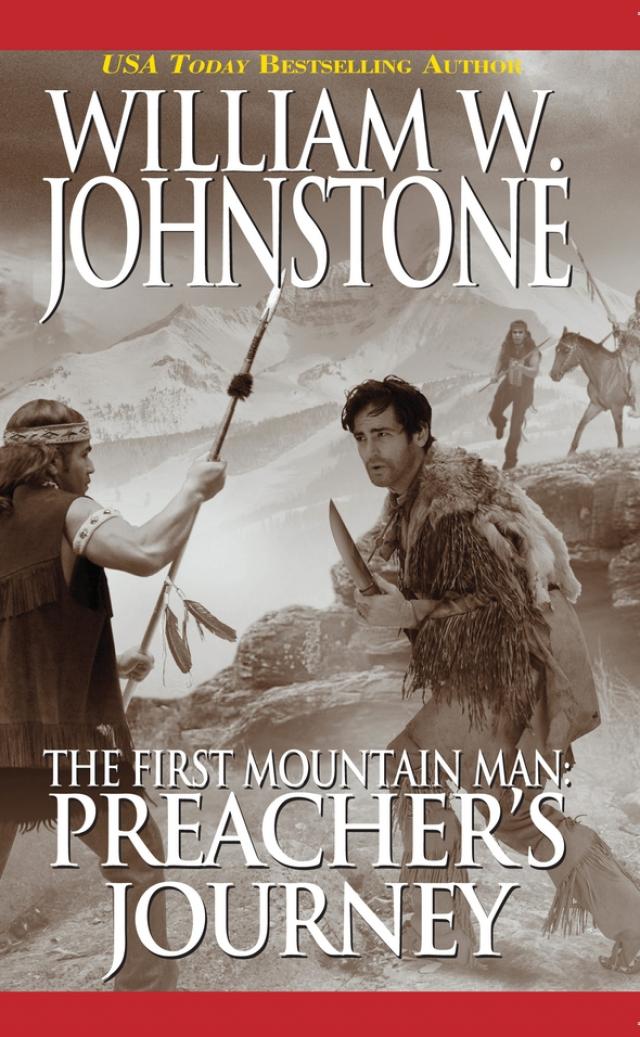
WILLIAM W. JOHNSTONE
THE FIRST MOUNTAIN MAN
PREACHER’S JOURNEY
PINNACLE BOOKS
Kensington Publishing Corp.
http://www.kensingtonbooks.com
All copyrighted material within is Attributor Protected.
Table of Contents
Title Page
ONE
TWO
THREE
FOUR
FIVE
SIX
SEVEN
EIGHT
NINE
TEN
ELEVEN
TWELVE
THIRTEEN
FOURTEEN
FIFTEEN
SIXTEEN
SEVENTEEN
EIGHTEEN
NINETEEN
TWENTY
TWENTY-ONE
TWENTY-TWO
TWENTY-THREE
TWENTY-FOUR
TWENTY-FIVE
TWENTY-SIX
TWENTY-SEVEN
TWENTY-EIGHT
TWENTY-NINE
THIRTY
THIRTY-ONE
THIRTY-TWO
THIRTY-THREE
THIRTY-FOUR
THIRTY-FIVE
THIRTY-SIX
THIRTY-SEVEN
THIRTY-EIGHT
THE FIRST MOUNTAIN MAN SERIES BY WILLIAM W. JOHNSTONE
Copyright Page
ONE
Sometimes days went by when he did not think of her, and when he realized that, it saddened him. Sometimes on an evening, when he sat by his lonely campfire—not staring into the flames, mind you, because that ruined a fella’s night vision and was a damned good way to get him killed in a hurry in this wild country—but just sitting there, he tried to conjure up the image of her face, and he couldn’t. No matter how hard he tried, he just couldn’t remember exactly what she looked like. The caress of her voice, the music of her laugh were equally elusive.
Jennie.
He had been fond of her when he was a boy, he had loved her when he was a man, and now she was gone, foully murdered by a son of a bitch not worthy of kissing the hem of her dress or even licking the sole of her shoe. Her death had been avenged, but the pain of her loss was still there, lurking in the back of his mind more than two years later, ready to leap out like a hobgoblin when it was least expected.
For a time, the pain had been his only friend. Well, that and the big, wolflike dog known only as Dog. But eventually it began to recede, washed away by time and hard work and the glorious surroundings of the Rocky Mountains. He had welcomed the easing of the pain, until he realized that it meant the memories were beginning to fade too. That was bad, because he never wanted to lose any of his memories of Jennie.
One generation passeth away, and another generation cometh; but the earth abideth forever. The sun also ariseth. . . .
That’s what it said in the Good Book, in the part called Ecclesiastes, and he knew it meant there was no way to turn back time. The sun would go down, and the sun would come up in the morning, until the end of the earth, forever and ever, amen.
Ecclesiastes . . . also known as the Preacher.
Just like the man who sat beside those lonely campfires and rode the high mountain trails.
Preacher reined in the big hammerheaded dun and sniffed the air. He thought he smelled snow. Beside him on the trail, Dog whined softly. Preacher grinned down at him.
“You smell it too, old fella? Winter’s comin’ on. Be here before you know it. But it’s time, I reckon.”
He was a tall man in buckskins and a coat made from the hide of a bear. Lean but not skinny, he packed plenty of hard muscle on his frame. When he shaved—which wasn’t often—and when he was around womenfolk—an even rarer occurrence—the gals seemed to find him handsome. At the moment he sported a thick mustache and a beard that he kept cropped relatively close with a hunting knife. Under a brown felt hat with a broad, floppy brim, his hair was black as a raven’s wing. His age was difficult to tell, because he had always looked a little older than his true years. He was thirty-one, and he had been making his own way in the world since he was twelve. Sometimes with help, friendship, at least companions, but often alone, except for a horse or a mule, and the dog. When he was little more than a boy, he had made a promise to a dying friend that he would come west and “see the creature” for himself, since they couldn’t go together as planned. And he had done it, traveling to the Shining Mountains, as they were sometimes called in those days instead of the Rockies, and he had seen the creature, all right. He had seen it aplenty.
Now he saw something that shouldn’t have been there—a tendril of smoke climbing into the pewter-blue sky above the valley spread out before him.
Preacher’s pale gray eyes narrowed. There shouldn’t have been anybody in that valley. With winter coming on, the prime fur-trapping season was over for a while. Some of the mountain men had gone back to St. Louis or elsewhere closer to civilization to spend the winter; others would pass the months of cold weather with friendly Indians. A few, like Preacher, would live alone, travel their own paths until Rendezvous in the spring. But he was acquainted with most of those men and knew that none of them planned to winter in this valley.
Besides, no mountain man worth his salt would build a fire big enough to give off that much smoke. It would announce his presence to any unfriendly Indians who were in the area, and besides, it was plumb wasteful.
Must be white men, he thought, and pilgrims at that.
He heeled the dun in the flanks and rode toward the smoke. He could have ignored it, could have ridden the other way, but he had a powerful curiosity and most of the time he went where it took him.
Curiosity could be a hazardous vice in the mountains, so he was well armed. Behind his broad leather belt he carried a pair of pistols, each of them double-shotted. He had two more pistols in saddle holsters, with the butts turned toward him, and two more in his saddlebags, loaded but not primed. A heavy-bladed hunting knife rode in a beaded sheath on his left hip. Strapped to his right calf was a smaller knife, more of a dagger, really. The butt of a Hawken rifle stuck up from a saddle boot under the right fender of the saddle, and he carried another Hawken balanced in front of him. Men who saw Preacher for the first time sometimes said he was armed for b’ar, but truth was he was armed for just about any kind of trouble that up and came at him.
That smoke meant trouble. Pilgrims always did.
Time was, these mountains had been the sole province of the Indians. Then the fur trappers had come, first Frenchmen down from Canada, and then, after Lewis and Clark’s expedition to the Pacific, Americans who traipsed out from St. Louis, following the Missouri River. A fella named Manuel Lisa had bankrolled the first American fur trapping party. Others had followed. Colter, Bridger, Holt, and Clyde Barnes and Pierre Garneau, who had saved Preacher’s life and become his friends . . . these and hundreds more like them had come to the mountains to harvest the beaver pelts. Some of them had gotten along with the Indians and some hadn’t, but they hadn’t disrupted life in the high country too much.
Movers were a different story.
Immigrants from back East had just gotten started heading west in the past year or so, and already there were too damned many of them to suit Preacher, traveling in those big wagons that came a-rollin’ and a-creakin’ across the plains and through the passes, leaving ruts that marred the ground and might not ever come out.
He couldn’t blame people for wanting to improve their lives; hell, he had come west himself when he wasn’t much more than a greenhorn, hadn’t he? But too many of the pilgrims didn’t really care about the country they were passing through. They weren’t going to make their homes here. The mountains didn’t mean anything to them except as obstacles to be crossed. And they sure as shootin’ didn’t care about the folks who actually did live here, both red and white.
Still, if there was trouble, Preacher couldn’t turn his back on it. He just wasn’t made that way.
He topped a rise, reined in again, and looked down on a tree-lined stream meandering along through some lush-grassed bottomland. Four wagons with mule teams hitched to them were parked alongside the stream. Canvas arched high over the rear of the wagons. Preacher leaned over in the saddle and spat. Movers, all right. Immigrants had to have wagons like that because they hauled so damned much stuff with them.
They were off the trail too. They wouldn’t get anywhere going the direction they were headed except deeper into the mountains. Had to be lost.
The smoke came from a big fire near the creek. The pilgrims had gathered broken branches into a large pile and set them ablaze. Preacher’s keen eyes made out a big iron pot set on stands at the edge of the fire. They were either cooking stew or heating water for something, and he didn’t smell any stew. Neither did Dog, who sat next to the dun and growled, and not pleasant-like either.
“Yeah, my teeth are a mite on edge too,” Preacher told the dog. “You reckon we ought to ride down there and turn those folks around, send ’em back where they come from? If we get to talkin’ to them, they’re liable to ask me to lead ’em on to the Promised Land, and I ain’t in much of a mood to play Moses.”
Dog just growled again.
“That’s what I thought,” Preacher said, but he was suddenly alert as a new sound came to his ears through the clear, crisp air.
Somebody in one of those wagons started screaming.
The screams came from a woman, Preacher judged, although he supposed it might have been a man who was really hurting like blazes. The odd thing was that several people were moving around the wagons, tending to the mules and chores like that, and they didn’t seem the least bit disturbed by the agonized screeches. They just went on about their business, unhooking the teams and evidently settling in for a long stay.
“Good Lord A’mighty!” Preacher exclaimed. “Don’t they know somebody’s torturin’ that poor gal?”
Dog turned his head sharply toward the east, and his growling took on a new, deeper, more menacing tone. Preacher’s instinct for trouble started to bubble up even harder than before too, and he looked in the same direction as Dog. What he saw made his hands tighten on the Hawken across the saddle in front of him.
A half-dozen or so figures were slipping along the creek toward the wagons, sneaking through the aspens and cottonwoods that grew along the banks. Preacher saw buckskins and feathers and a few bright splashes of color that told him the stealthy figures had painted their faces. Painted for war . . .
Indians were notional folks and hard to predict. And they differed greatly from tribe to tribe. But once warriors from any tribe had daubed on the war paint, they did not turn back. They were bound for trouble, and nothing would make them spit the bit.
“Aw, hell,” Preacher said softly. It looked like his mind had just been made up for him.
He was about three hundred yards from the creek. A ball from the Hawken would carry that far without any trouble. He would make sure of one of the Indians first, then gallop down there and deal with the others. Backing the dun into the shelter of some trees, Preacher swung down from the saddle and then turned the horse so that he could rest the barrel of the rifle across its back.
Dog’s neck fur was all bristled up. He wanted to charge down there and bite somebody, but he wouldn’t do it until Preacher gave him the word. “Don’t get your fur in an uproar,” Preacher said quietly as he cocked the Hawken and drew a bead on the warrior who was closest to the wagons. As Preacher watched, the Indian drew an arrow from his quiver and nocked it on his bowstring, pulling the string back and taking aim at one of the movers.
Well, that settled the question of whether or not they were hostile, not that Preacher had had any real doubts in his mind about it.
He pressed the trigger. The hammer snapped, setting off the priming charge, and an instant later the powder packed in the barrel ignited with a roar. The buttstock kicked hard against his shoulder. The unexpected sound must have thrown off the Indian’s aim, because the arrow he loosed whipped harmlessly past the head of one of the settlers. A heartbeat later, the heavy lead ball smashed into the Indian’s body, entering just under his left arm, driving down at an angle through his left lung, ripping the bottom off his heart, and lodging deep in his right lung. The Indian staggered, blood welling from his mouth, and then pitched forward on his face.
Up on the rise, Preacher vaulted into the saddle and kicked the dun into a gallop.
The fight was on.
TWO
Now that their surprise attack was ruined, the Indians burst from the trees and raced toward the wagons, whooping and shooting arrows. Preacher’s shot had warned the immigrants, though, and they went diving for the cover of the wagons. As guns began to bang and puffs of smoke came from behind the bulky vehicles, Preacher gave the pilgrims a little reluctant credit for being prepared. At least they had some loaded weapons close at hand.
Preacher swapped rifles as he rode, pulling the loaded one from the saddle boot and ramming the empty back in its place. He guided the dun down the slope with his knees. When he had the Hawken primed and ready, he left the saddle and landed on his feet, running forward a few paces before he bellied down on the ground. Arrows cut the air above his head.
He fired without seeming to aim, but the ball flew true. It struck one of the warriors right where his arm joined his shoulder and busted the socket to smithereens, shredding so much flesh in the process that the arm wound up attached to the Indian’s body only by a couple of strands of meat. The warrior flopped on the ground, his lifeblood pouring out onto the grass from the hideous wound.
Dog flashed by, a gray streak low to the ground, as Preacher surged to his feet and drew the pistols from behind his belt. He had covered enough distance in his initial charge that he was now within range for the short guns. An arrow tugged at the fringe of his buckskin jacket as he cocked and leveled the right-hand pistol. It roared and bucked in his hand, launching its double-shotted load of death.
The first ball caught an Indian in the belly while the second smashed his kneecap and dropped him. Preacher was already pivoting and drawing another bead before that warrior hit the dirt. The left-hand pistol thundered. Only one of those balls hit its target, but since that one smashed through the throat of one of the remaining Indians, it more than did its job. The Indian spun around crazily, blood fountaining from severed arteries.
Preacher saw that only one Indian was left, meaning there had been five to start with. The lone survivor had a bullet burn on his arm, a souvenir of the volley that had come from the wagons, but the minor wound didn’t slow him down as he charged at Preacher, screaming out his hate as he lifted his war ’hawk.
Preacher dropped the empty pistols and yanked the hunting knife from its sheath. He got the heavy blade up just in time to block the tomahawk stroke. Preacher grunted under the impact. The Indian was strong and fast, a worthy opponent. Preacher slashed at him with the knife, making the warrior give ground for a second.
At times such as this, when Preacher was locked in a struggle for his life, he didn’t burden his brain overmuch with thinking. His eyes, his reflexes, his muscles all knew what to do already. He acted. Later, if he lived, he would think about what had happened, because despite his rough exterior and his sparse education, Preacher was a thoughtful man.
He grabbed the wrist of the hand in which the warrior held the tomahawk. The Indian grabbed the wrist of Preacher’s knife hand. Muscles straining, they stood there locked together, each knowing that the first one who slipped or eased up would probably die. Their faces were only a few inches apart. The warrior’s features were contorted with hate behind their war paint. Preacher’s jaw was tight with strain, but he didn’t hate the Indian. Likely the fella believed he had a good reason for wanting Preacher dead. For his part, Preacher just wanted to stay alive, and he knew that meant killing the Indian.
The Indian suddenly tried to hook Preacher’s leg with his foot and pull it out from under him. Preacher shifted his stance with blinding speed, and the warrior missed his try. That gave Preacher his chance. He got a heel behind the Indian’s leg and jerked, and the Indian went over backward. Preacher went down with him, using the impetus of his fall to break free of the Indian’s grip and plunge his knife into the man’s chest. The muscles in Preacher’s arm and shoulder bunched as he turned the knife and ripped to the side with it. The blade rasped against ribs and cleaved through flesh and organs until it reached the heart. The warrior spasmed for a second underneath Preacher before dying nerves relaxed. The Indian’s fingers opened and let the war ’hawk fall on the ground beside him. Blood trickled from the corner of his mouth as he stared up into Preacher’s eyes and died.
Preacher pushed himself up and tugged the knife free, then wiped the blade on the dead warrior’s buckskins as he knelt beside the corpse. “Mighty good fight, fella,” he muttered.
It had been pretty hectic while it lasted, which was no more than three minutes. In that time, five men had died. At least five, Preacher amended to himself, because he didn’t know if any of the pilgrims from the little wagon train had gone under.
He turned toward the wagons, thinking to see if any of the immigrants had been wounded or killed, when he got a surprise. One of the pilgrims came at him, rifle in hand, and pointed the gun at him in a threatening manner.
“Stand right there, mister! Don’t move or I’ll shoot!”
Most times, pointing a gun at Preacher was a mighty efficient way of getting dead, but today Preacher controlled his instincts and didn’t throw the knife in his hand. He knew a flick of his wrist would have buried the blade hilt-deep in the damn fool’s throat. Still could, if the tarnal idjit didn’t lower that rifle.


