

Lure of the grapes, p.1
Lure of the Grapes, page 1


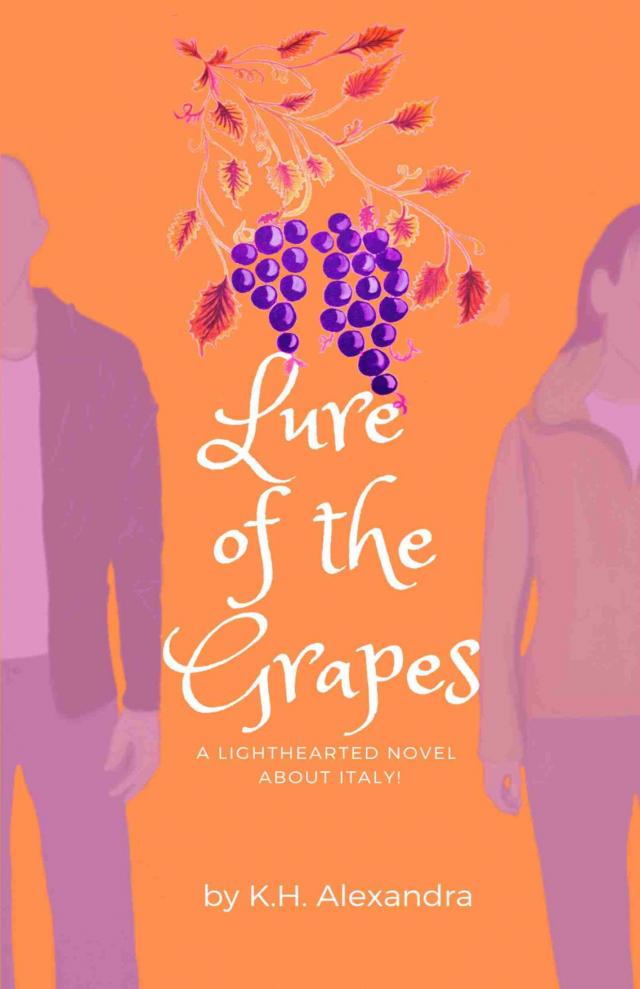


Written by K.H. Alexandra
Copyright © 2020, 2024 K.H. Alexandra
The characters, names, locales, and events in this book are fictional. Any resemblance to actual persons or locales or events is entirely coincidental.
All Rights Reserved. No part of this book may be reproduced or utilized in any form or by any means, electronic or mechanical, including photocopying, recording, or by any information storage and retrieval system.
Cover Design by Author
Edited by Sandra Byrd
Unless otherwise indicated, all Scripture quotations are the author’s own translation.
Ebook ISBN: 978-1-949558-29-6
Paperback ISBN: 978-1-949558-30-2
www.khalexandra.com
Printed in the United States of America
2024, Second Edition

There is nothing like the soft lowing of cattle on a Tuscan hillside to awaken a person in the morning.
Akala yawned from her four-poster bed and stretched. Sunlight shined in through the flowing white curtains. The weather the night before had been so perfect, Akala had slept with the windows open. The curtains moved in a slight breeze, and she heard sounds of the rolling Italian countryside, with the farm and vineyard right outside.
At the sound of a jingling sheep’s bell, Akala pretended she was in her own medieval farmhouse and moved toward the window to peer out. It was such a beautiful and perfect world, like the pages of a tale had come to life!
A little bird landed on the red-tiled roof outside and looked at her with its mouth open.
“Buon Giorno to you, too, little guy!” Akala cried, as the bird turned its head from side to side.
As Akala breathed in the fresh air, she imagined herself already painted with makeup just like the films, with her hair in perfect waves, cascading down her shoulders.
How could life have been any better?
An accidental glance in the vanity mirror revealed the round cheeks with dimples, still red and splotched from sleeping. The mess of reddish hair, which looked like a calf on the hill out back had licked it, was the source of her name meaning “raspberry” in Hawaiian.
“Not what I was expecting,” Akala said, and blinked her sleepy eyes.
Oh well, she thought; life in Italy was still great! Then she moved to the closet to sort through her clothing for something to wear.
Before arriving in Italy a few weeks earlier to take classes and study poetry for a semester, Akala had been working in an antiques store in her nostalgic little hometown. There, she pretended to be a pioneer most days, among the old-fashioned furniture and appliances, and hid from the scrutinizing manager who liked to bark his disapproval.
Most customers in the store assumed she was a kid and generally left her alone. Akala was not sure if it was her looks: the ponytail and the round cheeks, or the fact that she was usually playing house with the teapots and porcelain dolls and tried to pretend she wasn’t.
Needless to say, Akala had tried to find her calling back home, but was a bit too outlandish for most people. She convinced herself she wasn’t childish, but really, she simply loved the things of fantasy, romance, and poetry. Italy offered her all of these things.
Of course, Akala would have to return home eventually, and already heard her parents’ voices: “We told you to stay and finish your degree at home while you had a job. Now what will you do for work? Write poetry?”
The classes in Italy were only proving to accentuate this fantasy-loving part of her. Akala seemed to fit in Italy, with the dreamy landscape, at least. It was essential to find her calling in Italy, as well as a place in life, because her parents had warned her not to come home to “start all over again.” So, Akala had to get the degree and get the job, what job that would be for a poetry major, she wasn’t sure. There weren’t many jobs near her hometown, mostly car factories. If Akala failed to find some kind of work, she would have nowhere to go. So, she would have to make a career of writing poetry or some other fantastic endeavor fairly quickly, if she was to have a say in her own future.
Just when her goals seemed within reach, Akala opened her wallet… A few more cups of coffee and the money would be gone.
Some of Akala’s classmates were around the same age of twenty-five, and some even younger. However, they were mature and confident, and took great care of their appearances. Would they truly accept her? Akala had grown so accustomed to being rejected for the slightest things, or in her mind: being herself.
Therefore, Akala still felt lonely, even surrounded by such beauty.
She sat down at the vanity and took out a notebook to write.
A cowboy walked into the living room of the cozy house. The cowboy seemed nicer than the men in the literature books. Also, he was strong and handsome, didn’t talk too much, and provided her with a sense of security. He also didn’t look at other girls, spit too much, or say anything negative about her. The girl didn’t think this was too much to ask of a man.
She approached him; he put his arms around her.
“Are we married?” he asked.
“I haven’t decided yet, but I will figure it out if I keep writing.”
“You must figure out how we met!”
She laughed to herself.
“Who are you?” he asked.
She smiled. “I can be anything I want to be when I pretend.”
“When you pretend?” he asked. “So maybe you are an actress.”
“Hm. Maybe! I like to change myself into the person I want to be.”
“Why?”
“I must change myself to find real love.”
“You must change yourself? What about your real self?”
“People like me don’t exist in reality, I’m fairly sure.”
“Who are you, who do you want to be, and who gets to define you?”
The girl thought hard.
“You? I will write my own story! It will be about me and… you.”
The title is: Lure of the Grapes.
“But what is the ‘Lure’?” he asked.
“A hope of things to come! The first line will be: ‘The grapevines of the vineyard lured her away from home. So she left to find them!’”
“And then?” he asked.
“Hm. Let me think about it. There is a bookshelf in the room next door. I will look!”
Akala proceeded to the next room and discovered the storybooks in a tall armoire, some in English. Beside the books hung a beautiful, old, lacy orange dress where she had already snooped. She opened the cabinet again and moved the orange frills to the side. There, to her astonishment, were many paintings. The faces were simple but all so lovely, with different colored eyes and hair and big, heart-shaped lips.
Into her mind swept all the times in her life that Akala wanted to be a painting; a one-dimensional picture, to melt into wallpaper or a canvas and receive admiration for nothing but the looks she was born with, not with the struggle put forth; looks that would make her forget all the stupidity of her past.
“Someone saves the girl. Me…” she said, as she entered the spacious bedroom with the cowboy again.
“From what?”
She blinked a few times.
“From mundane life, I guess.”
“Can’t you save yourself?”
“Well, I’m trying!”
“Then why do you need me to save you?”
“People are mean to me. I need you to save me from them!”
“Who was mean to you and how?”
She gazed down to elicit sympathy. “They were mean, when I needed someone the most. And now, it seems no one accepts me. People are not kind to me. I have to face that I am different. What do peculiar people do? What will I do, in the future?” she wondered.
“Perhaps you should face what made you dislike yourself in the first place,” he said.
The last words of the cowboy startled her.
“The realization that no man will love me the way I am?” she said, as an afterthought.
“There are many men all over the world, Akala.”
“Perhaps,” she answered.
As Akala closed the notebook and packed her things for class that day, she dropped a cup of tea on her textbook, and gasped. She reprimanded herself. After wiping the tea off the textbook, she did what she could with her unruly hair.
Akala walked to the kitchen, down the shiny wooden staircase, which creaked underneath her feet.
“Buon giorno!” Akala said to her host mother, a lovely farm woman named Josephina.
“Buon giorno, Akala! Did you sleep well?”
“Oh yes! As usual! I haven’t had a bad night since I came!”
“Oh, good! I have the biscotti that Zio brought me, yesterday. You can have it for breakfast, if you’d like.”
“Thank you so much, I am so hungry!”
Akala sat down at the farm table and Josephina poured her a cup of coffee in a locally made pottery mug. Akala felt incredibly spoiled.
“Do you mind if I take this storybook and read it?” Akala asked.
“Please do, Akala. Niccolò loved that one as a child!”
Josephina had already told Akala about her son, and how he was only a few years older than herself, but she had not met him yet.
“He did?”
“Oh yes! Speaking of Niccolò, he will pick you up when you go to Fiorella, so you can attend your classes again.”
“Okay, great!”
“Niccolò will pick you up outside the Taverna di Conchiglie near the big bridge, the Ponte Grande.”
“Yes, I think I can find it.”
Akala dunked a biscotti into her coffee and took a bite.
“Akala, tell me why do you want to major in poetry?”
Akala cupped her hands around the beautiful mug, still steaming.
“I’m not that good at anything, really, but I know that writing is something that I love. Plus it could be something admirable… and it will give me the freedom… you know, to stumble upon an idyllic job in the countryside. A place like yours Josephina! Then I’ll have a place to live and meet a man! And then live there in peace, and write poetry!”
Josephina watched her for a moment, then she burst out laughing. Akala’s dreamy smile faded. “Sounds very romantic Akala!” Josephina said while turning away to break some eggs into a bowl.
Akala looked down at the table, sadly. It was like her brief life in Italy would be; simply a page in a storybook. “Perhaps it is too outlandish,” she said. “Or hopeful at best.”
“So it seems what you truly want, is to find a husband and contentment.”
Akala rubbed her cheek while thinking. “I suppose so, but I always felt I had to be something… because what will my parents tell people? That I am a housewife? They want me to be something…”
“What do you want? God has a plan for you, Akala. You don’t have to force it. And it doesn’t matter what other people say, not even your parents. It matters what God says.”
Akala sighed again. “I don’t know. I just want to be happy. Are people in real life ever truly happy?”
“Do you think you must live in a storybook, to have such happiness?” Josephina asked as she stirred the bowl of eggs she was mixing for a cake Akala was eager to try.
“Hm. Perhaps,” Akala answered.
“I found it,” Josephina said, while her eyes drifted off as if looking into a dream. “He was a good man, who believed in God, and he treated me with kindness. I loved taking care of the home. And if you want a career, God can help you with that, too. You can find that like I did, Akala. A man who loves God and his family. It can be real!”
“It can?” Akala said and paused for a moment.
“My son is single!” Josephina repeated. “You would like him, Akala!”
Josephina hummed as she washed some dishes in the sink. Akala had hoped she would have a real career suggestion, but it was okay. She gathered her books and proceeded towards the door.
“Goodbye Josephina!” Akala cried toward the open window as she got on her bike.

Later, Niccolò came inside the farmhouse through the kitchen door.
“Mamma,” Niccolò said, and kissed his mother on the cheek.
“Niccolò, you look good today!” Josephina said. “Are you still driving the taxi?”
Niccolò had not wanted to leave the farmstead, but when his father died almost five years ago, the stipulations for Niccolò’s inheritance of the vineyard were to make it on his own for five years, and also to make sure the grape festival in Bagno a Fiori, the nearest small town, happened without trouble. This meant he must pay for the grapes to be made into juice, for that was what his father did. If these things did not happen, he would surely lose the inheritance.
He had done several odd jobs in Fiorella, though none had been steady, or very well paid.
“No, I kept getting lost in Fiorella,” Niccolò answered.
“Oh!”
Niccolò wanted to inherit the vineyard, for one thing, he didn’t know much else. If he didn’t, he would be destitute and humiliated in front of his family, even as it already seemed, trying to make it on his own in Fiorella. If he inherited the vineyard, it would bring pride, and a family of his own. Not only this, Niccolò found it hard to admit to anyone how he missed the cattle at this place, and tending to the vines early in the morning when covered with dew. Niccolò thought of the smell of the smokehouse and the sound of the friendly sheep. How he missed the life and wondered if he would always feel out of place in the city.
If Niccolò did not inherit the vineyard, his cousin Saverio would. Saverio’s father Aurelio, the brother of Niccolò’s father, would inherit the vineyard first, then pass it right to his son Saverio. Saverio had always been Niccolò’s rival. In fact, Saverio did not need or want the vineyard, as his mother was an heiress herself, but Saverio had always wanted to outdo Niccolò in any way possible.
Niccolò had been fortunate to pay for the four previous festivals since his father had passed away.
“Don’t worry, Niccolò,” said his caring, positive mother. “You will be fine. God has always provided for you before, He will again.”
Niccolò smiled. It was reassuring, but he was not sure he deserved the help. He had struggled so much that even though he managed to do what his father expected by some stroke of fortune; he did not experience any sense of pride in it.
“The people have always expected the grape stomping that your father provided. It gave visitors an ‘authentic’ experience,” his mother said.
Since Niccolò’s father had become a Christian, he had given up on making wine. He donated the grapes to the annual grape festival dedicated. The town let visitors stomp the grapes and pasteurized and sold bottles of the old-fashioned grape juice the next year.
Niccolò looked over his shoulder at his mother as he made his way out of the kitchen door and walked toward the stable.
“Yes, Mamma,” he answered.
The air was cool that time of morning. Niccolò loved that. Niccolò visited the sheep and to check on the lambs that had been born a few weeks earlier. He smiled down at them. His mother had already milked the others early that morning.
Footsteps trudged softly through the grass. His father’s older brother Francesco appeared in the doorway. Niccolò and most others affectionately called this uncle: Zio.
“How are you this early morning?” Zio asked.
Niccolò was tired from not sleeping the night before.
“I am tired and… concerned.”
Zio came and leaned over the stable fence with Niccolò and sighed.
“I understand,” Zio said.
Niccolò took in the fresh air.
“When my father was my age, he had a family of his own, and he lived here, in this vineyard.”
“That is your dream?”
“I am not sure. To have someone to share a dream with, that is my dream. But how can I have someone to dream with, if I cannot provide for even myself alone?”
“If you trust God, put your delight in Him, not only will He provide for you, He will give you the desires of your heart!”
Niccolò nodded and smiled as Zio walked out of the barn. But he wasn’t quite sure, yet. Would God really help him? Does God help those who cannot seem to make it on their own? Why would God help him, if he couldn’t even help himself; especially when his own father didn’t trust him?
“But when?” Niccolò asked himself in the silence.

Akala rode a bike from the farmhouse to the literature class in Bagno a Fiori, a little town only seven kilometers from Fiorella. Students from all over the world came there to study in Italy, due to the diverse paths of study.
The professor read in a dramatic, theatrical voice.
“I am left after all wondering,” he said, and held out the book, “Where am I? After the mistakes, the criticism, is there success, for me? Who am I, that anyone would love me when I am bare, scared and sad? What am I?” he paused and closed his eyes and said the words with passion. “And where should I go? If I had nothing to give, nothing to show, nothing to look at, what would I be? That,” he said, “is what the character is truly expressing.”
Deep, that’s for sure, Akala thought.
However, Akala only pretended to care as she flipped through the pages of the international storybook from the farmhouse closet and sandwiched it inside the literature book on her lap. The book seemed to call out and invite her to open up and read. Akala slowly and discreetly turned the pages until she reached a story. “The Prince and the Girl in the Olive Tree,” she read. Akala’s brow twitched with curiosity and her elbow rested in front of her on the table to feign relaxation.
Akala turned a page. A painting of a doll-like and perfect girl portrayed the main character of the story. She had large eyes and heart-shaped lips, like those paintings in the closet. Unexpectedly, the cowboy showed up and stood beside her.


