

No choice, p.1
No Choice, page 1


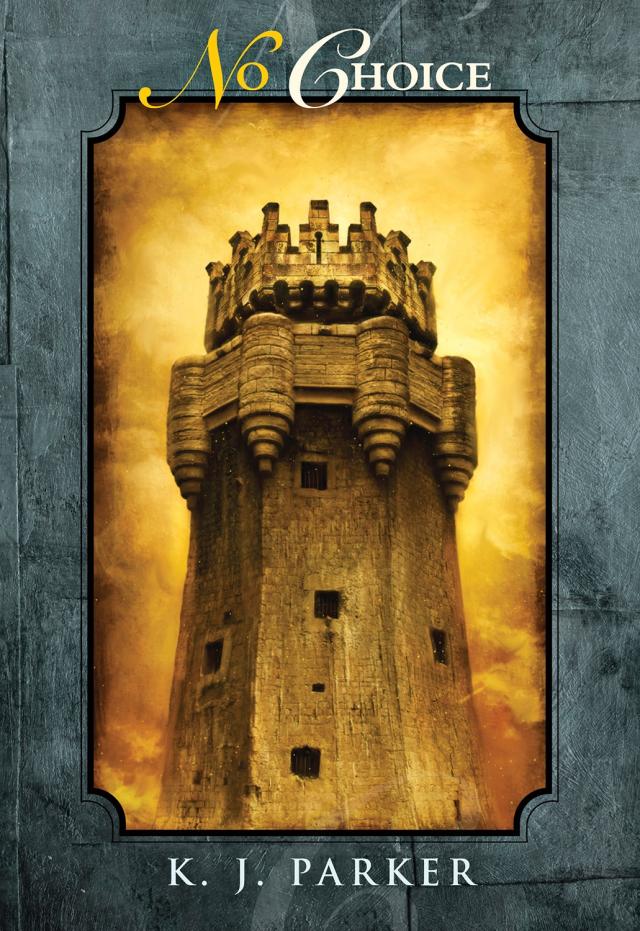
No Choice Copyright © 2023 by The One Reluctant Lemming Company Limited. All rights reserved.
* * *
Cover illustration and design Copyright © 2023 by Vincent Chong. All rights reserved.
* * *
Electronic Edition
* * *
Subterranean Press
PO Box 190106
Burton, MI 48519
* * *
subterraneanpress.com
* * *
Manufactured in the United States of America
No Choice
I had an hour or so to kill in town before my regiment moved out, so I popped into Northgate Tower. It’s not the biggest jail in the City, and by no means the roughest, but generally speaking, people make an effort to avoid it. That’s where Death Row is.
They don’t encourage visitors, but I let the duty officer get a good look at the rank insignia on my left shoulder; poor bastard, I felt sorry for him. Not that long ago, I was a junior captain too. Inevitably, we turn into the monsters we used to dread.
The duty officer referred me to a lance-corporal, who handed me over to a couple of jailers, who led the way. Here’s where protocol comes in. If you walk behind the jailers as you march down the loathsome corridors, you haven’t got much to worry about. It’s when they walk behind you that you know you’re in trouble.
Northgate Tower is, well, a tower. It’s the highest structure in a city world-famous for its vertiginous skyline. What most people don’t realise is that it goes down almost as far as it goes up. There are twenty-six levels underground, painfully hacked out of the grey basalt that underlies New Town by nine generations of life-with-hard-labour men. Death Row is level twenty-six. The corridors and staircases leading to it are shoulder-wide plus a handspan—every twenty yards there’s a locked door, with a man on guard in a sentry-box, and before you enter a corridor or a stairway there’s a bell you ring, to let everyone know you’re coming through, because if two parties meet going in opposite directions, one of them would have to go back. Moral; it’s next thing to impossible to get out of the underground section of the Northgate even if you’re a free man. If you’re not, forget it.
Very difficult place to get out of. Horribly easy to get into.
They unlocked cell one-hundred-seventy-six, right at the end. The jailer swung his lantern inside, making the occupant curl up like a salted slug. No light in the cells on level twenty-six, until they come for you.
“Hi, Dad,” I said.
His eyes were still screwed shut. “Son?”
I gave the jailer my best military look. “Give me the lantern,” I told him. “I’ll give you a shout when I’m done.”
Everybody knows about my family, understandably enough. In Genseric’s Histories there’s one or two of our lot on every page, from the semi-mythical foundation stories right up to the Third Social War. Ancestors of mine feature as characters in all twelve of Saloninus’ history plays—they made me be Phaenomai met’Oc in our school production of Lusius and Saphetua, possibly the most embarrassing thing I’ve ever had to do in my life. Stroll round the City and you’ll see twenty-foot high bronze met’Ocs on rearing horses in practically every square. If you can’t read the inscriptions, just check out the noses. Reverence for precedent and tradition being what it is in this man’s town, twenty-six generations of my family have been called Carrot-face at school; curiously, each successive generation of taunters claims to find it funny. Family legend has it that somewhere in my great-uncle Deinomai’s library at Castle Roche there are three enormous books containing every single big-nose joke ever made, and on the rare occasions when a completely new and original one is added by the castle librarian, great-uncle feasts the whole town and the fountains run with sweet white wine.
As nominal head of the family, it’s Deinomai’s job to record births, marriages, and deaths, and they say he’s got a huge family tree painted on a wall somewhere, which is known as the Scoreboard. met’Ocs who die in their beds are ringed in white. Those of us who gave their lives for their country on the battlefield are highlighted in gold leaf. Those of us executed for treason are underlined in red. I’ve never seen the thing myself, but I would imagine there’s precious little white, and roughly equal amounts of gold and red. Another interesting statistic is met’Oc life expectancy; the average for the empire as a whole is forty-two, but for us it’s twenty-six. Interesting to me, anyhow, because I turned twenty-five this spring.
I hadn’t actually seen my father since it happened, which was, what, nine months ago. I’d been away, slaughtering the enemies of the empire before they slaughtered us. Not the current enemies; another lot. We have so many.
“What are you doing here?” he asked.
So like him. “How have you been?” I asked.
“Oh, marvellous.” He scowled at me. “How do you think I’ve been?”
He looked thinner; thin, like someone dying from some horrible wasting disease. I looked at him and felt dreadfully uncomfortable. I couldn’t think of anything to say.
“Well?” he said.
“Sorry?”
“Aren’t you going to ask me?”
Why he’d done it. No, actually. Last thing on earth I wanted to ask, or talk about even peripherally. My father was on level twenty-six of the Northgate because he’d killed my mother.
He shrugged. “Shouldn’t you be with your regiment?”
“We’re sailing tonight,” I told him.
“Scheria, isn’t it?”
“Olybria.”
He nodded. He’d fought six campaigns in Olybria, four of them in his twenties. Four glorious victories, one defeat, one complete waste of everybody’s time. “Don’t drink the water,” he advised me solemnly.
“Understood.”
“There used to be this place in Medio Castro where they did the most amazing stuffed vine leaves, but I don’t suppose it’s still there.”
“Probably not.”
He’d grown a beard—no razors on level twenty-six—and it was mostly white. He looked like he was dressed up as somebody else. He’s got the Nose, of course, but on him it looks almost distinguished. Me, I look like a flat piece of wood with a nail driven through it.
“I tried to talk to Uncle Maino,” I said. “He said he was too busy to see me.”
My father has never had much time for his brother-in-law. “Don’t bother,” he said.
I’ve always liked Uncle Maino and he’s always liked me; my favourite uncle, out of a pretty good selection. Come to that, I’ve always got on really well with all my relatives.
“I’ll see him before I leave,” I said. “I promise.”
“Don’t make promises you can’t keep.”
From which you might get the impression that my father and I didn’t get along. Far from it. To me, he’d always been a mixture of the Invincible Sun and an older brother—much more so than my older brother, an exceptionally intelligent and talented man who died a hero’s death in a desperate rearguard action against the Aram no Vei, but absolutely no sense of humour, not the tiniest hint. To Dad, I think I was something in between a kid brother and a rather unsatisfactory but endearing dog; the sort who can’t be trained to do anything, but only because you’ve spoiled him rotten.
“I’ll see him,” I repeated. “I’ll get you out of here. It’ll be all right.”
He glared at me as though I’d just said something dirty. “Bit late for that.”
“It’s never too late,” I told him. He rolled his eyes; how could any son of mine be such an idiot?
He was still wearing his senator’s gown; purple silk, with gold lace collar and cuffs. They’d dragged him straight from our house to the Northgate, no trial, no time to change into something more practical. Members of our family don’t usually have to wear the same clothes for nine months. “When did you say your ship leaves?”
In our family, we change the subject like sacrificing a pawn in chess. On level twenty-six there’s nothing to mark the passage of time, but if I was late and missed the ship, there’d be hell to pay. And I’d be here in the City, not en route to bloody Olybria; on the spot, in a position to barge in on Uncle Maino whether he wanted to see me or not; here where it’s safe, not in Olybria, where Imperial officers and mayflies have so much in common.
I looked at him. In our family, there’s never any time. When I was a kid, he was usually away, fighting in some war or forty-eight hour emergency sessions of the House; then I got my first commission and I was away, fighting in some war. The idea was that in the spring, or the autumn, or next year, or after your father retires, we’d all get together in one place and spend the rest of our lives enjoying our fabulous wealth and each others’ company. Now here he was, unable to slip away or suddenly be called back to his regiment or the division lobby; and I’d been away at the war and now I was off there again. I’d read the dossier on Olybria, and I knew how the war was going. My chances of making it out of there alive were—well, there’s always a chance, isn’t there? But suppose I did make it, and came back in one piece—
We don’t say goodbye in our family. It’s sort of a tradition.
By the time I made it back to the surface and out of the Northgate, the sun was starting to drip red into the sea, like a cracked egg seeping. If I was going to get to see Uncle Maino, I was going to have to be quick about it.
Uncle Maino, by the way, was Mainomai Met’Ousa, First Citizen of the Empire. You see the problem.
There are two ways to get to see Mainomai Met’Ousa at short notice. One is to send up your name to the chief clerk, who passes it on to the private office, who pass it on to the assistant private secretary, who tells the principal private secretary, who sends someone down to let you know that he can spare you five minutes. The other is quicker, but rather more involved.
When he isn’t presiding in the House, Uncle Maino spends most of his time in his private room at the top of the old Admiralty building. It’s common knowledge that the Admiralty is about all that’s left of the mad dictator Issamer’s megalomaniac palace, the Golden House. What most people (outside of my family) don’t know is that Issamer, an insanely courageous man in war and politics, was scared to death of fire, and he had elaborate fire escapes built into every part of the Golden House. Being brave and mad but not as brave and mad as all that, he realised that one man’s fire escape is another assassin’s dream come true, so the various boltholes were a closely-guarded secret and riddled with interior doors to which only he had the key. When my great-great-great-grandfather and his pals eventually caught up with him and proved to him that burning to death was actually the least of his worries, one of them happened upon the special key to all the doors and kept it as a memento. Of no practical use whatsoever, generations of us proclaimed, since the Golden House was flattened before the crows had finished stripping Issamer’s shattered bones. Like most of the things my family says, it was almost entirely true.
My mother inherited the key, along with two million acres of prime arable land, a fleet of merchant ships and a copper mine, from her uncle Stheno. She wore it round her neck on a little golden chain, but only on special occasions, not when she was sitting around the house or having her throat cut by my father. The only place it could possibly be, therefore, was in her jewellery box, on her dressing room table. And now, since my father was disbarred from inheriting from the wife he’d murdered, her jewellery box—along with two million acres of prime arable land, a fleet of merchant ships and a copper mine—belonged to me.
It’s nice to be rich, but there’s never any time. Rather than hanging about for a chaise or a sedan chair, I ran like a hare from the Northgate to our house on the Sulpiciana, up the stairs, along the corridors to my mother’s bedroom, found the stupid box, grabbed it, then off again, panting like a dog, to Admiralty Square.
It’s all very well knowing something, but putting the knowledge to practical use is another matter entirely. I got through the door easily enough, simply by pretending to have an epileptic fit on the doorstep; they hauled me inside and ran off to fetch a doctor, leaving a sentry to look after me and make sure I didn’t swallow my tongue. Once we were alone I knocked him silly when his back was turned, then tied him up with a bell-rope and hid him behind a curtain. That was the laughably easy bit. Finding the hidden door to the secret fire-escape wasn’t going to be that simple, I knew—except that the door just happened to be behind the curtain where I hid the unfortunate sentry. Very occasionally, the Invincible Sun helps people, especially idiots like me, for some reason.
The key turned in the lock and I was through. I pulled the door to behind me, locked it and started feeling my way up the screw-thread spiral stair. Pitch dark, of course, and I had no idea what I was liable to run into, by way of locked doors and other tribulations, and I’m one of those sad bastards who gets all pathetic and whimpery in confined spaces. I know I’d have had a screaming fit and given up if I hadn’t been so painfully conscious of how little time I had, and how much I had to do in it.
I count things. It’s a bad, annoying habit of mine that drives people crazy. When I throw sticks for my dog, I count them. Back when I was a kid and the cook let me help her pick gooseberries in the kitchen garden, I counted them as I dropped them into the pot, and if I got to 297 and the branches were all bare, I’d carry on searching high and low and getting myself all scratched up until I eventually found three more. So, needless to say, I counted the steps—two hundred and seventeen, if you’re interested—and it helped take my mind off the screaming horrors. I did mental arithmetic instead. Each step was ten inches high, Admiralty tower is a hundred and forty feet, therefore x should equal something in the region of a hundred and sixty steps. Clearly arithmetic’s not my strong point; that or architecture. After ninety-four steps I ran into a locked door. Another at a hundred and sixty-seven. At a hundred and ninety-two I slipped and went down backwards on my knees, until I slammed into the door, which I knew was 192, so I managed not to lose count. At 217, another locked door, which opened into blinding sunlight.
I looked up. Not so blinding, in fact; the sun was getting horribly close to the sea, and I was standing on that tiny parapet you can just make out from ground level, about eight inches wide, that runs round the top of the tower about twenty feet from the top.
You bastard, I thought, though who I was swearing at I had no idea. About a foot above my head I saw two rusty stumps about as wide as my thumb, which puzzled my fear-numb brain until I realised they were all that was left of an iron ladder, which used to connect the ledge I was standing on to the window fifteen feet above me, but didn’t any more. Sometimes the Invincible Sun helps idiots like me, but not always.
There’s never enough time. I could go back down, apologise to the guard whose head I’d bashed in, explain that I was Maino’s nephew and he really did want to see me, even though he’d refused seven urgent requests for an interview, or I could try and climb fifteen feet of vertical wall, without a rope, and me scared shitless of heights. More mental arithmetic. How much time would it take to climb fifteen feet, change my uncle’s mind, then run down the main staircase and across the plaza to the Esplanade, down the Esplanade to where my ship was tied up? I figured I could just do it if I got a move on.
Fortunately, it wasn’t my first time climbing a wall. Back at the siege of Ascra, some bloody fool of a commanding officer thought it was entirely feasible for two hundred heavy infantry in full armour to scale the south wall of the east guard tower, at night, without making a racket and attracting the attention of the sentries. Turned out he was quite right. Come to think of it, the idiot commanding officer was me.
Admiralty tower is sandstone, and they didn’t bother getting the blocks at the top absolutely smooth and perfect, because who the hell was ever going to see them? I had a nasty moment when I realised the shutters were closed, but luckily they were just pulled to, not barred; I dangled from the sill with one hand and swung them out of the way with the other. By this point I was so tired I wouldn’t have had the strength to blow my nose, so it’s just as well I didn’t have to.
I scrambled through the window and poured off the sill onto the floor like a liquid; and uncle wasn’t there. Impossible. Every day of every year since I was born, Uncle Maino is at his desk from noon till midnight. I stood up, completely at a loss as to what I was supposed to do next. Then the door opened, and uncle came in.
“Hello,” he said. “What are you doing here?”
I guess even Mainomai Met’Ousa has to pee occasionally. “Hello, uncle,” I said. “I need to talk to you.”
“Shouldn’t you be—?”
“Yes,” I said, “so I’m in a bit of a rush.”
He was looking at my bloodstained hands and knees. “How did you get in here?”
“I’ve just been to the jail,” I said. “To see Dad.”
He looked at me as though I’d just spat in his face. “I’m sorry,” he said, and I think he was taking liberties with the truth.
“He’s my father.”
“She was your mother.”
When I was a kid, Dad always used to tell me; say exactly what’s on your mind, son, don’t hold back. Yet another piece of bad advice my father gave me. Instead, I said, “I loved my mother. You know that.”
“Yes.”
“And I love my father too. But Mum’s dead and Dad isn’t. It’s like Saloninus says, in the play.”
He frowned. Uncle Maino’s always quoting. He really likes that I can quote back at him. The main reason I’ve read so much Great Literature is so I can make sense of what Uncle says.


