

Saevus corax gets away w.., p.1
Saevus Corax Gets Away With Murder, page 1


This book is a work of fiction. Names, characters, places, and incidents are the product of the author’s imagination or are used fictitiously. Any resemblance to actual events, locales, or persons, living or dead, is coincidental.
Copyright © 2023 by One Reluctant Lemming Company Ltd.
Excerpt from The Eight Reindeer of the Apocalypse copyright © 2023 by One Reluctant Lemming Company Ltd.
Excerpt from Sixteen Ways to Defend a Walled City copyright © 2019 by One Reluctant Lemming Company Ltd.
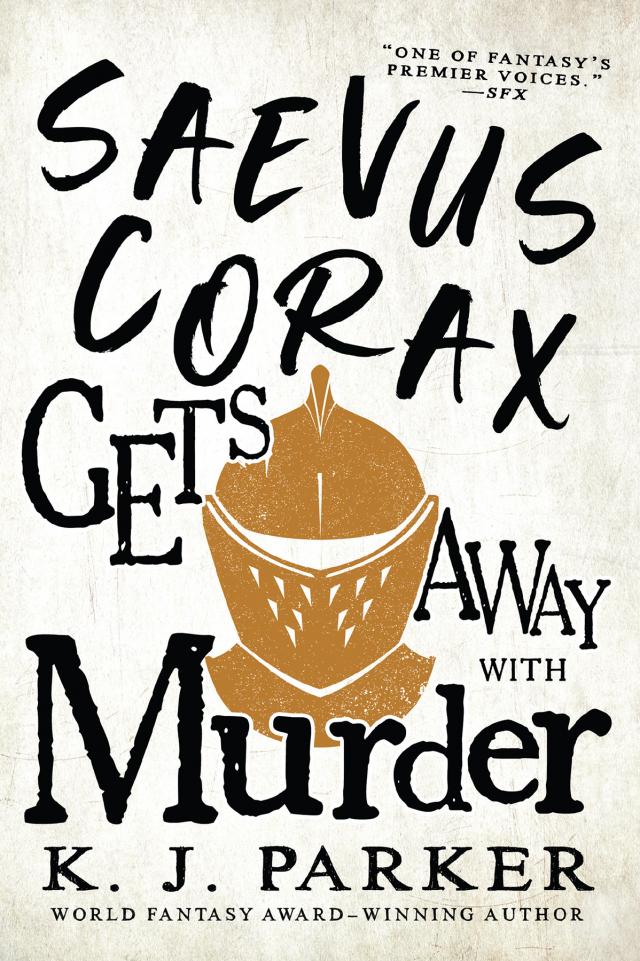
Cover design by Lisa Marie Pompilio
Cover illustrations by Shutterstock
Cover copyright © 2023 by Hachette Book Group, Inc.
Hachette Book Group supports the right to free expression and the value of copyright. The purpose of copyright is to encourage writers and artists to produce the creative works that enrich our culture.
The scanning, uploading, and distribution of this book without permission is a theft of the author’s intellectual property. If you would like permission to use material from the book (other than for review purposes), please contact permissions@hbgusa.com. Thank you for your support of the author’s rights.
Orbit
Hachette Book Group
1290 Avenue of the Americas
New York, NY 10104
orbitbooks.net
First Edition: December 2023
Simultaneously published in Great Britain by Orbit
Orbit is an imprint of Hachette Book Group.
The Orbit name and logo are trademarks of Little, Brown Book Group Limited.
The publisher is not responsible for websites (or their content) that are not owned by the publisher.
The Hachette Speakers Bureau provides a wide range of authors for speaking events. To find out more, go to hachettespeakersbureau.com or email HachetteSpeakers@hbgusa.com.
Orbit books may be purchased in bulk for business, educational, or promotional use. For information, please contact your local bookseller or the Hachette Book Group Special Markets Department at special.markets@hbgusa.com.
Library of Congress Control Number: 2023941501
ISBNs: 9780316669047 (trade paperback), 9780316668989 (ebook)
E3-20231028-JV-NF-ORI
Contents
Cover
Title Page
Copyright
Dedication
1
2
3
4
5
6
7
8
9
10
Discover More
Extras Meet the Author
A Preview of The Eight Reindeer of the Apocalypse
A Preview of Sixteen Ways to Defend a Walled City
Also by K. J. Parker
Praise for the Novels of K. J. Parker
For my friends; Given what’s coming, our only hope is to have no hope at all.
Explore book giveaways, sneak peeks, deals, and more.
Tap here to learn more.
1
Isn’t it nice, I remember thinking as I tried to yank an arrow out of a dead soldier’s eye, when things unexpectedly turn out just right? And then the arrow came away in my hand, but the eyeball was firmly stuck on the arrowhead. I glared at it. A standard hunting broadhead, with barbs, which was why it had dragged the eye out of its socket. I could cut it away with a knife, but could I really be bothered, for an arrow worth five trachy?
Everything about this job (apart from the flies, the mosquitos, the swamp and the quite appalling smell) had been roses all the way. For a start, Count Theudebert had paid me, rather than the other way around. In my business – I clear up after battles – you have to pay the providers, meaning the two opposing armies, for the privilege of burying their dead, in return for what you can strip off the bodies. Since we’re a relatively small concern and the big boys (mostly the Asvogel brothers) outbid us for pretty well every job worth having, we tend to get contracts with wafer-thin margins, and our profits are generally more a state of mind rather than anything you can write down on a balance sheet, let alone spend. But the Count had written to me offering me a flat-rate fee for clearing up the mess he intended to make in the Leerwald forest, plus anything I found that I might possibly want to keep. That sort of deal doesn’t come along every day, believe me.
I could see where the Count was coming from. Five thousand or so of his tenants, living in a clearing in the vast expanse of the Leerwald, had decided not to pay their rent and had killed the men he’d sent to help them reconsider their decision; accordingly, he had no choice but to march in there, slaughter everything that moved and find or buy new tenants to replace the dead. The tenants didn’t own anything worth having, so no reputable battlefield clearance contractor would want the job on the usual terms. Either the Count would have to do his own clean-up, or he’d have to hire someone.
He wasn’t exactly offering a fortune, but times were hard and we needed the work. Also, as my good friend and junior partner Gombryas pointed out, chances were that the Count’s archers would probably do a fair amount of the slaughtering, which would mean arrows… Nothing but the best for Theudebert of Draha, so they’d be bound to be using good-quality hard-steel bodkins on ash shafts with goose fletchings – again, not exactly a fortune but worth picking up, and if what people were saying was true, about a big war brewing in the east, the price of high-class once-used arrows could only go up. Also, he added, according to the Count’s letter there’d be dead civilians as well, and even peasant women tend to have some jewellery, even if it’s just whittled bone on a bit of string. And shoes, he added cheerfully: everybody wears shoes. At a gulden six per barrelful, it all adds up…
Gombryas had been right about one thing. There were plenty of arrows. But they turned out to be practically worthless, which was wonderful—
“Over here,” Gombryas yelled. “I found him!”
I chucked the arrow with the eyeball on it and shoved my way through the briars to where Gombryas was standing, at the foot of a large beech tree. Its canopy overshadowed an area of about twenty square yards, forming a welcome clearing. Nailed to the trunk of the tree was a man’s body. He’d been ripped open, his ribcage prised apart and his guts wound out round a stick. Piled at his feet were his clothes and armour: gorgeous clothes and luxury armour. Nothing but the best for Theudebert of Draha.
“Charming,” I said.
Gombryas grinned at me. “I guess they didn’t like him much,” he said. “Can’t say I blame them.”
He had a pair of clippers in his hand, the sort you use for shearing sheep or pruning vines. I could see he was torn with indecision. Gombryas collects relics of dead military heroes; relics as in body parts. His collection is the ruling passion of his life. Mostly he buys them for ridiculous sums of money from dealers and other collectors, and he’s not a rich man, so he finances his collection by harvesting and selling bits and pieces whenever we come across a dead hero in the usual course of our business. Theudebert was definitely in the highly sought-after category. Hence the agonising decision: which bits to sell and which bits to keep for himself?
The point being, Theudebert had lost. He’d led his army into the Leerwald, knowing that his tenants were forbidden to own weapons and therefore expecting, reasonably enough, not to have to do any actual fighting, just killing. What he’d overlooked was the tendency of forests to contain trees, which any fool with a few basic hand tools can turn into a functional bow in the course of an afternoon… Tracing the sequence of events by means of the position of the bodies, I figured out that Theudebert was only about half a mile from the first of the villages when he walked into the first ambush. About a third of his men were shot down in what could only have been a matter of a minute or so. Understandably he decided to turn back, figuring that the tenants had made their point. He was wrong about that. There were further ambushes, about a dozen of them, strung out over about five miles of forest trail. Finally, Theudebert had turned off the road and tried to get away through the dense thickets of briars, holly and withies which had grown up where his late father had cleared a broad swath of the forest for charcoal-burning. The beech tree was, I assumed, the place where the tenants had finally caught up with him and his few surviving guards.
“Will you look at the quality of this stuff?” Olybrius said, waving a bloodstained shirt under my nose. “That’s best imported linen.”
“It’s got a hole in it,” I said.
Olybrius gave me a look. “Funny man,” he said. “And you should see the boots. Double-seamed, and hardly a mark on them.”
I should’ve been as delighted as he was, but somehow I wasn’t. I wasn’t unhappy, either. We’d lucked into a substantial windfall, at a time when we badly needed one, and for once the work wouldn’t be particularly arduous (except for the flies, the mosquitos, the swamp and the truly horrible smell) – and, God only knows, my heart wasn’t inclined to bleed for Count Theudebert, even though he was a sort of relation of mine, second cousin three times removed or something like that. Quite the opposite; when you’ve spent your life either imposing authority or having it imposed upon you, the sight of a head of state nailed to a tree with his guts dangling out can’t fail to restore your faith in the basic rightness of things. Just occasionally, you can reassure yourself, the bullies get what’s coming to them, so everything’s fine.
I decided that whatever was bothering me couldn’t be terribly important, and got on with the wo rk I was supposed to be doing. Since I’m nominally the boss of the outfit, it’s more or less inevitable that I get the lousiest job, which in our line of business is collecting up the bodies, once they’ve been stripped of armour and clothing and thoroughly gone over for small items of value, and disposing of them. Usually we burn them, but in a dense forest packed with underbrush it struck me that that mightn’t be a very good idea. That meant digging a series of large holes, a chore that my colleagues and I detest.
Especially in a forest. It’s the nature of things that forests grow on thin, stony soil; if there was good soil under there, you can bet someone would’ve been along to cut down the trees and plough it up a thousand years ago. Typically there’s about a foot of leaf mould, really hard to dig into because of the network of holly, ground elder and bramble roots. Under that you find about ten inches of crumbly black soil, along with a lot of stones. Then you’re down into clay, if you’re lucky, or your actual rock if you aren’t. On this occasion Fortune smiled on us and we found clay, thick and grey and sort of oily, which we laboriously chopped out with pickaxes. Two feet down into the clay, of course, we struck the water table, which turned our carefully dug graves into miniature wells in no time flat. Still, we were only burying dead soldiers, so who cares? Let them get wet.
Gombryas and Olybrius had finished stripping the bodies and loading the proceeds on to carts long before we got our pits done, so they and their crews gathered round to give us moral support while we dug. I was up to my waist in filthy water, I remember, with Gombryas perched on the edge of the grave explaining to me the finer points of relic collecting. For instance: singletons – organs of which there are only one, such as the nose, the heart and the penis – are obviously more valuable than multiples (fingers, toes, ears, testicles), but complete sets of fingers, toes, ears &c are more valuable still. But you can make a real killing if a rich collector has got nine of so-and-so’s fingers and you’ve got the missing one, which he needs to make up the set. Accordingly, after much deliberation, Gombryas had decided to keep Count Theudebert’s heart and liver (preserved in honey) and one finger; the rest of the internals and extremities would probably be alluring enough as swapsies to net him either the complete left hand of Carnufex the Irrigator – with most of the skin still on, he told me breathlessly, which is practically unheard of for a Warring States-era relic – or the left ear of Prince Phraates; he already had the right ear, but the First Social War wasn’t really his period, so the plan was to swap both ears for the pelvis of Calojan the Great, which he knew for a fact was likely to come up at some point in the next year or so, because the man who owned it had a nasty disease and wasn’t expected to live…
“Gombryas,” I interrupted. “How much is your collection worth?”
He stopped and looked at me. “No idea,” he said.
“At a rough guess.”
He thought for a while, during which time he didn’t speak, which was nice. “Fifty thousand,” he said eventually. “Well, maybe closer to sixty. Depends on what the market’s doing at the time. Why?”
I was mildly stunned. “Fifty thousand staurata,” I said. “And you’re still here, doing this shit.”
He was shocked, and offended. “I’d never sell my collection,” he said. “It’s taken me a lifetime—”
“Seriously,” I said. “All those bits of desiccated soldiers are worth more to you than a life of security and ease. Fifty thousand—”
“Keep your voice down,” he hissed at me.
“Sorry,” I said. I straightened my back and rested for a moment, leaning on the handle of my shovel. “But for crying out loud, Gombryas, that’s serious money. You could buy two ships and still have enough left for a vineyard.”
“It’s not about money.” This from a man who regularly went through the ashes of our cremation pyres with a rake, to retrieve arrowheads left inside the bodies. “It’s about, I don’t know, heritage—”
“Talking of which,” I said. “You’ve got no family. When you die, who gets all the stuff?”
He shrugged. “I don’t know, do I? None of my business when I’m dead.”
“Maybe,” I suggested, “your fellow collectors will cut you up and share you out. Wouldn’t that be nice?”
He scowled at me. “Funny man,” he said.
I gave him a warm smile and started digging. Quite by accident, I made a big splash in the muddy water with the blade of my shovel, and Gombryas’s legs got drenched. He called me something or other and went away.
Six feet deep is the industry standard, but I decided I’d exercise my professional discretion and make do with four. I called a halt, we scrambled up out of the graves and started tipping the bodies. They rolled off the tailgates of the carts and went splash into the water, displacing most of it in accordance with Saloninus’s Third Law, and then we filled in, making an eighteen-inch allowance for settlement. Not that it mattered a damn in the middle of a forest, and we’d been paid in advance by a man who was now exceptionally dead, but there’s a right way and a wrong way of doing things, and I hate it when Chusro Asvogel goes around making snide remarks about the quality of our work.
So that was that. We loaded our tools on to the carts and made our way back to the forest road. It was blocked with fallen trees.
Not so much fallen, I noted after a cursory examination, as chopped down. I started shouting the usual stuff about shunting the carts into a square, horses and people in the middle, but nobody seemed to be paying attention. That, I soon gathered, was because they were looking at the archers who’d suddenly appeared out of the trees, and were standing there looking at us.
Nuts, I thought. But I put a trustworthy look on my face and walked towards the treeline. “Can I help you gentlemen?” I said.
A man came forward. He was being helped by two others, and his left leg dangled, the way they do when they’re broken. “Who the hell are you?” he said.
I explained. He looked at me. “Seriously?”
“It’s what we do for a living.” I paused. These, presumably, were the people who’d just shot to death a famous general and six thousand trained soldiers. “Morally,” I said, “I guess the stuff belongs to you, but we’ve just done a hell of a lot of work, so—”
“We don’t want any of that,” the man said.
I can’t say I warmed to him straight away. I guess he looked the way you’d expect a man to look when he’s just miraculously won a battle he really didn’t want to fight. I’d put him a few years either side of sixty, but men age quickly when they’re tenants of someone like Theudebert; a short man, slight, bald, with a wispy white beard. “Are you sure?” I said.
“I just said so, didn’t I? You keep it. Sell it. Just go away.”
Which was exactly what I wanted to hear; more, I guess, than I deserved. “How about the weapons?” I said. “There’s spears, shields, helmets, some body armour.”
“Are you deaf?”
“For when they come back,” I explained. “You’ll need weapons then.”
He frowned. “They won’t come back,” he said.
“Want to bet?” Shut up, my inner voice yelled at me, sounding remarkably like my mother. “You killed the Count and six thousand men—”
“No.” He looked at me. “That many?”
“Six thousand, one hundred and fourteen,” I said. “Of course they’ll be back. You’ve got to be punished. Otherwise, the whole doctrine of the monopoly of force falls apart.”
“The what?”
I may be many things, but I’m not an educator. I have better things to do than spread enlightenment. “At the very least,” I said, “keep the bows. They’re standard Aelian issue, top of the line, about the best you can get unless you upgrade to composite. Keep them and practise with them, and when the bastards come back, wearing proper armour instead of just skirmishing kit, at least you’ll be able to make a fight of it. Your homebrew bows simply don’t have the cast to shoot through plate armour, or lamellar.”
He had no idea what I was talking about. “I told you,” he said. “We don’t want their garbage. And we don’t want you. Go away.”
“Fine,” I said. “And thank you. But trust me, they will be back.” I wasn’t getting through to him. Besides, it wasn’t any of my business. “Make yourselves stronger bows,” I told him. “Practise.”


