

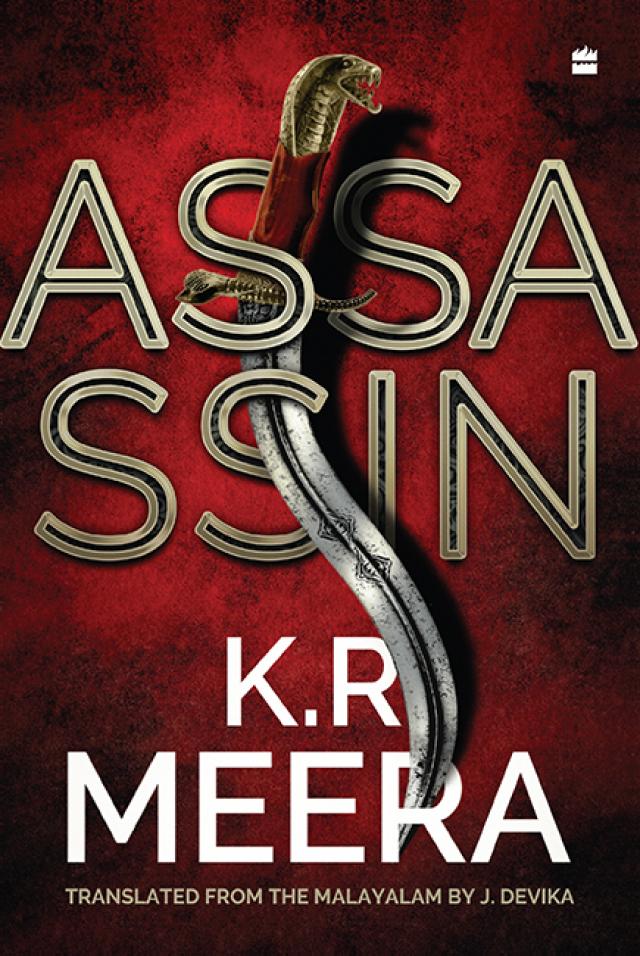
Assassin, p.1
ASSASSIN, page 1


Contents
AUTHOR’S NOTE
ONE
TWO
THREE
FOUR
FIVE
SIX
SEVEN
EIGHT
NINE
TEN
ELEVEN
TWELVE
THIRTEEN
FOURTEEN
FIFTEEN
SIXTEEN
SEVENTEEN
EIGHTEEN
NINETEEN
TEWNTY
TWENTY-ONE
TWENTY-TWO
TWENTY-THREE
TWENTY-FOUR
TWENTY-FIVE
TWENTY-SIX
TWENTY-SEVEN
TWENTY-EIGHT
TWENTY-NINE
THIRTY
THIRTY-ONE
THIRTY-TWO
THIRTY-THREE
THIRTY-FOUR
THIRTY-FIVE
THIRTY-SIX
THIRTY-SEVEN
THIRTY-EIGHT
THIRTY-NINE
FORTY
FORTY-ONE
FORTY-TWO
FORTY-THREE
FORTY-FOUR
FORTY-FIVE
FORTY-SIX
FORTY-SEVEN
FORTY-EIGHT
FORTY-NINE
FIFTY
FIFTY-ONE
FIFTY-TWO
FIFTY-THREE
FIFTY-FOUR
FIFTY-FIVE
FIFTY-SIX
ABOUT THE BOOK
ABOUT THE AUTHOR
Copyright
AUTHOR’S NOTE
Assassin is an attempt to document the times and lives of the women of my generation as personally witnessed by me. It is my own humble experiment with the Indian political truth. Naturally, Assassin is very much autobiographical, and although the characters and situations are fictional, the emotional core of the story remains true. Satyapriya has a lot of me in her, and her mother’s quirkiness is borrowed from my own.
Assassin wouldn’t have been possible without J. Devika, who was gracious enough to take up this translation project despite her busy schedule as a professor and researcher. She has remained my most trusted reader and valued critic ever since we first met, and this is our fifth book together. I thank her from the bottom of my heart for being there for me all these years.
This is my first book with HarperCollins. I express my gratitude to the Associate Publisher (Literary), Rahul Soni, an acclaimed translator himself, for commissioning this book, and Rinita Banerjee for her immaculate and insightful editing.
I am immensely grateful to A Suitable Agency – particularly Hemali Sodhi and Ambar Sahil Chatterjee – for being a part of my journey. There are not enough words to thank my friends and first readers V. Jayakumar, Adv. G. Mohan Raj, author and journalist P.K. Parakkadavu, Dr Resmi Bhaskaran, Dr Dhanya Lakshmi N., Sadhya K.P., R.K. Bijuraj and Dileep Raj. Also, Thrissur Current Books and DC Books.
Special thanks are due to P.K. Sajan for his valuable help during the initial stage of this translation, and Dr C.J. John, V.V. Krishnan Kutty and K. Sankara Pillai for their valuable inputs in clearing my doubts.
Have you ever faced an attempt on your life? Gauri Lankesh had. I dedicate this book to her.
– K.R. Meera
ONE
Have you ever faced an attempt on your life?
A pity, if your answer is no! If only because the soul experiences a tremendous release in that moment. Instantly, body and soul part ways within your living self. They take wing on their separate paths. One thing, however, is certain. It is better to die at an assassin’s hands than escape. If you do escape, then say ‘swaha’ to the rest of your life, which is gone forever, like an offering to a sacrificial fire. Every face you see after will be suspect. Even your own shadow won’t seem to belong to you – but to the assassin. You will feel something piercing right through your chest; you will squirm in sudden bursts of pain.
I have been in such a state since 16 November, the night on which I was attacked. The whole of that day was spent standing in a queue in front of the bank. Just eight days earlier, one-thousand- and five-hundred-rupee notes were banned in the country. The government was still making mutually contradictory statements; the new notes were not yet ready. People camped in front of banks day and night. News of them collapsing and dying in queues kept piling. I had reached my workplace looking limp and wilted. I was on the fourth shift. The attack happened when, after work, I was dropped off at the rusted gate of my rented house, just as I had started to push it open. It was past midnight. The company vehicle that had dropped me had not even disappeared from sight when a motorbike came up noiselessly from the dark. Someone who’s lost his way inside the housing colony, I thought, and turned. I saw his hand slink between his legs. Ah, an exhibitionist, thought I – a member of that eternal race, sure to outlast us all. Then he pointed something at me. I did not peer again to make sure that it was a gun. I ducked; the sound of a windowpane shattering rang terrifyingly. My consciousness was dripping away but I saw him take aim again. I fell flat on my face. A bullet hit the ground, and the sand and dust got into my eyes. I did not see him aim a third time, but I could foresee it. Clutching on to my life, I rolled towards the road. My good luck or bad – a wild-looking young man, a neighbour whom I had not yet met, arrived there on his hulk of a motorbike after a late-night movie. He braked suddenly and honked repeatedly. The gunman’s vehicle sped away, and I escaped.
The young man helped me up. But body and soul had already parted. I am dead, I continued to believe. My limbs stiffened. Still holding me up, honking, and shouting for help, he roused the neighbours. I heard his voice as if from across a river. Death was the bluish-red-tinged bank of a river – such things were revealed to me. I was crossing it, seated atop my bullet-ridden body as a canoe. The river was the colour of flames. The ripples rose as cool tongues of flame towards the sky, the spray of sparks scattered all over.
Some people ran up to us and carried me to the house of our neighbour, Dr Fernandes. The doctor shook me awake gently, splattered water on my face. I was reborn into the disquiets of life with great reluctance.
Completely exhausted, I lay still for about an hour, still craving for the violet shores of death. Akhil Gupta, a Superintendent of Police and a resident of our colony, came up to me in between and asked some questions. I could only babble. He told me that men from the local police would be protecting me. I spent the rest of the night in the house of that ‘freaken’ young man. I couldn’t but help a laugh even in my terrible state when I heard that his name was Mrityunjoy Sen. His mother, Dr Sandeepa Sen, was a teacher at the university. She received me very kindly. Dr Fernandes had given me a sleeping pill; I slept like I was rehearsing death. In the morning, Sandeepa told me that I had screamed twice in my sleep. By the time I bid her goodbye and staggered towards my house, my body had become a damp sheath of leather with soggy flesh hanging inside. A sheath like the one Gurkhas use to keep their knives in. One used to conceal the sharpness of the dagger and to protect the world outside from that sharpness.
The SP and the president and secretary of our Residents’ Association were waiting outside, in front of the gate of my house. They were chatting about the wedding of an ex-minister’s daughter. I overheard the inspector say that the bride’s sari was worth seventeen crore. The optimism around black money vanishing was dimming, it seemed. I led them inside. The broken shards of glass had fallen on the sit-out too. The inspector was observing the premises keenly. He loosened the bullet that had broken the windowpane and pierced a wall. He frowned like a great crime investigator, pressed his fingers on his lips, bent, craned his neck and stretched to examine closely all of the 750 square feet, including a drawing-cum-dining area, a bedroom, a study, a small living room, a kitchen, and a small work area outside, enclosed with an iron grille. He asked me to describe what had passed. The president of our Residents’ Association H.H. Reddy and the secretary Atul Shetty encouraged me to speak. Shetty recorded all of it on his iPhone. Maybe it was a case of mistaken identity? Reddy expressed his doubt. A senior scholar had been murdered this way. I, too, remembered the image of the blood-splattered pieces of his round spectacles. Not surprising he died that way, said Shetty. He wrote false stories against the government. Sandeepa Sen also writes such things, Shetty added, lowering his voice. He shot the wrong person, the SP said to himself. For a split second, Samir’s face flashed in my mind. But my voice did not rise. The three continued to ask questions which they themselves answered. Gandhis are gone, said Shetty, now the contract killings are going to go up. But only the ordinary folk are bereft of Gandhis, Reddy countered. They were talking about the five-hundred-rupee notes, of course. The SP assured me that soon a detailed statement would be taken from me. He promised Reddy that security in the colony would be increased. Soon, all of them were gone. The house was now empty. My heart was still pounding. I was swamped with guilt and the fear of humiliation. Intense darkness rolled and thrashed about inside my head.
After some time, in came a sub-inspector with swarthy cheeks and eyes that looked as though sorrow had congealed in them forever, accompanied by a pot-bellied head constable and a young woman constable who was at least five feet ten inches tall. They were to record my statement. They asked me the following questions, and these were the responses I gave them:
‘What is your name?’
‘Satyapriya.’
‘How long have you been living here?’
‘Sixteen months.’
‘Aren’t you afraid to live here alone ?’
‘The woman who used to live here earlier was also alone.’
‘But you could have found a flat or a hostel room?’
‘Simply can’t put up with hostel wardens on top of everything at the age of forty-four.’
‘Where were you before you moved here?’
‘In Odisha.’
‘Why did you move here?’
‘Because I found a better job.’
‘What is your job?’
‘It is in the HR department of a software company.’
‘Do HR employees work at night?’
‘This is an American company.’
‘At what time did you go to work yesterday?’
‘At five, in the evening.’
‘Where were you until then?’
‘I had gone to the bank at ten in the morning.’
‘To deposit or withdraw?’
‘To withdraw.’
‘How much?’
‘The ink to mark those who change notes ran out. So I couldn’t change any money.’
‘Do you think that the motive was robbery?’
‘No.’
‘Aren’t there security arrangements in your company’s vehicle? Shouldn’t they make sure that you are safely inside your house before leaving?’
‘That’s the rule.’
‘Why have you not complained against this breach of rules?’
‘Have not really felt insecure here. The SP’s house is just past the bend down the road.’
‘All right. What is your educational qualification?’
‘Double MA, MBA.’
‘Double MA?’
‘In Communicative English and Malayalam.’
‘You have no relatives?’
‘My parents live in my native place.’
‘Are you married?’
‘No.’
‘What does your father do?’
‘Nothing nowadays. He is fully paralysed.’
‘Siblings?’
‘A sister. She died in a car crash.’
‘A car crash?’
‘On the road. Her scooter collided with a lorry.’
‘Was it an accident?’
‘That’s what the police said.’
‘Do you have any enemies?’
‘Not to my knowledge.’
‘Anybody in the office?’
‘There have been disagreements.’
‘About what?’
‘Work-related matters.’
‘Why are you not married?’
‘Because I haven’t found anyone suitable.’
‘Didn’t you try putting out a matrimonial ad?’
‘No luck.’
‘It is difficult to imagine that no man ever fell in love with a good-looking woman like you.’
I thought for a moment and then said, ‘Luck in love is directly proportional to submissiveness, not beauty.’
The SI frowned. The woman constable gaped, her eyes filled with disbelief. To change the topic, the SI asked for my identity card. I gave it to him. The head constable copied down the address carefully. The questions continued.
‘Have you seen the man on the bike anywhere?’
‘I didn’t see his face. He was wearing a helmet. All I saw was the pistol in his hand.’
‘Can you describe him?’
‘The truth is that I saw only the pistol.’
‘Did you note down the bike’s registration number?’
‘No, but I think it ended with 25.’
‘So you have no suspects in mind?’
‘No. At least for now.’
‘That means?’
‘My mind feels numb. Can’t focus.’
‘All right, we will come again. Do let us know if you recollect anything else.’
The police left.
I felt helpless. My memories don’t return like that; they aren’t kittens tied up in a sack and let out somewhere faraway. They are like banyan trees that send down roots from every branch to cling on to the earth. As the tree grows, these roots grow bigger than the trunk itself. Just the way stories survive even if the one who wrote them is killed, the roots remain even if the trunk is felled.
The sun that noon was like the hole from a bullet that had pierced clean through the crystal sky. The sunlight glinted like broken bits of glass. I swept the house clean. I was still running on the cup of tea that Sandeepa had offered me. Going into the kitchen, I looked for something to eat. I hadn’t bought any provisions last week. I was loath to spend the money that I had before the new currency notes reached me. Money, and money alone, protects the woman who lives alone. Yesterday, I was hindered by the government ordering that the indelible ink, used generally on voters, be used on citizens changing their money. The ink ran out just before my turn came.
I found a packet of bread in the fridge. A cup of tea and two pieces of toast made me feel stronger. I then phoned the HR general manager Rakhi Gupta and told her everything. She was horrified. The police think it is a case of mistaken identity, I calmed her down. My colleagues called, one by one. By noon, the manager Shantanu Sir and another colleague of mine, Ali Akbar, came to see me. They told me that the security guard on escort duty in the company’s vehicle, who had broken the rule, had been dismissed. Ali Akbar chided me for not having reported him before. Take a week’s leave and go home, Shantanu Sir insisted. They left some new notes, so needed in this time of note ban. Ten Gandhis each worth a hundred rupees inside a paper cover. Gandhi’s face reminded me of the bullet. Its angry buzz resounded in my ears and inside my head. I was overcome by the fear of death. But I was not so afraid as to go on leave. I was more wary of the police. The unspoken answers to unasked questions scared me. I needed more time to regain balance. I decided to make use of the unexpected leave. After sending Shantanu Sir a leave application, I booked a ticket to my home town on an AC bus that was to leave at 7.30 p.m. And then, I slept like the dead until five o’clock in the evening.
The bus was not crowded. The passengers were talking about currency notes. Most of them were happy that black money would disappear now. The video-player in the bus began to play a movie five minutes later; most people were engrossed in it. I could not concentrate. So I leaned on the glass of the window letting my eyes wander outside. Night, like a knife-thrower, threw daggers of light. My brain was still numb. Though it was an air-conditioned vehicle, the bright slivers hit the windows and pierced my eyes. The fellow was such a fool to have fired at the wrong person, I thought with mild frustration. But what if the bullets had found their target, what if Mrityunjoy had not appeared then? I shivered at the thought. Lost in such reflections, I felt very sleepy. Like a leaf about to fall off in the wind, I dangled between sleep and wakefulness. And then, you know that moment when the leaf falls off its stalk into deep slumber, one that arrives silently, unknowingly, just then, the mobile phone rang, shaking me like a naughty child shaking a tree trunk. I took it mechanically. I could hear a male voice:
‘Khushi rawho…!’
Before I could say ‘wrong number’, I heard him speak again. ‘Khushi rawho, Satyapriya, khushi rawho, motte bhuley na … as there is always going to be a third chance!’
I was fully awake. It was a call from a burner phone. The part of the threat that was said in Odiya meant: ‘Be happy, Satyapriya, be happy … Do not forget me.’
A bolt of lightning shot through my body. Who was this? The gunman? A third chance? Didn’t that mean that two chances were over by now? My earlier brushes with death flashed through my mind. I had come close to it at least three times before. Did it mean that those three times were not accidental? Probably just one was an accident – the other two were murder attempts. He’s picked up a gun because they failed. My eyes flew open, and my sleep vanished. Like a half-broken leaf, I hung perilously from the stalk and shook helplessly. I grew clammy with sweat in the chilly air of the air-conditioned bus. I tried to calm down, analyse the facts, and soon managed to retrieve the memory of the three preceding experiences.
The first was three years back, and close to home. It was night, and I was on my way back after visiting an old retainer of our family, Venukkuttan Chettan. The bus stop was close to our house, so I decided to walk home. I had walked some distance when a bike passed by me. The path was deserted. I quickened my pace. The bike reappeared, this time, very slow. When it came up close, the rider thrust out a hand towards me. I thought it was a chain-snatcher. I have always had Amma’s quickness in the face of danger. I spun around and grabbed his shirt. He swung a knife; my arm was hurt but he lost his balance and slipped off the seat. The bike moved forward, and he fell down. But just then, another vehicle came that way, and he leapt up, got back on his bike, and sped off.


