

Just once, p.1
Just Once, page 1


Thank you for downloading this Simon & Schuster ebook.
Get a FREE ebook when you join our mailing list. Plus, get updates on new releases, deals, recommended reads, and more from Simon & Schuster. Click below to sign up and see terms and conditions.
CLICK HERE TO SIGN UP
Already a subscriber? Provide your email again so we can register this ebook and send you more of what you like to read. You will continue to receive exclusive offers in your inbox.
Dedicated to Donald, the love of my life, my husband of thirty-five years. And to our beautiful children and grandchildren. The journey of life is breathtaking surrounded by you, and every minute together is time borrowed from eternity. I love you with every breath, every heartbeat. And to God, Almighty, who has—for now—blessed me with these.
MARCH 2018 Prologue
A wicked nor’easter crippled Washington, D.C., that March afternoon, closing down the entire federal government under a snow emergency. But one order of business remained:
Today the spies of World War II would finally get their recognition.
In a ceremony at the snowed-in U.S. Capitol’s Emancipation Hall, thirteen thousand members of the Office of Strategic Services would receive the Congressional Gold Medal, the highest civilian honor awarded by the government.
Audra Mitchell could hardly wait.
Back then, four thousand agents of the OSS had been women, and one of those was Audra’s grandmother Irvel Holland Myers. Never mind the blizzard, Audra wasn’t going to miss a minute of the celebration.
Her husband, Tom, pushed through the last steps of the snow-covered walkway to the building’s entrance and held the door so Audra and her parents could enter first. The four had walked two blocks from their hotel to be here.
Once inside, they brushed the snow from their coats and boots and made their way to the ceremony room. Already the front was filled with senators and representatives, each of them having tackled the weather so they could declare for all time the honor due the members of the OSS.
That these men and women were, in the words of OSS founder General William “Wild Bill” Donovan, the “glorious amateurs” of World War II. Heroes who deserved their day in the sun.
Audra and her family took their seats in the third row, in the section reserved for the twenty living OSS members who would attend today, and the children and grandchildren of many others who had passed on. Audra settled in between her husband and her father. She turned to Tom. “I still can’t believe it.”
Tom looked deep into her eyes. “Soon everyone will know.”
He was right. A thrill ran through Audra and she faced the front again. Her grandmother, the sweet, genteel Irvel Myers, the one who finished her days at Bloomington, Indiana’s Sunset Hills Adult Care Home drinking peppermint tea, had lived out World War II not as a nurse or a volunteer for the Red Cross.
Her grandma Irvel had been a spy.
And until three years ago, the only one who ever knew was Irvel’s beloved Hank. Audra’s mother had no idea, and neither did Irvel’s only son—Audra’s father—Charlie Myers. Irvel’s secret was one that she and Hank took to the grave—Grandpa Hank, first, in 1995, when he died of a heart attack while out fishing.
And Grandma Irvel, a decade later.
For fifteen years, Audra had lived in Hank and Irvel’s Bloomington house not far from Indiana University. Through the seasons while Audra attended school at IU, and then while she got her master’s degree in writing, and later when she stayed on as a professor. Audra lived in the house after she married Tom, and the two stayed there as they welcomed their twin boys—both home with Tom’s parents this week.
Then three years ago, Audra and Tom decided to remodel the old place, and that’s when they found the wooden chest. Audra closed her eyes and she was there again, crawling through the cobwebs of the dusty attic, intent on reaching the old box. It was splintered and weathered, but it was still intact.
Tom helped her bring the chest down the ladder and into the living room.
Painted across the top in fine black lettering was a simple message:
The story of Hank and Irvel… a love that could only happen just once.
Working together, Audra and Tom removed the fragile lid of the chest and took from the box a sealed plastic bag containing five Super 8 videotapes, each labeled simply Our story 1, Our story 2, and so on. Audra took the cassettes to a video transfer shop near the university, and a week later she and Tom sat down and watched the footage that had been so precious to Irvel and Hank.
Ten hours of a story that had taken Audra’s breath away. And to think the wooden box had been in the attic all that time, since long before Audra moved in as a twenty-year-old college sophomore.
The first lines of the video had taken residence in Audra’s heart, where they would live forever. In the video, her grandma Irvel sat straight and dignified and beautiful, her intelligent, kind blue eyes as clear as they would ever be. Her voice never wavered.
MY NAME IS IRVEL MYERS.
THIS IS FOR MY SON, CHARLIE, AND HIS WIFE, PEGGY, AND MY PRECIOUS GRANDDAUGHTER, AUDRA. IT IS ALSO FOR ME, AND FOR WHOEVER MIGHT WANT TO KNOW THE DETAILS OF MY LIFE, AND MY LOVE STORY WITH HANK MYERS.
YESTERDAY, I WAS DIAGNOSED WITH ALZHEIMER’S DISEASE. ALREADY, I FEEL ITS EFFECTS, SO HANK BOUGHT THIS CAMERA. HE THOUGHT WE SHOULD TELL OUR LOVE STORY… WHILE WE STILL CAN.
ALSO, THERE IS SOMETHING NO ONE KNOWS ABOUT ME. FORTY-SEVEN YEARS AGO, I WAS RECRUITED BY THE OFFICE OF STRATEGIC SERVICES TO WORK FOR THE U.S. MILITARY DURING WORLD WAR II.
THAT’S RIGHT, I WAS A SPY. BUT OUR STORY DOES NOT BEGIN THERE. IT BEGINS THE SUMMER OF 1940.
Commotion in the room was settling down and the memory of Grandma Irvel’s voice faded. Audra opened her eyes. The ceremony was about to begin.
Five American flags stood at the front of the room, and off to the right, a color guard waited. The Speaker of the House, the honorable Paul D. Ryan, stepped up to the podium.
“Ladies and Gentlemen, welcome to the United States Capitol. I want to thank you for braving the elements to get here.” The Speaker looked over the crowd. He went on, talking about the privilege of Congress to bestow Congressional Gold Medals in recognition of extraordinary deeds. “Today, we present the medal to the members of the Office of Strategic Services for their indispensable contributions to victory in World War Two.” He paused. “The men and women of the OSS have never been collectively recognized for their heroism until this moment.”
Audra squeezed Tom’s hand. If only her grandparents could be here.
The next person at the podium recalled some of General Donovan’s speech in 1945 at what was the final gathering of the OSS before the group was disbanded. “We have come to the end of an unusual experiment,” the general had told the group that long-ago day. “An experiment to determine whether a group of Americans made up of different races, temperaments, and talents could perform America’s first intelligence work, and by doing so, defeat their enemies.”
None of this was news to Audra. She had done her research. The OSS had not only succeeded in aiding the victory in World War II, but then led to the creation of the current-day CIA.
It was time to hear from a number of actual OSS operatives, and the children and grandchildren of late OSS members. Each speech was emotional, ripe with the emotion these heroes and their family members had carried for decades.
Finally, a white-haired, retired OSS code breaker finished his talk and introduced Audra. “There was some speculation,” the man still had a twinkle in his eyes, “that the U.S. was using spies to gain an edge in World War Two.” He looked at Audra. “But back then no one would have guessed so much of our intelligence group was comprised of women.”
The man held up a hardback book—an advance copy that Audra had mailed to him weeks ago.
“Soon, you will all know the name of our next speaker,” the man said. “She spent the last few years writing a novel based on her grandmother’s days in the OSS, a novel that will be in stores everywhere next week.” He motioned to her. “Please welcome author and Indiana University Professor of Writing Audra Mitchell.”
Audra smoothed the lines of her long skirt and adjusted her sweater jacket. For the next five minutes she could only ask God to give her grandma Irvel Myers a window from heaven. She deserved it.
The audience seemed extra intent on what Audra had to say. “I’m here today to honor my grandmother Irvel Holland Myers and to tell you a little about her story.” Audra touched only the most heartfelt points, enough so that the people in attendance were smiling and wiping away tears by the time she took her seat again.
When the ceremony was over, Audra and her family walked through two feet of snow back to their hotel. With the blizzard still bearing down, and their flight home canceled, her parents returned to their room for a nap. When they were gone, Tom sat in front of the TV to watch college basketball—Indiana vs. Gonzaga.
Audra found another advance copy of her novel in the front pocket of her suitcase. The copy she had brought in case she wanted to give it to someone at the ceremony. With the craziness of the storm, she hadn’t remembered to take it. She changed into sweats, grabbed the cozy chair near the window, and settled in. She turned to the first page.
For Irvel and Hank, that your daring, heroic love story might be remembered forever.
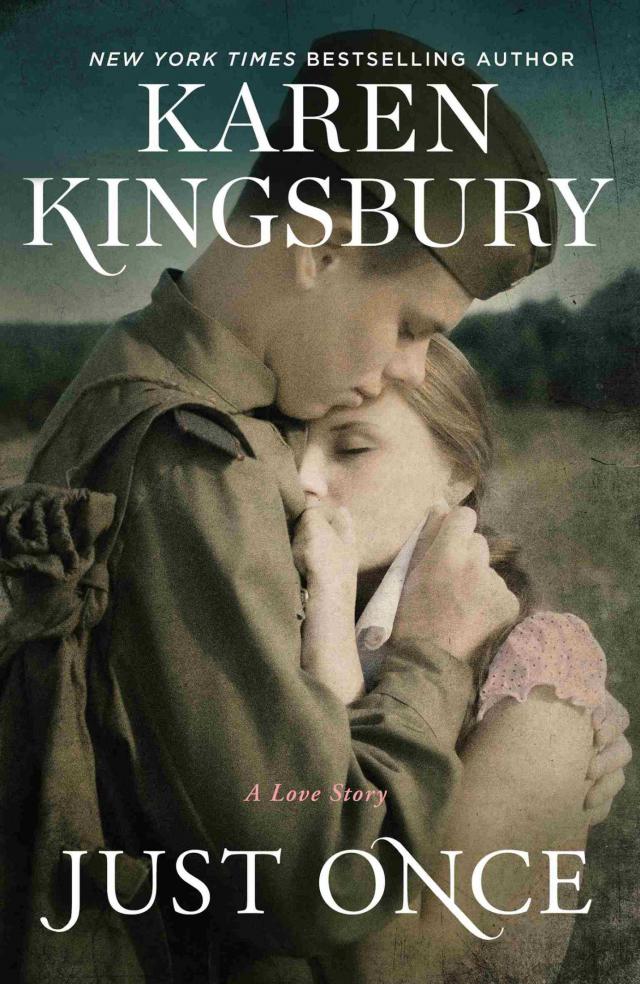
She ran her hand over the image on the cover, a young couple much the way her Grandma Irvel and Grandpa Hank might’ve looked during World War II. And below that, the only title that could ev er have worked. The one Irvel would’ve given it, had she been here.
JUST ONCE.
OCTOBER 2, 1989 1
Red was the last color, the very last. That’s what Dr. Edmonds was saying.
Irvel Myers’s mind would splinter and fracture and fade under the burden of Alzheimer’s, and she would forget the love that long ago caused her world to stop and stare in awe. Irvel and Hank. In little time, she would no longer know his face or his voice, or Hank himself, the one who had held her hand when she said, “I do,” and who had stood beside her that rainy Wednesday morning in Bloomington, Indiana, when she delivered their son.
Her brain would release to nothingness the name of that boy, the one she had cherished for thirty-two years, and also the smell and feel of the wood and walls and windows of the house where her life had taken shape for the past four decades, and it would do something else. It would erase entirely her years as a spy for the Office of Strategic Services.
But until the very end, it would remember the color red.
That’s what the doctor was saying.
Irvel Myers adjusted her sweater and tapped both feet on the floor beneath the doctor’s desk. The tick of the clock on the wall was louder than before. Deafening. The doctor stopped talking. For a long time, he didn’t say a word, just stared at them. And Irvel wanted to scream. How could this be happening? Her strong and glorious mind was dying? Through the years of fighting for her life and her heart, Irvel could always count on three things.
God. Hank. And her mental acuity. Until now…
Tall, strong Hank released a guttural sound. Like someone had kicked him below his ribs and he was still trying to figure out how to inhale. He tightened his hold on Irvel’s hand and whispered his next words. “How… how long?”
It was the only question that mattered.
Dr. Edmonds looked down at Irvel’s file and after a beat he lifted his eyes. “Since your first exam, your degeneration has been happening at a rapid pace.”
Her first exam. Irvel blinked and stared out the window. Two months ago today, Hank had brought her to this same office. Irvel had been acting scattered. That’s how Hank had described it. “You’re just a little scattered, my love.”
Setting dirty dishes in the refrigerator. Pulling into the driveway of the wrong house. Calling Hank from a pay phone and asking if he remembered the name of their favorite grocery store. “I know what I need to make chicken piccata.” She had forced a nervous laugh. “But for the life of me, I can’t remember where the store is.”
Now the doctor exhaled. He hesitated, as if the news was only real and true and terrible if he spoke it out loud. Finally, his answer pushed its way through. “By my estimation, you’ll need full-time care sometime in the next year, Mrs. Myers.”
A year? The word hovered over her and screamed at her and consumed her in a single instant. And as it had done all her life, Irvel’s mathematical brain imagined that time in increments. Precious, passing, dissolving, disappearing sections of time. Three-hundred and sixty-five days… fifty-two weeks… twelve months.
“I have to be honest here.” The doctor lifted his eyes to Hank and then to Irvel. “You may only have six months.”
Hank was holding on to her hand so hard now she was losing feeling in it. She slid her chair closer to his, so their arms were touching. Hank’s arm against hers, his skin against her skin. Because the two of them were only halves of a greater one. So that if he were close by, if she could feel him next to her, then maybe she would be okay after all.
The doctor was going on about a host of medications, two of which he’d like to try. The side effects included sleepiness, dizziness, mood swings and confusion. Which, of course, sounded a lot like Alzheimer’s, itself. Irvel stared at her hands and then at her husband. The doctor was still talking.
“Though slight, there is an increased risk of brain bleeds and therefore, a greater chance of premature death with these drugs, I have to tell you that. But we hope that over time they prevent the progression of disease for at least—”
“Excuse me.” Hank held up his hand. “I have a question.”
The doctor fell silent.
Hank blinked. “Will… the drugs reverse Irvel’s symptoms?” Hank looked at her, and then at the doctor again.
For a few seconds, Dr. Edmonds stayed quiet, his face slack. Then he took a slow breath. “Mr. Myers, there are no drugs that cure Alzheimer’s disease, no drugs that reverse symptoms. Good evidence exists that certain medications can slow progression for a while, maybe ease symptoms. But there are no guarantees. With the medications I’m recommending, some people experience favorable results. Some suffer worsening levels of dementia.” He paused. “It’s a personal choice.”
Hank nodded. His eyes told Irvel he was sorting through his options. Fast. Like a man running out of time. He made a fist with his free hand. “Do we have to decide now?”
Dr. Edmonds hesitated. “If the drugs are going to make an impact, they need to be taken on the front end of an Alzheimer’s diagnosis. We’ll need to act quickly to accomplish that. Your wife is already struggling to remember.”
Irvel sat straighter in her chair. “That’s not true.” She blinked, her eyes locked on the doctor’s. “Forgetting my keys or… or putting the milk in the cupboard does not mean I’m struggling to remember.” She looked at Hank. The hint of tears made her voice waver. “I remember everything.”
A perplexed look came over the doctor’s face. He closed Irvel’s file and leaned back in his chair. “We can hold off on the medications. I want you both to be comfortable with your decision.”
Hank nodded. “Thank you.” He stood and helped Irvel to her feet. “We’ll be in touch.”
On their way out of the office, Irvel stopped at the door. “Our car’s to the left, yes?”
“Actually it’s to the right.” He smiled. Then he put his arm around her and opened the door. “It’s a confusing building.”
That was it. Very confusing. Irvel stayed close to Hank as they walked down the hallway and out into the parking lot. Anyone could struggle to recall where they left their car. But she didn’t say that. She didn’t say anything and neither did Hank. When they reached their blue Ford Escort, Hank stopped and turned to her. He took her purse and set it on the ground, then he drew her into his arms. In a voice almost too quiet to be heard, again and again, he said the same thing. “It’ll be okay. God has us, Irvel. It’ll be okay.”
Then he opened the door for her and when they were both inside, Irvel saw proof that Hank was only trying to convince himself. Her decorated World War II vet had tears streaming down his cheeks. He swiped at them with the back of his hand and smiled at her. “It’ll be okay.”
Irvel couldn’t bear to watch. She looked out the passenger window at the medical facility growing farther and farther away. What were they doing here, anyway? She squinted her eyebrows and focused. Really focused. They were at the doctor’s, that’s what. They had just finished getting her diagnosis.
An aggressive case of Alzheimer’s disease.
She leaned into the seat and watched the trees pass by, each of them decked in brilliant oranges and reds. Red. The last color. See, there? Irvel felt herself relax. The doctor was wrong. She could remember just fine. Not just small details like that one, but the bigger ones. The details that made up the story of her life. What about sixth grade? She opened her eyes again. Did she remember that year? The year she and Hank Myers became friends?
A myriad of vividly familiar sounds and smells and images filled her mind and she smiled. She could feel the soft grass beneath her white tennis shoes and hear the rushing creek that ran through that part of town. Young Hank was there beside her, most handsome boy she’d ever seen.
Yes, she definitely remembered. It was spring, 1931. She and Hank were twelve years old, and since he lived three doors down on the same street, the two of them walked home together. Every day. But that April afternoon, they took a different route. The one Irvel’s parents had warned her never to take, because it meant walking alongside the rushing creek.
“The earth could give way and you’d wind up in the water,” her mother had said. “Stay away from that path, Irvel.”


