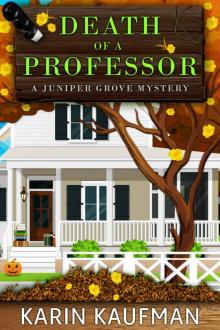
Death of a professor, p.5
Death of a Professor, page 5
part #10 of Juniper Grove Cozy Mystery Series


His question caught me off guard, though it shouldn’t have. Gilroy must have told him his mother’s death was now classified as a homicide. “It’s possible one of the others at the meeting was worried about what she was writing. She said the novel was loosely autobiographical. Have you read any of it?” I scooped up another few books and checked the titles before shelving them.
“She never let others read something before she finished it. Even her academic papers.”
“Are her academic papers in the house?”
“What’s left of them. They were in the file cabinet in her office, but whoever did this took some of the folders. They probably thought her novel was in one of them.”
“Dragonfire!” I said. On the floor, staring up at me, was a large paperback with a green dragon on the cover and, above it, the word “Dragonfire” in yellow letters. It was the title of a fantasy novel! I bent to retrieve it. “Look at this.”
Conroy was at my side. He seized the book, held its spine up, and shook it, hoping to dislodge anything stuck between its pages. Nothing. He flipped through it, but again, nothing. Then he turned to the first few pages of the book, looking, I supposed, for something written there. Once again we were disappointed.
“Shoot.” Disheartened, he handed me the book. “Take it. Maybe you can figure something out.”
“Thank you. I’ll take care of it and get it back to you.”
We had discovered Dragonfire—the first instance of the word in connection with Pia—and yet were no closer to its meaning than before. My thoughts were spinning with possibilities, flitting from one half-formed idea to another. In my mind, Dragonfire had a dozen meanings.
Yet one thing was obvious: someone had searched for something in the bookcases—a book or something hidden in or behind the books—but had overlooked the Dragonfire paperback. The culprit had no idea what the word signified. I had an advantage. Pia had given me the means to unravel a mystery.
“Are you working with the police?” Conroy asked.
“Not professionally. But after finding that note . . .”
“You’re hooked?”
“I feel compelled to discover what happened,” I replied, smiling faintly.
“You’re a lot like my mom, then. And that note is just the sort of thing she would do—scrawl out a word at the last moment, hide it somewhere, leaving no clue to what it means. She must have trusted you’d work it out.”
“To be honest, I don’t feel I know enough about your mom to work it out.”
“Then I’ll have to help you know more about her.” He grabbed more books from the floor, straightened, and arranged them on a shelf. “I’m going to look for other memory cards. If the answer to why she was killed is on one of them, I trust you more than the police to see that.” He shoved back his bangs. “Not that I don’t trust them, but my mom trusted you, so you need to see those cards too. I’ll be back. I’ve got a few ideas where I might find them.”
Conroy walked off in search of the memory cards while I hurriedly gathered and straightened the rest of the books, checking their titles as I went. Though I spotted more fantasy novels and leafed through their pages for clues, there were no more books with the word “Dragonfire” in the title.
While Conroy continued his hunt, I sat down and took a closer look at Dragonfire the fantasy novel, thinking that perhaps Pia had written something on one of its pages. I started at the front, browsed a few pages, and then turned to the back. Next I thumbed through the book, examining the inner margins. When I read books, I frequently made marginal notes and underlined passages of interest, but Pia’s Dragonfire, so far at least, was pristine. I was rapidly losing hope that the book would be of any use in discovering her killer.
“Do you write too?” Conroy asked, returning to the living room.
“Yes, mystery novels.”
Smiling, he held up two memory cards, one in each hand. “Yeah, I think she chose you.”
“You found them!”
“In addition to liking word games and clues, my mom was a woman of habit. All I had to do was find the right picture frames in the bathroom.”
He gave me the cards, and as I took them in hand, I sensed their value, not only to the case but to him, her son. “I’ll be very careful with these,” I said.
“I know you will. And don’t worry. The police have copies, and I’m positive she hid more cards in her office. Two sets of memory cards weren’t nearly enough for her. In fact . . .” He headed for the kitchen, signaling me to follow him. “There’s her laptop,” he said, pointing at a Dell next to the coffeemaker on the counter. “She hid it behind cereal boxes in a cabinet.”
When I’d first heard that Pia hid her memory cards, I’d wondered whether she’d been overly cautious, putting it kindly, or she’d had reason to be worried about someone finding and stealing her work. But seeing the results of the break-in, I realized Pia had been right to worry. And had she left her laptop in the open, it would have been stolen.
Conroy opened the laptop and turned it on. “I promised the police I’d take this to the station later today—I wanted to check for family photos—but you’re welcome to go through her files first.”
“Your mom was aware that someone didn’t want her novel to come out,” I said. “That means she knew who didn’t want her novel to come out. Published or not, that person didn’t want it to see the light of day, even in manuscript form.”
“She planned to give it to an editor after she finished the second draft, but no way has anyone else seen it. It’s not possible. She never let anyone see unfinished work. So how could anyone know what’s in it?”
“She may have hinted at what she was writing at one of the meetings. The very idea that she was fictionalizing her real life in Juniper Grove terrified someone.”
“Something in the past,” Conroy said. He tapped a few keys on the keyboard. “I don’t believe it.” He tapped again. “The computer is password protected, and she never told me what her password was.”
I stared at the laptop. No. Could it be so simple? “Try Dragonfire.”
CHAPTER 7
Conroy typed “Dragonfire” and hit Enter. A second later, the lock screen’s wallpaper disappeared, and in its place appeared a host of file folders superimposed on a blank home screen. Every folder on the screen was labeled with a number, 1 through 18.
“Wow. It worked.” He looked back, grinning. “Brilliant.”
“You would’ve figured it out,” I said. “Do you think those same folders are on her memory cards?”
“Let’s find out.” He stuck out his hand and I gave him one of the cards. “If I can open this puppy up.”
A moment later we both realized that her cards, too, were password protected. Thankfully, they also opened with the password Dragonfire. Pia may have been cryptic, but she was also consistent.
“I recognize this,” Conroy said, looking at the contents of the first folder. “Academic papers that were published in journals, but they’re all from a few years ago.” He opened folder 17. “Look, chapter 15. This is part of her novel. It goes from chapter 15 to 22. It looks like that’s as far as she got, since 22 ends midsentence.”
“Then the whole thing is there? Fantastic.”
He exited the folder, went back to the laptop home screen, and clicked on folder 17. “Chapters 15 to 22 here too. It looks like the laptop and memory card folders are the same.” He pulled out the card and gave it back to me. “I can’t believe someone in that group killed her because of this.”
“Gilroy is keeping an open mind on the motive,” I said, sliding both memory cards in my jeans pocket.
“But it was someone at the meeting, one of her so-called friends, who killed her.”
“I’m afraid so. Have you met any of them?”
He shut down the laptop and closed it. “No, but I know them from a photo my mom keeps in her office, and after listening to stories she told me, I don’t want to meet them. They sound like a load of snobs.”
“They try very hard to impress one another.”
“I know, right? That’s what she said. She told me about their conversations. The meetings were something for her to do on a Monday night, but she didn’t think of those people as real friends.”
The doorbell rang, and Conroy grumbled and threw back his head, glaring open-mouthed at the ceiling.
“Do you want me to get it?” I asked.
“No, I should,” he said, moving for the door.
I followed Conroy out of the kitchen, and while he answered the door, I went back to the couch, where I’d left Dragonfire. Why had Pia chosen the book’s title as a password? I didn’t know if examining the book more closely would yield an answer to that question, but on the off chance it would, I planned to take it with me.
“Why are you here?”
My head jerked and I looked up. Jack Lusby was standing just inside the front door, leaning on the doorframe and scowling at me as though I were an interloper.
“She’s here because I invited her,” Conroy said, his tone both biting and matter-of-fact. He shut the door and gestured toward the couch, the only relatively uncluttered place to sit.
“I’m not going to stay long,” Jack said. “What happened in here, an earthquake?”
Jack glanced at Conroy and about the living room as he spoke, but his eyes kept coming back to me. Was he confused by my presence in Pia’s house? Or worried about what it signified?
“There was a break-in,” Conroy said. “Weird timing, huh? Take a seat, Mr. Lusby. I insist. I’ll make a pot of coffee for everyone.”
Conroy shot a look my way, and instantly I knew what he was up to. Here was my chance to grill a suspect.
“Thank you,” I said.
“Yup.” Conroy motioned once more at the couch and then strode for the kitchen.
Reluctantly, Jack joined me, grimacing on his way down to the cushion. I was about to hide Dragonfire behind my back, but wanting to see his reaction to the book, I left it on my lap. “Why are you here?” I asked, returning his sweet greeting.
He reared back a little. “Pia Montfort was a friend. You only met her yesterday.”
“We hit it off.”
“Did you now?”
“You know her death was declared a homicide, right? Someone added peanut oil to her brownie.”
“That’s a rather elaborate method.”
He didn’t seem at all shocked. “I forgot. You like simple methods. But peanut oil injected into the center of a brownie is simple. I’m sure the surrounding brownie soaked up the oil so there wasn’t a glob of it in the center.”
“Hence the overall gooeyness I noticed. You seem to know a lot about this. I haven’t heard a thing.”
“I asked because I wanted to know what happened to her. Didn’t you?”
“Are we going to dance like this, Miss Stowe?”
“I’m not dancing, Mr. Lusby. Why would someone in your group want to murder her?”
“The malignant human spirit, Miss Stowe. There’s no accounting.”
“Was that spirit mobilized to murder by Pia’s novel on Juniper Grove?”
Jack forced a laugh and raked a hand through his thick, gray hair. “It was never going to be published, and everyone knew it.”
“An editor would see it. So would a literary agent and multiple publishers. You know how the publishing business works. Word would get out. People would talk.” I leaned his way. “Did you and Pia know each other when you lived in Denver? Could you be in that book?” I knew I was out of line being so personal, but the man brought out the smart aleck in me.
“Never met the woman before our crime meetings,” he said, pulling his mouth into a grimace. “You met everyone but Sam for the first time yesterday and you think it’s decent to ask these questions?”
“I’m just wondering what a college professor could write in a novel that would result in her murder.”
“How much vile poison could Pia have put in it? That’s a better question.”
“Are you saying her book is a lie?”
“I haven’t read it, have I?” He grinned, all teeth and lips and wide jaw.
It was time for me to tone it down and get some real information from Jack. “Have you read anything the others in your group have written? I imagine you all share your work.”
“You imagine wrong. I haven’t the time for that.”
“What about Gerald Rossi? At the meeting it sounded like you were encouraging him to write a book.” For emphasis, I tapped the book on my lap, but he didn’t glance down at it.
“Yes, on cultural anthropology,” Jack said with another laugh.
“Some people might enjoy it. He’d have a smaller market than you do with thrillers, but he could find a publisher. Has he thought about writing a textbook?”
Conroy came out of the kitchen bearing two blue mugs, his eyes shooting from me to Jack. “Milk or sugar for either of you?” he asked, giving us each a mug. “I’m sure I can find sugar.”
“Milk would be nice,” I replied.
“Don’t trouble yourself,” Jack said.
Conroy retreated to the kitchen. Knowing I had at most three more minutes with Jack before he bolted or refused to speak, I pressed on. “Most college professors try their hand at writing a book. I’m a little surprised Gerald hasn’t.”
“Gerald is a huckster.”
“How so?”
“Ask him.” Jack blew on his coffee and took a sip.
“I don’t understand.”
“Huckster,” Jack repeated.
This was going nowhere. “What about Nadine? Have you read her nonfiction works on art?”
“Do I have reams of time? She writes for magazines. Art and Whatzit or Arts and Poodles. Something along those lines.”
Conroy returned, this time with an opened half pint of milk, and left the living room as quickly as he’d come. For show, I poured a little milk in my coffee. I was strictly cream or half and half, but I’d soldier through if it meant getting more out of Jack the Famous Writer.
“Whose writing do you consider acceptable, Jack?”
“Sam might have made a novelist,” he answered.
“Last night you encouraged Libby to try her hand at writing.”
“I was being gracious.” He grinned, thrust out his substantial jaw, and bobbled his head a bit.
Little Jack Horner. What a good boy am I. The man was always trying to impress, always trying to be witty and bright.
As I took a long sip of my coffee—it was either bury my face in my mug or give Jack the verbal lashing he richly deserved—the doorbell sounded again. I pictured Conroy in the kitchen, groaning and rolling his eyes, and I resolved to leave in a few minutes, as soon as I could politely do so in the presence of the new arrivals.
But that was before I saw Gerald Rossi and Libby Weiss.
“Well, look at this,” Jack exclaimed. “The gang’s all here, and Libby’s got flowers. Where’s Nadine?”
“I don’t know,” Libby said. Misunderstanding Jack’s question, she squinted and peered about the living room.
I left the Dragonfire book on the couch and got up to shake her hand. “She’s not here, Libby. Good to see you again. It’s Rachel from last night.”
“Yes, I remember,” Libby said. “Conroy . . .”
When she held out her bouquet of sympathy flowers, Conroy shut the door, circled around her, and took hold of them. “Thanks. You’re Libby Weiss? My mom talked about you. Well, she talked about everyone.”
“She talked about you, too,” Libby said. “It’s nice to meet you. I’m with Gerald Rossi.”
Gerald hadn’t budged. He stood near the door, hands in his pockets, casting his eyes about the living room. “Can I ask what happened? It’s sort of . . .”
“A break-in,” Conroy answered.
“Wow, I’m sorry,” Gerald said. “They made a mess, didn’t they?”
“They? It wasn’t a they.”
“Oh? Have the police charged someone?”
“Pia’s son is trying to tell you he believes there was one offender,” Jack said. “Unknown as yet.”
Gerald pushed up his glasses and rubbed his eyes.
“Why are you here, Gerald?” Jack asked. “Libby brought flowers, but why did—”
“He drove me, you fool,” Libby snapped.
I thought I’d spill my coffee. So she could defend herself. I set my mug on a half-empty bookcase shelf for safekeeping.
“I’ll put these in a vase,” Conroy said, heading back to the kitchen.
Gerald was back to scanning the room, twisting this way and that. Foraging with his eyes. His interest in Pia’s things was unseemly.
“Can I help you find something, Gerald?” I asked.
He whipped around. “Huh?”
“Gerald my man,” Jack said, “Rachel wants to know what you’re looking for. Conroy asked her over, and she got here before I did. Isn’t that fascinating?”
“Captivating,” Gerald sneered. “And you, Jack? What did you come for? Coffee?”
“What did you come for, Mr. Lusby?” Conroy asked.
“To pay my respects to your family. If you’d rather, I’ll leave.”
But Jack didn’t make a move to get up. Not even a twitch. I had a feeling he didn’t want to struggle to his feet in Gerald’s presence, and I almost felt sorry for him.
After a few awkward seconds, Libby said, “Well, we don’t want to keep you. We’re sorry for your loss.”
“Let’s stay, Libby,” Gerald said. “We’ll all leave together. When Jack does. Conroy, do you need some help cleaning up? Did they make a mess of the other rooms?”
“I have it taken care of,” he replied.
That was my cue. Maybe if I left, the others would as well, and we could leave Conroy in peace. With a lot of clutter on his hands, but in peace.
When I went back to the couch to pick up Dragonfire, Jack finally noticed the book.
“Pia’s book?” he asked.
“I’m borrowing it.” Suddenly I wanted to keep the book private. I brought it to my chest and hid the title with my crossed arms.
“What is it?”
“None of your business.”