

Xavier in the meantime, p.1
Xavier in the Meantime, page 1


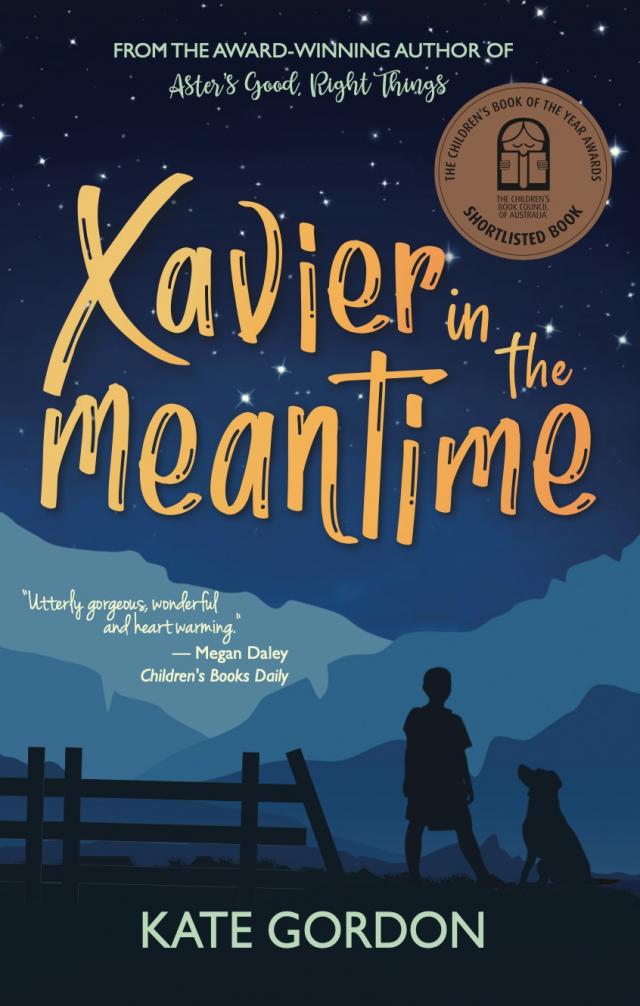
Xavier in the Meantime
Text © Kate Gordon, 2022
This is a work of fiction. Names, places, events and incidents are either products of the author’s imagination or are used fictitiously. Any resemblance to actual persons, living or dead, is purely coincidental.
Riveted Press
Unit 3, 5 Currumbin Court
Capalaba QLD 4157
Australia
First published by Riveted Press in 2022
Print ISBN: 978-0-6452180-9-1
eBook ISBN: 978-0-6452180-5-3
All rights reserved. No part of this publication may be reproduced, stored in a retrieval system or transmitted in any form by any means without the prior permission of the copyright owner. Enquiries should be made to the publisher.
Printed in China by Shanghai KS Printing Co. Ltd
10 9 8 7 6 5 4 3
Dedication:
For Leigh, for being there through all the meantimes.
I love you.
-KG
Chapter 1
Monday’s Affirmation:
Be the change you want to see in the world.
Xavier sat with his father on the tray of his ute. His fingers kept returning to the rust holes in the tailgate, as if they were touchstones, worry stones. They connected him to here.
The ute was parked in the middle of a field. It smelled of hay and grease and summer. Underneath it all was the scent of his dad. It felt like home, but it wasn’t home anymore.
“I like it here,” said Xavier.
“You should come with me more often. Get out of the house a bit, you know?”
Xavier nodded. “I know.”
“Maybe you could do some work for me …”
Xavier shook his head, ferociously. “I’m not the farm work sort,” he said. “I’d just end up hugging all the sheep and never actually get anything done.”
“The sheep here aren’t for hugging,” his father said, gently.
“I don’t want to talk about what the sheep here are for.” Xavier shuddered. “Can’t we change it?”
His father sighed. “It’s the way it’s always been,” he said. “As long as I can remember.”
“Be the change you want to see in the world,” said Xavier.
His father grinned. “Affirmation?”
“Affirmation,” Xavier sighed, rolling his eyes. “They’re getting to me, Dad.”
“Is it helping?”
Xavier shrugged. “I guess it’s not hurting. But I wish we could do something more, in group. Something that … fixes something properly.”
“Maybe you could? Maybe you could suggest something? Make the change … be the change.”
Xavier shook his head. “I can’t …” he murmured.
Because I am a failure. Because I am a freak.
Despite how loud the voice was, he locked it safely inside himself. Instead, he said, “The affirmations are okay.”
“That’s something. And … maybe we can find something else. Something else you can do on the farm.”
Xavier raised his eyebrows.
He didn’t want to work on the farm—he’d told his dad that, before. He wanted the farm to be his happy place, away from the world and his mind. Not that he could ever escape that.
Not really.
“How’s Iris?” said his dad, when it was clear that Xavier wouldn’t answer. Iris. He always said that now.
Before, when he lived with them, he called her “your mum.” And he danced with her in the kitchen, to old songs by Fleetwood Mac. Sometimes he whispered to Xavier, “Isn’t your mum beautiful?”
He never called her Iris back then. It was an elegant name: the name of a beautiful flower. But now, when his dad said it, it somehow felt cold and hard and nothing like a flower at all. Now, it felt somehow sad.
Xavier didn’t answer his dad. Not outright, anyway. Instead, he asked, “When are you coming home?”
And his dad laughed, the way he always did. The laugh that wasn’t really one at all. “When she invites me.”
Xavier’s mum and dad weren’t divorced. They weren’t even separated.
They were broken.
No.
That wasn’t it.
They were on a break.
While his mother found herself.
While she found Xavier.
While she worked everything out.
“I still love her. She still loves me,” his dad insisted. “This is just … the meantime.”
Xavier looked out across the paddock. The sky was the colour of mangoes—the juiciest, midsummer ones.
“I don’t mind the meantime,” he told his dad.
And it was true.
He liked this place—his grandmother’s farm. He liked the animals and the wide, open spaces. His grandmother lived in a home, now. She still owned this place, this farm, and his dad always worked here, but usually another family lived in the house. His mum said the tenants were “hippies, just like us.” They had two children and a goat. Their children didn’t wear shoes and were often covered in dirt, but were completely joyful with it—as if joy and dirt were somehow the same.
Sometimes, the family took off on adventures, to “see where the wind took them.” They were away now—travelling Australia in a bright blue caravan.
That was why his father was able to stay in the house.
It was all serendipity, his mother said. It was all completely meant to be.
When Xavier asked what was meant to be and why his father had to leave, his mother had only told him that it wasn’t forever. “It’s just …” she said, “for the meantime.”
His father had cried, Xavier remembered, the day he left their home to move to the farm.
As they stood in the driveway, his mother had held his father tightly in her arms. From the outside it still looked a lot like love, and Xavier hoped that meant it really was only “for the meantime.”
“Blink and you’ll miss it,” she’d said.
Xavier was blinking. He was blinking all the time, especially at home, wishing that in that microsecond, as his eyes closed and opened again, his father would appear, solid, as if he’d never left. He missed his dad and the way things used to be. The three of them.
He was thinking about that—all of that—and was quiet because of the thinking. That happened sometimes. He went into his head and got lost there. His dad noticed, because of course he did.
“How’s the black dog?” his dad asked, gently.
Xavier looked down at his feet. The black dog was there, looking up at him. He was skinny and scruffy and sharp-toothed and mean. Only Xavier could see him, which seemed impossible—he was so big and so horrible and so … there. So obviously there. Xavier didn’t know how everyone who saw him couldn’t see the black dog, too.
He shuddered.
“I don’t want to talk about him,” said Xavier. “I’d prefer to talk about Aster.”
Chapter 2
Tuesday’s Affirmation: There’s no harm in trying.
Aster was Xavier’s new best friend—his first best friend, if he was honest.
His first proper friend.
The only other children he’d ever been sort-of friends with were the other home-schooled children he saw sometimes at “meet-ups,” and the other kids with black dogs like his, at the day program he went to.
He didn’t really speak to any of them.
It wasn’t because he was shy or rude or thought that he was better than them.
It was more because … they were friends by design. They were put together because they supposedly fit, because adults thought they matched in some way.
They were the other children who learned at home.
They were the other children with broken brains.
They were meant to be the same, but …
They weren’t.
They didn’t fit with him, even though they were meant to.
The first one who ever fit with him properly was a small, black rabbit, whose name was once Daenerys, but who they more often called Hollyhock these days. The next was a girl called Aster.
Aster’s brain was a little bit like his; also ‘broken,’ but in a different way.
But it wasn’t the things that made them the same that connected them as friends. It was just her Asterness and his Xavierness. They just made sense.
Aster loved him for who he was, and he loved Aster, too.When he was with her, the black dog was quieter.
Aster used to do good, right things. She had to, every day, or everything would collapse. She had to do them in secret, or it didn’t count. She wasn’t allowed to feel happy. But now, she was happy. Now, she did good things because she wanted to, and people were allowed to know. She didn’t call them good, right things anymore. Now, they were just small kindnesses. Sometimes Xavier helped her.
It felt good, to do the kindnesses.
They didn’t plan them, or write them on a list, or think of them as deeds to be rewarded by God or karma or whatever. They were happenstance and serendipity and Aster and Xavier did them to do good and to feel good.
Aster made Xavier feel good—as much as anything did. Sometimes, the good feeling went all the way from his scalp to his toes. Sometimes, it felt only skin deep. More and more, lately, it felt that way. But ev en that was better than nothing … and much better than before.
Aster was the first person he wanted to see, when he came back from the farm. They met at the milk bar, to celebrate. The first thing they did was order ridiculous milkshakes—a celebration can’t truly be called a celebration without them.
“This holiday seems the longest one ever,” said Aster, rolling her eyes. Her top lip was covered in milk foam. He didn’t tell her. It looked good on her. “I thought it would be fun, having Indigo stay, but she’s in a terrible mood all the time.”
Xavier swallowed, at the sound of Indigo’s name. He had never told Aster, but he was a bit frightened of Indigo Michael. She was so wild and loud and angry and chaotic and she could break Aster, he knew, with the flick of her finger. “I’m so glad you’re back, so I have an excuse to ...” She shook her head. “I sound so mean. It’s just that she’s so mean to me. She stopped, for a little while. We were almost friends, but … no matter how nice I am to her, she’s almost never nice back, now.”
“You don’t have to feel guilty,” said Xavier. “It’s fine to feel your own feelings, and it helps to talk about them. You know you can talk to me about anything.”
Aster grinned. “Did you learn that at day clinic?”
Xavier nodded, proudly. “I’m a wealth of mental health information. Go on, ask me anything.”
Aster leaned her chin on her hands. “How do we get through this?” was all she asked.
Xavier shrugged. He might go to the day clinic once a week; he might have a mother who had read every “What to Do When Your Child Has Depression” book out there; he might even have read a few of them himself, but the answer to Aster’s question seemed as close to him as the moon.
Aster could see he was struggling. She always knew. She handed him half of her Hundreds & Thousands biscuit.
“A small kindness?” he asked.
She shook her head. “Just what you do with friends.”
That’s when Xavier saw the lady, through the window of the shop. She held a baby in her arms and the baby was crying. The mother was, too.
Xavier met Aster’s eye, at the exact same time as she spoke,“I have a cat toy in my bag. Sometimes my dad forgets I’m not five and I kind of love that about him. Do you think it could work?”
“There’s no harm in trying,” said Xavier.
Aster grinned at him and her grin was like daffodils in springtime.
While Aster went over to pay Esme for the milkshakes, Xavier took the cat toy and skipped outside.
And the baby loved the cat toy. The mother held Xavier so tightly he thought he might melt away.
And she cried on his shoulder and she said he was a precious boy.
And that should have been enough.
For most kids, that would have been enough—to make the greyness go away. To make the black dog run. To make the feeling of skin-deep happiness go all the way to his toes.
But Xavier could still see him, out of the corner of his eye. His fur was ruffled and his fangs were bared and he was panting, panting. He was hungry.
For Aster, small kindnesses were enough.
For Xavier, they were only a tiny spark in the darkness. He needed so much more light if he was ever going to find his way home.
Chapter 3
Wednesday’s Affirmation: My story is important.
Wednesday was group session day.
His mother drove him, in her rusted old Gemini. It was the colour of ripe mandarins, with seats that stuck to your legs. She spoke to the Gemini, as if it were alive.
“Come on, Gem,” she muttered, when the turn of the key only made the car groan. “You’ve got this, girl.”
Xavier looked down at his feet. He knew he was wearing his glitter Converse, but all he could see was the dog.
He couldn’t see his rainbow-striped socks, or his shorts with the flamingo print. The dog was covering everything.
It panted and it groaned and Xavier could almost hear it, whispering:
“This won’t help, you know. You’re far beyond all help. You’ll never get better. You don’t deserve to.”
Gem finally gasped into life, like the king in Shrek on his deathbed, waking one more time.
Aster loved that movie.
The radio crackled on, belching something about politics and pandemics.
“Enough of that,” Iris grumbled. She pressed a cassette tape into the slot.
“You’re the only person alive who still uses cassette tapes,” Xavier pointed out.
His mother laughed. “You’ll see. They’re making a comeback.”
“The same can never be said for this music,” Xavier sighed, closing his eyes in disgust as his mum began warbling along with the song.
It was all about freedom and thunder and rain. And loneliness.
“Do you miss Dad?” Xavier blurted.
His mum stopped her singing, mid-line.
“What’s to miss?” she asked, peering at him as she switched her indicator on. “We talk every day on the phone, and every time I drop you off at the farm …”
“I mean miss him in the house,” Xavier clarified. “Miss being …” His nose wrinkled, “married … or whatever.”
“We’re still married,” his mum corrected him. “We’re not getting un … married?”
Xavier noticed the barest hint of a question mark at the end of her sentence.
“We’re not,” she said, more firmly, when she saw him gaping at her. “I just need … you and I just need …”
“Your freeee-dom,” Xavier sang, echoing the song.
His mother sighed. “I just don’t have enough spoons for dealing with everything right now. It’s nice, to have space and time to devote entirely to you. To helping you get better.”
Iris talked about spoons a lot—it was a word she used to describe her chronic illness. Iris had Crohn’s Disease. It was painful and made her tired a lot. So tired, sometimes, that she couldn’t do much at all but sit on the porch and drink tea. She needed to conserve her energy—save it up so she had enough for the important things.
Every time she used some of it, she was giving away a spoon.
And she only had so many. And sometimes she had none.
“I don’t want to take up all your spoons,” said Xavier, not for the first time.
“I’m your mum,” she said, smiling at him. “You’re my baby. I’d give you all my spoons, if I could.”
Xavier sighed. “I don’t want to be the reason you and dad break up.”
“We’re not breaking up. He’s just spending some time at the farm, with the sheep.”
“Killing the sheep,” Xavier grumbled.
His mum—a vegetarian, just like him—rolled her eyes. “It’s tradition,” she said, parroting his father’s words. “The farm has been in the family for a century and a half and it has always been a hogget farm.”
“It’s barbaric.”
“At least the sheep get to live a little. And there really is no other way, Xave. How can a hogget farm keep going if it doesn’t kill the sheep? What other way is there?”
Xavier stared out the window awhile. The song on the tape changed, to one about storms. But outside the window, all was blue.
“Such a pretty day,” his mum said.
But of course, she wasn’t grey inside.
And she couldn’t see the dog.
***
There were ten of them, in the group. More than half were girls. And then there was Maren, who was the group facilitator.
“Just a fancy word for a ‘shrink’,” one of the girls, Tobi, had told him on his first day. “A less scary word, maybe. So that we don’t feel so crazy.”
Her explanation made Xavier think of Indigo Michael. She used to call Aster that word: crazy.
His stomach dropped, thinking of Indigo, thinking of her calling Aster that.
Thinking of the harm words could do.
Somehow, it didn’t sound so bad, coming from Tobi’s mouth, because she had used it about herself.
Xavier didn’t think of himself as crazy, ever. He’d read enough to know that the brain is only another organ of the body. Sometimes brains get sick, just as lungs and livers do.
Still, he liked the idea of reclaiming a word for himself. He played with the idea of depressed but it just sounded so …


