

Whalesong, p.1
Whalesong, page 1


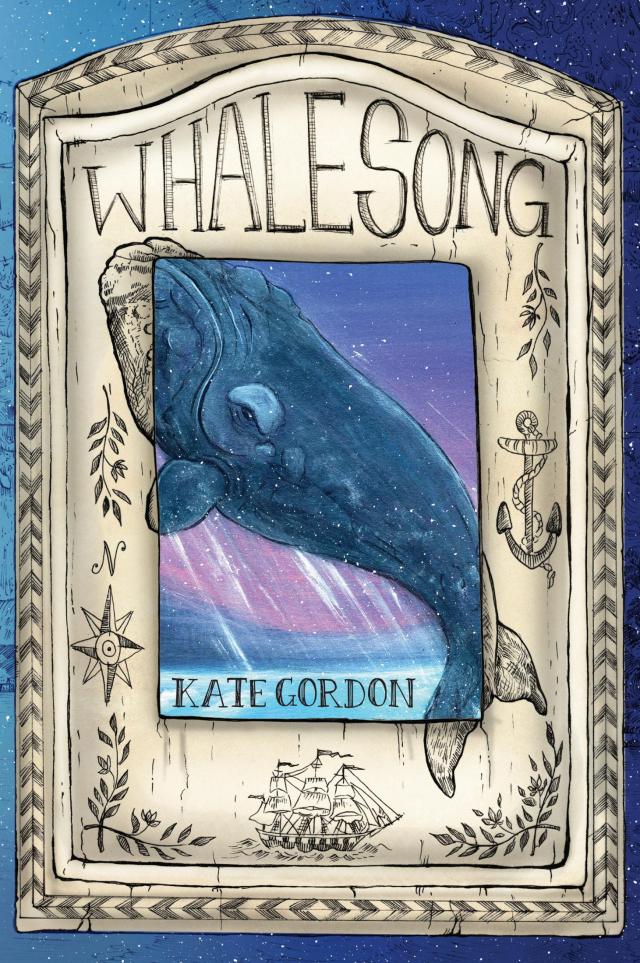
Whalesong
Text © Kate Gordon, 2022
This is a work of fiction. Names, places, events and incidents are either products of the author’s imagination or are used fictitiously. Any resemblance to actual persons, living or dead, is purely coincidental.
Published by Riveted Press
Unit 3, 5 Currumbin Court
Capalaba QLD 4157
Australia
Cover Design by Tam Teow
First published by Riveted Press in 2022
Print ISBN: 978-0-6452180-2-2
eBook IBSN: 978-0-6452180-4-6
All rights reserved. No part of this publication may be reproduced, stored in a retrieval system or transmitted in any form by any means without the prior permission of the copyright owner. Enquiries should be made to the publisher.
Printed in Australia by Ligare Book Printers
10 9 8 7 6 5 4 3 2 1
For Annalise and the staff of
the Tasmanian Maritime Museum.
And for my Nan, Alwyn, the
original powerful woman in my life.
All my books are to make you proud.
KG
Acknowledgements
Kate would like to sincerely thank the
following organisations for the opportunity
to write this book while participating in the
LUME writers in residence programme.
Maritime Museum of Tasmania
Hobart City Council
TasWriters
Chapter 1
Aberdeen Knopwood sat on the edge of Constitution Dock, her legs dangling off the edge. The autumn sunlight turned the water to molten gold. The breeze on her cheeks was honey-warm. She turned her face to the sky, to the clouds, and hummed a song of summer.
Aberdeen Knopwood liked to hum, usually in secret. Sometimes, the songs were from the radio. Sometimes, they were her own creation and sometimes they came from she-didn’t-know-where.
Constitution Dock was one of her favourite places. The whole wharf area felt, to Aberdeen, like the hand of a giant, reaching out, dipping its fingertips into the water. Each pier was a finger and, sitting here, in the giant’s palm, Aberdeen felt safe. This was home.
Further along the dock, she could hear her little brother, Fred, pleading for an ice cream. Her mother, patient as always, reminded him that he hadn’t yet eaten his lunch.
Aberdeen could smell it, cooking—oily fish and crisp-as-apples chips and squid rings as big as her wrist. The fish and squid were for her family, of course. Aberdeen couldn’t stand the idea of eating something that had been alive. She was looking forward to the chips and coleslaw, though. Any moment, Jeb behind the counter would call out ninety-four, and she would be summoned back, from the edge, from the water and her happy humming, and her brain would be full again—of Freddie’s whining and her mother’s questions and her father’s did-you-knows.
This morning, he’d been on a mediaeval jag. Who knew what it would be at lunch time? Probably, given their location, it would be a water sort of thing.
He’d been at the museum all morning, researching—the Maritime Museum, just up the hill. Something to do with lighthouses and pigeons and the history of how they entwined.
Light and flight and secret messages…
Dean Knopwood was a man of obsessions, but amongst them all, history was the greatest, especially the history of this place—his birthplace—Tasmania.
His family—the Knopwoods—had been in Hobart for generations. They were famous, around these parts, the roots of their tree going down and down and down into the earth. Aberdeen knew well (and Dean did, too), that their roots did not go all the way. The people to whom this place truly belonged had many names—and here, in Hobart, they were called Mouheneenner (a name Aberdeen practised saying, over and over, rolling it in her mouth like a sweet). The roots of Dean Knopwood’s ancestors were in East Anglia, and they went down, down, down there, deep. Her mother, Meike, was German, so her roots were in another place entirely.
Dean told them about English history too, of course—they knew all about all the kings and that Arthur was not a real one. Meike told them about Germany and that it was so much more than a nasty, coward of a man with a strange, small moustache. Aberdeen and Fred knew so much about the histories of them that when they closed their eyes, they could see the past, as if it were on a movie screen, but it was this place—that was theirs and not theirs at the same time—about which they knew the most.
When Aberdeen’s best friend, Vera (whose family had roots in Tasmania all the way down), came to visit Aberdeen’s house, she argued with Dean about his “facts” and Dean loved it when she did. “I’ll add that one to the memory bank,” he’d say, and Vera would nod and solemnly reply “As it should be.”
Vera spoke out and challenged and argued, campaigned and protested, while Aberdeen stood by her side, the fire inside her crackling, but not blazing. Vera spoke for both of them, Aberdeen’s quiet longing to make a difference somehow fuelling Vera’s flames.
But she felt it. Sometimes she felt she’d explode with it. Especially now Vera was gone.
Vera had left for the mainland, last week, on a ship her father built. They were going to live on the boat for a year.
And Aberdeen felt a bit lost, a bit greyer. Somewhere her fire still burned, but the light and heat seemed almost gone. She felt untethered. Lost at sea.
On the day Vera left, her mother gave her a present, to soothe her sorrow. It was a pendant—a picture carved on bone, of a whale, breaching. “Scrimshaw,” she called it. “Your dad gave it to me, when we were first dating, to remind me of him, when he was away from me—he was away much more often, back then, on assignments on the mainland and overseas. Sometimes, he even travelled on boats, like Vera is. He told me, when he gave it to me, that sailors often made scrimshaw for their loved ones back home. It’s a connection—from one heart to another, from one place and time to another, always tethering people together—the heart and love winning, beating the laws of space and time.” She smiled. “There’s this old John Donne poem he used to quote.” She peered at Aberdeen. “Can I quote it to you, or would that be too woo-woo?”
Aberdeen rolled her eyes. “It would. But you can.” She secretly loved it when her mum went woo-woo. It was a nice contrast with her dad’s facts and evidence.
Her mum cleared her throat.
Dull sublunary lovers’ love
(Whose soul is sense) cannot admit
Absence, because it doth remove
Those things which elemented it.
But we by a love so much refined,
That ourselves know not what it is,
Inter-assured of the mind,
Care less, eyes, lips, and hands to miss.
Our two souls therefore, which are one,
Though I must go, endure not yet
A breach, but an expansion,
Like gold to airy thinness beat.
If they be two, they are two so
As stiff twin compasses are two;
Thy soul, the fixed foot, makes no show
To move, but doth, if the other do.
In the lingering silence, Aberdeen found herself wishing her mum would go on. She didn’t really understand most of the words but, somehow, she understood the intent of them.
Her mum leaned over and kissed her forehead. “It means you’re never away from me. Not really. You’re always safe in my arms and in my heart. Being physically close doesn’t matter, if it’s real, true love. It’s the soul
stuff that matters.” She passed the scrimshaw to Aberdeen, then.
“I believe there are hundreds of these,” she said, in her woo-woo whisper, “connecting people who love each other, all around the world, to this day. Through space and time. This one connects you to me. Always. As long as you wear it, you’re safe in my arms.” She grinned. “It suits you. You’re made for it. You and your beautiful, big heart. You and your whales. Oh, and don’t worry—it’s found bone, your dad said. Not bone from a whale that was hunted. And it’s been in his family for longer than anyone can remember.”
Aberdeen leaned into her mother’s arms, who whispered to her songs of the sun and the river, all the way until she fell asleep.
And the next day, her mother said to her, “Let’s get you out of your head. Let’s go out in the sunshine. Everything is better in the sunshine, especially next to the water.”
Now, they waited for fish and chips near a golden river, under a blue summer sky, and Aberdeen didn’t feel better exactly, but the sun was warm and the water sparkled and she felt, almost, as if there was hope.
She rubbed the pendant, traced the lines of the whale, and she whispered, “I miss you, Vera.”
She imagined her best friend, on her family’s boat, sailing far, far away…
On a buoy, further into the river, a shadow-coloured shape caught Aberdeen’s attention. Grey and fat and moving and stretching its nose up towards the sky. She caught her breath and then she smiled. “Hello, Sammy the Seal,” she whispered.
And she thought, then, of other seals she had seen, in the books she had read and the David Attenborough documentaries she had watched.
Seals being hunted.
Seals dying.
And she thought of the turtles and the dolphins, caught in nets. And she thought, of course, of the whales—harpoons in their flanks, turning to flesh and memory.
Aberdeen had watched those documentaries and read book after book after book in the school library and her whole body vibrated with rage at all of it. But when she opened her mouth to say anything—when she lifted her limbs to do anything—her rage and anger and fire felt stuck, as if there were a grate across her mouth.
It had never mattered before, because Vera was bright enough for both of them.
But now…
The repulsive jock boys at her school teased her about the patches on her bag, the badges she wore, with slogans from The Greens and Kids for Climate.
She rolled her eyes at them, and pretended she didn’t care, but of course she did.
She cared, mostly, because they didn’t. She also cared because she wished she had a way to make them see, make them understand: this was their battle, too.
But all she did was roll her eyes and sometimes mutter, “Go away.”
How was eye-rolling and muttering ever going to change the world?
She wasn’t a girl like Vera, or like Greta Thunberg. She was a girl who read too much and wrote stories to nobody.
She wasn’t like her father. Her father spoke. Her father acted. Aberdeen just thought too much.
Thinking never changed the world. Only doing did.
“I’m sorry, Sammy the Seal,” she whispered. “I want to do something. I just don’t know how.”
And of course, she was probably wrong—she was almost definitely wrong—but when she said that, she could almost imagine that Sammy turned his head to her and nodded.
But of course, that wasn’t possible. Not intentionally, anyway.
“Deenie! Grub’s up!” the sound of her brother’s voice disturbed her reverie.
Aberdeen sighed and swung her legs off the edge of the dock. She turned away from the golden water and the blue sky and Sammy the Seal. Wandering over to her family, she took her white, cardboard box and inhaling its salty-oily-vinegar scent, she took a bite of a chip that made her mouth blaze.
She leaned against her mum and her mum put her arm around her and whispered into her hair, “I love you so much, my beautiful girl.”
Aberdeen glowed, warm and strong in her mother’s arms, in her love.
Why did she only feel strong when there was someone beside her?
But she said to her mum, “I love you, too.” Because she did, fiercer than the sun.
And she said to her dad, “So, what’s the history lesson today?”
And Dean Knopwood grinned, like he always did, on the precipice of a story.
He reached into his leather bag and pulled out a small, wooden box. On the side, in elegant script, were the words Parkinson and Frodsham, London. “Actually,” he said, “today the story comes with a gift.”
“For me?” asked Freddie, hopefully.
But Dean shook his head. “No, Fred. Deenie’s had a bit of a rough time, with Vera leaving. This one is for her.” He passed over the box. “One of the volunteers was doing a clear-out,” he said. “He was putting some old instruments in the shop for sale. I saw this one and thought you might like it.”
Aberdeen carefully opened the brass clasp and lifted the lid of the box. Inside was what seemed to be a giant pocket watch. There was an engraving of a whale on its face. She looked up at her dad, inquiringly.
“It’s a chronometer,” he said, as if this explained everything. When she still stared at him, blankly, he elaborated. “It’s a timepiece, but it also helps ships to navigate, by means of the stars.” He leaned in, his eyes twinkling. “It lets you see where you really are, and where you need to be. It gets you there, and all the way back home again.”
“I love it,” said Aberdeen, honestly—it really was a beautiful object, all polish and glimmer and untold secrets. “But it’s Vera who needs this, not me. I’m still here. I’m not going anywhere.”
Her father shrugged. “Maybe,” he said. “Or maybe it will help you get to where you really need to be.”
He lowered the bite of trevally that had been en-route to his mouth, and said, “Now, for stories—which are the real gift to all of you, am I right?”
Freddie groaned and rolled his eyes and said something about, “asking for ages for a Nintendo Switch…”
“I’m reading a book, actually,” Dean went on, “about this very river. I found it at the Maritime Museum…”
Aberdeen listened, with half an ear, until her father said something that caught her attention.
“Did you know,” he said, “that on the day you were born, for the first time in 190 years, a Southern Right Whale gave birth to a calf in the Derwent River? That’s why we called you Aberdeen—because it means river. One hundred and ninety years, Deenie. It happened just off the shore of Taroona. People came from miles around, to see the baby.”
“Did you go?” asked Fred. “Did you and Mum go and see the baby whale?”
Her father laughed. “Of course not, Freddo,” he said. “We were a bit busy, at the time, with a baby of our own.”
“Why did the whale come back?” asked Aberdeen. “What made that whale think they could? What made them brave enough?”
Her father lifted a shoulder. “The river is getting cleaner. Whales like clean water, of course. And maybe they just feel… safe here, finally, after all these years. Maybe they know that this generation are the ones who will protect them, and that it’s safe now, to come home. That we will welcome them home.
“Interesting fact: did you know that our ancestor Robert Knopwood…”
Aberdeen tried to pay attention to the rest of her father’s lesson, but her eyes were heavy with sleeplessness and tears. Her soul was heavy with missing Vera. She peered towards the water, thinking of Vera, out there, somewhere, on the waves.
And she was here, still stuck to the earth and full of missing…
And everything… everything seemed so bad, now, as if the world itself was sick. She thought of lonely polar bears on melting ice caps. She thought of bad men with big guns and anger in their hearts, of politicians who didn’t seem to care that the people they were meant to serve were suffering and hurting. She thought of sickness, disease, poverty, animals dying and the whole world felt on fire.
Why did she have to be born into a world that seemed to be at its end? Why was she born at this time, when so much seemed to be falling apart?
When Vera was here, she could jolly Aberdeen out of it, joke her out of it, but now…
Now, Aberdeen was alone with her mind and it seemed a ravaged place to be.
She tried to distract herself—let her thoughts wander, away, and her eyes along with them. She looked back at the water, searching for the seal. He was gone, off on his own adventures. A glinting light caught her attention. She looked down. Sunlight bounced off the face of the chronometer. It seemed, oddly, to arc up and away. She followed its trajectory. The light seemed to extend—as if in a rolling wave—all the way to the warehouses of Salamanca.
Of course, they weren’t warehouses any more, not really. They were, once, 200 years ago—Georgian sandstone warehouses that stored fruit, grains, fabrics… and whale oil. Now, they were art galleries, cafes, fancy boutiques.
But if you closed your eyes and let your imagination take over, you could still smell the oil.
The light continued to dance on the sandstone.
And there, standing at the end of the light, there was a girl, in a white linen dress, broderie anglaise on its sleeves, winding through the crowds, past the square where sometimes people danced in the fountain.
Aberdeen watched her, as she moved. She seemed, at once, part of the crowd and far outside of it. As if she was superimposed on to this place but was, really, walking somewhere else. Some time else.
The girl stopped, suddenly. The tourists kept walking around her, as if she wasn’t there, as if she had never been there. Then she stopped—and looked back at Aberdeen.
Except, of course, she couldn’t have been looking at Aberdeen, could she?
Aberdeen was too far away…
Wasn’t she?
But Aberdeen could see the girl. She almost felt as if she could smell her. The scent of lilacs seemed to linger in the air.
What a strange thought…
And then Aberdeen saw the girl’s mouth move and it almost looked like…


