

Fyneshade, p.1
Fyneshade, page 1
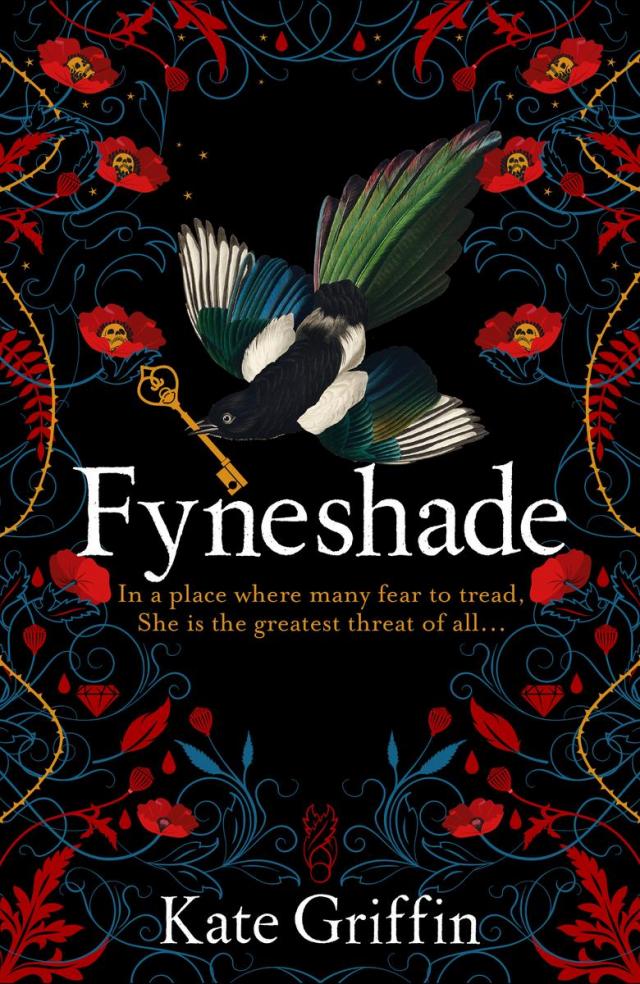


‘Dark, heady and bold, Fyneshade is a seductive treat, with a protagonist who is both wicked and irresistible. I was entranced from the first page to the last’
Antonia Hodgson, author of The Devil in the Marshalsea
‘With a satisfyingly dark anti-hero at its core Fyneshade makes for compelling storytelling and proves Kate Griffin’s a new standout voice in gothic fiction’
Susan Stokes-Chapman, author of Pandora
‘A tour de force! I thoroughly enjoyed this darkest of dark tales with its canny and complicated heroine, and a final twist that made me gasp out loud. Gloriously wicked’
Rosie Andrews, author of Leviathan
‘A darkly delicious joy of a historical gothic novel. Mature and accomplished storytelling that’s utterly compelling. I loved it’
Essie Fox, author of The Somnambulist
‘A dark and sophisticated gothic novel of the governess tale with a twist. Marta is the anti-heroine you won’t help rooting for’
Laure Van Rensburg, author Of Nobody But Us
‘Absolutely pitch-black brilliance. Dark, creepy and utterly compelling with characters who jump right off the page – this is gothic suspense at its very best’
S.J.I. Holliday, author of Violet
‘What a devious and delightful tale. In Marta, Kate Griffin gives us one the most inventive and compelling characters of recent years. A gloriously gothic and often darkly funny story. I devoured it whole’
Anna Mazzola, author of The Clockwork Girl
‘A gothic triumph. With so many hidden secrets, you won’t know who to trust’
A.J. West, author of The Spirit Engineer
‘An elegant iron fist of a novel cast in tattered finery and soaked in velvet darkness. Its darkness cloaked me to the end. Magnificent’
Matt Wesolowski, author of Six Stories
‘I loved the gothic horror of Fyneshade. Dark flashes of Fingersmith, Jane Eyre and The Turn of the Screw, with witchy governess Marta taking on the secrets that scratch around the walls. Deliciously dark and twisty’
Tina Baker, author of Call Me Mummy
‘Stunning. With a refreshingly complex protagonist and a story as richly threaded as the tapestries within the beautiful rooms of Fyneshade itself, the novel left me guessing its secrets till the very end’
Polly Crosby, author of The Illustrated Child
‘A piercing, acerbic, deliciously dark take on the governess tale; dripping with atmosphere, cobwebbed with twists, and with an anti-heroine you’ll never forget’
Lizzie Pook, author of Moonlight and the Pearler’s Daughter
‘A delightfully dark gothic tale, beautifully written, with a beguiling narrator. The seemingly innocent Marta turns out to be more than a match for the other occupants of a house full of secrets. An excellent read’
Guy Morpuss, author of Black Lake Manor
‘A bleak atmosphere and sense of foreboding whispers through the walls at Fyneshade. This historical suspense draws you in through its pages towards a looming fate. Full of gothic intensity, dread and a twist of seductive humour’
Jo Furniss, author of All the Little Children
‘I absolutely adored this unforgettable and original take on the governess gothic. Marta is the anti-heroine you can’t help rooting for: I was under her spell from the very first page. A deliciously dark and decadent novel, sure to bewitch readers everywhere’
Emilia Hart, author of Weyward
‘The most delicious nastiness one could hope for. Marta is Jane Eyre with the darkest of hearts, and Fyneshade is every bit as ghoulish as she is. Devour alone by candlelight!’
Kate Simants, author of Freeze
For Stephen
‘It may be, of course, above all, that what suddenly broke into this gives the previous time a charm of stillness – that hush in which something gathers or crouches. The change was actually like the spring of a beast.’
Henry James, The Turn of the Screw
Contents
Title Page
Dedication
Epigraph
Wolf Moon
1
Bone Moon
2
3
4
5
6
7
8
9
10
Worm Moon
11
12
13
14
15
16
17
18
19
20
21
22
23
24
25
26
Egg Moon
27
28
29
30
31
32
33
34
Mother’s Moon
35
36
37
38
39
40
41
Rose Moon
42
43
Thunder Moon
44
Acknowledgements
Copyright
1
Grandmere died in the midst of a winter white and hard as the alabaster monument marking the entrance to the Van Meeran family crypt. Death took her slowly, gnawing her flesh to the bone before casting her aside. It was cruel that her mind was sharp until the end. Her eyes, black like mine, refused to shut even when the last breath left her body.
I was safe while Grandmere was alive, but as I listened to the Reverend Van Meeran wheeze through the liturgy in the churchyard beside the rimed hole that swallowed her coffin, I knew that my days in the village would soon be over. Aunt Clare would see to that. And so would the Reverend, who had noted the way his son looked at me during his interminable sermons.
I glanced up from the frosted earth piled at the edge of the grave. Nathaniel Van Meeran was staring at me now. Just for a second, the tip of his tongue appeared between his lips. I cast my eyes down, stepped forward and scattered a handful of dirt onto the coffin below. It pattered across the brass nameplate attached to the wood. I slid a look at the Reverend to reassure myself that he hadn’t noticed Nathaniel watching me today.
If he knew the truth, I would have been sent from Croyle a long time before Grandmere died.
For my part, I liked Nathaniel well enough. I liked his stiff red hair, his soft pink mouth and his hard green eyes. But most of all I liked the fact that one day he would be rich.
Nathaniel was not destined for the Church. He would, in due course, inherit the family estate and a title. When his father’s older brother died without issue, the Reverend and his family would leave the flint-walled rectory and move to the fine old manor house on the hillside above the village.
There had been Van Meerans in Croyle since the days of William and Mary. In six generations they had become prosperous without ever achieving anything of note, although I believe that many years back a variety of tulip – a startling shade of crimson – had been named after a distant female cousin in Leiden. I imagined the girl as a blowsy creature, topped with the vivid red hair that suited Nathaniel but made his three pale, plump sisters look tired and cheap.
When we retired to the cottage after the funeral, Judith, Caroline and Susannah crammed themselves into the window seat overlooking Grandmere’s herb garden. They clashed with the improvidently early daffodils fluttering beyond the glass. The day was unexpectedly bright and the low sun made the yellow flowers glow with a delicate beauty the Van Meeran girls could never hope to attain. In the sky, the sliver of the new moon curved like a jewelled hairclip above Susannah’s head. Grandmere had died with the waning light of January’s Wolf Moon. In the last days her body had been devoured swiftly and mercilessly by the scavenging beast within her.
Fat Judith had already eaten her slice of mourning cake. Now she was chasing the crumbs around the plate with a stubby finger. The way her small eyes darted to the funeral breakfast laid out along the parlour table told me that she was wondering when it might be permissible to pay a second visit.
I watched my aunt move among the mourners. Our little parlour was rank with the musty smell of cloth dragged from the back of dingy cupboards. I’d always thought it an irony that the stiff black dresses and dusty coats carefully hoarded for the most formal occasions became shabby through underuse. I would never keep things for best. I knew I was born to feel the finest cloth next to my skin.
Most of the village had come to see Grandmere buried. I suspected that some of those present were there to reassure themselves that she was truly dead. The fact that she was French by birth and had never lost her accent had always been a cause for mistrust, but it was mainly her skill with herbs that caused people to whisper.
Aunt Clare had no interest in Grandmere’s recipes. In truth, I knew she was more than a little frightened that the villagers might regard her with the same suspicion.
I heard the word ‘witch’ only once when I went out with Grandmere. It was when she took me to visit old Mrs Canvin of Lytes Farm, who had been struck by palsy. I was around ten years old and thought it natural that a woman should prepare tinctures and syrups of ease. In the centre of the village a group of boys, simple lard-faced fools, gathered under the thatched roof of the butter cross and watched us as we walked by. They were silent, but I heard the crunch of their boots on the stones as they turned to see where we went.
‘Witch.’
The word was hissed at our backs, but Grandmere
‘What do you think, ma petite?’
‘Think of what, Grandmere?’ I knew very well what she meant. Until that day, I had never heard anyone call her witch to her face, or even to her back for that matter, but from the mutterings and occasional raised voices I heard through the boards of my attic room, I knew Aunt Clare was fearful for our reputation.
Grandmere smiled. ‘Am I a witch, Marta?’
She always said my name in the French way.
I thought of the farm boys at the butter cross and shrugged. ‘Witches exist only in stories for children.’
She ran an age-smudged hand over the shawl covering the pots and herbs in her basket and nodded. ‘Bien. Then neither are you, ma petite pie. But stories have a great power. They often hide a truth. Always remember that.’
I did. And sometimes I wondered if her words were a warning or a simple statement of fact.
I watched Aunt Clare batter flies from the funeral baked meats. There was nothing of Grandmere in her form or her thoughts. My aunt was small, stout and pink. The buttons down the back of her black crepe mourning gown pulled and gaped across her wide shoulders.
Looking back, I believe Grandmere must have known about that little tin hidden beneath a board in the corner of my bedroom, but when she first gave me that French pet name, pie, I simply saw myself as the magpie to her crow. I never met my mother, she died before I could form a memory of her, but I imagined she was also a crow or perhaps a rook. Or maybe a jackdaw.
Aunt Clare was a hen, but not the maternal kind. Here was an ordinary domestic fowl that scratched and quarrelled. She disliked me and I think she also feared me.
Now she turned from the baked meats and flapped a small puffy hand at the Reverend and his wife. They were talking to Mr Colson, a farmer, and his wife Rebecca, who was standing half in the room and half in the hallway. The dark bulge of Rebecca’s belly, the only part of her visible through the door-frame, announced the imminent arrival of another Colson child. This would be her fifth. In six years, I’d seen Rebecca’s neat body spread. Now her pretty features were blurred by the flesh of childbearing.
‘Reverend.’ Aunt Clare called across the room and waved again. Her wrist was red where the crepe caught too tight.
I felt a hand on my arm and turned. Nathaniel offered me a thin slice of crumbling mourning cake on a small china plate.
‘Sweets to the sweet,’ he bent to whisper in my ear. I took a currant and pushed it between my lips.
‘Shakespeare.’ I looked up at his wide green eyes. ‘That line is also spoken at a funeral – or did you think it to be a compliment?’
His grip tightened on my arm. ‘I have to speak to you, Martha. In private.’
It was too late for us. Nathaniel Van Meeran had thrown away his chance to make me his wife, and less than a month later, I’d thrown away his child. Besides, I knew that we were not destined.
‘Not here.’ I shook my head and drew back, aware of a flutter of interest from the window seat. I glanced at Judith, who was staring at us. A fresh morsel of cake between her fingers hovered before her open mouth.
‘Martha!’ Aunt Clare’s voice was shrill above the dismal murmurings. ‘Join us.’
I freed my arm from the pinch of Nathaniel’s fingers and walked slowly around the table. Aunt Clare was standing with the Reverend and with his sour-faced wife, Agatha. Her grey eyes travelled from me and back to her son on the far side of the table. For once she looked almost happy.
‘Martha, I have some news for you. Away!’ The beads on Aunt Clare’s gown rustled as she batted at yet another fly. Agatha Van Meeran’s eyes locked on mine as the fly fell to the white tablecloth. Some of its legs still moved.
My aunt dabbed at her fingers with a square of cotton and gave me a small, tight smile. ‘Reverend Van Meeran has an old friend in Derbyshire in need of a governess. We have decided that this position would be most suitable for you.’
2
The Pritchard carriage was fine enough but it reeked of dog. It was too cold to open the window for fresh air so instead I held a square of cologne-soaked cotton to my nose as I watched the landscape harden into the north. We had passed through the last village some time ago and now we were rumbling along a rutted track. Beyond the glass, the world was blank. The craggy hills that rose and fell beside us were smothered by snow and the twisted branches of trees that sometimes scratched across the top of the carriage were black as the cane Grandmere had used in her last months.
If Aunt Clare had expected me to argue against the plans so carefully laid to remove me from Croyle – and from Nathaniel Van Meeran – she must have been disappointed. I made no objections to the position offered and within a fortnight the Pritchard carriage was sent for me. An honour, according to Agatha Van Meeran.
The lane to the cottage was narrow, so the carriage waited by the butter cross while the groom – a dark, stooped man – came to collect me. When I followed him to the square Aunt Clare did not accompany me. In fact, no one came to see me off on that frozen February morning. Winter had returned to snuff out the heralds of spring two days after Grandmere’s funeral.
The carriage was darkest red and its lacquer reflected the snow that lay thick on the ground. It was grander than the Van Meerans’ landau and more elegant. On the door the letter ‘P’ was painted in scrolls of gold. Before I climbed inside, I traced the outline of the letter with the tip of a finger.
Nearly everything I possessed was packed into the leather-bound travelling trunk the groom had strapped to the back of the carriage. Occasionally, when we juddered over a furrow in the road, the trunk bumped hard against the wood behind my head. My old life knocking.
I smiled at the thought, folded the scented cotton to a square and tucked it into my sleeve where I had hidden Nathaniel’s note. I slipped out the little square of paper and flattened it over my knees. He had passed it to me two days ago when Aunt Clare and I left the last Sunday service I would ever attend in Croyle. His hand had brushed mine as we stepped out into the porch side by side. A small hard parcel had been pushed into my palm.
I stared at the paper scrap, stark against the black bombazine of my skirt. It was fortunate that mourning became me so well.
‘Not long now, miss,’ the groom called from the box. ‘You’ll see her down in the valley after the ridge.’ I heard the crack of a whip. The carriage veered left and started to descend as I tore Nathaniel’s passionate declaration into strips. Sliding the glass, I let the papers fly away. His bleating promise disappeared into the snow. The sudden sharp chill caught my breath, but I thought of the flush that would come to my cheeks and left the window slightly open.
I linked my gloved hands together and rested them in my lap. Through the thin leather, I felt the little stone in the ring Nathaniel had pressed upon me. It was a simple thing – a gold band set with a ruby. I wore it on my smallest finger and saw no reason to cast it to the snow after the note that had wrapped it.
The carriage lurched and the trunk bumped again at my back. I wondered about Grandmere’s bowl. It was wrapped in my shawl and tucked into the folds of my second-best gown, but if it was to crack would it still serve? I moved closer to the window and scanned the pallid landscape for the house. The carriage was moving faster on the decline. The horses in the traces, two fine bays, whinnied – a sure sign that they were nearing their stable.
And what was coming to me?
My employer was a widower. His wife Sophia had died ten years ago in childbirth. I gathered, despite Reverend Van Meeran’s delicacy on the subject, that the child was unexpected given Sophia’s age. Now the girl required a female companion. At Grandmere’s funeral breakfast, I had watched Agatha’s fingers pluck at the black ruffles of her bodice while her husband talked about his old friend. Occasionally her eyes flicked to my face and then quickly away. She seemed uneasy. I decided that she thought I might make a scene, or worse, that Nathaniel might disgrace himself before the better half of the village.
In truth, I was angry that day. I was furious to think they had decided my future. Without Grandmere to protect me, I was to be packed off to Derbyshire like a chattel. But as I listened to the Reverend describe his friend’s simple requirements and then his estate and house – one of the finest in the county – I began to reconsider. I knew I would accept the offer when Reverend Van Meeran said his friend was Sir William Pritchard.


