

The wrong way home, p.5
The Wrong Way Home, page 5


We start by stripping the bed and remaking it with fresh sheets. I help her tuck the corners in, just so. She cleans up the wrappers and water bottle, and then we start on the bathroom.
As we work, I can’t help but notice that it isn’t only the food wrappers. There’s plastic everywhere. Plastic wrapped around a tiny piece of soap. Tiny plastic bottles in the shower. In one single room there’s more garbage than we make in a week on the Ranch.
I imagine each little piece drifting on top of the ocean, fish and turtles choking on it, dying with plastic scraps in their stomach. I imagine the cleaning chemicals we’re using—which are nothing like the homemade supplies we use at the Ranch—soaking through the rags and into our skin. Poisoning us.
I crouch down on the bathroom floor and hold my head in my hands.
Mom comes over and kneels next to me. “This is a lot. I know.” She rubs my back. “Why don’t you go back to our room and lie down?”
“But I should help you,” I say, head still in my hands. “No one should work alone.”
“No. This is my new job. They’re paying me to do this, which means it’s my responsibility, not yours. If anything, you should be starting school, not working.” She sighs and gives my shoulder a squeeze. “But for the meantime, I got you a surprise. Now seems like as good a time as ever to give it to you.”
At that, I look up. “What is it?”
“You’ll have to go see for yourself. It’s in my tote bag, wrapped in paper.”
“Okay.” I stand up shakily. On my way out of the room, I turn around. “Mom?”
She stops scrubbing and pokes her head out of the bathroom. “Yeah?”
“We should tell Alex the motel needs new cleaning supplies. He might not know how toxic all this stuff is.”
“Okay, honey,” Mom says. “I’ll make sure to mention it.”
* * *
—
When I’m back in our room, I go directly to Mom’s tote bag. And there it is—a rectangular package wrapped in brown paper and twine.
I unravel the twine and unfold the paper, careful not to tear it so we can use it again for something else.
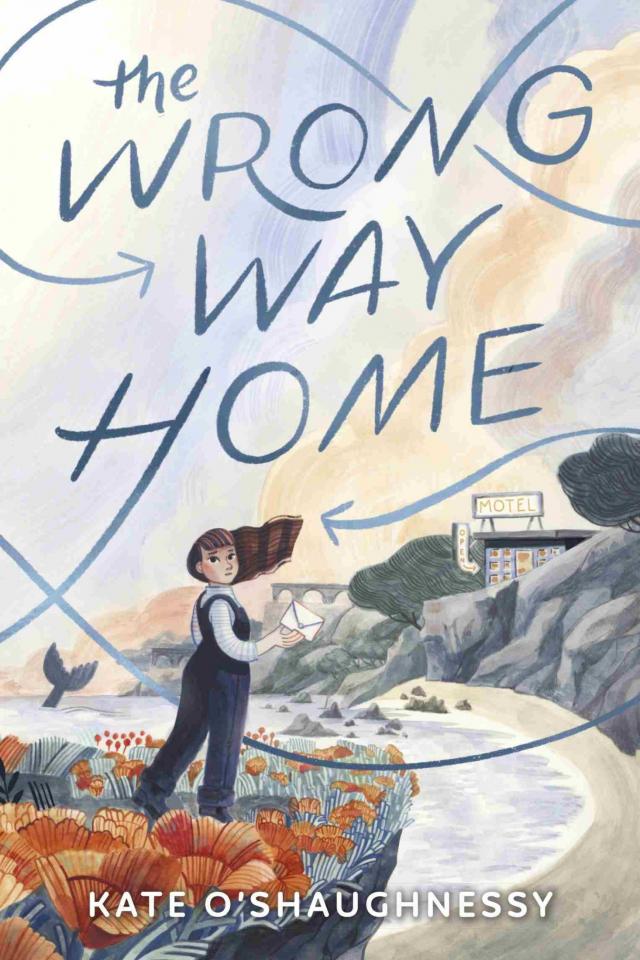
It’s a book. One I’ve never seen before. There’s a picture of a girl on the cover, with a long brown braid down her back. There’s a horse, too, and something flying in the sky. An airplane. I trace my finger over the words at the top. Finding where you belong is always worth the fight.
I read part of the back cover, and immediately I can tell it isn’t the kind of book Dr. Ben would allow in our library. The Ranch doesn’t have books like this, or the kind I remember from when I went to school, with their bright colors and pages full of illustrations and cartoon-like pictures. Not that those books are banned at the Ranch—he’d never put down a rule like that. It’s more that the Ranch’s library is practical, filled with books about permaculture, carpentry, animal husbandry, and some about making your own essential oils, natural cleaning supplies, and body products, and other stuff like that. There are also books written by Dr. Ben himself, which were hand-bound at the Ranch. My favorite is the one he wrote about the six months he spent traveling in the Amazon by riverboat.
Dr. Ben says most books have mainstream society’s misguided ideas about how a life should be lived written right into the fabric of their stories. Even if the stories are fiction. Even if they’re about wizards and witches or other magical stuff. And because of that, he says it’s better to avoid them altogether. Otherwise, you risk forgetting the true danger we’re all really in. Which is why we don’t have these kinds of books back home.
I don’t want to get any of society’s misguided ideas in my head. I want to stay focused. So instead of reading it, I grab a pen and open to the book’s blank inside back cover.
Dr. Ben probably had my rite planned for the spring. Near the spring equinox, to be exact. I know it isn’t a perfect plan, but I feel like if I can figure out a way to get us back before then…maybe I could save this. Maybe I could still save us.
Spring Equinox, I write at the top. March 20th.
Today is January 7. I draw three boxes, and divide those into smaller boxes, until I have a makeshift three-month calendar. I number the days and count them up. Seventy-two. I have exactly seventy-two days until the spring equinox. Seventy-two days to get us back home.
Again, I know this isn’t the most ideal plan ever. It might fail spectacularly. And yet something deep in my gut tells me if I can figure out a way to get us home by then, to be back in time for what Dr. Ben had planned for me, everything will be okay.
After slipping the book beneath the mattress, I lie down on the bed and try to remember everything I can about sending letters. I know where it’s going, obviously. There can’t be too many sustainable futurist communities in New York State called the Ranch, so I feel like that part should be easy.
But the actual sending…I’m not sure. Sometimes I help package things to be sent by mail—homemade mint tooth scrub in little glass jars, knit hats, and things like that. But an adult takes them away to get shipped. I don’t know where or how.
I close my eyes. Alex at the front desk would probably know. Or even Dina. Or maybe I should stop a stranger on the street, so the fact that I’m asking how to send a letter won’t get back to Mom. The idea of talking to a random stranger makes me nervous, but it does seem like the safest option.
Anyway, it’s way easier to focus on the how instead of thinking about what I’ll actually write in the letter to Dr. Ben.
Because how can I possibly explain Mom’s decision to leave when I don’t understand it?
* * *
—
I must fall asleep at some point, because I wake to the sound of the door opening and Mom coming in. The light is a little different outside, too. It’s darker and heavier.
“Sorry. I didn’t mean to wake you,” she says. “Feeling any better?”
I sit up on my elbows. “What time is it?”
“Almost four.” Mom unties the white apron from around her brown dress and tosses it on her bed, and then takes her hair out of its ponytail. “Are you hungry? I can make us something.”
I shake my head.
“Then how about a walk? I’m done for the day, and we haven’t really explored yet.”
“Okay,” I say, sitting all the way up. Despite everything, I am curious to see more of the place she was willing to give up the Ranch for.
The weather’s grown moodier since I fell asleep. Even so, California winter is different from winter back home. The air is chilly and heavy with gray fog, but it’s not so cold that I need to wear my hat.
We leave the car parked where it is and set off through the parking lot on foot. We pass a couple who keep turning to stare at the ocean as they unload black suitcases from the trunk of their car.
“Driftaway Beach isn’t big,” Mom explains. “You can walk the whole thing. It’s only about ten blocks long.”
“How do you know?” I ask. “Have you been here before?”
“A very long time ago.”
“Oh. Have I been here before?”
“No. It was before you were born.” Mom nods to the left. “Come on. I’m pretty sure the main streets are this way.”
And she’s right: Driftaway Beach is tiny. You can walk from one end to the other in about twenty minutes. There are so few trees here. All around us is pavement, ocean, and in both the near and far distance, a coastline of sandy-colored cliffs. It’s nothing like the Ranch, where the untouched land and dense woods stretch for miles. To get to the farthest edge of the property is an hour’s hike.
We walk by store after store. There’s a restaurant called the Seafarer, advertising its “famous” crab sandwich. Little iron tables are crowded together outside, damp from the wet weather. There’s a clothing shop that, according to its colorful sign, sells “knickknacks and accessories.” A tiny grocery store has produce displayed outside, with faded notes marking the prices. As we pass, an older lady in a clear plastic raincoat picks through the display of wilted lettuce.
There’s trash on the streets and sidewalks, too. Lots of it. Smushed paper cups in the gutter, long strands of clear plastic, bits of food wrappers. I flinch every time I see a piece. We barely made any garbage at the Ranch. We composted most of our waste and used it as fertilizer.
As we walk, one shop in particular catches my eye because it’s so…pink. The building itself is painted bright pink, and it has a pink sign in the shape of a teapot that says Birdie’s Tea Shoppe on it in white cursive. A few women are leaving the shop, laughing and chatting with one another.
I start moving closer to the windows so I can see in. I’m curious if the inside is as pink as the outside. But Mom grabs my arm to stop me.
“Let’s keep walking.” Her eyes dart between me and the tea shop. “I don’t want to stop here.”
I pull my arm away from her. “Why not?”
Mom’s eyes don’t leave the shop’s wide front windows. “Because I want to show you something. There’s a pretty path back to the motel that goes all along the ocean.”
“Okay,” I say, relenting. Because walking right next to the water does sound nice. So far, listening to the pounding of the waves has been the only thing that’s helped my brain stop spinning.
The walking path Mom takes me to is a couple streets away from the pink tea shop. It’s pebbly and gravelly under our feet, a mix of beach and pavement. Like the motel’s parking lot, there’s a low wooden fence lining the far side of the road—I guess to keep people and cars from falling into the water, which is fifteen or so feet below us. The water comes directly up to the land. That’s how close the town of Driftaway Beach sits next to the ocean.
I wonder if this feels at all like Florida. I wonder what Meadowlark would think of it. My heart gives a squeeze.
Walking to the left would lead us straight back to the motel. Not too far to the right, the street ends at the base of a huge cliff. It’s so tall that when I crane my head all the way back, I can’t see to the top of it. And it just rises straight up—there are no paths up or anything. There’s only the sheer rock wall of the cliff.
Mom wanders over to a metal stand with words engraved on its top. All around the base of the stand are flowers and candles. I follow her.
“Gosh. I’d forgotten about this,” Mom says, her eyes scanning the words on the plaque. “The Spirit of the Sea. It’s a big deal around here.”
“What is it?”
“A local myth. Or mystery, I should say.” She clears her throat. “ ‘This bluff is the haunting ground of the Spirit of the Sea,’ ” she reads. “ ‘If you’re—’ ”
“What’s a haunting ground?” I ask.
Mom thinks for a moment. “It’s where ghosts live. Spirits. If you believe in that sort of thing.”
I’m not sure if I do believe in them—or what Dr. Ben would say about them—but this seems like the kind of place that might have one. With its misty fog and low-hanging clouds and cold ocean spray that clings to your clothes and hair in tiny droplets.
“Keep going,” I say, pointing at the plaque.
Mom clears her throat. “ ‘If you’re lucky, you might see her in her white dress, with a flickering lantern held aloft, on the very top of the bluff. Some say it’s the ghost of Amelia Lester, the lighthouse keeper, who died in the fire that burned down the lighthouse in 1903. Locals say she was so devoted to her job that she continued it in the afterlife. The story goes that her spirit moved to higher ground to better cast her light, which is said to beckon the souls of drowned sailors back to land, so they can finally make their way home, and find peace.’ ”
She reads more of the plaque silently. “It says that locals claim she appears on particularly dark, foggy nights on top of the bluff, which is inaccessible by foot. If I’m remembering correctly, lots of people have tried to prove that someone is faking it, but no one’s ever been able to figure out how they’d get up there. We should keep our eyes peeled for her.”
“Huh,” I say, because I wasn’t really listening to that last part. Something else has grabbed my attention.
I’m staring at a little building across the street. It has two blue mailboxes out front. The building’s sign reads United States Post Office: Driftaway Beach, California.
Of course.
The blue mailboxes! The memory comes back fast: Mom dragging me to the post office when we lived in Brooklyn. I remember because sometimes there were dogs on the sidewalk I always wanted to pet, but Mom never let me. But the most important part of the memory: we went there to send packages…and letters.
That’s it, I think. That’s where I have to go.
7
Our lives pretty much follow the same pattern over the next week.
Mom and I get up before sunrise so we can eat breakfast together, because her shift starts so early. At first, I wasn’t sleeping well, partly because Mom talks in her sleep. It woke me up the first night or two, and I thought she was trying to tell me something. But then she mumbled about dandelions and rolled over. It’s strange; I’d totally forgotten she did that. Only on the second night did I remember she used to talk in her sleep all the time when I was little, too.
After breakfast, I help her clean the motel rooms, even though she keeps telling me I don’t have to. I make the beds while she does the bathrooms, because I can’t bear to touch the cleaning chemicals. If Mom’s talked to Alex or Dina about making our own safer supplies, I haven’t heard about it.
We don’t talk a lot while we work. Mostly I let my mind go blank and focus on the task. That or I think about what I’m going to say in my letter to Dr. Ben.
We go back to our room for lunch. On our second full day here, we ran out of food from the Ranch entirely, so we started walking to the little grocery store every day after Mom’s shift. Our mini-fridge isn’t big enough to hold a lot of produce, so we get only what we need for the next day or two. It’s strange to see how much out-of-season produce they have there, like underripe cantaloupes and sickly-looking pale red tomatoes. It doesn’t seem right to be able to eat fresh tomatoes in January. We don’t buy any of that stuff, though. We stick mainly to the basics, things we’d be eating at home right now, like oats, winter greens, squash, and eggs.
After lunch, Mom encourages me to hang out in our room. To rest, watch TV (absolutely not), read my new book, do whatever I want. But I always choose to go with her.
“I don’t want you working all day,” Mom says. “This is my job, not yours.”
More than that, I can tell she feels weird about the way the guests look at us—at me—when Mom knocks and says “Housekeeping!” in an upbeat voice and they’re in their room. They tend to give me a funny look, like, Why is there a kid here? I’m always relieved when she knocks and the room is empty, and I can tell she is, too.
But then on our fifth day, she makes me stay in the room after lunch.
“Can I at least go for a walk by myself?” I ask. “I could get us groceries.”
From the walks we’ve taken together, I’ve already memorized the route through town to the post office, so I could get there with my eyes closed. Take Gusty Way two blocks from the motel parking lot, left on Main Street. Right on Moonraker. Then one more left to get to Ocean Road, and the post office is right there. I memorized the street names and even made a map in the back of my book, right next to the calendar.
“No. Not yet. Just—stay in the room, okay?”
“But—”
She puts her hands up. “My answer for today is no. But I’ll think about it.”
Her answer for the next few days is no, too. At least she picks me up some yarn and knitting needles, which I requested the first day she made me stay back. I don’t like knitting—it makes my mind feel itchy—but it’s good, important work. It connects me to what I would be doing at home. I’m working on the same style of sweater that I was making when we left. I’m trying to re-create it as closely as I can, but I’m messing up more than usual. I’m distracted, so I take lots of breaks to open the curtains and look out the window. Yesterday a big crew of men on motorcycles arrived in the parking lot and parked their bikes by the water. They all wore black leather jackets. They spent a few hours laughing and talking before roaring off on their bikes, like a swarm of loud mosquitoes. Lots of guests come and go. Most people seem to stay here for only one night, maybe two.
I like to watch the seagulls wheel and cry. There are some other types of birds I’ve noticed, but I don’t know their names. I listen to the pounding of the waves and try to imagine what kinds of sea animals might be out there, lurking under the surface.
But mostly I feel…empty. Back home, every day is filled with such purpose. And sure, on some bitter cold mornings, especially in the late winter, when there was freezing rain instead of snow, I would dream about climbing into my bed and spending hours there. But now that I can spend as much time as I want lying in bed, it seems…pointless.
* * *
—
On our tenth day in Driftaway Beach, a day after I finish the sweater and have moved on to a new one, Mom surprises me with something.
“Here,” she says over breakfast, handing me a small object. “I got myself one, too.”
I don’t realize what it is until I flip it open and see the buttons on the inside. “A phone?” I snap it closed and immediately toss it on the bed. “I don’t want it.”
“I got you an old kind,” Mom explains. “It doesn’t have the internet or anything like that.”
“I don’t care. I still don’t want it.”
Mom takes a sip of her coffee. The adults don’t drink coffee at the Ranch, only tea. Mom started drinking coffee again on the drive here. I don’t like how fast she switched or its bitter smell. “You know, Dr. Ben has one.”


