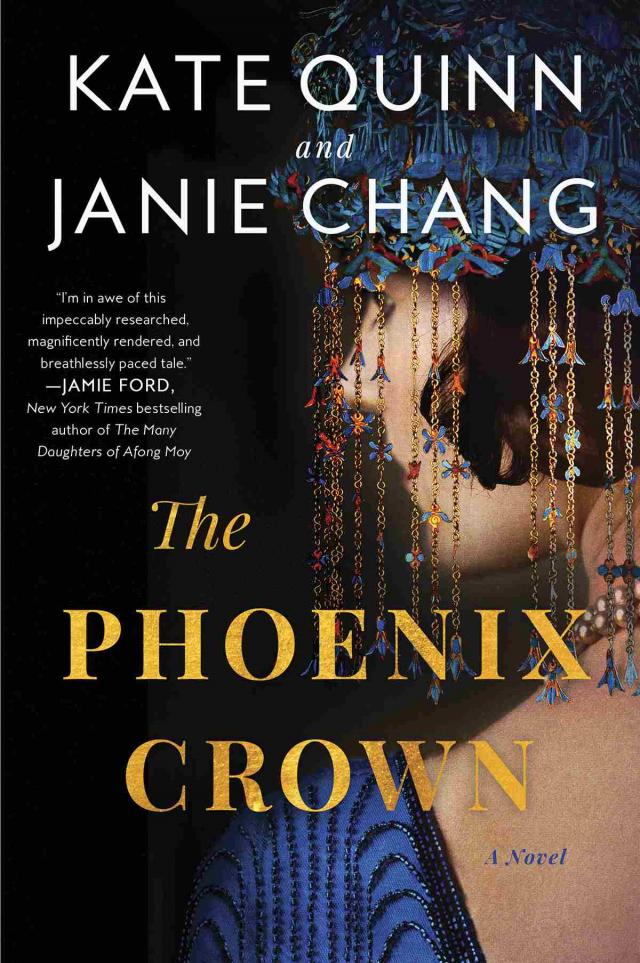
The phoenix crown, p.1
The Phoenix Crown, page 1


Dedication
To Stephen and Geoffrey
Contents
Cover
Title Page
Dedication
Prologue
Act I Chapter 1
Chapter 2
Chapter 3
Chapter 4
Chapter 5
Chapter 6
Chapter 7
Chapter 8
Chapter 9
Chapter 10
Chapter 11
Chapter 12
Chapter 13
Chapter 14
Chapter 15
Chapter 16
Chapter 17
Chapter 18
Chapter 19
Chapter 20
Chapter 21
Chapter 22
Chapter 23
Chapter 24
Chapter 25
Entr’acte Chapter 26
Chapter 27
Chapter 28
Act II Chapter 29
Chapter 30
Chapter 31
Chapter 32
Chapter 33
Chapter 34
Epilogue
Authors’ Note
Acknowledgments
Teaser Announcement The Briar Club
The Porcelain Moon
About the Authors
Praise for The Phoenix Crown
Also by Kate Quinn and Janie Chang
Copyright
About the Publisher
Prologue
Summer 1911
London
“A rose by any other name,” someone quoted, and Alice Eastwood was hard-pressed not to roll her eyes. When it came to Shakespearean quotes about flowers, hang Romeo and Juliet. She preferred Julius Caesar: “Nature must obey necessity.”
Because Mother Nature was a carnivore: she ate what she wanted when hunger made it necessary. Alice had known that in her bones since that day five years ago, when the earth shrugged its shoulders and a city cracked in half.
“You’ve been on quite a pilgrimage of Europe’s gardens and conservatories, Miss Eastwood! Will you return to San Francisco soon?” The question came from the director of the Royal Botanic Gardens in Kew as he trailed Alice toward the Palm House with its great glassed layers like a crystal wedding cake. “I understand you’ve been invited to resume your old position at the California Academy of Sciences—curator of botany?”
“Not yet.” But she knew it was coming, the invitation to help rebuild the lost herbarium. Whether she could bear to accept or not, she hadn’t yet decided, so Alice sped her footsteps to outpace both the question and her companion. She still had the vigor for the work, no question—perhaps she was fifty-two, but she certainly hadn’t calcified with her advancing years: whether heading up a California mountain to investigate a poppy field, hauling herself into a pack mule’s saddle for an expedition in the Rockies, or striding along raked gravel paths of formal gardens, Alice Eastwood was always first on the scene.
No, it wasn’t the vigor she lacked—it was the heart. Set foot on that treacherous San Francisco earth again, after what had happened there?
The director hurried after her, a little out of breath. “The Academy’s herbarium was destroyed during the ’06 earthquake, I believe? Such a loss to science.”
“Yes,” Alice said briefly, eyeing the Palm House as though it were a thorny sample she had to yank out of the ground without her field gloves. She had a little bit of a Thing about conservatories (she wasn’t going to call it a fear) ever since that particular day in ’06, but you couldn’t be a botanist and have a Thing about conservatories, so she squashed it down firmly and strode inside. Ah—the smell of vegetation, warm air, fern fronds. Life. The sun twinkled through the glass panes overhead, paths wound under shading palms, and she thought she could smell the elusive scent of orchids. “You have a sample of Encephalartos altensteinii I was interested in seeing . . .”
“Yes, this way. Someday I’m hoping to lay hands on an Epiphyllum oxypetalum, but—”
“A Queen of the Night?” Alice didn’t often veer away from proper scientific names—it felt mildly rude, like addressing a woman by her nickname when you hadn’t yet been formally introduced—but Epiphyllum oxypetalum was special.
“Yes!” The director of the Royal Botanic Gardens brightened, tugging on his whiskers. “I’ve never been lucky enough to lay eyes on one, much less in bloom. Difficult when it only flowers for one night, eh?”
“I’ve seen one bloom.” Alice could see it now: a white, exotic blossom opening slowly in a dark room, almost seeming to cast its own light, emitting a heady and indescribable fragrance. She remembered her fingers trembling as she touched one exquisite petal, remembered the look on the faces of the women around her. Four women who could not have been more different, united in vast, wondrous awe around the miracle of that flower. Miracle had not seemed too momentous a word, after what they had endured.
“Where did you see . . .”
“Oh, a long time ago.” Alice fiddled with the Zeiss lens hanging around her neck on the same chain as her spectacles, bringing it up to her eye to examine a spot on a palm leaf. “Let’s see that Encephalartos altensteinii.”
Later, having said her goodbyes, after being introduced to a dozen botanists and trading addresses for correspondence (“I know of your interest in the Genista genus, Miss Eastwood, and would be happy to send you some samples!”), Alice wandered the lawns outside the Palm House, clapping a hand to her flower-laden hat to keep it from blowing away in the summer breeze. The hat had come from Paris, made by a master embroideress at the Callot Soeurs atelier: the only remotely fashionable touch on a woman who would always rather carry a plant press than a velvet handbag. Her stride along the path was still brisk, but she hadn’t outpaced the question after all: Will you go back to San Francisco?
Alice found a bench nearby and sat, picking up a discarded newspaper and fanning herself. Later she thought how random that was: she never read the society pages; and she shouldn’t have seen that article at all. But the abandoned paper had been folded back on one of those gushy social columns, the sort that breathlessly reported which ball Lady So-and-So had attended in a gown of pale green liberty satin and an eight-strand pearl collar, or which earl’s daughter had married in a cloud of mousseline and Valenciennes lace . . . Only it wasn’t a description of a gown or a ball that caught Alice’s eye on this bright summer morning.
—phoenixes carved in rare blue-and-white jade—
—fifty-seven sapphires and four thousand pearls—
—butterflies fashioned out of kingfisher feathers—
—carved ivory Queen of the Night flowers—
And she found herself reading, fingers clenched so tight the newsprint crumpled in her grip. Reading it once, twice, her hands shaking. Putting it down at last, staring blindly over the children bowling their hoops and the strolling women in their white summer muslins. Instead of banks of blowsy roses she saw a wall of flame, and instead of twittering birds she heard the crystalline shatter of glass.
She rose, not bothering to formulate a polite apology as she approached the first top-hatted gentleman hurrying past her bench. “Excuse me, sir, I don’t know London at all well. Where would I go to send a telegram overseas?” The man stared at her uneasily before rattling off some directions, and Alice didn’t blame him. She was drenched in icy sweat, white-faced and trembling—Alice Eastwood, who had not trembled as she climbed a railing six stories high over a shattered atrium in the old California Academy, who had laughed when she was nearly swept over a waterfall to her death at Cataract Gulch but struggled out of the river with a handful of wet plant samples instead.
Alice Eastwood, afraid?
Very, she thought as she hurried out of Kew Gardens, already parsing her words for that telegram. Three telegrams, actually. One to New York, one to Buenos Aires, one to Paris . . . but all beginning with the same four words.
The Phoenix Crown
Found
Act I
Chapter 1
April 4, 1906
Thirteen days, fourteen hours, fifty-two minutes before the San Francisco earthquake
The birdcage was starting to squawk and vibrate indignantly on the seat, so Gemma Garland lifted the cover a crack and spoke down into it. “Almost there, I promise.” The woman who had just settled into the seat opposite shot her a look, but Gemma had been traveling all the way from New York in a third-class compartment—she was travel-stained, weary, feeling every one of her thirty-two years, and certainly well beyond caring about censorious looks. Especially looks from hatchet-faced schoolmarms in navy bombazine and mouse-colored toques. Women like that had been giving Gemma looks since she was twelve years old.
“Chilly day,” the woman finally said. She’d been moving from compartment to compartment with a stack of pamphlets, and Gemma already had a wary feeling about where this conversation was headed. “Stopping in San Francisco, are you?”
Why, no, Gemma considered replying. I’m just going to keep riding the train straight into the bay. There wasn’t any farther west to go than San Francisco, was there? “Yes,” she answered, lacking the energy to be acerbic. The train was already racketing through the city outskirts; she wouldn’t have to endure this stuffy cigar-stinking compartment or its nosy occupant much longer. “Yes, San Francisco,” she murmured.
“It’s a godless place,” the woman tutted. “Rotten with sin and depravity. Full of painted harlots, heathen Chinee, and wicked millionaires.”
Just t he town for us! Gemma imagined her oldest friend, Nellie, laughing. Nell’s first letter from San Francisco, in fact, had said much the same thing: It’s a rollicking sort of place—San Francisco’s made its fortune, so now it’s mad to improve itself. Galleries, theaters, mansions . . . not to mention rich men lying around everywhere like lumps of gold, just waiting to be picked up!
“I hope you won’t be staying long, dear,” the woman opposite continued. “The Cesspit of the West is doomed, you know. Prince Benjamin has foreseen it.”
“Mmm,” said Gemma, not asking who Prince Benjamin was, but that wasn’t going to save her, she could just tell.
“Patriarch of the Flying Rollers of the House of David,” the woman said. “In Benton Harbor, Michigan.”
“Benton Harbor, Michigan, is that so.” Explains the mouse-colored toque, Gemma thought.
“The patriarch himself sent me here. I am to warn the people of San Francisco to give up their ways of vice—” Clearly nothing was going to shut the woman up, so Gemma fell back on stagecraft: chin on hand as if fascinated, widening her big blue eyes until they nearly clicked in doll-like innocence. The same expression she always donned when singing Olympia in The Tales of Hoffmann, right before she launched into “The Doll Song,” and it always brought down the house. “—if they don’t renounce their vile sinning, God will bring fire and earthquakes down upon them,” the woman opposite finally finished up her rant. “Within the month.”
“Goodness, fire and earthquakes.” Still wide-eyed. “Wouldn’t one or the other be enough?”
“The ground shall break apart beneath their hell-bound feet by May, if they do not repent!”
“How lucky I’m only staying through the end of April,” Gemma murmured.
The Flying Roller looked her over, clearly approving of Gemma’s plain traveling suit in London smoke cloth and ebony braid. “Visiting family, dear? I do hope it’s not misfortune that brings you so far.”
“On the contrary, I’m making my debut.”
“Debut?” The Flying Roller blinked. “Into society?”
“Oh, no.” Gemma knew her peach-fair skin was still good, and her Nebraska-corn-blond hair didn’t need any tinting yet, but no one was ever going to mistake her for eighteen. “On the stage! I’m an opera singer.” The woman recoiled as if she’d been confronted with a viper, and Gemma threw out her biggest, most glittering smile. “I’m making my debut with the Metropolitan Opera traveling company in two weeks, on the boards of the Grand Opera House—in Bizet’s Carmen, in fact, opposite the great Caruso.”
Praise be, that finished off the Flying Roller, who slapped a tract down on the seat and moved on to the next compartment with a great deal of muttering.
Not quite true, though, is it? Gemma’s thoughts whispered, once she had the compartment to herself. You aren’t exactly making your debut opposite Caruso.
“Close enough,” Gemma said aloud, picking up the tract. She was making her debut; it was with the Metropolitan Opera traveling company; it would be in Carmen; and Caruso would be throwing that glorious golden tenor across the footlights at her . . . along with the rest of the chorus, because that’s where Gemma was making this great debut: in the chorus. Laced into some cigarette-factory-girl bodice, swishing some Spanish petticoats. Maybe she’d get a bit of stage business in the tavern scene, get to flutter a fan at the bullfighter.
It’s still the Met, Gemma thought. It’s still Caruso. But the chorus, oh dear. Not exactly where a girl wanted to be at thirty-two, when she wasn’t really a girl any longer. When she was headed into the absolute prime of her voice, her best singing years . . . By then you hoped you’d have made it out of the ranks of cigarette factory girls.
“By this time next year, you will be.” She said it aloud to the empty compartment, adopting the steely tone of the matron in Red Hook, Nebraska’s only orphanage. Gemma knew very well that steeliness did not come naturally to her—that was the trouble with having the sort of farm-raised childhood that involved cows and plains and white-steepled churches, not to mention parents who raised you with the belief that being kind and generous to everyone you met would ensure a good life. It wasn’t until age fourteen that the farm, the cows, and the parents had all gone, and Gemma landed at the orphanage and realized just how wrong those early lessons were. The plain fact was, the only person a woman could rely on was herself, and she’d better be hard-nosed about it because otherwise she’d end up alone, humiliated, and stony broke.
Gemma shut her eyes hard against that particular train of memory before it could progress too far down the last few horrible weeks in New York, and skimmed the Flying Roller’s tract with its lurid illustrations. (Thunderstorms, billows of hellfire; cracks in the earth opening up to swallow a crowd of shrieking San Franciscan sinners.) A new beginning, that was all she needed.
And a little bit of a holiday, too. Caruso and the rest of the company were on the road and wouldn’t be arriving in San Francisco for another fortnight. I’m being sent to replace a chorus soprano who’s quitting after the Kansas City run to marry her beau, Gemma had written Nellie several weeks ago. I’ll join the company when they arrive in San Francisco, and start in Carmen. I hear we’re opening for the cream of San Francisco society (does San Francisco society have a cream, exactly? Surely they do, if they can afford Caruso’s fees!). Anyway, why don’t I come out early? I haven’t seen you in nearly a year, and to be quite honest, I need a good dose of your unshakable optimism. I’ve had such a horrible time lately, Nell, you can’t imagine. I don’t just need your optimism, I really need you.
Darling Nellie was a patchy correspondent—her letters sometimes stopped coming for weeks or months, whenever she disappeared into some new passion or project—but she’d answered that letter at once. Of course she had, because Gemma’s oldest friend might be scatterbrained and disorganized but she knew desperation when she heard it. Hop the next train to San Francisco and come stay with me while you wait on Caruso, farm girl, she’d written in her backhand scrawl. I don’t know what’s gone wrong for you lately, but I promise we will fix everything. I’ve got a room on Taylor Street on Nob Hill; it’ll be just like bunking together in the Bronx when we were wide-eyed greenhorns. Only with fewer roaches!
Gemma smiled, thinking of that squalid cold-water apartment where they’d first met. Nellie had been a tall bony brunette of sixteen, brandishing an artist’s sketchbook and a roll of brushes, throwing words like cubism and perspective around like jabs from her sharp elbows. Gemma had been plain Sally Gunderson, nineteen and a year out of the orphanage and terrified that the set of pipes in her throat wouldn’t be good enough to make a splash in New York, even if they could nearly lift the steeple off the church in Red Hook—but even more terrified of being a hired girl with milkmaid calluses for the rest of her life, sleeping on a pallet in the cellar and getting the belt when she didn’t work fast enough. She and Nellie had sized each other up as they stood in that roach-skittering Bronx apartment, both of them trying so hard to look like jaded professionals and not scared girls, and Nellie had been the one to burst out laughing.
“I don’t have a clue what I’m doing,” she confessed with one of her big infectious grins. “And I don’t think you do, either, farm girl. Except that we both need new names, because who’s going to take us seriously in this city with handles like Nellie Doyle and Sally Gunderson?” And they’d picked out new names on the spot—though to each other, even now so many years later, it was still Sally and Nell.
Oh, Nell, Gemma thought. What would I do without you? She hadn’t been able to write about all the unpleasantness that sent her fleeing from New York (the shouting and the contemptuous gazes and the shame, no, don’t think about that, not right now), but she could tell Nellie about it once they were face-to-face. Nellie would understand. She was the one person in the world who could be exempted from the general rule that everyone in the end would just let you down.
The train began slowing with a great screech of wheels. Gemma hastily folded up the Flying Roller’s tract, cramming it through the bars of the birdcage. “Enjoy,” she told Toscanini, lowering the cover again and reaching for her handbag. She had arrived.