

Undercurrent, p.19
Milo March #13, page 19


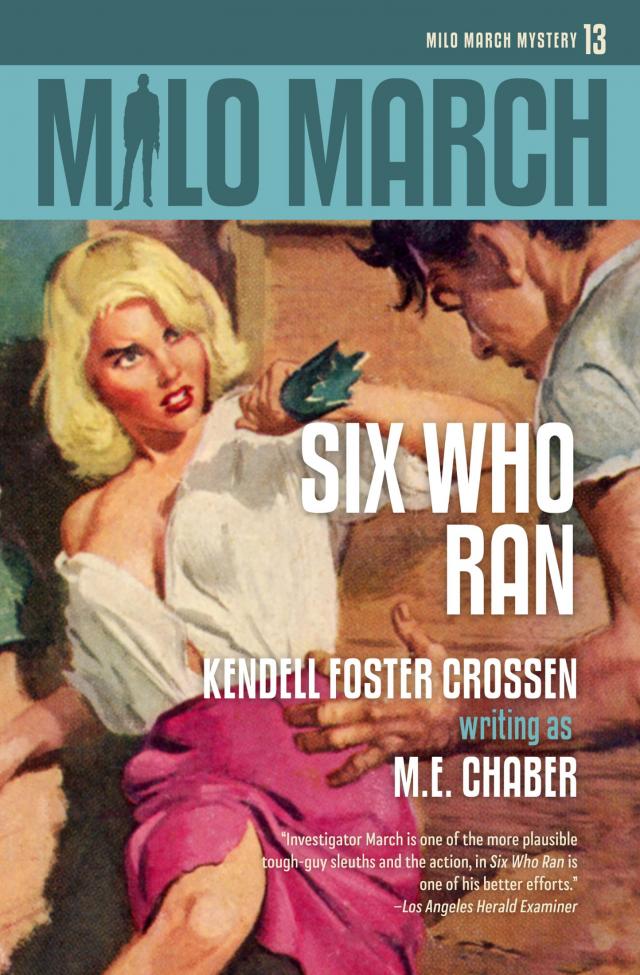
Six Who Ran
by
Kendell Foster Crossen
Writing as M.E. Chaber
Steeger Books / 2020
Copyright Information
Published by Steeger Books
Visit steegerbooks.com for more books like this.
©1992, 2020 by Kendra Crossen Burroughs
The unabridged novel has been lightly edited by Kendra Crossen Burroughs.
All rights reserved. No part of this book may be reproduced or utilized in any form or by any means, electronic or mechanical, without permission in writing from the publisher. The scanning, uploading, and distribution of this book via the Internet or via any other means without the permission of the publisher is illegal and punishable by law.
Publishing History
Hardcover
New York: Holt, Rinehart & Winston (A Rinehart Suspense Novel), July 1964.
Toronto: Holt, Rinehart & Winston of Canada, 1964.
Roslyn, NY: Detective Book Club #272, Walter J. Black, Inc., 1964. (With The Laughter Trap by Judson Philips and The Departure of Mr. Gaudette by Doris Miles Disney.)
London: T. V. Boardman (American Bloodhound Mystery #498), 1965.
Paperback
New York: Paperback Library (63-380), A Milo March Mystery, #10, July 1970. Cover by Robert McGinnis.
Dedication
As another scribe once said:
It seems she hangs upon the cheek of night
As a rich jewel in an Ethiop’s ear;
Beauty too rich for use, for earth too dear!
Before
Storm King Mountain reared in all its grandeur above Newburgh, Cornwall, Highland Falls, even the majesty of the Hudson River, and finally above West Point, until its peaks flirted with the clouds that came down for a closer look.
The armored truck, looking like a small replica of the mountain’s strength, left Highland Falls and started over the mountain for Newburgh and its next stop.
It had barely started up the mountain when a state highway truck pulled up. Two men got out, lifted a heavy sign from the rear of the truck, and placed it in the center of the road. The sign announced Road Closed for Construction. The men trudged back to the truck and returned with a smaller sign, which they placed beside the road. This one simply said Detour. An arrow pointed to an alternate route. The men went back to the truck and drove away.
The armored truck passed the West Point gate and wound up into the mountain. It rounded a hairpin turn, and the driver braked. There was a State Police car parked across the road, its red light blinking. A state trooper walked over to the armored truck, flashlight in hand. He waited patiently until the driver opened his door.
“What’s wrong, officer?” the driver asked.
“A bad accident just around the curve,” the officer said crisply. “My partner is there and we’ve already phoned for an ambulance, but we need some help before it gets here. Can you give us a hand?”
“I guess so,” the driver said. He looked at the man beside him. “Let’s go, Jim. Lock up.”
The state trooper waited patiently while the two men got out of the truck and locked the doors. When they turned to face him, he had his gun out. He shot them both before they even had time to show surprise. As they fell to the ground, the door of the police car opened and another man got out.
“Hurry up,” the man in the trooper’s uniform said. He bent down and took a ring of keys from the dead driver.
They dragged the two dead men over to the police car and loaded them in the rear seat. They took a suitcase out of the car and opened it. From it, they pulled two uniforms exactly like the ones worn by the dead men. They changed quickly, putting their other clothes into the suitcase and tossing it into the armored truck. Then they started the motor of the police car, put it in drive gear, and watched as it rolled over the side of the mountain. It was a long time before they heard the final crash from below.
They walked back to the armored truck and climbed in. They drove for about a mile and then turned off on a weed-infested road that had been the original path over the mountain. They drove slowly over the old road for about four miles. Then the headlights picked out two cars parked among the trees, beside the road. The armored truck stopped in front of them and its lights went off.
The two men got out of the truck and opened its rear door. They were joined by two figures from the parked car. The four of them quickly and quietly took the bags from the truck and loaded them into the two passenger cars. They drove away, leaving the truck behind.
When they reached 9-W, they followed it to Route 32, then turned south. They reached Mountainville and took Taylor Road. They followed the winding road until they reached the top of the hill. There were no houses near, but there were two cars parked with their lights out. The approaching cars blinked their lights and were answered by the lights of the parked vehicles.
The two approaching cars parked behind the others. Once more the bags were shifted, but this time there were six people to do the work, so it took even less time. When they were finished, they took rags and carefully went over the doors, the steering wheels, and the instrument panels of the cars they had driven to this place. When they had done this to their satisfaction, they closed the doors, being careful not to leave fresh fingerprints. They got into the other cars, three to each one, and drove off.
The whole thing had taken less than an hour. …
One
March. Milo March. That’s me. At least, that’s what it says on the door of my office on Madison Avenue in New York City, and nobody’s given me an argument about it since it was put there. The rest of the legend on the door says that I’m an insurance investigator. My license says that I’m a private investigator. So does my gun permit. I guess they’re all correct.
It was a quiet morning. I had the morning Times and a container of coffee. My feet were on the desk and all was right with my world at the moment. Then the telephone rang. I let the paper drop to my lap and picked up the receiver.
“Hello,” I said.
“Milo, boy, how are you?” a hearty voice asked. I recognized it at once. It belonged to Martin Raymond, a vice-president at Intercontinental Insurance. It probably meant a job, so I was respectful, but not too much so.
“I’m not sure yet,” I said. “It’s only my second cup of coffee.”
“Coffee?” he said mockingly. “I thought you always started the day with a dry martini.”
“Only when I’m on an expense account,” I said evenly. “This is my own money I’m spending now.”
“Good.”
“What’s good about it?”
He chuckled. “It means that you’re not too busy at the moment, and I think I have a job for you.”
“You think?” I said. “Call me back when you’re sure.”
“Wait a minute,” he said. “Can you run over here for a minute?”
“No,” I said. “I might walk over, or take a cab, but I’m getting too old to run.”
“Maybe I should look for someone younger,” he said, and I could tell he thought he’d scored a big joke, “but come over as soon as you can.” He hung up.
I finished my coffee and threw the container in the wastebasket. I went out and took a taxi up Madison Avenue. If he had a job for me, there was no reason to walk.
Intercontinental Insurance has its own office on Madison Avenue, one of those new peekaboo buildings made of glass and concrete. I rode up to the fifteenth floor, where all the executives were caged. The reception room was a good clue to where their money went. The carpeting on the floor, the modern art on the walls, the modernistic furniture, were all as lush as they could be, but they faded into nothing when the receptionist was sighted. She was a beautiful redhead with measurements that would have made Anita Ekberg look like an underfed orphan.
She recognized me, but didn’t let on. “Yes?” she said.
“I’m glad you said that,” I told her solemnly. “I’ve been waiting for months for you to say that one word.”
She gave me the benefit of a small smile. “Do you want to see Mr. Raymond?”
I sighed. “I don’t want to, but I guess he’s about all I will see.”
That wasn’t really quite accurate, for there was a beautiful view as she leaned over the telephone. She announced that I was there, waited a minute, then replaced the phone.
She looked up at me. “You may go in, Mr. March,” she said.
“Fine,” I said. I looked down at her. “Take a deep breath.”
Without thinking, she obeyed.
“Beautiful,” I murmured.
She got it then. She exhaled, her face taking on a touch of pink. “What was the idea of that?”
“Blame it on Vic Tanny,” I said gravely. “He wants all of us to stay fit.”
I left before she could think of an answer. I walked down the long corridor and turned in at Raymond’s office. His secretary greeted me with a smile and motioned for me to go on in. I opened the door to the private office and stepped inside.
It was a nice office, furnished with antiques, including a cobbler’s bench and an old cupboard that had been converted into a bar. The original owners must have been turning over in their graves.
“Hi, Milo,” he said, looking up. “Glad you were able to get here.”
“It was tough,” I said, dropping into the chair beside his desk. I lit a cigarette. “Madison Avenue was covered with slogans, and I didn’t think we’d get through.”
“That’s my boy,” he
Martin Raymond was a great one for remarks like that.
“Are you free for a job?” he asked.
“I can take a job, but I’m not free.”
He sighed. “When were you ever. This is a tough one, Milo.”
“When did you ever give me any other kind? What’s the case?”
“A week ago,” he said, “an armored truck was picking up money from banks to be delivered to the Federal Reserve. In Upstate New York. The truck made a pickup in Highland Falls and started over the mountain for Newburgh. It never got there.”
“A heist?”
He nodded. “The two guards were found three days later, over the side of the mountain. Both had been shot, placed in a car disguised as a state police car, and run off the road. The armored truck was found on an old road that hasn’t been used in years, leading down from the mountain. There was no money in it. No fingerprints either. State highway signs had been placed at both ends of the regular road over the mountain, so that no one would come along and interrupt the thieves. It had been well planned.”
“How much did they get?”
He sighed again. “One million dollars in cash. No records on the bills. Plus about a half million in securities and bonds. Those will be more difficult to get rid of.”
“Clues?”
“None.”
“Sounds like a juicy one. You carried the insurance on it?”
“On all of it, cash and securities and bonds.”
“Do you have any more information?”
He shook his head. “That’s it. Oh, I can give you the name of the man in charge of the investigation for the State Police. He’s Lieutenant Paul Haynes. You can have the file if you like, but there’s nothing else in it.”
“It sounds like the kind of case that you always give me,” I said. “A hundred a day and expenses?”
He nodded. “And a bonus if you succeed. I think I can promise you it’ll be a big one.”
“Depending on how much money I recover,” I said ironically. “Okay, Martin, I’ll take it. When do you want me to start?”
“As soon as you can.” He looked as if he were suffering pain. “I suppose you want some expense money?”
“Naturally,” I said cheerfully. “You don’t expect me to spend my own money, do you?”
“How much?”
“We’d better start with about two thousand.”
He winced.
“You know damn well, Martin, that this is not going to be a short case. Anybody smart enough to walk away from a job like that without leaving any clues is not going to be found in a day or two. So you better plan on the two thousand just being the first installment on expenses.” He knew that I was right, but it didn’t make him look any happier.
“All right,” he said. “See my secretary and she’ll give you the authorization. Keep in touch.”
“Sure. I’ll be in touch as soon as I need more expense money.”
I gave him my best smile and left. I stopped beside his secretary’s desk. She looked up.
“I can see the triumph in your eyes,” she said. “You made him part with some more money.”
“Two thousand dollars,” I said. “A man needs cigarette money and carfare.”
“What kind of car? A Rolls-Royce?” She scribbled on a memo and handed it to me. “You know the way to the cashier? You ought to. You’ve been there more often than anyone in the company.”
“I always speak well of you,” I said, taking the slip. “Besides, I’ll take you to the best lunch in town as soon as I come back.”
“Promise her anything, but give her a hotdog,” she said.
“You have no gratitude, woman,” I said stiffly. “I give my all for dear old Continental and all I get are insults. Oh, well …”
She laughed. “Milo, you’re a con man. Run along and get your loot. I’ll be busy. Every time you take a case for us, Mr. Raymond is a nervous wreck until the case is over and the expense vouchers have been filed away.”
“It’s good for him,” I told her. “It’s the only excitement he ever gets. I’ll see you, honey.”
I went down the corridor to the cashier’s office and presented the memo. In return, I received a pack of nice, crisp money, which I put in my pocket.
I went back to my office and left word with my answering service that I would be out of town for an indefinite period. Then I took a cab down to my apartment on Perry Street. I packed a bag and took another cab to a car rental agency. A few minutes of time and a few dollars, and they put me in the driver’s seat. I drove up the West Side Highway, crossed the George Washington Bridge, and turned right on the Palisades Parkway. I knew the way, for I had worked on a case only a few months earlier that had terminated in that same area.
The drive took about an hour and a half. When I reached Cornwall, I stayed on 9-W toward Newburgh. I stopped at the first likely motel, registered, and left my bag. Then I drove on to the nearest restaurant. It was already noon. I went in and had a couple of martinis and some lunch. Then I drove to the State Police barracks. There was a sergeant on duty at the desk.
“Lieutenant Paul Haynes,” I said.
“Who wants to see him?”
“I do.”
He didn’t like that. “Who are you?”
“Milo March.”
“Why do you want to see the Lieutenant?”
“About a case he’s working on.”
“What case?”
I smiled. “I’ll discuss it with him, if you don’t mind.”
“We’ll see,” he said darkly. He picked up the phone and pressed a buzzer.
“There’s a man who says his name is Milo March and he wants to talk to you about a case you’re working on. He won’t say what the case is.” He listened for a minute, then hung up. He looked at me. “He’ll see you. Second door down the hall.”
I nodded and walked down the corridor. I reached the second door and opened it. The Lieutenant was a pleasant-looking young man, his appearance similar to all other state policemen. It was probably the uniform.
“March?” he asked.
I nodded and stepped inside, closing the door behind me.
“Insurance dick,” he said, as though he had a file on me inside his head. “You were up here on a case about a year ago. Lieutenant Pilus didn’t think you were very cooperative.”
“I’m flattered,” I told him.
He gave me a mechanical smile. “It’s my job to know what goes through here. What do you want this time, March?”
“The armored truck job. I understand that you’re in charge of it.”
He nodded. “What’s your interest in it?”
“I work for Intercontinental Insurance. They carried the policies on the entire million and a half.”
“That’s a nice sum of money. I gather that your company doesn’t believe the New York State Police can solve the crime?”
“Not at all,” I said. “We may have some slight suspicion that the case has moved outside of your jurisdiction.”
“There are other state police and city police, all of them quite competent.”
I sighed. “I’m aware of that, Lieutenant, having worked with most of them at one time or another. Intercontinental Insurance is not worrying about whether the police are competent or not. They are worried about their money—a million and a half dollars. It’s a habit they have. And sometimes I can work on a case and not have to worry about crossing state lines—or even national borders. And I always cooperate with the local police, no matter where I am.”
“That wasn’t the impression I had from the report on your last visit.”
I lit a cigarette and looked at him. “I didn’t write the report. I brought in two wanted men. When one of them was on the point of killing me, I could hardly ask his permission to call Lieutenant Pilus. And if you’ll check the newspaper stories, you’ll find there is no mention of anyone named March and there are quite a few of the good lieutenant. What the hell am I supposed to do? Hold his hand, too?”
He laughed. “Well, one thing in the report was right. It said you operated on a short fuse. What do you want to know, March?”
“I’d like to know what you’ve found out so far.”


