

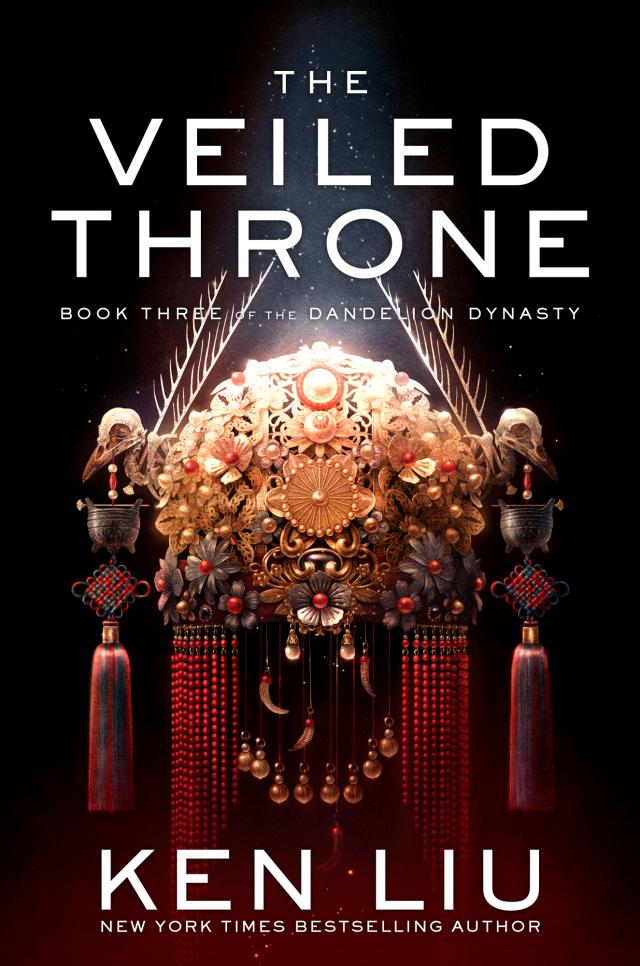
The veiled throne, p.67
The Veiled Throne, page 67


CHAPTER THIRTY-THREE TREASURE
MEANWHILE, IN KRIPHI.
Goztan came to see Vocu Firna at his tent.
The servant, an old native who kept his eyes on the ground, tried to convey in broken Lyucu the idea that his master was not home. The nervousness of facing a garinafin-thane made him stutter and lose command of the foreign tongue, and his whole body shook like a leaf in the wind.
“Where can I find him?” Goztan asked in Dara, trying to keep her voice gentle.
But instead of calming the old man, her effort only seemed to frighten him more. Without speaking, he sank to his knees and touched his forehead to the ground before Goztan again and again.
Goztan sighed. The old man must have thought she was trying to trick him. Cutanrovo’s “purification packs,” roaming bands of naros, culeks, and zealous native soldiers hoping to prove their loyalty to the Lyucu, were known to speak Dara to natives they accosted and then kill them on the spot if they answered back in the forbidden language.
She knelt down in front of him. “I think Thane Cutanrovo is a fool,” she whispered to him, still in Dara. “You don’t have to speak, just draw me a map of where to find your master.”
The mention of a map brought to mind Savo, her son. She hoped that he was all right in his life among the pirates. In her desperation, she had prayed to the gods of Ukyu-taasa, and the idea of rescuing him and sending him into exile had come to her in a flash. She couldn’t even articulate, to herself, why she had given him the turtle shell, except a vague sense that the shell’s carver would perhaps protect the boy in his native land.
She shook the thought away. Savo was on his own; she had to focus on the present.
The old man touched his forehead to the ground a few more times. Then he drew a map in the earth with his finger.
Goztan had barely enough time to read the map before they were interrupted by loud childish voices.
In one quick motion, Goztan wiped away the map and turned around. A gang of children, most of them eight or nine years old, was marching through the street. They held bone clubs and axes that were far too large for them, and some of the younger children staggered as they tried to keep up. Before the gang strode two naros leading a string of shuffling native prisoners shackled to a chain. Some of the prisoners appeared to be peasants, while one or two looked like scholars, perhaps former court-appointed tutors.
The children chanted as they marched.
We strengthen our limbs and hearts with the sweet blood of our enemies.
We purify our spirit with the lamentation of our prey.
Dara-raaki must be destroyed!
The prisoners, their feet bare and bloody, shuffled along listlessly, their glassy eyes showing no expression, not even despair. The children, however, chanted every syllable with fervency and ardor, their eyes burning with a wild flame.
With a start, Goztan saw that Todyu Roatan, Tanvanaki’s eldest, was among the children.
“Where are you taking them?” asked Goztan of the naros.
The naros, surprised to see her, stopped to salute. “We’re taking them hunting, votan. Thane Cutanrovo thinks the children need more practice to prepare for war.”
Goztan recognized many in the gang as children of prominent thanes. A few faces were new to her, but based on their resemblance to others in the group, she realized that they must be previously unacknowledged fruit from unions between Lyucu thanes and native slaves or lovers. One of Cutanrovo’s stated goals was to ensure that the togaten were brought up in as Lyucu a manner as possible, so these children had been taken away from their native parents to be brought up in Kriphi.
Since it was the custom of the scrublands for even very young children to learn to hunt, Goztan supposed that this hunting party was part of Cutanrovo’s program of remedial education.
“Are you going for hare or geese?” asked Goztan. “This is a good time of the year, but you’ll need slingshots.”
“Oh no,” said one of the naro, laughing. “We’re bringing the prey along.” She pointed at the chained prisoners.
A chill seized Goztan’s heart. “What do you mean?”
“Thane Cutanrovo thinks the children have been coddled too much,” said the other naro. “They’ll grow up to be tanto-lyu-naro unless they get real experience. We’ll release these Dara-raaki once we get outside the city and let the children have a go at them.”
Goztan could hardly believe what she was hearing. “You are asking the children to kill defenseless prisoners?”
“Eventually we may allow the prisoners some weapons for realism,” said the first naro. “But for a first practice session we don’t want to risk injuring the kids. The prey are hobbled so that they can’t outrun the children, and Thane Cutanrovo has promised extra servings of sheep sponge to whoever bashes in the first skull.”
Fury and disgust rose in Goztan’s heart. Cutanrovo’s plan was a perversion of Lyucu custom. On the scrublands, young Lyucu learned to fight by defending the tribe against real enemies, not by murdering starved prisoners.
She grabbed the chain to which the prisoners were bound. “That isn’t going to happen. I’m taking over these prisoners now.”
The naros looked at each other and then turned back to her. “Votan, we’ll have to report this to Thane Cutanrovo.”
“Do whatever you have to,” said Goztan. She turned back to the children. “If you want to learn to fight, come to me anytime and I’ll teach you. But preying upon the defenseless teaches you nothing. It isn’t the Lyucu way.”
* * *
The map drawn by the old servant led to Vocu Firna’s old mansion, the one he had had to vacate once Cutanrovo shamed all the Lyucu into abandoning native dwellings.
With the prisoners tagging along after her—Goztan had no idea what to do with them—she approached the naros guarding the door of the mansion. The naros had fought under Vocu Firna for years and knew of the friendship between their votan and Goztan. They nodded at her and allowed her in.
For a while, Goztan waited in the foyer, but Vocu didn’t come to greet her. A constant thudding inside the mansion aroused her curiosity. Following the noise, she went into the cellar, taking the prisoners with her.
She found Vocu leaning against a spade in a pit in the middle of the cellar, along with several other naros and culeks.
Vocu was startled to have visitors, but his tense face relaxed as soon as he saw Goztan.
“I come to speak to you about Cutanrovo’s destruction of native fields,” said Goztan. As the unusual sight of a Lyucu thane with a farming implement finally sank in, she asked, “What are you doing? Digging… a well?”
Vocu chuckled bitterly. “Burying treasure.”
“I never knew you to care for gold and jewels,” said Goztan.
“Not that kind of treasure.”
Vocu pointed at the boxes and crates stacked along the wall of the cellar. By the unsteady light of the torches, Goztan saw that the crates were filled with silk scrolls, paper codices, zamaki figurines, bronze ritual vessels, paintings, statuettes of native gods, and similar objects.
“I rescued these from the homes of the native officials denounced as traitors by Cutanrovo,” explained Vocu.
Goztan browsed through the crates and held up a scroll with a wax seal imprinted with a stylized image of a Mingén falcon. She quirked an eyebrow at Vocu.
“All right,” said Vocu. “Not everything is from the homes of the officials. Maybe a few of the objects are from the Temple of Kiji—er, of Péa.”
“It’s all right; Cutanrovo isn’t around,” said Goztan. “But this is forbidden! If she finds out what you’ve done—”
“I can’t help it,” protested Vocu. “That scroll contains the only known example of calligraphy by Lady Datha, Emperor Mapidéré’s mother. The codex by your hand was one of the notebooks of Kino Ye, inventor of the Dara airship. These are irreplaceable treasures.”
“These may be priceless treasures to the natives, but what do they have to do with you?” Goztan suppressed her growing impatience. “You know we cannot risk a confrontation with Cutanrovo right now. She’s at the height of her powers, and all we can do is to stay out of her way until she overreaches. What if she brings you down with this act of disobedience the way she tried to bring me down with Savo? How can you—”
Vocu grabbed her hand and pointed at the prisoners cowering behind Goztan. “And is that your way of staying out of her way?”
Goztan sighed. “I just couldn’t help myself. To see the defenseless die for no purpose, to hear her filling the heads of children with perverted traditions—”
“And now you know how I feel,” said Vocu. “I may not be a native, but these scrolls and codices are no less sacred than our voice paintings and spirit portraits. Look, put your hand on them. Can’t you hear a whisper of the voices of their ancestors or feel a tremor of their breath? It’s evil to burn or desecrate these, as terrible as the killing of the defenseless.”
Goztan recalled how, in her youth, as a captive of Captain Dathama, she had been so enraged to see the voice paintings abused by the Dara, and how much effort she had gone through to restore them to their families. She ran her hand over the scrolls and codices, and seemed to hear ancestral voices murmur in the dark.
“I got the idea to bury the treasure from the pirates we’re always dealing with,” said Vocu. “No one will think to look down here. Someday, if we’re lucky, our children’s children, who will be truly of Dara, will be glad to have these.”
Goztan nodded. She picked up a spade and jumped into the pit to dig alongside Vocu and his followers.
“I get the feeling that you’re also digging down here in part because you don’t want to be outside,” she said, pausing to wipe the sweat from her brow.
“It’s a depressing sight out there, isn’t it?” said Vocu. “Sometimes I just want to hole up down here and chew a few tolyusa berries. Forget about all the folly Cutanrovo is committing.”
As tolyusa was important for military and ritual purposes, its recreational use was generally forbidden in Ukyu-taasa, but more than a few thanes were known to engage in the habit in secret.
“Don’t give in to the urge,” said Goztan. “You need a clear mind to face reality.”
“There are times when I think you and I are the only ones sober.”
They said no more as they put their backs into the digging.
* * *
Tanvanaki tore up the demand letter she had just written.
No. To ask for more tribute is madness. It’s like shouting at them how weak we are.
But what else could she do? The storms had left pestilence and plague in their wake, and many heads of cattle had fallen sick. With so many naros and culeks drafted by Cutanrovo into her roaming purification packs to harass the natives, some cattle that could have been saved had died due to lack of care. And now Cutanrovo was leading troops in war games in farming fields, trampling crops and ruining the livelihoods of entire villages. There would be starvation in the fall if she didn’t demand more food from the Big Island.
She had thought of having Cutanrovo assassinated. The nameless spy, for example, could cut her throat in her sleep. But the very idea of turning on a Lyucu, a thane who had given so much of her life for the hope of a better future for her people, revolted her. This wasn’t a contest of succession; Cutanrovo was, in her own twisted way, trying to do what she thought was the best for the Lyucu, the same as Tanvanaki, the same as Tenryo.
What would my father do if he were still alive? What would my brother do if he were here?
In the old dance stories, Afir or Kikisavo had always known what to do. But she wasn’t Afir or Kikisavo. She wished it were easier to discern the waybones leading to the right path.
Reluctantly, she picked up the writing knife and began to reheat the wax. She had to redraft the stern demand to Jia to increase the tribute, yet again.
CHAPTER THIRTY-FOUR THE BLOSSOM GANG
GINPEN: THE FOURTH MONTH IN THE NINTH YEAR OF THE REIGN OF SEASON OF STORMS AND THE REIGN OF AUDACIOUS FREEDOM (TWENTY-FIVE MONTHS UNTIL THE REOPENING OF THE WALL OF STORMS).
“—one steamed carp, a plate of four-season dumplings, mashed taro with lotus seeds, and a flask of warm rice beer—”
“—honored masters and mistresses. Come back soon! And do remember the promotion—”
“—the sauce of the day is bean paste with pine nuts and crushed ice, with just a hint of honey—”
“—I’m so sorry, but we’re out of wild goose eggs today. I can recommend—”
The Splendid Urn was a hubbub of activity at the height of lunch service. Even Kinri, whose Dasu-accented speech normally meant he could only help in the kitchen or perform clean-up duties, had to fill in as a temporary, extra waiter.
Even as he ran up and down the stairs, greeted and bowed to the guests, shuttled stacks of empty plates and bowls and trays filled with the fragrant, well-flavored-but-light-in-the-tummy fare the Urn was famous for between the steamy, hot kitchen, the cool, breeze-filled private suites on the third floor (merchants discussing business, wealthy patrons wishing to impress a date, and groups of students vying to impress a famous teacher), the four- and eight-person square tables and sitting mats on the second floor (families and friends), and the big round tables and benches on the ground floor (anyone in a hurry or who couldn’t afford the prices charged on the upper floors), Kinri couldn’t help but be consumed with thoughts of the rider on the startled horse.
Since the muscle-bound actor needed to stay behind to help his partner secure the equipment, Kinri had brought the young woman back to the Urn by himself. Upon arrival, she asked if she might see the Grand Mistress.
“The Grand Mistress rarely sees visitors,” said Kinri apologetically.
“Would you bring her a message then?” said the woman. “Tell her… the daughter of an old friend is here.”
“Who shall I say is the old friend?”
The young woman looked thoughtful. Then she smiled. “Fin Crukédori.”
Then she waited with her horse under the parasol tree outside while Kinri went to deliver the message.
No one in the whole restaurant, not even Teson Wasu, the manager and Widow Wasu’s son, could ever recall seeing the Grand Mistress run as fast as she did a few minutes later, heading straight for the parasol tree like a harpoon boat chasing after a dome-headed whale, leaving even her two maids far behind on the stairs. Kinri and the other staff members watched the unfolding scene with growing astonishment.
Widow Wasu bowed in such a deep jiri that she almost fell on her face. “Oh, it is you! I can see his face in yours—though you’re much better looking. Prin—”
“Please call me Dandelion, Granny Wasu,” said the young woman, hurrying to lift the old woman by her shoulders.
“How can I possibly—why, Your High—”
“No, no!” said Dandelion. “I insist. Please, just treat me like a granddaughter.”
“That would never—”
Dandelion went up to the old woman and whispered in her ear. Widow Wasu’s eyes widened and she tsked sympathetically, patting Dandelion’s hands. “Oh, you poor thing—”
“Oh, there is one more thing,” said Dandelion. “I believe my father left a tab unpaid at the Splendid Urn back in Zudi. As his daughter, I’ve decided to clear this family debt.” She took out a heavy purse and stuffed it in Widow Wasu’s hands.
“Oh…” Widow Wasu looked stunned. Then she laughed. “You may be his daughter, but I think I like you a lot more.”
Widow Wasu tried to bow to the young woman several more times until Dandelion threatened to kneel down to her in front of everyone. Only then did Widow Wasu reluctantly straighten up. She barked orders for servants to clean out the best suite of rooms in the owner’s residence for “Supreme Mistress Dandelion” and insisted that the kitchen prepare special meals for her six times a day.
“Er, please don’t go to such trouble, Granny. A small guest room is more than adequate—”
“Nonsense! Look at how all the walls of my humble establishment are glowing just from your presence!”
After Dandelion told Widow Wasu what had happened at Temple Square, the old mistress thanked Kinri profusely for his bravery and for bringing honor to the Splendid Urn. She gave him a bonus equivalent to two months’ wages, and dispatched a team of footmen to find the actor to give him his reward, and to invite him and his friends to come to the Splendid Urn for a meal.
All the waiters and waitresses clapped Kinri on the shoulders to congratulate him. Kinri blushed, muttering that it really was nothing, anyone would have done the same.
No one knew who Dandelion was, though there was plenty of speculation. Was she the daughter of some important official? Did her family once benefit Widow Wasu in some way lost in family lore? The young woman mentioned the name “Fin Crukédori,” and the Crukédoris were once prominent jewelers in Zudi, but that family had long since fallen into ruin, and Dandelion didn’t look like she was short on funds.
Kinri, unfamiliar with the history of the Wasu clan, had nothing to add to the gossip among the staff. All he wanted was to see that fearless face, to hear that heart-calming voice.
Kinri was awakened from his reverie by an impatient growl. “Waiter!”
The speaker was a man in his thirties, sitting at a table next to the window on the second floor. His expensive water-silk robe, bright blue with a thick border of golden threads, looked far too ostentatious for the tasteful, plain bamboo walls of the Splendid Urn. A pair of sharp, narrow eyes peeked out of an oily and fleshy face, and a thin excuse for a mustache curled above his lip like a fuzzy caterpillar. The overall effect was of an arrogant man who was used to having others cater to his whims. He curled a finger at Kinri.
Kinri rushed over. “How can I be of service, honored master?”
“This fish soup is absolutely horrid!” said Caterpillar Mustache in a booming voice. “Smell the pipe scallions: as rancid as cow-trampled grass!” Other customers turned to gawk, and the man, as though pleased with the attention, raised his voice even more. “Observe the bean curd cubes: falling apart as soon as my eating sticks touch them! Taste the broth, it’s like your grand mistress’s foot-bath water!”


