

The hidden queen legends.., p.1
The Hidden Queen (Legends of Abreia Book 3), page 1


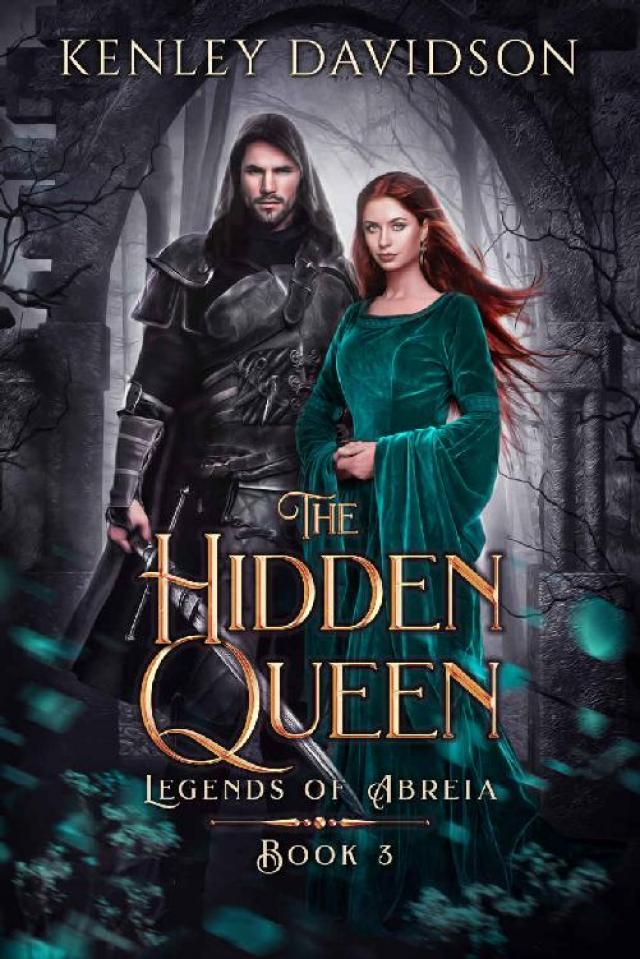
THE HIDDEN QUEEN
LEGENDS OF ABREIA - BOOK 3
KENLEY DAVIDSON
PAGE NINE PRESS
Copyright © 2021 Kenley Davidson
All rights reserved.
Published by: Page Nine Press
Edited by: Theresa Emms
Cover Design by: MoorBooks Design
This is an original work of fiction. All characters, names, places, and incidents are products of the creative imagination of the author or are used fictitiously. Any resemblance to actual persons (living or dead), businesses, institutions, places, or events is entirely coincidental.
No part of this book may be used, reproduced, scanned, or distributed in any manner without the written consent of the author, excepting short quotations used for the purposes of review or commentary about the work.
http://KenleyDavidson.com
For C.
Because facing the truth of our own stories may be the bravest thing we will ever do.
CONTENTS
Prologue
Chapter 1
Chapter 2
Chapter 3
Chapter 4
Chapter 5
Chapter 6
Chapter 7
Chapter 8
Chapter 9
Chapter 10
Chapter 11
Chapter 12
Chapter 13
Chapter 14
Chapter 15
Chapter 16
Chapter 17
Chapter 18
Chapter 19
Chapter 20
Chapter 21
Chapter 22
Chapter 23
Chapter 24
Epilogue
Author Note
Thank You
Books by Kenley Davidson
About the Author
Acknowledgments
PROLOGUE
After that day, she would forever associate crowds with grief.
Before her mother’s death, Evaraine had not known there were so many people in all of Farhall. And perhaps, normally, there were not. The palace had certainly never before overflowed with quite so many foreign visitors as on this solemn occasion, all wearing unfamiliar clothing, speaking in unfamiliar accents, and expressing their false condolences in smooth, hushed tones.
A few, she thought, seemed genuine. A tall, grim man in a cloak—wearing the dark greens and grays of Eddris—caught her eye and nodded gravely in a stiff but kind acknowledgment of her pain.
There was a woman, too—from the faraway Throne of Katal—whose eyes betrayed her with genuine tears as she pressed King Soren’s hand between her own.
Perhaps she had once known Queen Talia, before the mysterious illness that had confined the queen to her bed for the past seven years. Evaraine understood, in a hazy, distant way, that her mother had come from Katal many long years ago to marry the King of Farhall. Theirs was a political marriage, but not an unhappy one.
But those two mourners were outnumbered by the many—the voracious, bright-eyed pretenders—who had only come because there would be a spectacle, and because it might benefit them to be seen.
Their avarice hurt.
Everything hurt, and Evaraine’s heart most of all, because her mother—the only one who understood her—was now gone. Because she had to stand up in public and mourn with restrained politeness while she longed to run away and be alone with her pain. Because she felt utterly ignored at the same time that she wished someone would hold her and comfort her.
And because the bright and burning sparks of all those lives, all that energy, tugged at her and begged her to give in. Whispered for her to simply surrender to the dark emptiness that lived within and allow it to take what it wanted. What it needed. She could be strong, healthy, and free, if only she would stop fighting.
She must never stop fighting. Or people—her people—would die.
So she stood by her father’s side, shaking with the effort of remaining upright, unemotional, regal, and reserved. Thankfully she did not have to touch anyone. At barely ten years old, she was only required to be present—a princess, but never a person.
Until the man in red.
He was older, somewhat gray and grizzled and stern of mien, but when he saw her, his eyes did not skip over her as nearly everyone else’s had. Instead, he withdrew a folded, sealed paper from a pouch at his belt and held it out. Not to her father—to her.
“Your Highness,” he said gravely, “I am Barten, ambassador of His Majesty, King Melger of Garimore. I bear with me a letter from His Highness, Prince Danric, who wished to express his sympathies on this tragic occasion.”
A letter? For her?
No one had ever written her a letter before. What would it say? Why had Prince Danric written it?
But a princess did not betray her emotions—including curiosity—so she accepted it gravely, inclined her head in acknowledgment, handed the letter to the maid standing behind her, and remained in her place.
And so that day dragged on, for all the interminable hours until the guests had passed by—their condolences received, and their presence noted.
Only then was she allowed to slip away, almost stumbling with weariness, to return to her rooms and take the medicines her father insisted upon. He’d never listened when the queen told him they would do no good. There was no medicine for what ailed her.
But once she was tucked in bed, surrounded by quilts, with a single lamp burning and her most trusted maid sitting quietly in the corner, she allowed herself to pick up the letter from where it rested on her night table.
The paper was somewhat bent from the distance it had traveled in the ambassador’s pouch, but the wax seal was intact. And her name… It was indeed her name written on it in a strong, precise hand. Had Danric written that too? It looked like the writing of an adult, not a boy, but then, he was quite a bit older than she. Perhaps sixteen, and nearly a man in many ways.
She broke the seal and unfolded it cautiously, unable to even guess at what it might contain. Almost afraid to read it.
She did not want to be disappointed again. Did not want to learn that it contained more of the pompous, insincere sentiments she had endured over the course of that miserable day.
To Her Highness, Princess Evaraine of Farhall,
I must begin with my apologies for a message that may be unwelcome in this time of mourning. However, Her Majesty, Queen Portiana, has expressed an earnest desire that I write to you. I consider myself bound by her wishes in this matter, and hope that your patience with words of comfort from one completely unknown to you will prove greater than I apprehend it to be.
After learning of your loss, I did wish to express my sympathy in person. However, as my father’s heir, it was considered unwise of me to join the party traveling to Farhall at this time. This letter, therefore, will have to serve in place of my intentions.
I do not know what it is like to lose a parent (nor what it is like to be a girl), so I will not waste your time with false protestations of understanding or shared grief. I cannot truly comprehend the bleakness and misery of such a loss and refuse to pretend otherwise for the sake of politeness. However, as the heir to my father’s Throne, I believe I can share in what must be your wish for greater privacy in relation to those matters of the heart that strangers have no place in. Solitude in which to weep, to grieve, to rage, or to exult—this luxury is not granted to those in our position, and for its lack, I can only express my deepest sympathies.
My father says it is for the best. That we must learn early to bear the burdens expected of us without wavering or faltering, and I know he speaks only the truth I must hear. So perhaps my wish for you ought to be that you will be able to grow from this moment. That you will find it within yourself to bear the truth without flinching and face the future as a stronger version of the person you once were, now forged in the flames of deepest adversity.
However, perhaps I am not as strong as I should be, because my true wish for you is otherwise. Despite my father’s admonitions, I hope only that you will find solitude in which to grieve and yet not feel yourself to be utterly alone. Perhaps in our position, it is our destiny to feel so, but loneliness seems to me to be the heaviest burden a king or queen must face.
If these sentiments are unwelcome or bring only additional sorrow, I beg your forgiveness.
Respectfully,
Prince Danric of Garimore
Evaraine found herself staring at the page, mouth open, blinking a little in the lamplight as she read it again.
How perplexing.
He’d been rather rude, and yet… he’d also been honest. And strangely thoughtful.
Danric of Garimore was clearly a very strange boy.
It had dashed her hopes when she realized his mother had forced him to write to her, but his sentiments made her feel something warmer than the icy emptiness of her loss. Even while claiming he could not understand her, he also seemed to know precisely what she most needed.
A way to grieve in private and yet not feel alone.
To her surprise, Evaraine discovered that she didn’t feel quite so alone anymore. It was only a piece of paper—only a single tenuous thread of connection to a boy she might never meet, but it was more than she’d had only a few moments before. A tiny ray of light in the darkness.
Folding the paper neatly and smoothing it with her fingers, Evaraine tucked the letter beneath her pillow and lay back wi
th a sigh.
Her very first letter. It was not perfect, but it was hers and hers alone. Perhaps it made her silly and weak, but she suspected she would treasure it forever.
And maybe… just maybe… she would write back to the perplexing Prince Danric of Garimore.
At the very least, she could express her gratitude. Whether Prince Danric would welcome it or not, she owed him that much.
And maybe she would also tell him how rude he had been, so that he would know not to write such things in the future. Maybe she could explain to him what it was like to be a girl, so he wouldn’t be so confused about something that was really quite simple. And perhaps, as they were both the heirs to their Thrones, he wouldn’t mind if they exchanged letters. What would it be like to have a connection with someone she need not fear, because she would never see or be close to him?
But that was only her foolishness talking. She did not dare to dream of friendships. She was a princess, and a cursed one at that. She could never be honest with anyone, and so could never ask them to trust her.
For Evaraine of Farhall, the only possible life was one of solitude and secrets.
CHAPTER 1
It was an unacknowledged truth that life’s least comfortable moments nearly always began with a lie.
“Turn, please, Your Highness.”
Evaraine turned, a shuffling rotation to the left. From somewhere deep within the smothering folds of silk, a pin grazed her ribs, and she reflected wryly that she was lying even now.
Her complacence and serenity? A lie.
Her apparently biddable nature? An even bigger lie.
The unspeakably hideous wedding dress presently being adjusted by the seamstress? Well, one could hardly accuse lace of perpetuating untruth, but the dress was a kind of lie. Evaraine had no intention of being married in such a monstrosity. Her future husband was, by most accounts, monstrous enough.
But she had learned early the importance of concealing such thoughts, and so she remained still. Prayed that her strength would be sufficient to see her through the day. She had only to stand until this fitting was complete, and then she could sit.
If she recalled correctly, she’d been summoned to tea with the queen and certain select acquaintances this afternoon. It was merely a different type of exertion, but if she were being truthful with herself, Evaraine was rather looking forward to it.
For the past few weeks, she’d been confined to her suite in the palace at Hanselm—a velvet and brocade cage in which to recover from the strain of her cold, wet journey. Her maids, as expected, had been dismissed, so she’d been almost entirely alone.
Not that loneliness was unfamiliar. Despite the near-constant presence of maids, ladies-in-waiting, and either Zander or Leisa, Evaraine had spent much of her life feeling isolated and friendless. Perhaps that was why she was looking forward to even the anticipated hostility of the Garimoran courtiers.
“If Your Highness would raise your arms, then lower them to your sides,” the seamstress muttered around a mouthful of pins.
Evaraine complied, but gingerly. It felt as though a hedgehog had been trapped in her bodice, and she had no desire to provoke it. Were she to bleed on such a blinding expanse of white fabric, the seamstress might never forgive her.
And she might not be the only one. Evaraine still wasn’t certain her father had forgiven her for the actions that had brought her here.
After that explosive confrontation in King Soren’s own throne room little more than a month ago, she’d had scant few days to prepare before embarking on the long journey to Garimore. Not nearly enough time to confront her father and fully explain her decisions. Afterward, though, confined to a carriage with the few of her ladies willing to make the trip, she’d been given plenty of time to reflect on the wisdom of her actions.
To save her people, she’d promised to marry a complete and utter wastrel, thereby forming an unbreakable alliance with a kingdom that posed an unmistakable threat to Farhall’s sovereignty. And to make good on that promise, she’d come all the way to Garimore to prepare for her wedding, which King Melger of Garimore was unwilling to postpone even a day longer than necessary. He might have lost the opportunity to conquer Farhall directly, but the foothold this marriage gave him would eventually amount to the same thing.
Unless Evaraine could somehow manage the impossible—negotiate for herself and her people with a proud, violent, ambitious king determined to bring her kingdom under his own rule.
And she had no one to help her. No experience, no preparation. Like Leisa before her, she’d come to do what no one in their right mind would expect her to accomplish.
Not to mention, she must do all this while completely unprotected. No Zander, no Leisa. For the first time in her life, there was no one to stand between her and any physical threat, nor anyone to rescue her from the vicious undercurrents of a hostile court. No one to tell her she was too young, too weak, and too innocent to face the darkness.
There was but one thing working in her favor—facing down the darkness was very nearly all she knew how to do.
Well, perhaps two things in her favor. She could hardly get married when her betrothed was still nowhere to be found.
“Your Highness?” The voice from behind her was cultured and even, firm but not commanding. Designed to blend in and be in no way remarkable. “If your fitting is nearly finished, I’ve come to escort you back to your suite. I believe it is time to prepare for Her Majesty’s tea.”
Evaraine did not turn to acknowledge the voice. Not because she intended to be rude—she simply had no desire to be impaled on any of the numerous pins now protruding from her bodice.
“Thank you, Lady Piperell,” she replied quietly, trying to avoid even taking a deep breath. “Please wait for me in the antechamber. I will accompany you momentarily.”
The lady withdrew on nearly silent feet, and Evaraine forced herself not to sigh. She had done her best to prepare for the many people who would expect her to remember them. Expect her to think, speak, or behave in ways entirely foreign to her own habits and personality. But one of the most unnerving was the woman assigned as her lady-in-waiting.
Lady Piperell was likely twice Evaraine’s age and still unmarried. Her black hair was lightly silvered, but her warm, tawny-brown skin remained unlined, and her dark-eyed gaze was direct. Most significantly, she was perhaps even more efficient at hiding her thoughts than Evaraine herself.
Did Lady Piperell know that the woman she’d met months earlier was not actually Evaraine but her bodyguard in disguise? Was the plainly dressed former courtier actually a spy for King Melger?
Leisa had not known those answers either, so Evaraine had no choice but to be wary.
Wary of everyone. Of Lady Piperell, of the maids assigned to her, of the guards around every corner, of the vaguely smiling queen, the harsh-featured king, and of… him.
She most especially had to be wary of him.
The seamstress had begun to loosen the ties holding up Evaraine’s bodice when a rather loud knocking sounded from the antechamber—the door to the corridor, most likely, being pounded upon with unexpected violence.
Presumably it opened, because a deep voice said, “Where is she?”
Evaraine took careful hold of herself—her expression, her mood, and her magic alike—as a hastily murmured conversation took place in the chamber on the other side of the door.
She might have been worried that she was about to be surprised in dishabille, but the intruding voice was far more familiar than it ought to have been. And if there was one thing she was sure of, it was that the owner of that voice would never open the connecting door without permission.


