

Doc savage 163 the e.., p.1
Doc Savage - 163 - The Exploding Lake, page 1
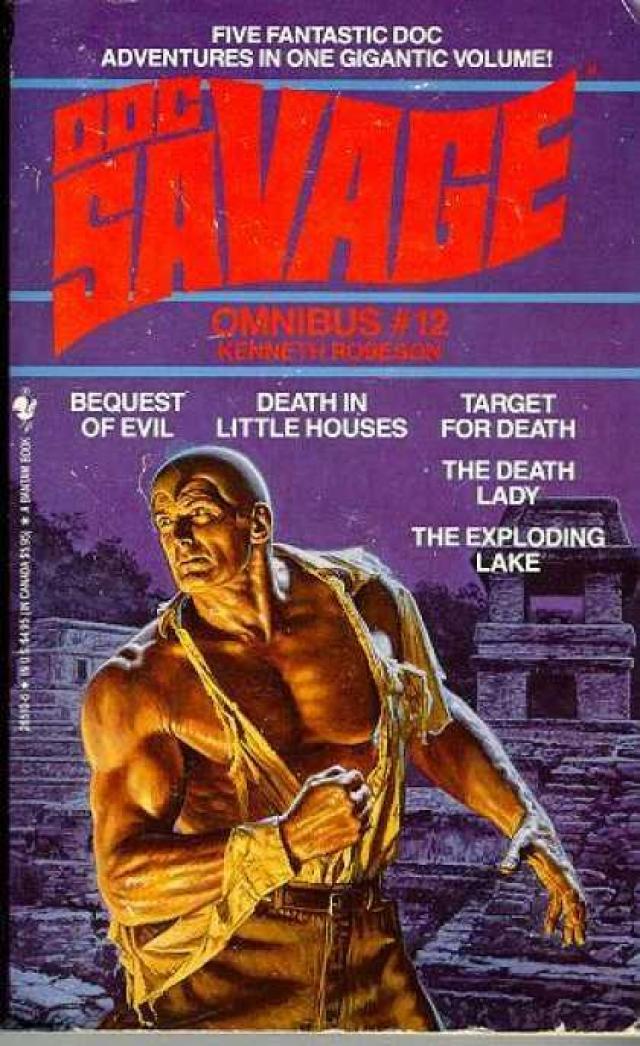


163 - The Exploding Lake
By Robeson, Kenneth
Table of Contents
Doc Savage 163 - The Exploding Lake
by
Kenneth Robeson
Chapter I
Chapter II
Chapter III
Chapter IV
Chapter V
Chapter VI
Chapter VII
Chapter VIII
Chapter IX
Chapter X
Chapter XI
Chapter XII
Chapter XIII
Chapter XIV
Chapter XV
THE END
Doc Savage 163 - The Exploding Lake
by
Kenneth Robeson
Chapter I
FROM the Negros River southward to Beagle Channel, distance measures somewhere near a thousand miles, and the cross-span measured from Carmen de Patagones to Point de Corral is somewhat less, about six hundred miles. Transplanted on to the United States, the dismal area would cover a triangle roughly with its three corners at New York City, Chicago and Key West, Florida.
Of a part of this godforsaken region the Encyclopedia Britannica has this to say: "From Lake Buenos Aires southward, the Andes are known in detail only on their eastern border. Two great fields of inland ice fill all the central part of the cordillera from about 46° south latitude to 51 ° south latitude. From these ice-fields great glaciers flow down to the lake region on the eastern border of the cordillera and to the fjords of the western border. At the time of writing this article these ice-fields have never been crossed, although the southernmost field has recently been penetrated to some distance by expeditions working in from Lake Argentino and Lake Viedma..."
Juan Russel, while he was no expedition--he was one man, two mules--could perhaps have added to the description, and certainly his words would have made it less forbidding. Juan had a romantic heart, an inheritance from his Spanish mother; he also had a practical streak, drawn from his father, a man from Kansas who had been a particularly good mining engineer. From his Castilian mother, Juan Russel drew a love of beauty and the arts. His father had sent him to Rolla School of Mines, which was in Missouri, not too far from Kansas, so Juan was a good metallurgist.
Juan Russel looked a little like a bum, it should be said here; but he had quite a wide name in his profession in South America.
Where Juan got his idea of humor was a question, but it was probably from American comic strips. His humor was of an obvious sort. He had, for instance, christened his pack mules Andy and Uncle Bim. Andy, who was perverse and unpredictable, carried the tools and what equipment that could not be broken easily. Uncle Bim was used for the provisions, the necessities. You could depend on Uncle Bim as much as it was safe to depend on a Patagonian mule. And Andy would follow Uncle Bim.
Uncle Bim--the mule was not all angel--suddenly balked. With feet planted and head down, he stopped at the crest of a hill.
"Get going, you blank-blank so-and-so," Juan urged. He did not have much confidence in the profanity. He jabbed a thumb in Uncle Bim's ribs, and that didn't get results either.
Beneath them a couple of thousand feet, then outflung for miles, lay an irregular plateau, its surface dotted with a series of small lakes. The view was imposing. Juan Russel paused to gaze at it, for he liked this country--he liked the view down there, although it was far less imposing than what he had seen recently. He had been skirting the edges of an almost inaccessible and little-known glacier, and it was lovely country. The practical side of him had made wondering note of huge waterfalls, with their promise of unlimited power. He had found indications of oil formations, not exactly oil--but could be. And he had been interested in ore outcroppings. This country, Juan thought, will be a hell of a place, some day.
He walked around in front of Uncle Bim and prepared to strike a match. Uncle Bim was impressed by fire. A lighted match in front of his mule-nose--it didn't need to touch him--would cure him of a balk.
Juan made the first pass at the match with his thumbnail. The results were more impressive on Juan than the mule. First there was a blinding, an incredible, glare of light. Juan peered, half-blinded, at the match in his hand. It was un-struck. It had not caused whatever had happened.
"What the hell!" Juan gasped.
Then came the blast. Powerful, it shook the hill itself--then the sound, and the sound was enough to paralyze the eardrums for a few moments.
"Earthquake!" thought Juan. He flung himself flat, a good thing to do when there was an earthquake, he had heard.
Presently, he said stupidly, "No earthquake!" and sat up and looked around.
He saw, down below in the comparatively level pampas, a gigantic billow of dark smoke that was growing and mushrooming as it lifted into the sky. The proportions of the thing were astounding.
Uncle Bim, the mule, was regarding his owner with admiration. Apparently he thought one match had caused all this, and he was impressed.
The mule stood with docility while Juan got out his binoculars and took a look at the base of the smoke column.
As nearly as Juan could tell, there should have been a small lake at the base of the smoke plume, and it was not there.
Juan was a scientist, as all metallurgists are to an extent, and presently the fear began to touch him. He didn't like what he saw. He continued to watch the lake, or rather the stupefying absence of a lake. Unquestionably, where water had been, there was a blackened depression, and the surrounding area was bare of vegetation and trees which should have been there.
The item that contributed as much to crawling horror as anything was the absolute lack of human life in the vicinity. A volcanic eruption? Not at all. There was no crater, no fuming, and after all it wasn't volcanic territory. An explosion? Yes, an explosion, but of an eerie sort.
"Atom bomb!" Juan thought. "Oh, hell! It can't be. There would be observers around. And it would have come from an airplane." He rolled on his back and scanned the sky for a plane, and found none, although the binoculars were good.
He shivered. Presently he arose and started descending the slope, which was in places cliff-like. Both Andy and Uncle Bim were unusually uncomplaining, as they moved toward the scene of whatever had happened.
FOUR days later Juan Russel led his mules into Piensa de Blanca, a small village which was on the outskirts of nowhere, even in Patagonia.
"El telefono?" said the first native he accosted. "It is miles to nearest, many miles. Say, stranger, you are in a bad shape, no?"
"A telephone," Juan mumbled. "I gotta get to a telephone." He said this in English, then translated it into Spanish when he saw the native's open mouth. "Yo querer telefono!"
"Friend, it is trip tough to nearest telephone," said the native. "What you need...rest. Eh?"
Juan Russel, it was obvious, needed rest. But he needed something else much more, and that was peace of mind. The old Juan, the guy who was a good romantic Spaniard and a hard-headed American businessman, and a practical humorist, too, was gone. He was no more. He was terribly lost.
"Got to reach telephone," Juan mumbled, and set the gaunt mules in motion.
He collapsed, though, at the end of the street, and they brought him back to the local hotel. There was a bar in connection, and they took him in there to put some soup inside him. But first they put in a shot of hard liquor.
Juan did not intend to talk about what he had seen. But, as soon as the liquor was in him and working, there was a battle between his inherited instinctive taciturnity--from his father--and his naturally garrulous mother's Latin temperament. He was stewing with what he had seen anyway, and he could no more have kept quiet than a fish could keep from swimming.
At first, it didn't make much difference. The peons thought he was crazy. A nutty prospector had wandered into town; the same sort of thing that happens in little desert towns in Arizona and Nevada and all the way up to the Klondike.
Furthermore, few of the peons in this isolated village had any idea what he was talking about. Juan was a scientist, and regardless of his looks--particularly, now, his condition--an erudite and learned man. He was too incoherent to use non-technical terminology, and so most of the peons merely decided he was loco and let it go at that.
Presently they got some soup into Juan, and he fell over in a stupor of exhaustion. They put him to bed, and the hotel proprietor, naturally wondering whether he was going to get paid for food and meal, looked in Juan's pockets. He learned the man was Juan Russel--and the name of Juan Russel, prospector, metallurgical research man, was known here.
Talk went through the village, as it naturally would. The talk became garbled--the things Juan had mumbled drunkenly mixed themselves up ludicrously--but eventually it reached the ears of a man who wore a blue shirt, and who was staying at the Casa Negros, the Black House, a rooming-house which was genteel in spite of its name.
"Juan Russel, eh?" this man said. "What did you say he saw?...Spontaneous disintegration....The beginning of the end of the universe, you say...Crazy? Oh, sure he's crazy. I wouldn't know." He beckoned Señora Coliz, the proprietress. "Vino blanca," he ordered. "By the way, I shall leave early, Señora. Very early. I will pay you now, so I need not awaken you when I leave."
He went out presently and filled the tank of his car with gas.
He left about two o'clock in the morning, headed in the general direction of Buenos Aires.
JUAN RUSSEL, somewhat refreshed-- although very tight of tongue--left in a rented automobile about eight o'clock the following morning. He left behind him in the village the impression that he was about the most terrified man who had ever visited the place.
Around noon, Juan reached his first fair-sized town. It had telephonic connection--of a poor sort--with another town, and then another town, and eventually with Buenos Aires. Juan placed a call. He got the next town, and was informed he could not talk to Buenos Aires--or to New York, which was where he wanted to talk. Line down.
"Listen," Juan said desperately. "Listen, Operator. If the lines are repaired, get me--I mean, get hold of Doc Savage, in New York City. Tell him it is Juan Russel calling him on a terrible, an infinitely terrible matter. Tell him to be available for my call, which I will attempt to place. I am heading on toward Buenos Aires, any place I can find a telephone line. Tell Doc Savage that." He was extremely earnest. "El Señor Doc Savage, Ciudad Nueva York. Estados Unidos... Si, si." He made the operator repeat it. "That is correct. Doc Savage is very well known in New York. They will be able to find him by name alone."
Juan Russel got going again in search of a telephone. He was, those who happened to notice him agreed, about the most terrified man who had ever been through that village, too.
JUAN RUSSEL had met Doc Savage once, several years ago, while attending a special meeting of metallurgists in New York City. There had been a notice on the convention bulletin board:
CLARK SAVAGE, JR., WILL SPEAK TUESDAY AT 2 PM ON "THE MOLECULAR STRUCTURE OF SEVERAL LESSER KNOWN METALS."
Juan had heard vaguely of Doc Savage before, but he had been surprised to find the lecture hall crowded to capacity, which was unusual, because metallurgists were not much different from all convention attenders; most of them spent their time getting tight and raising what hell could be raised. Juan had been fortunate to squeeze his way into the hall.
DOC SAVAGE was a conservatively dressed man who did not appear particularly large physically at first, although later, when Juan got close to him, he realized the man was a giant. Savage had rather regular bronze features; his coloring--the deep bronze--was rather striking, it was true. Physically, he struck a contrast to the anemic-looking faces of the audience, most of whom has spent the night in the nightclubs.
The man spoke in a voice that seemed low, well-modulated, but a voice that carried to every corner of the lecture hall. His text was a revelation. Juan had thought he knew something about metals. He began to feel like a school kid.
Later, he met Doc Savage personally--one of those things where you shake the speaker's hand and tell him what a wow he was.
"Oh, yes, Juan Russel, the Patagonian metallurgist," Doc Savage said. "You have done good work down there pioneering in fluorescence for prospecting, I understand."
That was the extent of their acquaintance, but Juan's interest had been aroused in Doc Savage. After that he read everything he could find about the man, and his uncanny abilities. He found out that Doc Savage--sometimes called the Bronze Man by the newspapers--was an expert in a number of fields, and that actually his specialty was surgery.
Juan also learned that Savage had a reputation as an adventurer, that he liked excitement, and that he had a name as a sort of modern Galahad who went around getting people out of trouble which was either of a fantastic nature, or outside the abilities of the law enforcement agencies.
Doc Savage, it developed, had five assistants, all experts in their fields; their fields were electricity, chemistry, law, civil engineering and geology. These men were also adventurers at heart. This group, Juan found out, had been given credit for wiping out some vicious criminal organizations and solving a number of fantastic mysteries.
Doc Savage's specialty, Juan had gathered, was the unusual. And he had always retained his admiration for the big bronze man. Juan, being an adventurer himself in a sense, felt that Doc Savage embodied some of the things he himself would have liked to be. In the back of his mind, probably, there had been a secret wish to someday be associated with Doc Savage in a matter involving something weird and very, very important.
THAT evening, Juan reached the town he had called by telephone, and found the wires were still down. He visited the telephone office, and he was a wild man. He impressed on everyone from the telephone company manager down that he must, absolutely must, get hold of Doc Savage, and he repeated the request that, should the break in the wires be found and repaired, Doc Savage should be contacted at once and urged to wait at the phone for his, Juan's, call.
"Tell him"--Juan gasped--"tell him that it is a matter so important that--that--well, words cannot describe the horror of it. It involves--involves everything!"
Here, too, they thought he must be a little touched. No man in a normal stage of mind could carry that much terror.
At the Cochina, an eating place, Juan had a steak which he forced himself to eat. And presently, while he was still at the table, a man sat down opposite him. The stranger was fairly well dressed. He wore a blue shirt.
"Juan Russel?" he said.
"I--yes." Continued terror was making Juan's tongue a little thick. He had trouble with words.
The man in the blue shirt was plain, almost mouse-like; there was a tiny scar across his lower lip; his voice, like his eyes, was flat and emotionless.
"I am Monk Mayfair," the man said.
"Monk--for God's sake!" Juan gasped. "You--I--mother of mercy!" He suddenly seized the man's hand. "Oh, what luck! Mother of all things--what wonderful luck!" He lapsed into Spanish in his excitement and babbled about how wonderful this was.
"I am one of Doc Savage's assistants," the man said, and the tiny scar flickered faintly on his lip. "You--I recognize the name--Monk Mayfair!" Juan blurted. "That is why I am--oh, this is wonderful!"
The man who had called himself Monk Mayfair nodded. The expression in his eyes did not change. He said, "I heard you are trying to telephone Doc Savage. They--at the telephone office--are a bunch of gossips."
"Si, si!"
Juan gasped. "Mio dios! Magnifico!"
Juan Russel had never met Monk Mayfair, but of course he had read of him. Monk was one of Doc Savage's five aides, the one who was a chemist. Doc Savage's men had a reputation for working in various parts of the world--they were consultants of high skill--so it did not seem strange that Monk Mayfair should be in Patagonia.
"Maybe I can help you out," the man in the blue shirt said.
"Yes. Yes, you can." Juan nodded vehemently. Relief was making him weak, almost incoherent. "I have much to tell you--a--a thing that is terrible, incredible. A lake--it disappeared--a lake--I mean--"
"I heard about that," the other said quietly. "You heard!"
"Rumor travels fast in this country." "Rumor?"
"You talked--you were a little drunk, I understand--in the town where you stayed last night. News about you has preceded you."
"Oh!"
"You wanted to keep this secret?"
"I--yes. That is--well--terror! The terror of it! I did not think--"
"Maybe," the man in the blue shirt said, "we had better not talk here. Rather public." "We--yes. Yes, not here. My hotel. We will go--"
"Good enough." The other arose.


