

Bad love strikes, p.8
Bad Love Strikes, page 8
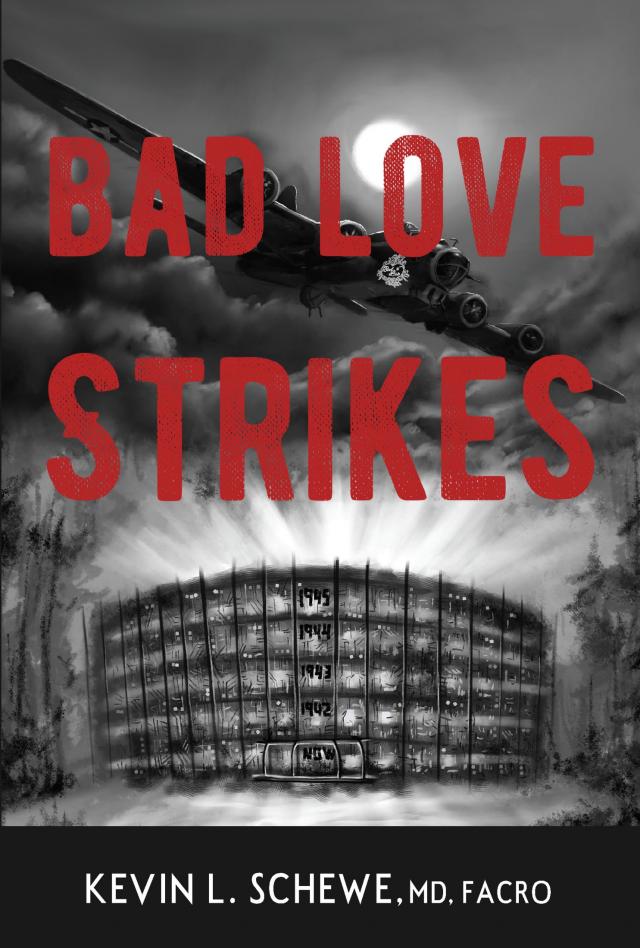


Bowmar proceeded to align and lock the upper racetrack of the time machine to the exact date of November 18, 1944, then engaged the lightspeed drive/cyclotron. Next, he docked the upper wide-mouthed opening of the telescopic exotic matter-lined funnel to the upper racetrack. Once that docking was complete and locked in place, he powered on the lower racetrack and all the other control panels. The room lit up with active machinery, all running at capacity. He then connected the lower transparent end of the telescopic funnel to the lower racetrack. The four GCPDs matching the Pud, Meatball, Goondoggy, and Crazy Ike were precisely docked and locked in place in the mission control panel. Bowmar had already programmed in the global geographic coordinates for the farmer’s field in Chelmno, Poland. The time travel machine was making a deep humming noise, combined with a higher whirr. The high-pitched whirring noise seemed to be emanating from the exotic matter-lined funnel connecting the two racetracks. The two noises seemed harmoniously linked.
There were two control buttons widely separated on the control panel: one marked SEND and the other marked RECALL. We could see the four of them sitting together in the eye of the lower racetrack. The clock struck 1:00 AM, and Bowmar hit the SEND button. At that very moment, Meatball, Goondoggy, Crazy Ike and the Pud vanished into thin air.
Even though that was exactly what we expected, we were dumbfounded and amazed anyway. Bowmar looked up at us and asked, “Do you all smell something odd?” None of us smelled anything up on the second floor, and within less than a minute, Bowmar said he couldn’t smell it anymore. We didn’t know whether to clap, cry, or both! Bowmar, who was certifiably brilliant, exclaimed, “That went exactly as planned; those four boys are sitting in a farmer’s field in Chelmno, Poland at seven AM local time on November eighteenth, 1944! The eight of you are next, at twelve thirty AM our time on November twenty-first.” His sense of confidence at that particular moment made all of us feel better.
November 21, 1974 at 12:30 AM local time, White Hole Project, Oak Ridge, Tennessee
It was time for Bad Love Gang time travel rescue group number two to go back in time to the U.S. Eighth Air Force airfield in East Anglia, England, where we would “hijack” the new B-17G Flying Fortress #545 for our part of the mission. Waldo, Crisco, Tater, Spaghetti Head, Cleopatra, Willy, the Runt, and I, all appropriately dressed for our parts, collectively climbed into the “eye” of the lower racetrack with all our gear and supplies in our backpacks. We were a little nervous, but more excited to go and make this happen. We sat and watched as Bowmar went through the same general routine as three nights before. The clock struck 12:30 AM, and the last thing I saw was Bowmar’s finger on the SEND button. The eight of us were gone in an instant, on our way to fly a plane that would soon carry the name Bad Love.
CHAPTER TEN
THE RESCUE AT CHELMNO, POLAND,
PHASE I: GETTING TO THE CHURCH
“The only thing we have to fear is fear itself.”
—Franklin D. Roosevelt
Day One: Saturday, November 18th, 1944,
7:00 AM local time—Chelmno, Poland
Goondoggy, Crazy Ike, the Pud, and Meatball were zapped by the white hole time machine directly to Chelmno, Poland; they landed in a farmer’s field just outside of town. The four of them shook their heads, looking at each other and their surroundings in amazement. They spent a moment taking in the crisp, early morning, fall air of November 1944 in the Polish countryside.
Meatball was the first to speak. “I don’t know about you guys, but I have butterflies in my gut right now. I am Jewish and I know that this place has been an integral part of the Holocaust killings since the day Pearl Harbor was bombed by Japan, on December seventh, 1941. President Roosevelt said that day that would live in infamy—but he did not know that in addition to the Japanese bombing of Pearl Harbor, the Holocaust started here in Chelmno, Poland at precisely the same time.”
Meatball was correct about the historical significance of the Chelmno extermination camp. It was the first place where Jews were gassed in the WWII genocide known as the Holocaust, which took the lives of six million Jews and 250,000–500,000 European Gypsies. On the evening of December 7, 1941, the “Final Solution,” or Holocaust, began when about 700 Jews from the Polish village of Kolo arrived at Chelmno. On the following day, all of them were killed at a local manor house (called “the Castle”) in the village of Chelmno, using carbon monoxide poisoning in gas vans specially designed as carbon monoxide killing machines. The dead victims were then taken in those vans to a clearing in the Rzuchowski Forest near Chelmno, where they were buried in large common graves. Later, in the spring of 1942, two crematoria were built to burn the dead bodies of the Chelmno victims. It is estimated that 330,000 Holocaust victims were killed at Chelmno from December 1941 through April 1943. The Chelmno extermination camp was temporarily closed in April of 1943, and reopened in the late spring of 1944.
The Holocaust activities at Chelmno in 1944 differed from what had occurred during 1941–1943. The victims were brought from Kolo, Poland by a local branch railway line directly to Chelmno during the day, and were taken to the village church to stay that night. The next day, after spending the night at the church, they were taken directly to the Rzuchowski Forest by truck. In the forest, two wooden huts had been constructed: One of them was designated as a place to undress, because the victims were told they were going by van to a bath house. The other hut was a clothing and baggage storage and processing site. After getting undressed, the unknowing Holocaust victims were directed into the back of gas vans and killed with carbon monoxide gas as before. They were then driven about 500 feet to crematoria (furnaces), where the corpses were burnt. It is estimated that another 10,000 Holocaust victims were killed using this methodology at Chelmno in 1944.
The Pud, Goondoggy, and Crazy Ike calmly reassured Meatball that they had all made this time travel trip to Chelmno on this specific day and time in history to make a small but real difference for some of Chelmno Holocaust victims. Part of their mission agenda for that day was to find Chelmno’s rail connection station coming from Kolo, Poland. Most incoming Jewish and/or Gypsy victims would be arriving by that route, and would be taken from the train station to the village church to stay for the night. It wouldn’t be as large a number of people as it had been during 1941–1943, when an estimated 1,000 victims were murdered every day. In 1944, “only” 10,000 total victims were murdered all year. By November of 1944, the Chelmno operation was really slowing down, with just one of two crematoria remaining operational in the Rzuchowski woods. That furnace and the remaining Chelmno operation were totally destroyed in January 1945.
The four of them gathering themselves and their gear to go to work were an unusual sight. Crazy Ike was dressed as a Nazi SS officer, Goondoggy was a German SS enlisted soldier, and the Pud could pass as a common Polish citizen. Meatball appeared to be a Jewish peasant and their prisoner. He had a yellow Star of David patch sewn onto the back of his shirt at the right shoulder, and a brown flat cap on his head. Their overall plan for day one was to scout out the road leading from Chelmno to the Rzuchowski Forest, and find the exact spot where the wooden huts and one remaining furnace were located. They would find a good ambush point along that road, where they would stop and steal the truck carrying the Jewish/Gypsy prisoners—and Meatball, who would also be on board when the time came. After identifying the ambush point, they planned to go into Chelmno to find the village church and spy on the Jewish and/or Gypsy arrivals to the church from the train station or elsewhere.
Crazy Ike spoke excellent, fluent German due to his childhood upbringing. The story line was that he was posing as a Nazi SS officer from Lodz, Poland; Goondoggy was mute but he was a good German SS soldier, accompanying Crazy Ike. Once they determined that the day’s Holocaust victims had been taken to the church to spend the night, they would then take Meatball as their Jewish prisoner to the church and leave him there. Meatball would spend the night with victims and get to know them, gaining their trust; he would be getting on the truck with them in the morning to go to the Rzuchowski Forest extermination camp. Failure was not an option for this rescue operation, or Meatball could die in the Holocaust.
In the meantime, the Pud had two objectives: One was to explore the local countryside and the lay of the land, to find a potential landing zone for the B-17. The second objective was to find a suitable hideout for the four of them and the Holocaust folks that they rescued, where they would need to stay until Tuesday morning. If all went as planned, a brand-new B-17G Flying Fortress named Bad Love would land on Tuesday at about high noon to scoop them all up, then fly them to freedom and safety in Belgium. The Pud was hoping to accomplish at least one of his two objectives on day one. The four of them had maps of the area and excellent long-range walkie-talkies to communicate their progress. They all group hugged, then Goondoggy said, “Don’t get lost, Pud; we need a place to stay!”
“You look like shit in that Nazi uniform. You’ll have to find something else to wear, if you want to stay in the house that I find!” he replied.
Crazy Ike chimed in. “So, Pud, you and what army are gonna stop us? Grow some balls and go find a runway for that big ass plane to land on Tuesday!” And with that typical Bad Love banter, they parted ways.
They had been zapped back in time and space to a farmer’s field due north of the village of Chelmno, east of the narrow-gauge railroad that connected Kolo, Poland to Chelmno. Meatball, Crazy Ike, and Goondoggy headed west toward the railroad tracks. The Pud headed east toward the small village of Ladorudż, Poland, where he hoped to find an empty country summer cottage somewhere along the way—and a long enough, flat enough field for the B-17 landing zone. They had come prepared, and their local maps were well researched and superb.
Meatball, Crazy Ike, and Goondoggy did not have to go far to get to the road. The narrow-gauge railroad tracks that connected Chelmno to Kolo ran generally parallel to the road. They stuck close to the tracks, staying out of sight from the road, and walked northwest roughly halfway to the Rzuchowski Forest killing camp, which was only about 2.5 miles from the village of Chelmno. It was here that they discovered the perfect place for their planned ambush. A small road intersected with the main road to the forest camp, and ran behind the camp; they could take the truck unnoticed past and around the forest camp to get to the hideout, which the Pud was busy finding. Goondoggy and Crazy Ike would steal two motorcycles in Chelmno before sunrise and lay in wait at this intersection to ambush the truck carrying Meatball and the Jewish/Gypsy prisoners. The Pud and Meatball would drive the truck to the Pud’s countryside cottage hideout location. Crazy Ike and Goondoggy would give the truck a motorcycle escort in their German Nazi uniform attire.
The plan was coming together. The three of them high-fived and then turned to walk southeast, parallel to the tracks, to the village of Chelmno. This perfect route would end at the train station in Chelmno, which was close to the Church of the Nativity of the Virgin Mary, where the Jews/Gypsies who were unknowingly destined for death by carbon monoxide gas poisoning were held overnight prior to their transfer to the Rzuchowski Forest extermination camp the following morning. The walk to the village, going unnoticed by anyone, took a little less than an hour.
In the meantime, the Pud was making some progress. He had headed east and approached the small village of Ladorudż, Poland. He crossed a road that on the other side had long, flat, fairly wide plowed fields that extended back in a northeasterly direction, and ended at the edge of a pine tree forest. There was forest on both sides and at the end of the fields. Since it was November, there was no one working or tending to the fields this time of year, and it was a sparsely populated area. He made a note on his map of this location, then paced down the fields to the edge of the forest pine trees. He estimated 4,000–4,500 feet (give or take) from the road to the edge of the forest. Interestingly, as he got to the forest’s edge, there was a dirt road leading through the forest; he saw another dirt road in the forest to the east. He made the simple decision to take the dirt road in front of him and see where it led. He was hoping it would lead to a nice summer cottage, abandoned for the winter. It wasn’t quite that simple, but he was on the right track.
The Pud radioed Goondoggy, who had left his walkie-talkie turned on for communications. Goondoggy was looking through his binoculars at Chelmno village when he heard the Pud’s signal. He grabbed the walkie-talkie and asked, “Hey, Pud, you having any luck out there?”
The Pud replied, “That’s a big ten-four, Goondoggy! I found a suitable landing zone adjacent to the small village of Ladorudż and now I am following a dirt road through the forest looking for a place for us to stay. Tell Crazy Ike that we’re gonna use that Nazi officer uniform he’s wearing as our door mat!”
Crazy Ike, who was sitting in the grass next to Goondoggy, smiled. He grabbed the walkie-talkie and said, “Listen, Pud, you little shit, you better start lifting some weights and working out, because I’m gonna make you our door mat when I get there!”
“I found a big-ass, black dog who hates Nazis. He’s already hungry, and I am not gonna feed him a thing for now. When he sees you, I’m cutting him loose. Rub a little German chocolate cake on your crotch to give him a scent to follow!” With that reply, the Pud signed off.
At the same time as the Pud’s update via walkie-talkie, the Saturday train from Kolo, Poland to Chelmno was on its way. It was all of a forty-minute train ride and on this particular Saturday, there were only thirteen souls on board who were destined for the Chelmno extermination camp the next day. The Chelmno killing operation in November 1944 was officially closed, but the Rzuchowski Forest work crew were still there “working” until January 17, 1945, when the German SS soldiers shot everyone (two Jews escaped that night) and burned everything to the ground. These thirteen unfortunate souls (eleven Jews and two Gypsies) riding on the train were among the last to suffer in the Holocaust at Chelmno, Poland in its waning days of operations. All of them had been told that they were going to go to work for the German war effort in the east, and that they would be fairly treated and receive good food. There were only two guards watching over them and making certain to get them to the Chelmno church, where they would spend the night under separate guard.
Among the thirteen prisoners on board the train were the entire Roth family of five, which included Daniel and Mazel Roth; their two daughters, twelve-year-old Zelda and ten-year-old Rhoda; along with Mazel’s mother, Rachel Soros. The five of them lived together in the small village of Wrzaca Wielka, and had nearly gone unnoticed during the Holocaust era; Daniel had quietly run the family farm and maintained a low profile. The night before, the local German police and German SS soldiers had essentially surrounded their small village and surprised them during their Sabbath (Shabbat) celebration. Before Friday nights’ Sabbath dinners, it was customary to light candles and sing two songs: one to greet two Shabbat angels into the house, and the other praising the women of the house for all the work they had done over the past week. Daniel had four hard-working women in his household; he was deeply proud of his family. As they were singing the second song together, German SS soldiers suddenly banged so hard on the front door with their rifle butts that it seemed like the door would bust off its hinges. The SS soldiers loudly yelled, “Open the door now!”
There was no time to prepare or react. Daniel told everyone to be calm, and not put up a fight. Mazel and Rachel locked arms and held their two terrified daughters closely. Daniel was much more afraid of harm coming to his family of four cherished women than he was for himself. He resolved to be cooperative in the hope that they could all stay together, no matter what else happened. Daniel opened the door and two heavily armed SS soldiers quickly entered. They told the family to pack one suitcase for all of them, and that they were being taken away in the morning to work for and support the German war effort. The Roths were given ten minutes to pack that single suitcase and Daniel instructed Mazel to comply. Ten minutes later, the Roth family was escorted out the door, loaded into the back of a covered truck with a guard, and driven to a jail in Kolo for the night, which they spent in a holding cell. The German soldiers and local police reassured Daniel that the family would be kept together—so long as they did exactly as they were told every step of the way. Any misstep or problem would result in their separation.
Sitting directly in front of the Roths was an elderly couple, Asher and Avigail Goldberg, and a young boy named Ben. Sitting behind the Roth family was a Roma (Gypsy) mother named Vadoma Loveridge and her five-year-old son, Barsali. Vadoma’s husband (and Barsali’s father) Manfri had been shot to death by a German SS soldier in a scuffle that had occurred when the Loveridge family was being transported by train to the Lodz, Poland Ghetto just over a year before, in late 1943. In the confusion and rush of soldiers to the scene, Vadoma was holding on to Barsali (who was age four at that time) tightly; an elderly man grabbed her arm from behind and barked, “Come with me, now!” They managed to slip away in the mass confusion, and the elderly man led Vadoma and Barsali to his house in Lodz, not too far from the Ghetto. That elderly Jewish man and his wife, Asher and Avigail Goldberg, then housed and safely kept Vadoma and Barsali in their home in secrecy for an entire year, hoping for the war to end.


