Clarkesworld mzine issue.., p.1
Clarkesworld Magazine Issue 101, page 1


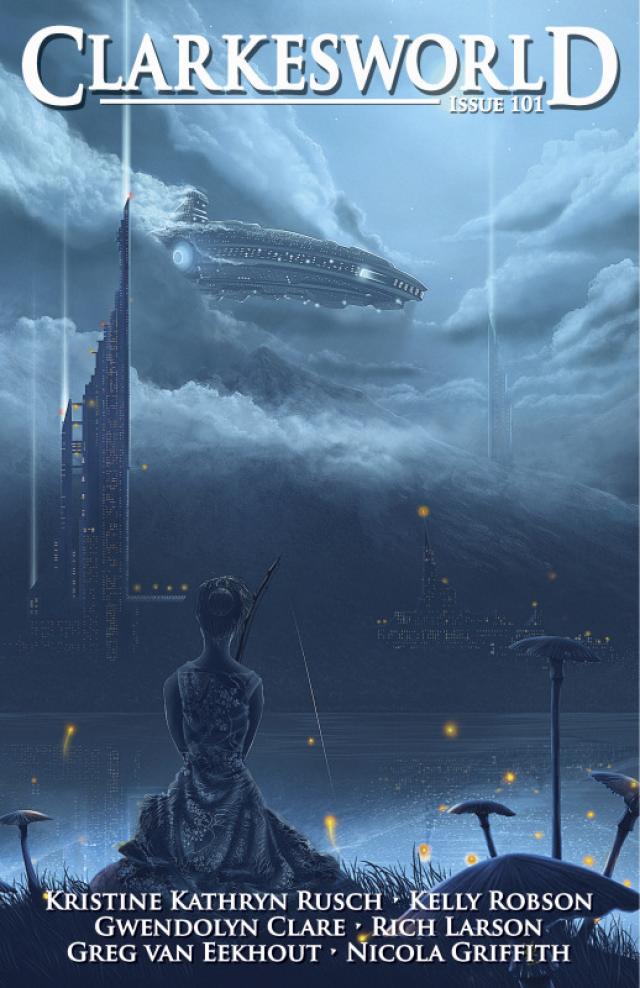
Clarkesworld Magazine
Issue 101
Table of Contents
The Last Surviving Gondola Widow
by Kristine Kathryn Rusch
Indelible
by Gwendolyn Clare
The Three Resurrections of Jessica Churchill
by Kelly Robson
Meshed
by Rich Larson
The Osteomancer's Son
by Greg van Eekhout
It Takes Two
by Nicola Griffith
What in the World Do They Want, Anyway? The Myth of the Friendly Alien
by Mark Cole
A Little Paranoia: A Conversation with Liza Groen Trombi
by Alvaro Zinos-Amaro
The Spurred Storyteller: A Conversation With Tang Fei
by Ken Liu
Another Word: YA is the New Black
by Dawn Metcalf
Editor's Desk: The Next Hundred
by Neil Clarke
Lady and the Ship
Art by Atilgan Asikuzun
© Clarkesworld Magazine, 2015
www.clarkesworldmagazine.com
The Last Surviving Gondola Widow
Kristine Kathryn Rusch
I slipped in for the motion picture. Regalese had set up a private screening in a tiny little theater near 19th and Dearborn, on the other side of the street from Bed Bug Row. I felt itchy just being there, and not only because of the proximity to the vice clubs, but also because I felt obviously out of my element.
Still, I dressed for the neighborhood. I wore my bobbed hair under an engineer’s cap I confiscated from one of the Gondola widows when I found her years before. My baggy shirt and filthy overalls hid my assets, such as they were, but one of the other Pinkertons told me—kindly, he thought—that it was impossible to hide the female nature of my backside.
The memory of his comment always reminded me to wear everything baggy except my steel-toed boots. I would put a little bit of char on my face, and I’d learned to grunt low and hard whenever I wanted to say hello or good-bye or get the hell out of my way. I kept my head down a lot too.
Not that it mattered much in this theater. Designed for burlesque shows mostly, the theater had a red velvet curtain that pulled back to reveal a real silver-painted screen. The screen was the fanciest thing about the place.
Regalese sat on benches with straw scattered across the floor beneath to absorb the crap on the patrons’ foul-smelling boots. The straw hadn’t been changed in weeks, if ever. Even though Regalese and I were the only two people in here, besides the projectionist and the organist, the place still stank of tobacco, sweat, and human fluids of a kind I didn’t want to contemplate.
Regalese had told me to come for the motion picture, but hadn’t told me how he’d first seen it. I wasn’t sure I wanted to know, either. I worked with men who patronized the Levee District, but I liked to pretend they didn’t.
The gaslights dimmed, and the motion picture started up. The organist started blaring some mock Sousa march, which besides being deafening was just damn offensive, given the nature of the images we were about to see.
Some so-called director had taken stereoscopes, still photographs, and silver addies, and had somehow—Using His Own Magical Abilities! the poster in the lobby blared—combined them into a herky-jerky semblance of a real film.
I didn’t need to see the pictures, even speeded up. I’d been on Michigan Avenue the day the Gondolas died, and what was flickering on that screen was nothing like what really happened.
When I tell that story, I leave out most of the details. Like the way Chicago smelled before the attack. The city smelled new. The recently completed buildings were made of terracotta, marble, brick, and limestone. When the downtown air wasn’t smelling like Lake Michigan fish, it smelled of newly milled stone dust. After the Great Fire, the city fathers had mandated all new construction—especially downtown—be made of fireproof stone.
I’d moved to the city five years after the fire, and had fallen in love immediately. The day the Gondolas died hadn’t changed my love affair with the Windy City. In some ways, that day had reinforced it.
That day, I’d been on the job. I was the third woman Allan Pinkerton had ever hired in Chicago. The other two no longer worked for him. One had died—murdered horribly—and the other had fled when she realized what the job entailed.
Me, I found freedom in investigations. The role-playing, the games, that tiny bit of magic I could use to add a luster to everything, all combined to make me one of the city’s greatest detectives. When no one could figure out what happened, the Pinkertons got called in. When no Pinkerton could figure out what happened, they called me.
Which was why I was just outside Cook County Bank & Trust that spring morning, dressed like a proper woman on a hot day. Shirtwaist, skirt with bustle, long auburn hair pinned to the top of my head, parasol to keep out the sun, and (for my sins) a corset, cinched so tight I hoped like hell I wouldn’t have to run after anyone. The high-button shoes I wore with enough heel to help me pass for five-seven wouldn’t have made it easy either.
I was supposed to determine bank balances by portraying the young wife of our target, an elderly millionaire who claimed he no longer had the funds to pay us. I’d been fighting to close the parasol before going inside, which was why I was on the sidewalk when someone gasped and pointed. Gondolas covered the sky over Lake Michigan like multicolored storm clouds. The whirring sound of their spiky engines sounded like heavy rain on water.
We’d heard about the Gondolas, but most of us hadn’t believed they existed. Not in America anyway, and certainly not made by the South. Reconstruction had ended the year before, and everyone knew the South was bankrupt. How it could afford not one, not two, but several fleets of Gondolas stretched the imagination.
Only later, we learned that Great Britain supplied much of the material in exchange for cotton. Britain really didn’t want the cotton as much as it wanted to see the Gondolas in action—
And it got to. The day the Gondolas died was the reason Britain stopped nurturing its own Gondola fleet and started building more ironclads instead.
But that switch was years away. We had to go through the horrors of that day, the death, the destruction, and what some call the Second Great Chicago Fire, before we came out the other side.
Or before some came out the other side.
The rest of us remained enmeshed in the War of Southern Aggression, even though the battlefield had emptied.
The motion picture captured none of that day’s essence, although it had much of the day’s symbolism. The Sousa march didn’t help. All that happy brass music, with a parade beat, made me want to steal Regalese’s pistol and shoot the organist in the back of his pomaded head.
Instead, I sat on my bench, hands clasped, watching moving images I’d seen before as photographs. The images didn’t move naturally or even well, which was good, since I probably would have run screaming out of the theater if the motion picture had been anything close to accurate.
The motion picture was set up well. First, the Gondolas appeared, their artistic sphere-shaped balloons hovering over Chicago, perilously close to the great stone buildings on Michigan Avenue. Then the images became distant, showing the clouds gathering over Lake Michigan. The images clicked and clicked and it became clear that those clouds weren’t clouds at all, but hundreds more Gondolas, coming in from the South, ready to rain hell on the Midwest’s greatest city.
Then the sparks, like tiny fairy creatures, spread out across the sky, looking like flaws in the photographs, followed by the next series of images—fires erupting on all of the Gondolas, smoke pluming, the sky alternating dark and light.
Finally, the motion picture focused on the destruction: the Gondolas breaking apart, falling to the buildings below—shattering the Tiffany skylight of the Cook County Bank & Trust—and landing, in flaming pieces, on the streets and Grant Park and into the lake itself.
I shuddered. I couldn’t help it. That day, the stupid parasol had saved me. If I had gone up the marble steps and through the brass handled double doors, I would have been one of those pathetic creatures burned alive inside Cook County Bank & Trust, after being showered with expensive glass and pelted with flaming Gondola parts.
No one had survived the inferno inside that bank.
No one.
When I had realized what was happening, I had run up the bank stairs. I had figured we had to pull people out before the situation got worse (I had no idea how bad it was) but as I reached the top of the steps, the windows exploded outward
I ducked, covered my face, and screamed as shards penetrated the back of my hands and arms. My black skirt, shirtwaist, and corset protected me from damage anywhere else, although I did spend the evening trying to clear slivers from my waist-length auburn hair.
That was the night I bobbed my hair, not because I was making a political statement years before the rest of America’s women would, but because I couldn’t get all of the glass out.
That day was more than images. It was smoke so black and smelly that anything it touched had to be destroyed. It was the stench of burning canvas and searing flesh. It was heat so intense that skin dried and turned red blocks away from the flames.
It was—and I can attest to this—hell on earth.
The motion picture made the disaster look small. Tiny Gondolas, sparks like fireflies, smoke rising from the multicolored balloons—and the silence, always the silence, because the images made no noise.
Or maybe I couldn’t hear anything. The organist was supposed to have been playing, but I didn’t hear it. I got lost in the memories.
That day had been filled with noise, noise that still woke me from a sound sleep. Screams and cries for help, sirens and the roar of flames, explosions and more explosions, followed by even more explosions.
My hands are still scarred from the burns I received as I grabbed a metal doorknob, as I tried to put out burning clothing before it seared flesh. My own magic, a little tiny bubble of protection, protected my skirts from catching fire. Still, like so many others, I ran to Lake Michigan. I plunged my arms into water—frigid despite the burning bits of debris on its surface—and that, doctors later said, prevented loss of motion.
I clenched my scarred hands as the images continued. Up—the burning sky; down—the fleeing and injured humans. Up—the debris falling off terra cotta roofs; down—the smoldering pieces of Gondola lying in the street.
The motion picture ended with a snap-snap-snap of the projector, and the bright silver light of an empty screen.
“See her?” Regalese asked.
I frowned at him. Regalese was fifteen years older than I was, a wanderer who had come to Chicago for the hunting after the day the Gondolas died. He freelanced for the Pinkertons. They didn’t like his trigger-happy nature, even as they relied on it.
“Her?” I asked.
“Run it again,” he said to the projectionist. I started to protest, but he grabbed my hand in his own. I knew he felt the crabbed, scratchy quality of my damaged skin, and I knew he didn’t care.
The organist sat up, hands over the keyboard.
“Without music,” Regalese added.
The motion picture started again. I wanted to close my eyes against the images, but I didn’t. I made myself watch.
Regalese hadn’t let go of my hand. I think he had expected me to look away, because he shook my fingers as one of the Gondolas toppled onto State Street.
“See her?” he asked again.
I squinted. The imagery had changed, away from the Gondolas and onto the poor unfortunate souls burning, and dying, their bodies littering the streets of this great city.
“See?” he asked, still shaking me.
The images were overlaid on each other. I had no idea how the compiler had done this, made it all look like it was actually moving, but when I stared I could see the different photographs, and this series had been taken in sequence.
Debris fell. People injured. Some looked up. Gondola basket toppled off the rooftop. People fled.
A woman fled.
She was thin and dressed in an oilskin coat with a matching cap, a bandana, and engineer’s goggles around her neck.
A Gondola widow, big as day, escaping south.
A lot of Gondola widows escaped that day. Gondola wives as they still thought of themselves that afternoon. Widows only came later, when it became clear they would be considered heroes if they managed to get back to the South.
Warriors all of them, defending God and country—the Unrepentative Confederate States of America. Feted, celebrated, protected.
Until Reconstruction began anew in the aftermath of the attack, shoved down the throats of the unreformed Rebels by the dogged determination of the Congressional delegation of the Great State of Illinois.
“What’s so special about her?” I asked.
“You don’t recognize her?” He turned toward me.
I squinted, waved my hand, made the projectionist run the damn motion picture again. There she was, running, a half-turn toward the camera, a shot of fear. I was about to ask for the actual photograph when my brain supplied the answer Regalese was seeking.
“Oh, my god,” I said. “That’s Maizy Farmington.”
First Lady. Wife of the current Governor of the Great State of Illinois.
It’s bad form to accuse the wife of the Governor of treason against the Republic without some kind of proof. Especially in an election year. Proof wasn’t hard to get against Gondola widows, but making proof stick, making it seem like it wasn’t a dirty trick played by Governor Farmington’s opponent—that was a little harder.
We needed witnesses other than ourselves. And that wasn’t the usual way Regalese or I worked.
We’d caught dozens of Gondola widows in the aftermath of the day the Gondolas died. Gondolas, married to their female engineers, responded to the engineer’s voice and the touch of her hand. First the voice. Then the Gondola would locate its engineer—its wife—and fly toward her.
What Regalese and I did was gather up the remaining pieces of the Gondolas and take them to potential widows. The pieces would respond to the voice, and float to the engineer, identifying her as a Gondola wife/widow.
Once the women were identified by the remains of their Gondolas, most of the women broke into tears. They mourned the loss of their great flying warships as if mourning the loss of an actual spouse.
Many of the women believed their lives were no longer worth living, and gave up without a fight. The rest attacked us as if we personally had destroyed their ships.
We hadn’t destroyed their ships. I couldn’t have, and Regalese hadn’t been here.
The real heroes of that day had been coalburners, most of whom had died for their bravery.
As the Gondolas gathered over the Mississippi, telegraph operators tracked them, growing alarmed at the increasing numbers of ships and the fact they had come from the Deep South. Messages about this impending crisis didn’t come to the authorities; they traveled north through the coalburner network, tracking the ships.
Coalburners have a sparking magic, dangerous and hard to control. They use bits of the Earth—not just coal, but flint as well—to spark fires. Coalburners often have to live underground or on lakes, just to prevent fires.
And after the Great Chicago Fire, coalburners were banned from the city proper, although they snuck in to fight the Gondola attack. No one ever discovered who helped the coalburners onto the roofs of the city, and no one knew how they managed to coordinate the release of sparks, but everyone agrees that the coalburners saved us—even though all of the Chicago area coalburners had died that day.
I hadn’t even noticed the coalburners, but I had seen some of the newly created widows pull themselves from burning Gondolas. The women tried to flee, but most were too injured to get away.
Those that did get away hid in flophouses south of the Loop. It took little to track them down, and even less to identify them.
Regalese had joined our search in the weeks after the crisis, when it became clear that a handful of women had escaped the city. He and I partnered to find them—he often playing a jilted husband, and me a heartbroken sister as we enquired about lost loved ones.
We thought we’d caught all of them, until this motion picture showed up and revealed an even greater perfidy than we had realized. What was she planning for the Great State of Illinois?
“It shouldn’t be hard to trap her,” Regalese said to me as the moving images ended for a third time. “All we need are the Gondola pieces.”
I bowed my head. He had moved to other jobs, including one investigating the magic behind moving images. That had been how he had discovered this bit of ephemera in the first place.
“Right?” he asked, his hand still holding mine.
I didn’t want to speak in front of the projectionist or the organist. Instead, I thanked them both, stood, adjusted my overalls, and headed outside, blinking in the pale sunlight of the afternoon.
We stood alone on the sidewalk. The Levee didn’t come alive until twilight.
“What am I missing, Lou?” he asked. He almost never used my name. No one in the Pinkertons did. It was too dangerous. But he caught my mood, and he then needed my attention. My name was the only way to do so.
“We destroyed them,” I said softly.
His eyes narrowed. He lived for the job, the hunt, the search for the next great magical threat. He stopped in Chicago only when he was in the area, when he needed the work, or when he had something to share with our version of the local constabulary.