Fiction river special ed.., p.1
Fiction River Special Edition, page 1


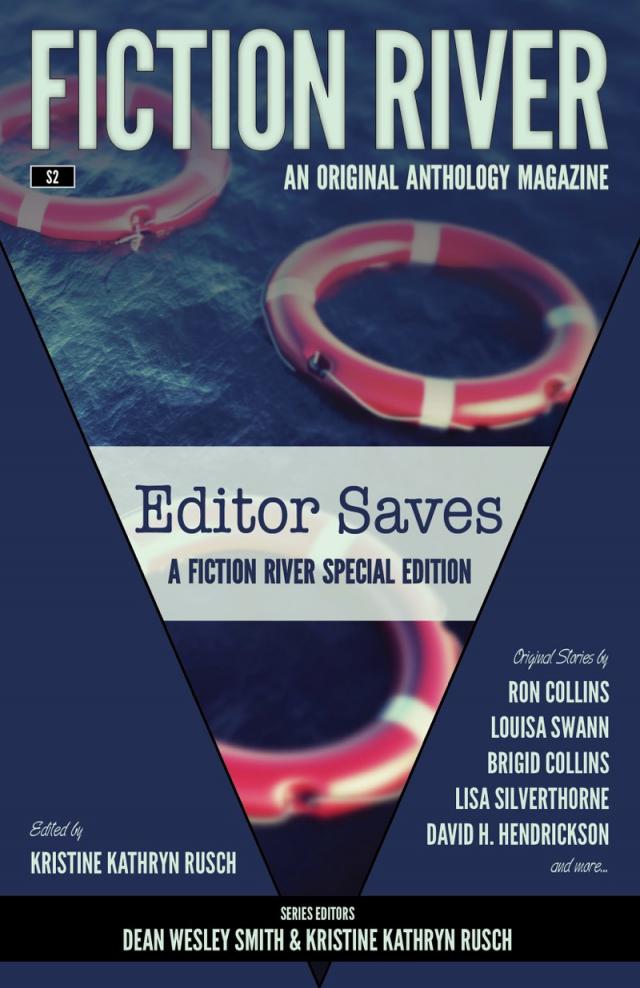
Fiction River Special Edition: Editor Saves
An Original Anthology Magazine
Edited by Kristine Kathryn Rusch
Series Editors
Kristine Kathryn Rusch & Dean Wesley Smith
Contents
Foreword
Introduction
Chuck Heintzelman
Stealing Mrs. Mackle’s Mojo
Lauryn Christopher
The Man in the Gabardine Suit
Kelly Washington
One Ballerina Dancing
Valerie Brook
The Disinvention of the Surveillance State
Ron Collins
Playing God
David H. Hendrickson
Makonde Tree of Life
Michael Kowal
The Dream
Jamie McNabb
Damsel on the Hard
Brigid Collins
Dragons Are Fond of Them
Jonathan Kort
Pixie Problems
Joe Cron
The Untimely Demise of Rachel Tamson
Dale Hartley Emery
Cassidy’s Ghost
Lisa Silverthorne
Combination
Louisa Swann
Airborne
David H. Hendrickson
City of Sin Strangler
Ezekiel James Boston
The Weird Shit That Happened Because of Tricia Fisher
About the Editor
Fiction River: Year Five
Fiction River Presents
Pulphouse Fiction Magazine
Foreword
Fiction River: Editor Saves
The most difficult thing an editor has to do is pass on a great story, one that is professionally written, engaging, and high quality. And this happens all the time for one simple reason: The story doesn’t fit the vision of the editor’s project.
Every year we put together six issues of Fiction River. And because Kris and I wanted Fiction River to be diverse, we have guest editors. Each editor has a vision for their volume of Fiction River.
A volume is around 70,000 words, which ends up to be around fifteen short stories, give or take.
The problem is the editors have fifty or so professional writers writing stories directly for the volume.
So the editing goes like this, in general. The editors read all the stories, giving each story the same chance as any other. About ten of those stories can be eliminated just because they don’t work for the editor’s tastes.
Often these stories get picked up by another editor.
Another ten to fifteen are eliminated because the stories are similar to other stories, but the editor likes the other versions better. Again, other editors are looking at stories in this group that might fit what they are editing.
That’s right, there is negotiation to get an editor to reject a story so another editor can buy it. Not kidding.
Again, all the writers invited are professional writers writing top-quality fiction, so watching six editors argue over stories is always entertaining, to say the least.
So that leaves twenty-five or so stories that could fit an editor’s vision for the volume. The editor can only take fifteen.
So somehow the editor must decide which stories to leave out, to not buy, not because they are poorly written or that they didn’t fit, or that the editor doesn’t like them. Nope, ten stories must be cut but because there are just too many high-quality stories.
Agonizing does not begin to describe this process the editors go through.
And at the Anthology Workshop, they do it in front of the entire room of the writers who wrote for the anthology, talking through why one author’s story does not make it in while another does.
Agonizing for the writers as well to watch, but it does show why rejection is never a personal thing. The workshop shows clearly how editors work.
So Mark Leslie a number of years back, after watching this process and seeing many, many stories he would have bought, but that weren’t getting bought, decided to fund a volume of Fiction River through Kobo. And he would put the stories together. It turned out wonderful.
The next year I got the honor and edited a volume coming out after this one called Fiction River: Hard Choices. Going into the process, I had three major ways the volume could go, but I wanted to see what stories the other editors let go.
Turns out I had to pass on some fantastic science fiction and fantasy stories because I structured the Fiction River: Hard Choices to be crime focused. Frighteningly difficult task because the stories were all so good. But I also had to focus it somehow.
So for this year we decided that all the editors should save one or two stories they thought should be bought, but did not get into a regular volume. If I remember right, five of the six of us saved one story, another story had four editors saving it, and it went on like that until we had saved enough stories to fill a volume.
Then Kris got to do her magic and figure out a way to put this book you hold in your hands in order. She talks about that process in her introduction.
And it is magic.
Just as Mark’s volume, I think this volume might be one of the strongest Fiction Rivers we have done.
So expect different in this book, expect a vast array of genres as is normal for Fiction River.
And expect very high-quality stories because the writers in this volume are some of the best short fiction storytellers working at the moment.
—Dean Wesley Smith
Lincoln City, Oregon
December 4, 2017
Introduction
Editing Challenges
Every now and then, we get the best ideas at Fiction River. Many of the ideas come out of our annual anthology workshop, which, really, we shouldn’t call a workshop because we don’t sit around in a circle and critique stories. We have five to six professional editors read for anthologies, and discuss their picks after the other editors have weighed in.
The writers who come are already established professionals. You need a healthy ego to hear six editors pass editing (buy/reject) judgment on your story. Writers come back every year, and for many, the workshop has become an annual networking opportunity and an idea generator.
Some of the ideas that have emerged from the workshop include the Uncollected Anthology and BundleRabbit. I’m sure there will be more in future years.
Because forty to fifty writers compete for slots in each anthology, the competition is fierce. I’ve been on an anthology binge of late, reading highly acclaimed sf and mystery anthologies (edited by other folk), and realized that Fiction River’s rejected stories are head and shoulders above much of what I’m seeing in print.
That’s probably why stories which didn’t make a Fiction River anthology have appeared in such places as Alfred Hitchcock’s Mystery Magazine, Heart’s Kiss, Analog, Asimov’s, and several other major anthologies. We’re truly getting the crème de la crème here.
One of the great frustrations for the editors is that we have to let so many brilliant stories slip through our fingers. Editors who come up with anthology themes always have an idea of what they want in the book, even if they’re not entirely sure how to articulate it. Or maybe more accurately, editors know what they don’t want.
So a lot of great stories don’t get bought. Often, the other editors will love, love, love a story only to have the editor in charge of that particular Fiction River pass on it.
We’ve dealt with that in the past. Mark Leslie edited Editor’s Choice, the first volume of brilliant stories that didn’t fit the original editor’s vision. He got frustrated that so many stories he loved went by the wayside that he told us at the workshop that he wanted to edit that volume.
We said yes, and poor Mark. He ended up with a list about fifty stories long, and he could only pick fifteen. That volume ended up being one of our best, but it was an editing challenge for him because, as you regular readers know, Fiction River spans genres.
So the stories in his volume covered everything from sweet YA to dark (vicious) horror.
He made it work. Spectacularly.
Dean edited the next volume, Hard Choices, which, for scheduling reasons, will appear after this one. He’s going to have the same challenge—combining stories that don’t have a set theme or through line.
We upped the ante, though, for 2017. Dean was buying for the revived Pulphouse, and none of us on the panel wanted to do the editor’s choice in the same way. Or maybe we all wanted to do it. I can’t remember exactly.
What I do know is that we editors all decided that we would pick four or five stories from the wonderful stories that didn’t get chosen for one of the upcoming Fiction River anthologies. We would combine those stories into Fiction River: Editor Saves. It would be easy, we thought, and it was.
For everyone but me.
Because I have the task of making these stories fit together. As I have mentioned in previous Fiction Rivers, I edit a volume for the folks who read anthologies like I do, from front to back. Which means that one story should flow into the next. There needs to be continuity and a bit of emotional logic to the way the anthology goes together.
Or if I decided to forgo that, then what I needed to do was something understandable. I could segregate the stories by editor, for example, or, as Allyson Longueira suggested, by the anthology themes that the stories didn’t get chosen for. I could even put the anthology together alphabetically, by author.
That la st is a joke, by the way. The Best American series (which I read every year) goes alphabetical by author, and that’s a huge flaw. Sometimes the most emotionally heartrending story or the hardest to read stylistically is first. Not the way to enter an anthology.
I didn’t want to segregate by Fiction River anthology either, since you haven’t seen any of the volumes from that workshop yet. Besides, these stories aren’t representative of those volumes, at least according to the editor, so I didn’t want to confuse matters.
After I had edited the stories and realized how disparate they are, I thought perhaps I would make little editor segments—these stories were chosen by Dayle A. Dermatis, these by Leah Cutter, those by me. Until I looked at who chose what and realized that almost everyone had chosen stories that were as different as chalk and cheese (as the British say). It wasn’t as if Dayle had chosen only dark mysteries and Leah only high fantasy.
The other problem was a little more complicated. Since the editors all chose four to five stories, there was overlap. On one story, all six of us agreed that it needed to be in a volume—including the editor who didn’t take it for the original anthology. On those stories, it really wasn’t fair to say that one editor chose it, because all of us did.
So, the idea of segregating the volume by editor had to go out the window, along with the alphabetical idea.
I was left with the hard work of assembling stories that range from a truly darling tale you could read to a child to a dark story about serial murder that you’d better not read to a child, at least while they still are a child. I had to make the anthology into a cohesive whole.
Fortunately, the stories are brilliant. They stand alone. They’re amazing works that make you catch your breath or make you smile. They also have a lot in common with each other.
If you look at the covers for the upcoming volumes of Fiction River, you’ll be able to see which anthology a few of these stories were initially submitted for. But only a few. Because I had to double-check as I went along. I assumed a particular story had been written for one anthology when, in truth, it had been written for another. Other stories could have fit in three or four of the anthologies, so it was impossible to know where the story originally started.
I’m glad we’re doing this volume before the anthologies these stories were written for, so that you’ll have no preconceived idea of what those thematic stories should be. You’ll be approaching the stories cold, the way we all did in our manuscript pile (virtual or otherwise).
Those of you who regularly read Fiction River will note that I have changed the format of the introductions just a little. Usually, we ask the writers to share their inspiration for the stories. We did that this time as well, but we also asked the editors why they chose that particular story. Like the old radio journalist that I am, I picked the juiciest quote or the one that revealed less or the one that set you up for the story. I’m not following format for format’s sake.
Even though editing this volume was hard, I’m going to argue that we publish another Editor Saves volume down the road. I don’t know if we’ll call it Editor Saves 2: Writers Fight Back or if we’ll have a completely different title. But I had a lot of fun putting this volume together, and I hope you have just as much fun reading it.
—Kristine Kathryn Rusch
Lincoln City, Oregon
October 17, 2017
Stealing Mrs. Mackle’s Mojo
Chuck Heintzelman
Introduction to “Stealing Mrs. Mackle’s Mojo”
The easiest task I had for Editor Saves was picking the opening story. The opening story sets the tone for the volume. The story must be strong, but not so emotionally devastating that you have to set the book down before going to the next tale.
I knew from the moment I decided to edit this anthology the old-fashioned way that we had to begin with “Stealing Mrs. Mackle’s Mojo.” Three of the editors chose this story, including me, and we all mentioned the story’s voice. Dayle said it best, “I love the voice in this story. A ten-year-old evil genius could just be a bratty jerk of a kid, but in Chuck Heintzelman’s capable hands, Killian Puth is a delightful bratty jerk of a kid.”
Exactly.
Now let’s discuss Chuck’s capable hands, because once you read this story, you’ll want more. You can find Chuck’s stories in four previous Fiction River volumes: Pulse Pounders, Sparks, Last Stand, and Tavern Tales. Chuck is the mastermind (not evil genius, nope, I didn’t say that) behind BundleRabbit.com, a service that allows authors to promote their books in DIY bundles and readers to get more ebooks for less money.
BundleRabbit is keeping him busy, but I want him to write more fiction. You will too, after you find out just what young Killian Puth has done.
The 10-Year Old Evil Genius
If you didn’t know who Killian Puth was and you saw him sitting in the front row of his fifth grade class you’d probably notice his thick, black-framed glasses with a bit of tape on the bridge and think to yourself, “Wow. This kid’s a nerd.” You’d be partially correct. In the same way you’d be correct if you saw a sabre-tooth tiger and said, “This is a cat.”
See, Killian Puth was an evil genius and when he grew up, he fully expected to be the ruler of the world. Perhaps even ruler of the universe.
And since he was an evil genius, Killian often did bad things to good people.
This is a story about the horrible, terrible thing Killian does to one of the sweetest people in the world, Killian’s fifth grade teacher Mrs. Mackle. So if you’re expecting to read a thrilling tale where the hero saves the day, don’t read any further. Go find a story about pirates or robots from outer space or even unicorns.
You’ve been warned.
Okay.
Still reading?
Good. Then I better tell you how it all started. What exactly caused Killian to unleash his unspeakable torment on Mrs. Mackle.
It was Thursday, December 15th, two days from the beginning of Christmas vacation. Rutherford B. Hayes Elementary’s fifth grade classroom was pretty similar to most fifth grade classrooms. There were five rows of seven desks, enough for thirty-five students, although there were only thirty-two kids in the class. Mrs. Mackle’s desk was in the front of the classroom. Next to it was a large whiteboard which ran across the front wall. In the front of the classroom, in the opposite corner from Mrs. Mackle’s desk, a flat-screen TV was mounted to the ceiling. Students sat alphabetically by last name, except for Killian. He should have been seated between Katy Nachtman and Warren Radzikowski but Mrs. Mackle liked keeping an eye on him and kept him right up front, close to her desk.
Mrs. Mackle stood in front of the whiteboard and faced the class. She held up a box filled with envelopes.
“It’s the moment you’ve all been waiting for. Report cards.” She smiled sweetly at the class.
You really need to understand her smile. It was large and wide and seemed to sparkle. It was the type of syrupy smile that seems phony on most people but not on Mrs. Mackle. She loved her students (even Killian) and her smile was genuine.
She beamed that smile at her class. “I’m quite proud of most of you.”
Then she looked at Killian and her smile turned into a stern frown. As you know it’s quite possible to love somebody and still be very disappointed in their behavior.
That she frowned at Killian didn’t bother him in the slightest. Mrs. Mackle was already on his enemies list. Actually, her name was on Enemy List #3—People to Watch Out For. It was his lowest priority list. He focused on Enemy List #1—People I Must Destroy Immediately, subtitle: Imminent Threats and Enemy List #2—People to Destroy at My Leisure.