

The last immigrant, p.1
The Last Immigrant, page 1


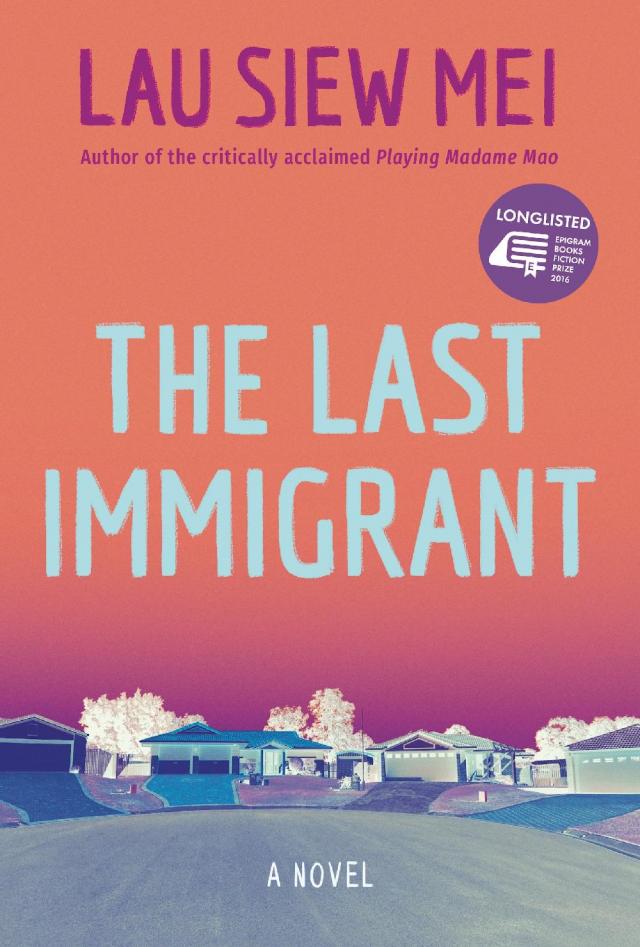
The Last Immigrant
A Novel
Lau Siew Mei
ISBN: 978-981-47-8513-6
First Edition: January 2018
© 2018 by Lau Siew Mei
Author photo by Esmi Lau Zajaczkowski. Used with permission.
Published in Singapore by Epigram Books
www.epigrambooks.sg
All rights reserved
This is a work of fiction. Names, characters, places, and incidents either are the product of the author’s imagination or are used fictitiously. Any resemblance to actual persons, living or dead, events, or locales is entirely coincidental.
Table of Contents
Acknowledgements
Prologue
Part One
Chapter 1
Chapter 2
Chapter 3
Chapter 4
Chapter 5
Chapter 6
Chapter 7
Chapter 8
Chapter 9
Chapter 10
Chapter 11
Chapter 12
Chapter 13
Part Two
Chapter 14
Chapter 15
Chapter 16
Chapter 17
Chapter 18
Chapter 19
Chapter 20
Chapter 21
Chapter 22
Chapter 23
Chapter 24
Chapter 25
Chapter 26
Chapter 27
About the Author
ALSO FROM THE EPIGRAM BOOKS FICTION PRIZE
WINNER
The Gatekeeper by Nuraliah Norasid
FINALISTS
State of Emergency by Jeremy Tiang
Fox Fire Girl by O Thiam Chin
Surrogate Protocol by Tham Cheng-E
LONGLISTED
Lieutenant Kurosawa’s Errand Boy by Warran Kalasegaran
2015
Now That It’s Over by O Thiam Chin (Winner)
Sugarbread by Balli Kaur Jaswal
Let’s Give It Up for Gimme Lao! by Sebastian Sim
Death of a Perm Sec by Wong Souk Yee
Annabelle Thong by Imran Hashim
Kappa Quartet by Daryl Qilin Yam
Altered Straits by Kevin Martens Wong
This book is affectionately dedicated to my oldest friends:
Elaine Jek and Liang Hwee Ming
Acknowledgements
I am grateful to Tan Hwee Hwee for faith, and my editor Jason Erik Lundberg for his insightful comments.
Earlier versions of this novel have been published in altered forms as short stories: “The Cat and the Soulmonger” in Hecate, edited by Carole Ferrier; and “Passion’s Fruit in the Flower Bed” in A Rainbow Feast: New Asian Short Stories, edited by Mohammad A. Quayum.
Prologue
Cats are nothing if not trouble, yet the Prophet had a cat and enjoined his followers to be kind to animals. A cat wandered the streets, marking people with its hypnotic blue eyes. The cat belonged to Ismael. Ismael.
Born prematurely at Kandang Kerbau Hospital in Singapore, he was cradled to his mother’s breast when the name came to her. And while his father went through a catalogue of possibilities—“Abdul, Ahmad, Ali,” he recited solemnly—she looked down at the tiny puckered old man’s face, and inspiration came to her lips: “His name is Ismael.” She tasted the sound and liked it.
She could not say how she knew that was his name but with it, she placed upon the baby the whole burden of its religious and historical significance; after all, Ismael was the first child God named prior to birth. There were others, later: Jesus, John; but he was the first. There is significance in that. Haven’t the history of the Middle East and its perennial squabbles been linked to his name or rather the way he was treated? The Man-planned, Man-created solution to nothingness or barrenness; surely, it is where the blame can be assigned? But just as surely, Ismael’s mother had no thought of what she had laid upon him when she named him.
“Ismael?” said his father and then in haste, as he saw a wrinkle forming in the mother’s brow, “Good. Good name, nothing better.” He coughed and secretly mulled over other possibilities. What about taking his father’s name? But looking at his baby lying quietly in his wife’s contented arms, he knew it was not an option. So, after a jerky start, Ismael grew into a small, skinny boy with a thin layer of skin covering bony arms and legs, and then into a small, plump man with a walrus moustache and jelly-like paunch on a body less used to vigorous exertion, more readily given to sitting.
And sitting or standing, Ismael in his naivety or passivity was an outsider. Was Ismael not an aberration in the scheme of things? As a boy, he recited the Koran with his father while nightly his mother put the sign of the cross on his brow. He grew up not knowing whether Jesus died on the cross or had his place switched with Judas before being taken up to heaven.
He never really found out.
Judas died?
Died on the cross.
Story secret told. “The Gospel of Barnabas,” his father said. A promise made not to tell his mother. “She doesn’t understand such things.”
Ismael understood secrets. He also kept the secret of his mother’s stories of the resurrection.
He thought of his energetic birdlike mother who haunted the kitchen and shopping malls, into which she lured him with delicacies and promises of presents.
Herstory was repeated, tales of childhood and grown-up years, as he perched on a kitchen stool eating or as he stormed through endless serried ranks of shops clutching her hand.
His tall, skinny father hovered uncertainly in his own home, seeming to exist in awkward corners, surrounded by books, enthralling Ismael with poetry words and abstract problems to which there were no solutions.
He knew his father had not been happy with his name but had given up trying to rename him. His father had told him the story of his birth. He liked hearing it and wanted his father to repeat it.
*
Ismael’s psalm is of the wandering man, the song of the lost, the outcast, the wild one born to a slave woman, the child wrought out of man’s will, not God’s.
The boy, thirsting in the desert, whistled upon the wind, and the dry sound went out and was scattered upon the millions of dust grains.
“Rise up,” his mother was told as she wept for what seemed the end of her son.
“I will make him a great nation,” declared God.
Hagar’s eyes were opened and she saw a well of water. The boy drank from the bottle she held to his cracked lips, and so lived to become a man in the Wilderness of Paran. He was destined to be a prophet…
A prophet! But when has a prophet ever come out of Brisbane?
Part One
“The public servant must be broad-shouldered and stout-hearted. His burden is heavy and his way is long. For humaneness is the burden he has taken on himself; is it not true that it is a heavy one to bear?”
Confucius
“I reject, in conscience, the idea that Australia should or ever can become a multiracial society and survive.”
Arthur Calwell, Australia’s first Immigration Minister, leader of the Labour Party from 1960-1967 and supporter of the White Australia policy
Chapter 1
Ismael’s unusual pilgrimage took him from Singapore to the States and then to Brisbane.
“So where are all the people?” Ismael’s father complained when he stood in the garden outside the house. In their fear of separation from potential grandchildren, Ismael’s parents had followed him to Queensland, Australia, where he had chosen to migrate after his marriage.
Ismael’s father was more than a little uneasy as he looked up and down their suburban street and saw no one. Not one single person. This was so unlike what he was accustomed to—there wasn’t even a car moving—but Ismael’s mother was pleased that her neighbours were practically invisible.
“What people you want? If we don’t see them, they don’t see us. No one spying.”
Gossip, tongues that moved quicksilver in hell mouths, malice…all these she resented. “Making trouble,” she called it. She hoped to leave all of that behind in Singapore: Singapore, where Ismael had been born.
While Ismael’s mother could raise her voice and be loud and chirpy within her home, she was relatively sombre outside it and Ismael did not know of what exactly she was afraid. The way she spoke of it, one would think that gossip, temporarily lost in the ocean crossing, might well be like a lizard that had lost its tail but would one day make its appearance again.
*
Ten years since his parents passed away, he still missed them. He and his American-born wife, Natalie Mary Chan-Williams, had moved after his parents’ deaths to a neighbouring suburb.
The street they lived on was called Fish Lane. Down both sides of the street, which ended in a cul-de-sac, houses were neatly planted, six altogether. Each had a U-shaped plot of land in front and a U-shaped back garden. Without gate or fencing, the front yard of each was laid open to any intruders: none, it seemed, was expected. The houses were designed for a safe, comfortable world. It was a quiet neighbourhood.
When Ismael’s parents first moved to Brisbane and his father had ventured for walks in his neighbourhood, someone had reported to the police that a “threatening foreigner” was stalking their streets.
Fish Lane veered off the end of Merchant Street. A rather misleading sign at the top of Merchant Street read “No Through Road”, which tended to repel drivers searching for it. It was also not clearly marked on the Brisbane city referdex. This made it hard for first-time visitors to find.
At the start of the street that sloped downwards was No. 1 and in it resided a woman from Turkey, whom Ismael knew as Mira, and her unmarried son, Yusuf, who looked about 16 but who she assured everyone was 30 years old. No one saw the father and so assumed that he was dead or had abandoned his wife and son. She worked odd hours as a cleaner in a hospital and was seldom seen.
On the same side was No. 3 where Anna, Darren and Darren’s mother lived. Anna, slightly built with shoulder-length black hair and a small, white triangular face, walked like a ghost, shunning attention. Ismael was unsure of her heritage. Her husband looked like an Anglo-Australian although he had mentioned to Nat, some time ago, that he had Russian blood in his ancestry. That would be from his mother, Marina.
No. 5 came next and that was where Ismael lived with his wife, Nat, and daughter, Sara. Bill and Marge were retirees and lived in No. 4 across the road from Darren and Anna, but Bill had died and left Marge a widow. They had come to Brisbane many years ago from the country, the Atherton Tablelands up north, where their families were sugar cane farmers.
In No. 2, on an incline, which caused the house to stand at a higher point than the rest, lived a Malaysian Chinese woman who grew her own vegetables, with a name Nat had only vaguely registered (“Sounds like Waiting”). Nat had talked to her but Ismael had merely uttered pleasantries. Waiting had a young daughter, the youngest person on the street. In No. 6, opposite Ismael’s home, was Cephas’ house.
Fish Lane, thought Ismael as he stepped onto it, is ageing. Tree roots cracked the asphalt. The wayside trees had grown so large they formed an umbrella under which was a greenish gloom. It was a haunt of cats. Most were strays, scruffy and battle-worn with scratches under the eyes, but among them, you had the privileged cats with the well-groomed fur and rounded bellies, some with collars, some without, so you had no way of knowing who fed them.
One cat who saw the street as her particular territory was Imelda. She had been given her name because her paws looked like pretty black shoes and reminded Nat of the wife of a former Philippine president. Imelda, however, was Siamese. She was affectionate though contrary in her affections, clever and mischievous. She liked to settle in the shadows and watch the movements of birds and people.
The inhabitants of Fish Lane were occasionally awakened by sudden squalls of catfights at times when all should be asleep. The strays that descended onto the street unleashed unearthly yowls, ululating through the rows of houses in the cul-de-sac. And Ismael, listening to them as he lay in bed, understood; for they, like him, longed for acceptance, no, more than that, appreciation, and somewhere to belong.
With Bill’s death, Fish Lane had become a street of dead or absent husbands, missing fathers who had gone AWOL; a street of widows, abandoned wives, forlorn women—with the exceptions of Ismael’s household consisting of himself, a wife, a daughter, a cat and several goldfish; Cephas’ blue bachelor house; and not forgetting Darren with his Russian mother and ghostly wife.
Ismael crossed the street to rap at the door to No. 6. It was his wont to drop in for a chat in the late afternoon or early evening. No one came to the door. He tried the handle and pushed the door inward. Cephas often left the door unlocked at this hour so Ismael could make his way in. Sometimes he would be baking in the kitchen so the house would be warm and the smell of freshly baking cake or biscuits would assail his lungs.
“Cephas,” he called; then again, a bit louder.
*
The cats might well point the way towards home; they beckoned with sound much as a streetlight showed the path to one’s door.
Ismael’s father once said his face was like a lamppost, “so narrow, so thin, then there is the light shining in your eyes”; he would cup his large hands over Ismael’s cheeks and pretend he was hanging on.
“Watch. Watch now,” his father said, pointing out their favourite scene in a movie. He held the hand of Ismael’s mother as they sat upon the sofa. Ismael watched Gene Kelly dancing around the lamppost on the small TV screen. The lamppost was a marker. A signpost for security and happiness. It captured a period in Ismael’s childhood. In that one moment, he was perfectly happy.
As a boy, Ismael’s skin had been translucent, so the blue-green veins were visible and the outlines of his bones stood out. He bruised easily. His father was adept at making things and one day, Ismael came home with large bruises on his knees and shins to find that his father had made him a colourful hand puppet with a long nose. Holding it, he forgot his battle wounds.
“It talks,” his father said, slipping his hand inside the puppet. “Listen.” He bent the puppet’s head towards Ismael’s ear.
Ismael listened and he thought he could almost hear a tiny voice. “What is he saying?”
His father put his ear beside the puppet. “He says he comes from somewhere far away. Maybe Iran.”
His father had a talent for speaking through his hand, i.e., through the hand puppet. That was often how they had a conversation. Ismael would lean against his father’s shirt and watch the puppet while pressing his ear to his father’s heartbeat, which thumped hollowly in his chest.
He still had the hand puppet tucked away under his socks in a drawer.
*
Ismael half-stumbled as he crossed the threshold. Imelda followed him inside, getting under his feet, rubbing herself against his legs. He could smell something welcoming from the kitchen. Ismael automatically went that way but his wife was peeling carrots and did not move towards him. Imelda was now mewling at her feet.
Ismael had married his mother. Not literally, but Nat and his mother shared certain characteristics, like their small build, bony shoulder blades and messy dark hair. He remembered the occasion that had prompted him to propose. They had gone to a movie in town and then walked by a river. He had looked at the girl beside him, at her smooth hair and skin, her paisley skirt floating around her ankles and her small feet in huge red clogs. Nat liked to wear clogs in her university days in the United States, where Ismael had gone for his studies. The clogs made a loud clacking noise as she moved about.
“I’m tired,” she said after a while and sat down on a bench. He stood next to her, looking silently at the expanse of sparkling water, and he heard a thud. He looked down. One of her clogs had fallen off her foot.
He looked at her foot, the shape of it and her toes. She had painted toenails. They were black in colour. He bent to pick up her clog and found himself with one knee on the ground. From that position, it was easy to propose, almost inevitable. He looked up at her as he fit her clog back onto her foot and the words came naturally out of his mouth.
*
Ismael came back to the house, earlier than Nat expected. She looked up to see his apple shape looming in the doorway of the kitchen. “Dinner’ll be ready soon.”
He was staring at her. He opened his mouth to say something then closed it. He sniffed the air. Probably Irish stew. He paused a moment, gazing at nothing in particular then wandered off to watch the six o’clock news on TV.
He saw it then on the TV screen.
The recent arrivals.
As yet another boatload of asylum seekers from whatever country they were from—Sri Lanka, Pakistan, Afghanistan, Iraq, Iran, China, it didn’t matter, they were all olive-skinned, Muslim and terrorists (Buddhists? Didn’t that rhyme with the last word in that last sentence?)—sailed into the waters of Oz Land, the media went into a frenzy beating their tom-toms and shooting fireworks into the air.
The emperor banged on his chest and all the officials of Fortress Australia followed suit, “We will decide who comes into this country, how they come and how they leave.”
Of course, the leaving part was what they were after, just as the equally determined boatload of contagion was desirous of landing. Ismael really did not know why. Why come when you are not wanted?


