

Free fall, p.1
Free Fall, page 1


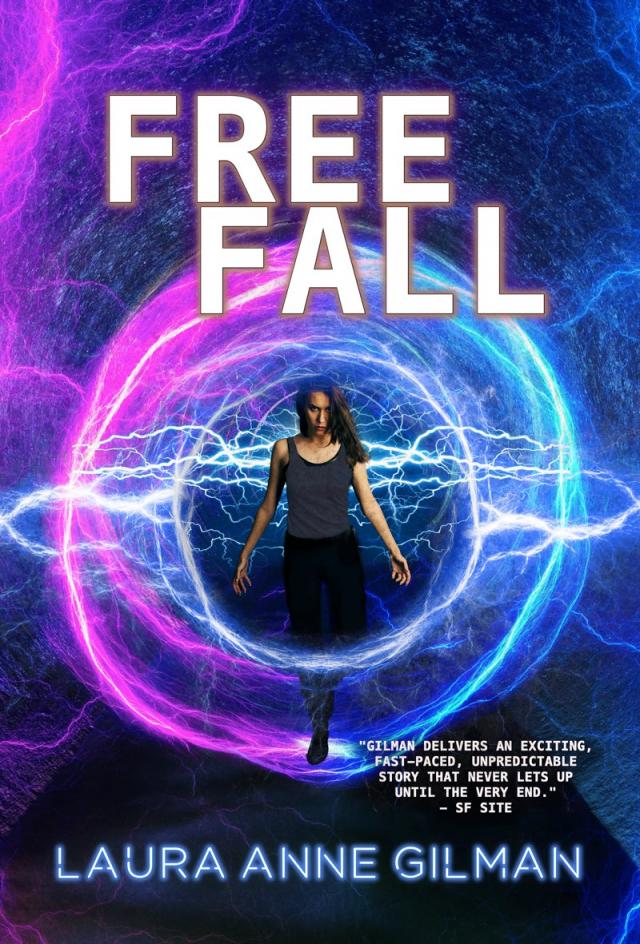
Free Fall
Laura Anne Gilman
Copyright © 2022 by Laura Anne Gilman
Cover Design: Natania Barron
Production: April Steenburgh
Ebook ISBN 978-1-951612-61-0
Print ISBN 978-1-951612-62-7
First edition Harlequin Luna 2010
All rights reserved.
No part of this book may be reproduced in any form or by any electronic or mechanical means, including information storage and retrieval systems, without written permission from the author, except for the use of brief quotations in a book review.
Contents
Chapter 1
Chapter 2
Chapter 3
Chapter 4
Chapter 5
Chapter 6
Chapter 7
Chapter 8
Chapter 9
Chapter 10
Chapter 11
Chapter 12
Chapter 13
Chapter 14
Chapter 15
Chapter 16
Chapter 17
Chapter 18
Chapter 19
Chapter 20
Chapter 21
Chapter 22
Chapter 23
Chapter 24
Chapter 25
Chapter 26
Chapter 27
Chapter 28
About the Author
Acknowledgments
Also by Laura Anne Gilman
Chapter 1
Spring, 1910 New York City
* * *
The conversation was subdued and civilized, as befitted the surroundings: a large, tastefully decorated library, surrounded on three sides by leather-bound books and a marble fireplace, and on the fourth by a wall of floor-to-ceiling windows, respectably covered by sheer curtains to allow light in but deflect the gaze of those on the street.
Out of the murmured conversation, a complaint lifted into the air. “We must have a motto.”
“Oh, not again,” the speaker’s companion replied. “Who would we tell this motto to, Alan? Where would we place it? Over what mantel would it be carved?” He gestured around the rather plain room they met in, the high ceilings and wainscoting on the walls almost austere in their simplicity. “It seems somewhat contraindicated for a secret society, if it truly wishes to remain unnoticed. If we must formalize our identity, 1 should think a statement of purpose before a motto.” The argument had been raging on-and-off for three months now, ever since they had gathered to bring in the New Year and officially inaugurate their organization, and most of the assembled men—eleven in all—were heartily sick of it.
The first man stuck to his guns. “We all know why we are here, Maxwell. A motto will bind us together, remind us of our purpose. Give us light in the darkness.”
“A lamp will work as well for that,” Maxwell retorted.
There was some muted laughter among the other men gathered, which quickly turned to coughs and covered grins. All eleven were well past the first blush of youth, with graying hair and faces that showed lines of wear. Yet they were all full of energy and vigor; the perfect advertisement for a generation of leaders, the lifeblood of Manhattan society, both business and social. Only under the surface did a difference show, a stern determination inherited less from Society and more from their Puritan forebears.
“Gentlemen, please.” Their leader, a relatively young man with a fashionably clean-shaven face and well-cut brown sack suit, held up his hand. “Peace. Alan, 1 am certain that a motto will be chosen when the time is right. It is not a thing to be rushed, after all. Posterity would not thank us for an ill-chosen motto.
“For now, it is more important that we come to order with the day’s business. If you would please join me?”
The eleven men gathered around the long, dark mahogany table that would not have looked out of place in a formal dining room, but instead of china and linen it was set with a three-color map of the United States, a Holy Bible, and a sword of gleaming watered steel placed lengthwise along the center of the table, its tip resting on the Bible. The hilt was of an Indian style, placing the age of the weapon at anywhere from 300 to 600 AD.
“Lord, we ask your blessing upon this gathering. In silence we have seen the wreck of human nature. In silence we have borne the predations of the old world, the creeping darkness coming upon us.”
In New York, in America, they were safe. But these men looked beyond their walls, considering what might be looking at them with a hungry or jealous eye. And Europe was under more than one shadow, stretching out toward the New World. They knew it, even if the government did not, yet.
“In silence we have watched as the glory of your word was drowned under the work of evil-doings. And so in silence we gather now, to protect those who would be true to their better natures, those who have no defense against the serpent of evil save your flaming sword and fierce justice, and those who, through lack of knowledge, have no salvation. We are the wall between the old world and the new, and we ask your blessing upon our hands, and our weapons, to guide them true.”
“Amen,” the others chorused. They all sat down, seemingly without thought of placement or precedence.
“All right. I hereby call this meeting to order, on this the 15th day of March, the year of our Lord 1910. Have we any special orders to be brought forward at this time?”
There was a short pause while the members looked to each other. When no one stood up or indicated they wished to address the group, the Speaker went on.
“Very well then. Have we updates on old business? Yes, Mr. Van Stann?”
The member so indicated let down his hand and stood up. He was a short man with sallow skin and a zealot’s eye. “The den of opium addicts near the fish market has been closed down. It required some cleansing to accomplish, but the owners will not attempt to reopen. ”
“Costs?”
“Two residents were trapped inside, unable to move themselves enough to escape. They would not have lasted long on their own, anyway. I doubt even the kindest of homes would have kept them from the drug longer than a day or two. The building is a total loss.” His report given, he sat down.
“We should have it strewn with salt, to be certain,” another man at the table suggested. “1 know it is but superstition, but at times using their own fears against them is the only way to ensure success.”
There was a low rumble of agreement to that.
“And yet,” Mr. Goddard, a banker who brought a refreshingly practical viewpoint to the table, asked, “If we play into those fears, are we not encouraging them, rather than stamping them out? How can that be true to our charter, to protect them even from themselves?”
Van Stann was back on his feet. “If we can keep another place such as that from being rebuilt? Sometimes, the lesser evil—the much lesser evil in this case—must be embraced, to keep the ignorant from greater crimes!”
“And who are we to determine what the lesser evil is?” Goddard shot back. “I do not claim that level of wisdom for myself!”
“Gentlemen! Please!” The chairman knew his fellow members well enough to intercede at this point. It had never come to violence before in this chamber, and he prayed it never would, but every member of the Silence was full of conviction and fire, else they would not have been allowed entrance to the group.
Once he had them settled down and seated again, he continued, in a more sedate tone. “A suggestion has been raised, and not without merit—and risks. Does anyone second Mr. Van Stann’s motion?”
Several hands went up, while other faces turned hard as granite.
“Very well. It has been moved and seconded. All who are agreed?”
Seven hands raised.
“Opposed?”
Three hands.
“Seven to three, one abstaining. The motion passes. Add the cost of the salt to the minutes, if you would, Mr. Donnelly?”
The secretary nodded, his hand flying over his notepad. They had offered to buy him a typewriter, but he preferred the old-fashioned way of doing things.
“Is that all for old business? Very well then, I open the floor to discussion of new business. Mr. Clare?” Ashton Claire stood, taking his time. He was a slender man, not much over five feet ten inches tall, and not quite so immaculately turned out as his companions, but the empty sleeve in his coat made others give way before him, as befitted a man who served his country in the Indian campaigns with honor, and paid the penultimate price.
“It has been reported that the selkies are back in the harbor. Already, we have lost three sailors to their wiles, two off naval ships at liberty, one a merchantman. The Portmaster begs our aid in the matter.”
There was a quiet murmur at that. Many of the men at the table had considerable investments tied up in shipping, and this struck close to home.
“We gave them fair warning, twice before,” the Chairman said heavily. “Still they cannot leave our harbor alone.”
Mr. Gilbert raised his hand, and was acknowledged, as he was an importer, with direct and firsthand knowledge of the problem. “I do not underplay the significance of the damage selkies may do—they have long been a temptation to the sailing man long gone from his home.”
Several of the men at the table crossed themselves, or looked horrified, but Gilbert ignored them. “However, we must acknowledge that selkies were once man’s allies on the oceans. They may not understand why—to their eyes—we have turned against them.”
“That partnership took effect when mankind was still mired in the ag
Gilbert bowed his head to indicate his acceptance of that. “I do not disagree. But they are, as you say, of a different age, and slow to change.”
“We have given them warnings. We have told them to leave our men alone. Still, they persist. Is there a man here who would argue that we have not given fair notice?”
Gilbert waited a moment and then, finding himself alone, shook his head and sat down.
“So be it. Have their rocks slicked with oil and set afire. Any of the creatures who do not willingly leave after that, take care of with a single shot to the head or heart.”
“We should destroy all of them,” Van Stann muttered. “Filthy abominations!”
Gilbert would have reacted to that, but the Chairman was more swift.
“They are simple creatures, Mr. Van Stann. Of human mien, perhaps, but without the grace of God’s touch, and so unable to understand the evil of what they do. Had it been harpies, then I would be the first to agree with you, but selkies... They were, as Mr. Gilbert reminds us, our helpmeets once, and it behooves us to remember that. Time and Science has passed them by. Destroy them for that? No. If we must, then let it be only when we ourselves are in dire threat, and only then with a heavy heart. The Lord created them, as he created all on this earth, and it is not our place to judge His works.
“Now. Is there further old business for us to discuss?”
There was none.
Chapter 2
Wren Valere was getting dressed to go outside. It was a lovely spring morning, complete with birds cautiously twitting and an almost pleasant breeze coming off the Hudson River. The sun was bright, the sky was blue, and she was trying to decide if she was going to need the hot-stick or not.
Some genius in the Cosa had come up with hot-sticks over the winter, after the Battle of Burning Bridge. Passed through a security screening, it looked like an insulated tube, maybe part of a thermos, or what bike messengers used to carry papers in. Totally harmless. In the hands of a Talent, someone with the ability to channel current through their bodies, it was the magical equivalent of a howitzer.
It didn’t pay, these dangerous days, to go outside unarmed.
She finally decided that she didn’t need it, not for a job in broad daylight, and put it back into the drawer with relief. She hated carrying a weapon, even when she had to.
To the ignorant eye, Wren looked the epitome of harmless and helpless: five feet and scant inches of nonentity. Brown hair, brown eyes, pale skin, and a figure that was neither eye-catchingly curvy nor attractively slim: Wren Valere disappeared the moment you laid eyes on her. It was a skill she had been born with, and honed over the years until she was one of the most successful Retrievers on record.
Now, it made her one of the most dangerous weapons the Cosa Nostradamus had. The more their enemies looked for her, the harder she was to find.
Hard didn’t mean impossible, though.
It had been three and a half months since the Battle, when an attempt to draw out the leaders of the human opposition had ended in bloodshed and destruction on both sides. Since then, the generations-old understanding between the “normal” world and the Cosa Nostradamus—best summed up as “you don’t see us and we won’t bother you”—had been badly shaken, if not shattered entirely. That shaking was the direct result of a vicious campaign waged, professionally and relentlessly, by anti-magical forces, unknowingly aided by factions within the Cosa who had seen only the chance to grow their own power and influence.
The intra-Cosa problems had been dealt with—or at least quieted for a while. The other...that force was still a real and present danger. The Humans First vigilantes who had been harassing the magic-using members of the Cosa and their non-human cousins the Fatae weren’t the real enemy, but merely shock troops employed unknowingly by a far more dangerous and well-funded organization—the Silence.
The same organization her partner—her ex-partner— used to work for. The same organization that had employed her, however briefly, when they were still pretending to be the good guys, the protectors of the innocent, the caretakers of Light and Virtue.
Innate and unwanted honesty forced Wren to occasionally acknowledge that it wasn’t that easy, as black- and-white as it sounded. Just as not everyone on the Mage Council was an uptight power-hungry murderer— just most of them—not everyone in the generations-old Silence was a bigot who hated magic and anything to do with magic.
Only the ones in power. Only the ones calling the shots. The ones who had hired over a hundred of the younger Talent, and brainwashed them into becoming weapons against their own people.
Who had set ordinary human bigots against the Fatae, causing innocent creatures to be harassed, chased, torn apart by dogs and run down by cars.
Who had sworn, at that highest level, to wipe what they saw as the “abomination” of the Cosa Nostradamus, the beings of magic, out of existence.
But on this morning, the first Tuesday in May, Wren had nothing to do with the Council, the Silence, or anything else with any sort of organization above and beyond herself. Right at that moment, Wren was lacing up a pair of flat-soled sandals under her carpenter pants and cotton sweater, and getting ready to go out on a job.
Life in wartime didn’t mean life without work.
“Hey. You want another cup of coffee?” a voice asked.
She shook her head. “When I get back.” She was wired enough; she didn’t need the additional push of the caffeine.
The demon nodded, and took a sip out of the mug he held in his white-furred paw. Thick black claws showed darkly against the pale blue ceramic of the mug, which had the sea-wave logo of the Didier Gallery on it. It was the last one she had: the other had gotten broken during the farewell party they had held for some friends the week before.
Most of the Fatae who couldn’t pass for human had left town well before then, through a chain of households and helping hands they were calling the Underground Furway, ignoring the fact that fully a third of the Fatae had scales and the other third were plain-skinned. Her fellow lonejacks—human Cosa members unaffiliated with the Mage Council—stayed put for the most part, facing the danger with strength, courage, and an unending dose of irreverence.
The strength and courage had surprised her. The irreverence she had expected. You didn’t become a lonejack if you were comfortable with the party line, or didn’t try to bend it every chance you got.
Despite being obviously Fatae, and therefore a prime target, PB had refused to even think about leaving town. The only concession he had made was to give up his basement apartment—in a crappy part of town the vigilantes patrolled too often—to move in with Wren for the duration. Her brownstone apartment was really too small for two people with personal space issues to live in comfortably, but another Talent, Bonnie, lived downstairs, and between the two of them, they could keep him safe.
They hoped.
These days, “safe” was a relative term.
“I have to go.” She picked up her leather jacket off the back of a chair and slid it on. The damned thing showed more wear and tear than she did, but there was comfort in the old familiarity of it.
“So? Go.” The demon shrugged. “We still on for the movies tonight?”
“Yeah. Bonnie and Jack will meet us there, they said. We can catch dinner after.”
Life in wartime didn’t mean you didn’t have a social life, either. You just went out in numbers. And armed.
“Did you...” PB didn’t finish that thought, much less the sentence.


