

Death lines, p.1
Death Lines, page 1


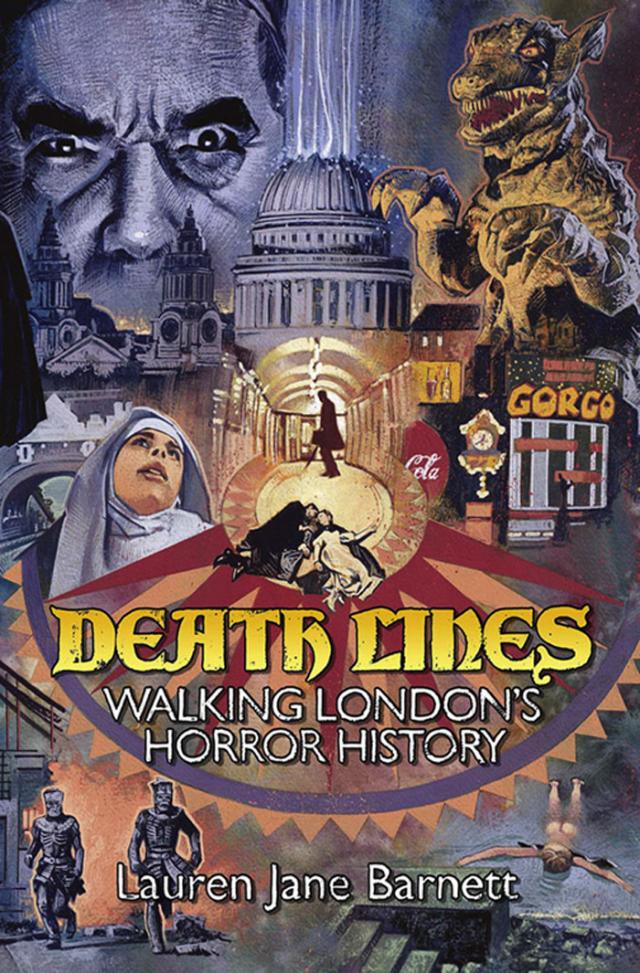
Death Lines:
Walking London's Horror History
First published by Strange Attractor Press 2023
Text © Lauren Jane Barnett 2023
Cover art by Graham Humphreys
Maps by Natalie Kay-Thatcher
Typeset in Scala Pro and Scala Sans Pro
Design/layout by Maïa Gaffney-Hyde
Lauren Jane Barnett has asserted her moral right to be identified as the author of this work in accordance with the Copyright, Designs and Patents Act, 1988. All rights reserved. No part of this publication may be reproduced in any form on by means without the written permission of the publishers. A CIP catalogue record for this book is available from the British Library.
ISBN 9781913689384
Strange Attractor Press
BM SAP, London, WC1N 3XX, UK
www.strangeattractor.co.uk
Distributed by The MIT Press, Cambridge, Massachusetts.
And London, England.
d_r0
For Richard
Contents
Introduction
Crisis on the King's Road: Chelsea Counterculture Hotspots
The New Dark House: Holland Park and Notting Hill Haunted Hotspots
Rocking the Cradle: Westminster Power Hotspots
Myth Made Manifest: Bloomsbury Occult Hotspots
The Maddening Crowd: Covent Garden and Leicester Square Madness Hotspots
Mind the Doors: The London Underground Transport Hotspots
Dark Waters: The Thames Invasion Hotspots
Beneath the Skin of History: The East End Gothic Hotspots
Filmography
Bibliography
Acknowledgements
Introduction
I wondered, though, why the best setting in the world for a thriller, a spooky picture, is London in the fog?
— Vincent Price on the set of Madhouse, 1974
Much like Dr Jekyll and his sinister counterpart Hyde, Count Dracula and his eternal nemesis Van Helsing, or Sweeney Todd and his steaming meat pies, London and horror cinema share a timeless and irresistible bond. It is a vast metropolis whose streets remain stained with the trace of horrors both real and imagined. This is the city of Newgate and Bedlam, of Jack the Ripper and the Highgate Vampire. The British Museum is said to be the object of an ancient Egyptian curse, and nearly every neighbourhood in the city has its own ghost or poltergeist. In addition to the great Gothic villains above, Dorian Gray took up residence in Mayfair, Sherlock Holmes lived and worked on Baker Street, Alex and his Droogs hung out on the King's Road, and a young Damien wreaked havoc in the London suburbs. For more than a century of cinema, directors and audiences have revelled in the dark shadows cast by London's past and the possibilities this unique city offers for fresh terror.
Since the silent era – with films like Jekyll and Hyde (1920), The Lodger (1927) and London After Midnight (1927) – London has provided a major setting for horror cinema. The H (Horror) certificate was created in 1932 in response to Universal's immensely popular adaptations of Mary Shelley's novel Frankenstein (1818) and Bram Stoker's Dracula (1897). The first British film awarded an H certificate was Walter Summers’ The Dark Eyes of London, released in 1939. Since then, more than 140 horror films have been set in London – more than any other British city. Home-grown villains like Jack the Ripper and Sweeney Todd have been reimagined for each decade, but London horror has grown beyond its roots in the neo-Gothic Victorian city. The sixties brought with it psycho killers like the unnerving antagonist of Michael Powell's Peeping Tom (1960), or the ghoulish Arthur Pimm in Herbert J. Leder's It! (1967). In Harry Davenport's Xtro (1982) and Tobe Hooper's Lifeforce (1985), aliens were imagined to either infiltrate or destroy the capital of the 1980s. Since the nineties vampires have repopulated the city, and thanks to zombie hits like Danny Boyle's 28 Days Later (2002) and Edgar Wright's Shaun of the Dead (2004), London was to become a defining locale for the millennial zombie resurgence.
Death Lines: Walking London's Horror History emerges from a deep love for, and a fascination with, these films and the city that inspired them. But it also arises from my own experiences walking the city as an occasional horror tour guide. As such, I've planned eight walks – each roughly two hours long – that aim to capture London's many moods and manifestations in horror cinema, alongside the history and myths that have inspired some of the greatest directors. The neighbourhoods and landscapes of the city provide the boundaries for each walk, and the book crosses London from the apparently opulent streets of Chelsea in the west to the cobbled alleyways of the East End. The walks can be taken in any order, and several of them may be connected if you so wish. I've been sure to mark any shared stops, particularly on the London Underground tour, so that you can join the dots in whatever way you like.
Each walk teases out themes shared by the films set in each area, and the ways in which these stories and nightmares respond to the history and character of the neighbourhood. At the end of each walk I've also expanded upon some of these themes by suggesting a series of other locations – or ‘horror hotspots’ – that you can visit elsewhere in the city. Each hotspot has inspired some of cinema's infamous tales of horror, and most of them appear in several movies. Among these hotspots are two mini-walks, which might take you even further afield into London's eerie hinterlands, to Enfield and to Crouch End – suburbs with deep connections to London horrors, both real and cinematic. Hand drawn maps by Natalie Kay-Thatcher have been provided throughout the book, but you may also want to keep your phone handy.
As you may have guessed, the walks contain a few plot spoilers to offer a vivid picture of each film and the way it uses the city to tell its story. Some you'll probably know, but I hope to introduce you to a few movies you may not have seen. If you come across an unfamiliar tale, the comprehensive filmography provided at the back of the book offers a brief synopsis to help you get the most out of each walk. That being said, a definitive guide to horror cinema in London would run to several thousand pages, so to keep this walking guide portable I've had to leave out many excellent films. This is not, however, a reflection on these films or their differing relationships with London, but an attempt to keep things pointed and concise. Each walk and horror hotspot has been constructed to give a glimpse of London as seen through the lens of horror cinema, refracting the most revisited and reimagined areas and stories in the city.
As I walked the city and wrote this book, I was reminded that cinema did not bring horror into the city but revealed the nightmares that have always lurked restlessly in its subconscious. It is as if the horror has always been here, cloaking the most contemporary serial killers or alien invaders with the same neo-Gothic atmosphere that concealed the actions of Hyde, the Ripper, or Dracula. To walk through London is not merely to pass through this horror, but to live alongside it. This guide is my invitation: horror, walk with me.
Crisis on the King's Road: Chelsea
Walk Length: 2 miles
Starting Point: Sloane Square
Transport: Sloane Square
End Point: Duke of York Square
Transport: Sloane Square Tube / Duke of York Square Bus Stop (G or KP)
What could be less horrific than the King's Road on a sunny afternoon? Lined with glistening glass shopfronts frequented by fashionable clientele, the former private royal road to Kew dazzles with the flash of wealth. Originally a village, but transformed by the residence of Henry VIII (demolished in 1753), Chelsea became a Royal Borough in 1965. Shortly after, the bohemian freedom and youthful optimism of Swinging London redefined Chelsea's character in a collision of old-money elegance and pop-culture icons like Mick Jagger and Mary Quant.
This burst of liberation had its darker side, and the horror films set in Chelsea – eight between 1967 and 1976 – brought the conflicts and tensions of Swinging London vividly to life. On this walk we will encounter the gruesome delight that horror films found in Chelsea's clash of extremes, whether pitting wealthy establishment figures against young nihilistic Satanists, or seeing the same rich conservatives at the mercy of the vengeful poor.
Route
✦ Starting Point: Sloane Square Station
A quick glance around the most famous square in Chelsea immediately reveals the beauty and wealth for which the area is known. If you were to take the road going off to the right of the square – Sloane Street – you would soon arrive at the anachronistically cosy green shed of Pont Street Cabmen's Shelter. Since the late 19th century it has offered rest and refreshment for cab drivers on their shifts – a scene recreated in Michael Reeves’ The Sorcerers (1967). Two cabbies are discussing a newspaper report of a recent murder. One of them recognises a photo of the victim, whom he drove home the night before along with a male companion who must be the murderer. This is a quiet, unsuspecting location for such horrific news, but the location was important for The Sorcerers, which was shot predominantly in this area (convenient for one of its stars, Boris Karloff, who lived nearby).
Released shortly before the Summer of Love, The Sorcerers is a scorching self-critique directed by an influential filmmaker of the Sixties counterculture who would attain legendary status for directing the better known folk horror classic Witchfinder General (1968). The titular sorcerers are two pensioners, Marcus and Estelle Monserrat, who discover a way to manipulate and experience the body of another individual. They decide that the ideal candidate for their experiment is someone seeking ‘ecstasy with no consequence’ – in other words, one of the young, suggestible, jaded youth
In the late sixties and early seventies this bleak vision of voracious pleasure-seeking drew horror directors back to Chelsea again and again. At our next stop we'll have a brush with a character who took The Sorcerers’ emotional detachment to the level of psychosis.
✦ Facing Sloane Square, take the road to the left, the King's Road. Continue past Duke of York Square, until you reach another square with a McDonalds on the far side.
Designed by Anthony Cloughley and modelled after ‘Le Drugstore’ in Paris, this building was cutting edge architecture when it opened in 1968 as the Chelsea Drugstore. A drugstore in the American sense, this was a place for hip Londoners to shop, have a soda, and hang out.
The Drugstore's trendy reputation and modernist design evidently appealed to Stanley Kubrick, who used it for an early scene in his 1971 dystopian horror A Clockwork Orange. Alex, the leader of a violent gang called droogs, has taken the day off school to visit the Drugstore and pick up two beautiful women. His visit is pure psychedelia, shot in the neon-tinted interior of one of the store's record shops. Though the film is set in a dystopian future, the use of this King's Road landmark leads viewers to connect Alex's casual moral depravity with the excesses of Swinging London. Alex is no flower child: by the time he walks into the Drugstore we have seen him brutally beat a homeless man, fight another gang, and rape a woman, usually while high. He is the embodiment of sixties nihilism pushed too far. The film, through Alex's association with the Drugstore, seems to warn against the potential dangers of the emerging counterculture.
Bizarrely, through their fleeting association with the protagonist, Kubrick also appears to take a swipe at the sexually liberated women Alex picks up at this store, one of whom is licking a phallic ice-lolly – a theme explored more prominently in the film at the next stop.
✦ Continue down the King's Road one block to Wellington Square, just past a flower stall. Number 32 is situated on the right-hand side of the square.
In Peter Sasdy's I Don't Want To Be Born (1975, also titled The Devil Within Her) worlds collide in this wealthy, exclusive corner of Chelsea. A newlywed couple – affluent, well-connected Gino and working-class dancer Lucy – bring their new baby back to Gino's home at number 32. Gino thinks he has found happiness with his new family, but we know that Lucy is struggling with a clutch of secrets. She doesn't feel she belongs in Gino's social world; she worries her new baby might be the son of her boss, Tommy, after a long affair that ended only with her wedding; and her baby has been cursed by a man whose sexual advances she rejected. When Lucy claims that the new baby is behaving strangely, even violently, Gino and the family doctor believe she has post-partum depression. We know better: the infant is a demon who nearly drowns his nanny, destroys much of his nursery, and kills his father and, eventually, the sceptical doctor.
I Don't Want To Be Born differentiates itself from other, more famous demon-children films of the era – Roman Polanski's Rosemary's Baby (1968) or Richard Donner's The Omen (1976) for example – by putting class-consciousness and sexual liberation at the heart of the story. The film heavily implies that Lucy's background, and her attempt to rise into the upper class, lies at the root of her suffering. Once an exotic dancer in a Soho club, she is now a woman of leisure with a lifestyle far beyond that of her former friends – a tension ruthlessly exposed when her demonic child drags the sins of her past into her future. The likelihood that her child is Tommy's son suggests she cannot escape her working-class past, and that her past promiscuity will be her downfall – if not, as the closing scenes suggest, the downfall of humanity.
✦ Continue along the King's Road another 350 yards until you come upon the Chelsea Potter pub.
The Chelsea Potter is an institution. Established in 1842 as the Commercial Tavern, it was renamed in 1958 to honour the Chelsea Arts Pottery. A decade later, the pub became a favourite of Jimi Hendrix and The Rolling Stones, drawing a more bohemian crowd. You can get a sense of this atmosphere in Massimo Dallamano's Dorian Gray (1970), in which Dorian returns after nearly a century of travel onto the vivacious King's Road of Swinging London. As if (ironically) overcome by the sight of short skirts and open sexuality he ducks into the pub for shelter.
At this point in the film, Dorian feels isolated: his looks and energy are too young for his former friends, but he cannot find a place for himself among the liberated generation. Cowering in the pub and shaken by the world outside, the final blow comes when the pub TV informs Dorian that the one doctor who may be able to help him age (and die) is dead. The thought of being eternally trapped in a world he sees as rapidly declining is the last straw. He rushes home, grabs a knife and violently attacks his portrait, killing himself. The critique of sixties culture couldn't be clearer: even the most hedonistic man of the Victorian era cannot bear to see the changes happening in Swinging London.
✦ Continue along the King's Road another 190 yards. Across from the Chelsea Fire Station is a Palladian style Georgian stone house with an iron gate known as ‘Argyll House’.
Argyll House was once the home of the English film director Sir Carol Reed, whose best known works include The Third Man (1949) and Oliver! (1968). The gothic Victorian atmosphere of Oliver! has a long tradition in horror movies, with cramped cobbled streets, gathering fogs, and glowing gas lanterns all adding to a sense of oppressive architectural foreboding. Many of the movies we see in Chelsea were consciously breaking away from this Gothic image in place of a realist horror in an attempt to capture contemporary moods. Resisting this shift however, Hammer Productions, one of the most successful horror producers at the time, continued to stick to this Gothic aesthetic, as we will see at the next stop.
✦ Continue on the King's Road for about half a mile until you reach Paultons Square on your left. The road is fairly quiet, and you should be able to find a quiet place to stop and take in the square.
Paultons square is the residence of Lorrimer Van Helsing and his granddaughter, Jessica, in Alan Gibson's Dracula A.D. 1972 (1972). Here, Jessica turns to her grandfather for help when her friends have raised Dracula from the dead. Van Helsing represents the establishment as a wealthy, respected historian. He also embodies a contemporary link to the Victorian past as he is played by Peter Cushing, who also plays Van Helsing's grandfather, Lawrence, the man who first kills Dracula at the start of the film. His house encapsulates these elements of the past, filled as it is with ancient books, antique furniture, and Lawrence Van Helsing's original notes on Dracula. As the hero of the film, Lorrimer suggests that both the establishment and the past are the places we can look for hope, not Jessica or her young friends; all of whom quickly fall under Dracula's spell.
Although the film is set in Chelsea during London's most swinging period, it presents this new generation as reckless, hapless, and even dangerous. The hipster leader of Jessica's friends is Johnny Alucard (whose last name is ‘Dracula’ spelled backwards in a nod to the 1943 film, Son of Dracula, directed by Robert Siodmak). Alucard not only raises Dracula, but becomes the real villain of the film. Count Dracula gets minimal screen time, leaving Alucard as the primary vampire to seek out victims and convert other members of the group; Dracula merely kills what Alucard brings him. Alucard also represents contemporary fears: when he raises Dracula using a Satanic ritual, the rite gestures towards contemporary fears surrounding occultism in youth culture and stories of esoteric delinquency such as the 1970s Highgate Vampire scandal. This supposedly real vampire lurking in north London was believed by some to be awakened by young people breaking into Highgate Cemetery and dabbling in Satanic practices.





