

One true wish, p.1
One True Wish, page 1


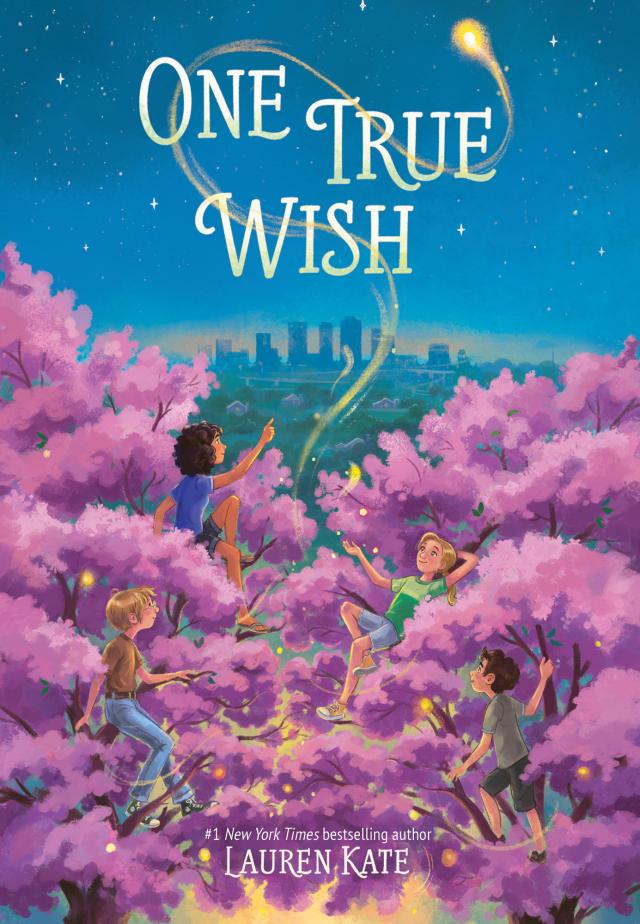
For Kris
1974–2020
“… all the stars
which long were pressed and hidden in the mass,
began to gleam out from the plains of heaven…”
—The Metamorphoses
ONE
Birdie
Birdie Borovsky had been waiting for this day for years. But on the afternoon the fairy landed, practically in her best friend Gem’s front yard, Birdie didn’t even feel the quake. She was distracted by the scene unfolding in Gem’s kitchen.
“I WISH I’D NEVER BEEN BORN!”
Lately her best friend screamed. A lot. Sometimes out of nowhere.
“Gemima Cash, what an awful thing to say!” Mrs. Cash was an accountant and still in her work clothes, though she’d taken off her heels. “And over a piece of cantaloupe? You’ll have some, Birdie, won’t you?” She was holding out the cutting board, really not reading the room.
It wasn’t Mrs. Cash’s fault. All she’d done was slice some fruit on one of those cutting boards that looked like the cross section of a tree. The cutting boards in Birdie’s house were plastic and flimsy as a fingernail. They made everything taste like onions. Gem’s mom wasn’t anything like Birdie’s mom, which was one reason Birdie spent so much time at Gem’s house.
Birdie appreciated the effort Mrs. Cash took to stick a toothpick into the center of each cold cube of cantaloupe. Still, out of solidarity, there was no chance Birdie could accept. She was on thin ice with Gem already, simply for having mentioned she was starving, that she hadn’t hardly eaten lunch. Which was true. But it was the wrong thing to say. It made Gem look at Birdie like she was a real idiot, like anyone with one brain cell should know that the topic of lunch was forbidden.
To be honest, Birdie probably should have known.
“No one understands me,” Gem fumed, even though Birdie was trying to do just that. For the whole second half of sixth grade, understanding Gem was a lot like algebra: the harder Birdie tried, the worse she did.
She knew it had started at lunch. She knew it had to do with Felix Howard. She knew—everyone knew—Felix Howard was the worst. What she didn’t know was how to help Gem feel better. Because the things that happened to Gem didn’t happen to Birdie.
Like: Felix Howard backing up on purpose in the cafeteria line and elbowing Gem in the boob. Then saying, loud enough for everyone to hear, that he was hungry for some melons. Birdie had felt her temperature rise, along with a few curse words she would have loved to sling at Felix. But then Birdie looked at Gem.
A weird thing about sixth grade was that there were moments when you didn’t recognize your best friend. A year ago, Gem would have punched Felix Howard. But a year ago, Gem didn’t have boobs.
Maybe boobs made all the difference. Birdie wouldn’t know.
Gem didn’t even look at Felix Howard. Even when he ended his taunt with one of his signature, thunderous, disgusting burps. She just walked past him with her tray and didn’t say a word about it, even to Birdie, the rest of lunch. When Birdie called Felix Howard a pig, Gem snapped at Birdie and said she didn’t want to talk about it. Worse, she’d turned away from Birdie, to Ava Rhodes at the other end of the table, and started talking about their history dioramas, due on Friday. It was like Gem just swallowed what had happened.
Right until the moment her mom put the cutting board of cantaloupe on the table.
“You used to love melon,” Mrs. Cash said. “Remember that honeydew sorbet I made last Fourth of July?”
Gem’s pencil tip snapped against her paper in the middle of her “Parts of a Whole” essay.
If Mrs. Cash had looked at her daughter then, she would have seen it: that moment just before the rowboat goes over the edge of the waterfall. She would have dumped the cantaloupe down the garbage disposal, no questions asked. She used to be good at stuff like that. She was one of those moms you felt was on a kid’s side. But she was halfway inside the refrigerator by then and muttering about expiration dates on yogurt.
Birdie closed the notebook where she’d been working on her comic for the final issue of the school newspaper. She readied herself for whatever would come.
“I HATE cantaloupe, and I HATE you!” Gem screamed. Then she flung her chair back and pushed the whole cutting board off the table, until there was cantaloupe everywhere, even in the dog bowl, and a pale pool of juice was oozing toward Mrs. Cash’s pedicure.
Gem bolted for the side door. She let it slam behind her.
She hadn’t taken Birdie with her.
Birdie wished Gem had bothered to look back, to say with her eyes, C’mon. I need you, my best friend. Instead the kitchen filled up with the awful quiet of Gem not being there.
Even though Mrs. Cash probably didn’t expect Birdie to stay and help clean up, Birdie still felt bad when she went running after Gem. She had to. That’s what best friends did.
But as she jogged out into the humid Texas afternoon, Birdie had a funny feeling that something wasn’t right. Something bigger than Gem’s mood. Something bigger even than Gem and Birdie’s friendship. Something in the air.
Something she’d forgotten she’d been waiting for.
TWO
Van
One minute, Van was sitting alone in their da’s kitchen, avoiding their English essay and binging Birdie B’s comic archive on their phone. The next minute, out of nowhere, the house shook, and a deep boom sounded close by.
Van was the only one downstairs. There was no way they were going upstairs to ask their da’s girlfriend, Nirusha, whether she’d felt it too. They put down their phone and ran outside. The sound rang in the air.
After a moment, their ears picked up something else: a thrashing coming from the woods. They stood on their da’s diving board and looked out at the slope of dirt beyond the fence, at the stand of trees beyond that. The sun hung over a canopy of leaves. It would be dark in an hour.
Van had never explored these woods before. When they stayed at their da’s, they boycotted everything that pre-divorce Van would have thought was fun. Van wanted their da to see how miserable they were, how miserable he’d made them. So far, he hadn’t picked up on their hints.
It had been more than a year since Van moved to Texas from Ireland, but people still called them “the new kid.” Even though there were a dozen newer students who started at Wonder Middle at the beginning of sixth grade. When Van cried about this at night to their mam, convinced that they were weird and not in a good way, their mam insisted that they simply hadn’t “found their people yet.”
Van used to have people. They used to have parents who were married, and a house so close to the shore they could walk there without shoes. They didn’t like to think about their life in Ireland. It felt so distant that it seemed more like it had happened to a character in a show.
Van had braces, glasses, big feet, sad eyes. They’d gotten a short haircut at the beginning of sixth grade, and it was a mistake. They didn’t look like Josie Totah. They looked like someone with enormous earlobes. They’d developed a tick of tugging on their hair, as if they could make it grow faster.
They hopped off the diving board and walked to their da’s back gate. Heading for the woods, Van wasn’t scared, only curious. It seemed like something had landed out there, and now that something was in trouble. A hawk? An owl? In Ireland, Van might have recognized the sound as any number of native birds, but here, they didn’t know.
The thrashing made it easy for Van to track. And soon they heard another sound, a faint tinkling, like a bell. Something about that sound… It made Van wish their best friend Caro was at their side. But Caro was twelve hours away by plane. Far enough that their old friendship wasn’t worth wishing for anymore. It had been a long time since Van even let themself think about the easy fun they used to have back home.
Alone was what Van was now. So alone Van went into the woods.
They came to an elm tree, whose exposed roots jutted up around its trunk like the arms of a star. The roots were gnarled and thick, almost as tall as Van. The sound was coming from the other side. They propped their elbows on the elm roots and peered over. For several moments, they couldn’t get their mind around what they were seeing.
A creature lay faceup, twitching in a pile of leaves. It was much smaller than Van, about the size of a new baby, but its face was mature, fine-featured, with a long nose and pointed chin. Its face made it look like it was Van’s age, twelve. It wore a shiny green dress of unusual fabric and had tangled red hair splayed out in all directions. Its belly could best be described as pot.
Van thought back to the comic they’d just been reading on their phone. The thing in the leaves looked a little like Phoebe LaCroix—the cheeky, eponymous villain from Birdie B’s weekly comic strip, who lived on a distant star.
“No way,” Van whispered. They swiped off their glasses, cleaned them on their sleeve, and set them back on their nose. The sight before them stayed the same.
Now the creature twitched toward Van, turning its head and widening its golden eyes. In its gaze, Van saw fear so sharp and real it reached out and pricked them.
“Are you hurt?” Van asked.
They’d left their phone on their da’s counter. Should they run back to the house and call 911? But they didn’t want to leave the creature, not even for a moment.
In the time it took Van to climb over the roots, the creature had struggled to its feet. Facing Van, pointy chin jutting up, it smashed a crimson flower-petal hat back atop its head. Only then did Van notice two dusty gray wings extending from it
“You’re seeing things,” Van told themself under their breath. A couple of years ago, this thought wouldn’t have occurred to them. In Ireland, children were raised on a diet of fairy lore, and there were reasonable people—like Van’s very own Gran—who actually believed. When their parents separated, Van’s first instinct had been to go to the fairy hill near their aunt’s and make offerings, begging the fairies to put their parents back together. By the time the divorce was final, things were different. Van was different. They’d returned to the hill and destroyed their offerings. They had sworn off fairies.
So this thing could not be a fairy, because Van did not believe in fairies.
They closed their eyes. “Count to three. When you open your eyes, it’ll be gone.”
But when Van opened their eyes, not only had the not-fairy not disappeared, it did the last thing Van expected. It let out an enormous burp. The sound vibrated, shaking the trees.
The creature’s cheeks turned pink. It placed a delicate hand over its mouth.
“Whoa,” Van said, fighting back an urge to laugh.
It pointed with a trembling arm. “What are you?”
“Me?” Van blinked. They touched their chest. “I’m a… human?”
“As in, a human-Child?” the creature asked, crossing its arms.
“Yeah, I guess, technically,” Van said. They’d finally gotten their da to stop calling them a young woman, but human-child didn’t feel exactly right either.
“Ha!” The creature stamped its foot. “Children don’t exist.”
When Van laughed, the creature walked a circle around them, squinting crossly. Beneath its torn gown… webbed feet poked out. Another feature of Phoebe LaCroix in Birdie B’s comic strip. This was getting weird.
“Are you a puppet?” it asked Van. “Did the priestess stitch you for a solstice play? Why is it so cold on this moon, and what is wrong with my wings?” The creature swatted at them angrily.
“What are you?” Van asked.
The creature placed a hand over its chest. “I am Phoebe, Fairy of the North Star.”
“No. No, you’re not.” Van rubbed their eyes. Were they that lonely that they’d resorted to imagining friends out of comic strips? “That’s impossible. You’re… made-up.”
The creature hooted with laughter. “You don’t believe me? That’s rich!”
“Okay,” Van said. “Prove you’re a fairy.”
“Prove you’re a Child!” the creature shot back.
“How would I prove I’m a child?” Van said. It was the craziest thing they’d ever heard.
The creature that called herself Phoebe tilted her head and smirked. “Make a wish.”
THREE
Birdie
Birdie jogged toward the street. She knew where Gem had gone. Gem’s house was at the end of a cul-de-sac, except instead of the circle being filled only with concrete, whoever built this street left these two old crabapple trees in the center and paved the road around them.
Over the years, a tall border of holly bushes, spindly ivies, and Mexican feather grass had grown up on that patch of earth around the crabapple trees. It was a little wilderness in the middle of the street. It looked more impenetrable than it was, and Birdie and Gem knew the best places to crawl through. They knew which branches to climb so you could see out but not be seen. On days like today, when the crabapples were blooming, Birdie felt like she was disappearing into a hot pink jungle on another planet when she slipped inside.
This was the one place where she and Gem could make the world the way they liked it. In the crabapples, Gem was an astronaut at SpaceX, and Birdie was a journalist, speaking truth to power, like her idol, Katy Tur. They were both important. Not just to relatives, but to the wider world. Even if it was just for an hour before dinner, until Gem’s mom called them down and Birdie biked the three miles back to her apartment. For a little while each afternoon, they were something.
But today Gem wasn’t there.
Instead Birdie found Gem’s little brother, Marley, at the crabapples, arranging some sticks at the base of one of the tree trunks.
“What are you doing here?” Birdie asked.
Marley didn’t look up. “Making a nest.”
Birdie noticed the subtle outlines of Darth Vader all over the fabric of his T-shirt, which was kind of cool and kind of dorky and just so incredibly Marley to straddle that line. Marley was only a year younger than Birdie, but the difference between them felt bigger. She couldn’t remember the last time she’d hung out with him.
“A nest for what?” she said.
“I’ll know soon.”
Birdie rolled her eyes. Marley was bizarre. “Gem told you not to play here. Remember?”
“Did you feel the earthquake?” Marley asked.
“Huh?” There weren’t earthquakes in Wichita Falls.
Marley looked at her then. He had crystal-blue eyes, nothing like Gem’s deep brown pools, and his skin was several shades lighter than Gem’s, but it was amazing how much brother and sister looked alike, all their features the same shape. Both Cash kids had very curly hair in a shiny shade of brown. They had thick, arched eyebrows, dark lashes, and particularly nice teeth.
Birdie was okay in the looks department, but she felt like everything had to be going right for it to show. Like the weather couldn’t be too humid, and she couldn’t be wearing orange or have forgotten to put on sunscreen the day before. Birdie was in a battle against her freckles: enough was enough.
“I heard her run off toward the woods,” Marley said.
Birdie would never have thought to look in the woods. Had Gem not come to the crabapples because she didn’t want Birdie to find her? “Did she know you were in here?” she asked Marley. That might explain it.
He shrugged. “Why’s she so mad? Felix Howard?”
Birdie squinted at him. “What do you know about Felix Howard?”
“I heard he was a jerk to her at lunch.”
“Yeah, well.” Birdie didn’t know what to say about that. It wasn’t exactly good news that the incident made its way not just to the Lower School, but to its outsiders, to Marley. And Birdie definitely didn’t want to talk about Gem’s boobs with Marley. The thought made her itch.
“I’m gonna go find her,” Birdie said, nodding at Marley’s stick pile. “You’re not about to set anything on fire, are you?”
He laughed like he felt sorry for Birdie that she’d thought something so dumb. “That was one time, when I was five. You think people stay the same their whole lives, don’t you?”
“No,” Birdie said. She wasn’t sure why the comment nagged at her. People changed. Obviously. For example: Gem.
Gem used to be…
Gem wasn’t always so…
Gem used to like Birdie.
Was it that pathetically simple? Birdie was surprised to feel she might cry. Since the start of May, as the other kids counted down the days until school let out for summer—eight—Birdie’s anxiety counted up. What was so great about summer? Nothing was the answer, if you were Birdie.
For the past three years, Gem had spent her summers at a super-fun sleepaway camp that Birdie’s family couldn’t afford. She was gone for six weeks, and Birdie was lucky to get six letters. This year, Birdie worried she might not even get one of those fill-in-the-blanks camp postcards.
It was always weird for a few days after Gem came home from camp. When the two of them would start talking at the same time (“Go ahead,” “No, you first”) and could never agree on anything that sounded fun enough to do. This year, Birdie didn’t know if their friendship could survive that awkward phase. And if it didn’t?
What would it be like to start seventh grade without a best friend? Birdie guessed she’d have all summer to worry about that.
“You know where the creek is?” Marley asked. “I bet she’s there.”
Birdie nodded. She sort of did.
“Need my help?” Marley asked.
“Why would I need your help?” Birdie snapped. She didn’t mean to sound so annoyed. None of this was Marley’s fault. Birdie couldn’t think of anyone to blame, except Felix Howard, which didn’t do her any good. She needed to find Gem.
“Because you’re still standing here,” Marley said.


