Saint ivy, p.1
Saint Ivy, page 1


Title page of the book is decorated with images of a blender whisking up a mixture in a bowl, cup cakes, messages of love at the click of a button, an open pencil purse, and a folder with a scale, pencils, a protractor, and a compass placed on top.
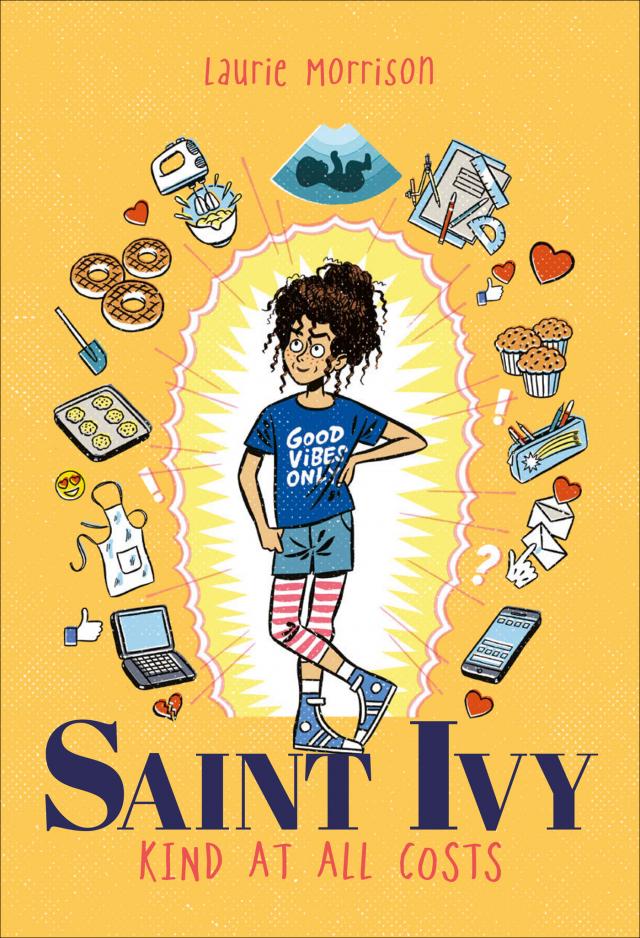
The title of the book "Saint Ivy: kind at all costs" by Laurie Morrison is shown. The title is surrounded by images of doughnuts, a heart-shape, a broken heart, a laptop, and a heart-eyes emoji.
For everyone who
struggles to be as kind
to themselves as they
are to other people
PUBLISHER’S NOTE: This is a work of fiction. Names, characters, places, and incidents are either the product of the author’s imagination or used fictitiously, and any resemblance to actual persons, living or dead, business establishments, events, or locales is entirely coincidental.
Cataloging-in-Publication Data has been applied for and may be obtained from the Library of Congress.
ISBN 978-1-4197-4125-8
eISBN 978-1-68335-750-6
Text copyright © 2021 Laurie Morrison
Cover illustrations copyright © 2021 Jason Ford
Book design by Marcie J. Lawrence
Published in 2021 by Amulet Books, an imprint of ABRAMS. All rights reserved. No portion of this book may be reproduced, stored in a retrieval system, or transmitted in any form or by any means, mechanical, electronic, photocopying, recording, or otherwise, without written permission from the publisher.
Amulet Books are available at special discounts when purchased in quantity for premiums and promotions as well as fundraising or educational use. Special editions can also be created to specification. For details, contact specialsales@abramsbooks.com or the address below.
Amulet Books® is a registered trademark of Harry N. Abrams, Inc.
ABRAMS The Art of Books
195 Broadway, New York, NY 10007
abramsbooks.com
CHAPTER ONE
The first anonymous email wasn’t that big a deal. Not right away, at least.
Ivy was on the bus, heading home from school, when she saw it on her phone. The subject line said, “Thank you,” and the sender came up as downby thebay5@mailme.com: no name. For a second she thought it was spam, but the preview text started with the words “Dear Saint Ivy.”
Saint Ivy. That’s what her best friend, Kyra, called her sometimes, and how would a random spammer know that? So she opened the email and read.
To: Ivy Campbell
From:
Subject: Thank you
Dear Saint Ivy,
Somebody really smart used to tell me that there should be two different kinds of thank-yous. A basic, throwaway kind for when somebody holds a door open or says bless you when we sneeze or something. And then a special version that tells a person, “What you just did for me mattered. It gave me hope when I didn’t have any. It turned a really awful day into an almost-okay one.” Because if we just mumble a quick thanks either way, people don’t know when they’ve really made an impact, and that’s a shame.
So, here goes. My day today was really awful, and you made it almost okay. It probably wasn’t a big thing for you, what you did. But it was a big thing for me. So I want to let you know that. I want to say the special kind of thank-you.
From, your friendly anonymous
good-deed appreciator
Huh.
The bus turned left, rumbling past the used book-store, the Italian restaurant Ivy’s family used to love, and the CVS.
Was this a joke? It didn’t seem like a joke.
If she really improved somebody’s day this much, she was happy. But she was confused, too. Why did this person want to be anonymous? Who was it? She scanned the email again, searching for clues, but she came up empty.
Kyra was the one who started calling her Saint Ivy, but now some other kids said it, too, and anybody could have heard. And Ivy had done nice things for a lot of people that day.
Maybe the email was from Sydney DelMonte, a junior in high school who lived next door to Ivy’s dad and had been crying on a bench outside the middle school that morning. Or Lila Britton, who’d borrowed Ivy’s math textbook so she wouldn’t get in trouble for forgetting hers for the third time in a week. Although . . . Lila wasn’t exactly Ivy’s number one fan. Or maybe Josh Miller, the boy Ivy’s other best friend, Peyton—and pretty much everybody else—had a crush on. He’d been hobbling around on crutches after he hurt his knee so badly at soccer, and Ivy had picked up his things when they spilled out of his backpack and then carried his bag to his next class.
Actually, the email could have been from Peyton herself. She’d been extra quiet today, and extra appreciative when Ivy went with her to the music room and played along on the piano while she practiced her solo for chorus. But Ivy did stuff like that for Peyton all the time, and Peyton had already thanked her plenty. Plus, Peyton had told Kyra that “Saint Ivy” was kind of a strange nickname since Ivy was Jewish on her mom’s side and Jewish people don’t even have saints.
The bus pulled up to Ivy’s stop, so she put her phone away and let the mystery go, mostly. Maybe she’d figure it out later, once she loosened up her mind and stopped actively wondering, the way she could sometimes remember a word in Spanish class as soon as she moved on to something else. For now, she and Nana had some pastries to bake.
Nana used to live in the suburbs just outside Philadelphia, but she’d moved into the city last year. Now she lived five blocks away from Ivy, down the hill in a one-bedroom rental on the twenty-first floor of a big apartment building.
Every Friday afternoon, Ivy went to Nana’s after school. Today, Nana was waiting in the hallway, wearing an impressively bright pink apron that said F.A.B. in black cursive letters.
“Ta-da!” Nana said, doing a little twirl. “I got us aprons. Do you love them?”
“Um, wow!” Ivy replied. “They’re—”
“I know!” Nana pointed at the letters one by one. “Friday Afternoon Baking. F.A.B. Fab-ulous, right?”
“Definitely fabulous,” Ivy agreed.
Nana kissed her cheek. “I knew you’d love them.”
She handed Ivy a matching apron in bright purple. It was stiff and scratchy and completely ridiculous, but Nana’s whole face lit up when Ivy put it on.
“Now, don’t just stand there,” Nana said. “This hallway’s sweltering and our time is limited.”
Ivy wasn’t sure if Nana meant “our time” in a literal sense, as in the two and a half hours before Ivy went home and Nana went to her neighbors’ apartment for Shabbat dinner, or in a more philosophical sense, as in their time on this planet as mortal beings. It could have been either, because Nana said tons of super-morbid things. Mom said it was because she had too much time to think, now that she’d retired from her job as an elementary school principal.
In fact, the whole reason they’d started Friday afternoon baking lessons was because every time Nana baked something delicious, she reminded Mom, Ivy, and Ivy’s brother, Will, that she didn’t “cook from a book,” so after she died, all her recipes would go with her. Mom got sad and flustered every time she said it and Ivy didn’t have anything else to do on Friday afternoons, so the whole thing was a win-win. A win-win-win, actually, because everyone got to eat a whole lot of truly outstanding desserts, too.
Nana led Ivy into the kitchen, where she’d lined up flour, sugar, salt, walnuts, and chocolate chips on the shiny-clean counter.
“It’s a perfect day to make rugelach, don’t you think?” she asked.
“Definitely,” Ivy said, because rugelach was delicious—especially Nana’s rugelach—so there couldn’t be an imperfect day to make it.
Nana plucked the cold stuff out of the fridge, adding butter, cream cheese, and blackberry preserves to her ingredient parade, and Ivy turned to a fresh sheet of paper in her recipe notebook.
She wrote the word rugelach in her prettiest handwriting and copied down the facts Nana rattled off: how the word rugelach was Yiddish for “rolled things,” and rugelach was an American version of an old Eastern European pastry called kipfel. Nana said the only real difference was that Jewish bakers in the U.S. had added cream cheese to the dough a couple generations back.
“Now. It’s fine to change up the filling however you want, but the dough is just right as it is, you got that?” Nana said, pointing at Ivy with a bright pink fingernail that matched her apron—Nana believed in “signature colors,” and bright pink was hers.
“Got it,” Ivy replied.
“No substituting coconut oil or fat-free yogurt or any of that health-food stuff for these good fats. Rugelach isn’t going to be healthy, and that’s why it’s good for you. You write that down, too.”
That was kind of a knock on Ivy’s dad and his partner, Leo, who had gone through a health-food kick recently when they swore by chia seeds and flaxseed meal and made some extremely disappointing cookie bars, but it wasn’t a mean knock, because Nana loved Dad and Leo.
Ivy wrote, “No substitutions for fats!” and then they got to work. Ivy copied down measurements and ingredients, and they cut and dumped and sifted butter, cream cheese, flour, and sugar into the food processor. Then they pulsed it all together until a delicious-smelling dough formed.
“Almost like magic, huh?” Nana said as they put the dough in the freezer to chill.
And it did feel a little bit magical to see how much the ingredients changed one another when they came together to create something new.
T
“Oh, don’t bother trying to make it too neat,” Nana said. “It’s all going to ooze out the edges and make a big, beautiful mess.”
They formed all the pastries into crescents and baked batch after batch. Some ended up crooked, some stretched out skinny and turned brown on top, and all of them were sticky and crumbly and delicious.
They packed some up for Ivy to take home, and then they walked back out into the hallway together. As the elevator climbed up to the twenty-first floor, Nana cupped Ivy’s cheeks in her soft, cool hands.
“You’re such a sweet girl,” she said. “I appreciate you doing this with me.”
She’d gone so suddenly serious that Ivy braced herself for some extra-morbid reflections, but then she just kissed Ivy’s forehead and said, “I’m here for you anytime. You know that? Anything you need, I’m around.”
“Okay, thanks,” Ivy said. “I know.”
Nana sighed. “I worry about you with your big, soft heart. Your brother—he lets everything out. But that heart of yours is like a sponge.”
The lights in the hallway buzzed, and it really was sweltering out here—ten degrees hotter than inside Nana’s apartment, at least. The elevator doors slid open, and Ivy hugged Nana goodbye and stepped inside.
What did that even mean, that Ivy’s heart was like a sponge? It was a good thing that Ivy cared about other people and tried to help them. Just ask down bythebay5@mailme.com! Having a kind heart—doing generous things and caring for other people—that was the thing that made Ivy special. It was the thing that made her Ivy.
She wasn’t a genius like Kyra—that had become obvious once they’d started middle school. She wasn’t an amazing singer like Peyton or a star athlete like Will. But she was kind. The kindest. She knew who she was and she liked herself, almost all the time.
There were a zillion new texts in the ongoing group chat with Kyra and Peyton, so Ivy didn’t have time to focus on Nana’s super-sentimental send-off after she got out of the elevator and walked outside. She had to catch up on what they’d been saying without her and figure out something good to add, because she was a little bit afraid they might start a new chain without her next time if she didn’t.
Later, she couldn’t believe she hadn’t realized why Nana had gone all serious like that. But it wouldn’t have occurred to her in a million years that Mom would tell Nana what was happening before she told Ivy.
CHAPTER TWO
The next morning, Ivy woke to the sound of Dad’s voice drifting up from the kitchen.
It was just Dad down there with Mom at eight o’clock on a Saturday morning, no Leo. Just Dad and Mom talking in hushed voices while coffee burbled in the pot, as if it were three years ago and not now. A general sense of uneasiness hit Ivy like the rush of heat when Nana opened her oven, but the pieces didn’t click into place.
Ivy and Will came out of their rooms at the same time, and Will rubbed down the top of his sleep-fluffed hair.
“What’s Dad doing here?” he asked.
Ivy shook her head. “No clue.”
Mom and Dad were still close even though they weren’t married anymore, and Dad lived eight blocks away, in a brand-new townhouse development that was pretty much the opposite of the skinny old row house where Mom, Will, and Ivy still lived. It wasn’t unusual for Dad to be at their house in general, but it was unusual for him to show up early on a Saturday morning when he and Leo should have been at their favorite spinning class at the gym.
As Ivy followed Will down the creaky stairs, her heart started thumping and her brain raced to keep up. Something was wrong. It had to be. The last time Dad had been here when they woke up, it was to break the news that their great-grandfather had died.
But when Will and Ivy got downstairs, Dad said, “Hey! My two favorite kiddos!”
Some of Ivy’s dread dissolved because Dad’s voice was even more cheerful than usual. And he sat there across from Mom at the round kitchen table with his dark blond hair neatly parted and a big bag of bagels from Kepners’ in front of him. Nobody would take the time to comb their hair that neatly and pick up bagels if something truly awful had happened.
Mom clasped her hands together, separated them, and tapped her fingertips against the edge of the table. “Morning, sleepyheads! Dad’s here!”
“Um, yeah,” Will said, raising his eyebrows at Ivy. “We caught that.”
“You hungry?” Dad asked. “I brought sustenance.”
Will and Ivy exchanged one more look, but then Will helped himself to a bagel, poured himself a glass of orange juice, and sat down in his usual seat. It would have taken a stranger situation than this one to keep Will away from bagels.
“How’s it going, Ivester?” Dad picked up a plastic container and waved it around. “The bagels are still warm and I even got whitefish, because that’s how much I love you.” He pinched his nose as if he could smell the whitefish through the sealed lid, the same way he used to do when he still lived here and the four of them always got bagels on Saturday mornings. Ivy pushed away the nostalgia that pressed down on her ribs and laughed. Then she tore open a perfectly doughy sesame bagel, spread on plenty of whitefish salad, and held out the container toward Mom.
Bagels with whitefish were a tradition on Mom and Nana’s side of the family, and Mom loved whitefish, too. She took the container from Ivy, but then she just set it down.
“You didn’t want any salty fish spread for breakfast, Rachel?” Dad joked.
Mom fidgeted with her hands some more and then ran her fingers through her hair—curly and dark brown, just like Ivy’s and Nana’s, and damp and citrus-smelling from the shower. “I don’t think I’m supposed to have . . . because it’s smoked, so I’m not sure if . . .”
“Oh!”
Dad smacked himself in the forehead as if he should have realized, and then Mom said, “I have some news.”
And finally, finally Ivy began to understand why Dad was here and what Nana had been talking about yesterday.
This was it.
This was happening.
Mom leaned forward to pat Ivy’s arm with one hand and ruffle Will’s bedhead with the other. Will’s hair used to be so much lighter than Dad’s, but now it was the same exact color, Ivy realized. When had that happened? And why was she focused on hair color when she knew what Mom was about to say?
“The IVF . . . the medical treatment, for the surrogacy. The third time we tried it, in June . . . it worked. I’m pregnant. Erin and Christopher are going to have their baby.”
Mom’s voice was bright, but her eyes were kind of panicky. She glanced from Ivy to Will and back again. She was checking their reactions, making sure they were okay.
Ivy needed to be okay. She needed to be a whole lot more than okay.
Erin was Mom’s best friend, and she and her husband, Christopher, desperately wanted a baby. Last year, after they’d tried everything else, they’d decided to try gestational surrogacy, which meant implanting an embryo with Erin’s eggs and Christopher’s sperm into another woman’s uterus. So somebody else would carry their baby, but the baby would have their genes.
There were agencies that helped people find gestational carriers, but Erin and Christopher couldn’t afford them. So they’d asked Mom last year if she might be willing to be their surrogate, and Mom had gone through a whole screening process with a doctor and a therapist to make sure she could do it. Then she’d asked Ivy and Will whether they thought they’d be okay with it if she said yes.
Will had kind of freaked out at first, but Ivy had been a hundred percent on board. For Erin and Christopher’s sake, and also because Mom needed this. Ivy knew—because Mom had confided in her—that Mom was frustrated with her job at the historical society but nervous to leave. Mom wanted to do something “meaningful and fulfilling,” and what could be more meaningful or fulfilling than this?
But then there had been two unsuccessful rounds of IVF last spring. Mom had said they thought they’d try again, but she’d never told Ivy they had.