The galactic breed, p.1
The Galactic Breed, page 1


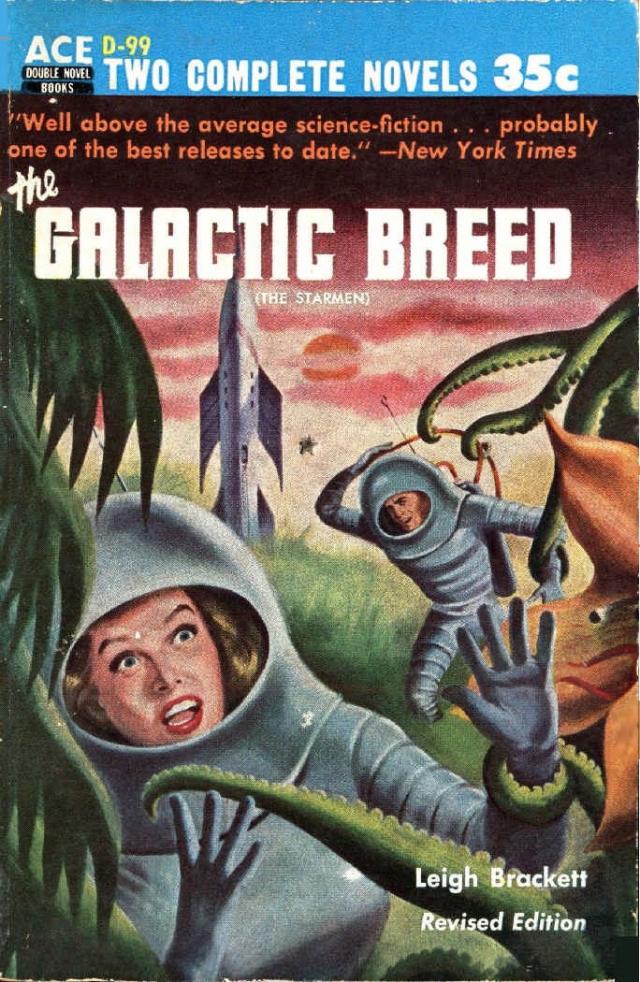
“A sweeping and dramatic story of interstellar civilization.”
—Philadelphia Daily News
Though he was born and raised on today’s Earth, Michael Trehearne always knew he was different. There was something about him that yearned for alien sides and other worlds. But until he unexpectedly bumped into the mysterious woman named Shaim, he never realized the whole startling truth—that he belonged to THE GALACTIC BREED.
How Trehearne fought to regain his starry birthright, how he thrust himself into the middle of a desperate struggle that stretched from one end of the universe to the other, make a gripping and highly exciting novel of the secret interstellar empire that exists at this very moment!
Turn this book over for second complete novel
CAST OF CHARACTERS
MICHAEL TREHEARNE
He could claim his inheritance only by enduring an ordeal no Earthling could possibly survive.
SHAIRN
The gifts she bought in New York stores would go to friends over a trillion miles awayl
EDRI
He believed that space travel should be the privilege of every intelligent being wherever bom.
KERREL
He believed that space travel should be a rigid monopoly barred from “inferior” peoples.
ORTHIS
He had invented a key to the stars and found it a Frankenstein monster.
TORIN
He longed for distant worlds—and his reward was horror.
The
Galactic
Breed
Original Title: THE STARMEN
LEIGH BRACKETT
ACE BOOKS, INC.
23 West 47th Street, New York 36, N. Y,.
The Galactic Breed (The Starmen)
Copyright, 1952, by Leigh Brackett
An Ace Book, by arrangement with Gnome Press, Inc.
Short version copyright, 1951, by Better Publications, Inc.
Conquest of the Space Sea
Copyright, 1955, by Ace Books, Inc.
Printed in U.S.A.
CHAPTER I
Michael Trehearne looked up into the night sky. It had been raining, but now the rain had stopped and there was a wide rift in the clouds, a valley of stars. In that valley was a presence. An impossibility, a madness, a huge solid inescapable fact. Trehearne said a word over to himself. The word was starship, and the presence dropping down so slow and solemn out of the sky was also a starship. But still the word had no meaning and his mind refused the implications of the fact.
Beside him in the darkness Shaim said, with the edge of cruelty that came sometimes into her voice, “You had to know the answer. Well, Michael, there it is.”
And the wind blew chill and damp from the Pennsylvania hills, and the monstrous shadow fell silently down across them, and on the other side of Trehearne the man whose name was Kerrel said with a stiff cold kind of sorrow:
“There’s no escape from this, Trehearne. I’m sorry—it’s a pity that you ever met us.”
And Trehearne thought, Yes, perhaps, a pity, but how was I to know?
Times Square on a mild June night. The familiar blaze of lights, the familiar crowds, the theatres, the shops, the tourists lined up waiting to get into Lindy’s. Trehearne had dropped into a technical-book store to pick up a new book on high altitude flying. And he had looked across a table into Kerrel’s face, and that was the beginning of the end.
It would not have been the beginning of anything for anybody but Trehearne. Trehearne was different, and the difference was a matter of looks. Most people look like somebody, their mother, their father, their grandfather, or at the least they bear a general resemblance to a type. Trehearne did not. He had never looked like anybody, and it was not only a question of features. It went deeper than that. It was coloring, and texture, and an indefinable something that always, somewhere along the line, made a woman draw back and look at him intently and say, “There’s something odd about you, Michael, you’re not like anyone I ever met.” After thirty-three years of this, Trehearne had worked up a sizable complex.
And now, in a bookstore off Times Square, he was looking into what might almost have been his own face.
He stared. In a second or two the other man looked up and saw Trehearne, and he stared too. Then he smiled and said, “Hello.”
A feeling of excitement came over Trehearne. He said, “Hello,” and stared some more. Now he saw that the face could not possibly have been his own because the resemblance was not individual but rather a racial one. Which brought him back to the same old riddle. Trehearne had been born in Schenectady, of fourth generation Cornish stock with the usual mixtures, but he resembled neither a Cornishman nor any of the mixtures. The question that rose immediately to his lips was, “Where do you come from?” But before he could ask it a girl who had been standing with her back to them at another table turned around laughing and held out a book.
“Kerrel,” she said. “We must get one of these.”
The book was called THE COMING AGE OF SPACE FLIGHT. Kerrel seemed to find that funny too. He showed it to Trehearne.
“This will make good reading on the voyage. Eh?” He laughed. “By the way, I don’t remember you on the last ship. You must have been here quite a while.”
Trehearne did not know exactly what he meant by that, so he only said, “Yes, quite a while.” He was growing more excited by the minute, and a good part of that was the girl. She was like Kerrel, and like himself, except that being a woman she was beautiful, and built as a beautiful woman should be. She wore a white dress. Her hair was dark, and her eyes were lazy, amused, and tilted with that same curious tilt that did not seem to belong to either hemisphere, east or west. They examined Trehearne with a bright, casual interest that roused something in him, he was not sure what, antagonism, desire, or just plain curiosity. He had to talk to her, and to the man who seemed in some odd way to recognize him. He came round the table and said impulsively, “Please, may I buy you a drink?”
Kerrel looked as though he wanted to think about it, but the girl smiled and said, “Why not? We’ve finished our business here.”
Trehearne waited impatiently while Kerrel paid for a small stack of books, all late technical or scientific texts. Then they went out, and Trehearne said, “There’s a little bar right this way. I hope you’ll forgive me. I mean, a perfect stranger—”
“I understand,” the girl said. “It’s a lonesome business if you’re working by yourself. Do you know Kerrel? No? Well, you know who he is, of course. And I’m Shaim—” She named a second name Trehearne could not catch, and then asked, ‘What’s yours?”
“Michael Trehearne.”
The girl looked at him. Kerrel looked at him. Then they looked at each other.
“Trehearne?”
“Yes, here’s the bar. Right down the steps.”
They went, but now the man was doubtful and withdrawn, and the girl named Shaim was staring at him with a queer, intent gaze.
When they had sat down at a comer table she said, “Michael Trehearne. Well and good. But what’s your Vardda name?”
“Vardda?” he repeated blankly. Then with sudden eagerness he said, “Listen, I doubt if you know what this means to me. It’s not only that I look different from other people. A chap at my school—anthropologist—said I was different, an atavism, nobody else like me at all. And then I meet you two who are like me, and—”
He did not finish. The two strangers had such peculiar expressions on their faces that he stopped, and Shaim said softly, “No, this isn’t possible.”
Kerrel leaned forward and spoke to Trehearne, in a language that was perfectly unfamiliar to him. He shook his head. “I’m a flier, and I’ve been around, but I can’t place that one. What is it?” Excitement had now reached a high pitch in him. “You said my Vardda name. What did you mean, Vardda?”
Kerrel stood up. “I’m afraid we must go. Forgive us, Mr.
Trehearne. It was a mistake.”
Shairn did not get up. “Wait a minute, Kerrel,” she said. “This is unbelievable. Let’s find out a bit more.” Her eyes, very bright, were on Trehearne. “Atavism? I suppose it could be. But—”
“Shaim.” Kerrel’s voice was bleak. “You know this is forbidden.”
She looked up with a lazy smile. “I like forbidden things. You should know.”
Trehearne, utterly puzzled, saw that Kerrel’s face was now a stony mask of anger. “We must go, Shaim,” he said again, and turned and walked toward the door,
Shaim laughed. “He thinks 111 follow him. And I won’t. And he’s too proud to come back.”
“Listen,” said Trehearne. “You said, unbelievable. What’s so unbelievable?”
“You are, Michael Trehearne.” She murmured, as though to herself, “The years, the generations, the mingling of other strains, and still the Vardda blood breeds true!”
He asked again, “Who are the Vardda?”
Shaim looked down at the untouched glass between her fingers. “I’m sorry, Michael Trehearne. I can’t tell you that. And I do have to go.”
Trehearne’s temper, never too long, began to bristle. He reached across the table and caught her hand, as she was about to rise.
“Oh, no,” he said. “You can’t toss a lot of mysterious hints at me and then just walk away.”
He thought she would resent his rough grasp, but she smiled at him. Her smile had mockery in it, but also it had interest. She said:
“What sort of a man are you, Michael? What do you do? How d
He looked at her keenly. “Do you really want to know? All right, I’ll tell you. I’m a man who has never been satisfied. I’ve never had a woman or a job I could stay with very long. I’m a flier by trade but even that seems dull. I’ve always felt there’s something lacking, either in me or the world.”
Shairn nodded, and he was conscious of a queer wisdom in her face. “Heredity has played a rather cruel trick on you, Michael.”
He said, “You know something about me, you and Kerrel. Something I don’t even know myself. You know it because in some way you’re different, like I am. You could tell me—”
She broke in. “I can tell you nothing.” She looked at him, and her lip was caught between small white teeth, and her eyes were full of a wicked light. “But you could find out for yourself, perhaps. It would be amusing.”
She laughed suddenly, and he thought that there was pure deviltry in that laughter. “Kerrel would be furious!”
He asked, “What the devil—”
But she leaned toward him and spoke in a rapid, intimate whisper. “There’s a place in Pennsylvania—oh, these names! It’s called Milo, just a few buildings. If you came there tomorrow night—”
His heart was pounding, he did not know why. “If I came—what?”
“Why, then,” she said, smiling, “Kerrel would be very angry! But remember, I haven’t asked you to come, if you want to follow I can’t stop you, can I?” She stood up, then bent swiftly, pressed cool, perfumed lips on his mouth, whispered, “Don’t come, Michael Trehearne,” and was gone before he could collect his scattered wits.
When he did, he went out into the street. There was no sign of her in the throng. He went back in, sat down and drank his Scotch, and found that his heart was still pounding violently.
“Now what the hell kind of a high-voltage tease was that?” he wondered.
Gradually, as he sat there, as people drifted in and out of the bar and voices called and waiters hurried, he began to calm down. After all, what was there to get excited about? He’d met a couple of strangers who had the same odd look he did, it had startled him a little, the man had walked out angry and the girl had flirted with him a moment, so what? There was nothing in all that to justify the crazy ideas that had begun to mill around in his mind.
He had another drink, and another, and went back to his room and went to bed, feeling like a disillusioned fool. In the morning, he would laugh at the whole business.
In the morning, Trehearne did not laugh.
He sat for a long time, thinking over every word of that encounter. He found in it much that was strange, and mysterious, and even a little menacing. But he did not find in it anything humorous at all.
He went out, finally, and at a travel agency got a directory and map. Milo proved to be a lonely fly-speck in the Appalachians, almost two hundred miles away.
Trehearne said, “Oh, the hell with it.”
Eight hours later, his car was tooling up the endless winding turns of a narrow but well-surfaced Pennsylvania highway, with the sunset hitting him in the face each time he crested a ridge.
He told himself that he was a fool. But then, he had never been wise. And he could not down the conviction that he had touched a mystery that concerned himself. Besides, there was Shaim. She was without real friendliness, without kindness, and he thought she was dangerous. He very much wanted to see her again.
Night fell, and it came on to rain. He turned his car presently, off the highway and onto a rutted track that boldly essayed to climb the wooded, rolling mountains. He had estimated the place he sought as twelve miles further, but he hadn’t known it was up one of these Godforsaken ridges. He went on apparently forever, but at last he came out into a high, small, cup-shaped valley.
Milo was an old stone farmhouse, a bam, and a garage. Nothing more. The place seemed at first to be deserted, but then he caught a glimmer of light, and when he stopped the car he could hear voices and the sounds of things being moved and people stirring. He got out of the car.
He took two steps toward the house, and a tall shadow detached itself from the darkness and spoke sharply in that language that Kerrel had used, and that Trehearne did not know.
“Look,” he said, “I don’t understand what you’re saying, but I—”
There was a metallic glint as the shadow moved a hand, and a flash so pale and quick that Trehearne hardly saw it before unconsciousness clapped down on him like a snuffer-bell over a candle.
There was no time where he went, so he did not have any idea how long it was before he began to be aware of voices again. There was one he thought was Shairn’s, and it was calling his name. Then there was another one—Kerrel’s?—that said, “You went too far this time, Shairn. A man’s life is nothing to tamper with just for the fun of it.”
Shaim’s voice said, “He’ll live. Michael, wake up, Michael, the ship—”
Kerrel’s voice. “You know that isn’t possible. Why did you do it?”
Shaim. “I didn’t ask him to come.”
Kerrel. “Why, Shaim?”
Shaim. “Because he wanted to know. He’s a Vardda, he has a right to know.”
Kerrel. Again. “Why, Shaim?”
“Because you bore me. Because I’m sick of your eternal bleating about the law, and your own importance. I wanted to throw something at you you couldn’t cope with, because it isn’t in the law books. Now. Are you satisfied?”
Voices. Words. Strange words, strange sounds. Wind. Cold. Light. Yes, light again, lanterns, skyshine, starshine, and he was standing up, or rather he was being held upright. And there was a face close to his, peering at him. A Vardda face, but an ugly one, shrewd, kind, worried.
It said, “My name is Edri. Can you hear me, Trehearne? Do you understand?”
Trehearne said, “Yes.” He stiffened his knees and raised his head. He was out in an open meadow, and there were people all around him.
“Listen carefully,” said the man called Edri. “Please try to understand, there isn’t much time to explain. You shouldn’t have come here, but you did, and so we could only do one of two things. We could kill you here, or take you with us. We decided to take you with us.”
“Where?” asked Trehearne. He still felt hazy and stupid. “She said something about a ship. But that’s crazy. Here?”
“Here,” said Edri. “A starship. No, save the arguments for later, and you’ll find you don’t need them. Starship. We come from Llyrdis, which is the fourth world of the star you call Aldebaran. The name Vardda means Starman. We are—”
Trehearne began to laugh. “Starships. Oh, sure. They fly back and forth all the time and nobody knows it, not even the Air Force.” Then he got mad. “Shaim? Damn you, Shaim, you’ve got a lot to do, dragging me out here just to make a fool of me—” The people around him in the meadow were all dressed alike, in trousers and loose tunics belted around the waist with belts that flashed all colors in the lantern-light, like jewels.
“We come in secret,” Edri said. “Your technology makes it tougher these days, but we have ways to foul up your radar. Nobody knows, and nobody can be allowed to know, and that is why you cannot be left behind alive. Now listen to me, Trehearne, because your life may depend on this. Somewhere you had a Vardda ancestor. You’re a perfect throwback in every other respect, so were hoping—oh, hell, why do I get all the dirty jobs like breaking the news when somebody dies? Somebody give me a drink. All right. Were a mutation, Trehearne. Were not like anybody else in the whole galaxy, and that’s why we have a monopoly on star-travel, because nobody else can fly at those speeds and live. You’re going with us. If the Vardda mutation bred true, you’ll be all right. If it didn’t—”
Trehearne broke away from the two men who held him and went toward Edri. “Well,” he said. “If it didn’t?”
“Well,” said Edri, “we couldn’t just kill you here in cold blood, law or no law. At least this way you’ll have a chance.” A cry went up, and Trehearne, too dazed and stunned as yet even for fear, looked up into a cloud-rift full of stairs and saw the ship come down. And Shaim said, “There’s your answer, Michael.” And, Kerrel said, in the voice of a man directing a firing squad, “I’m sorry—”