

Just between us the king.., p.1
The Last of the O-Forms, page 1


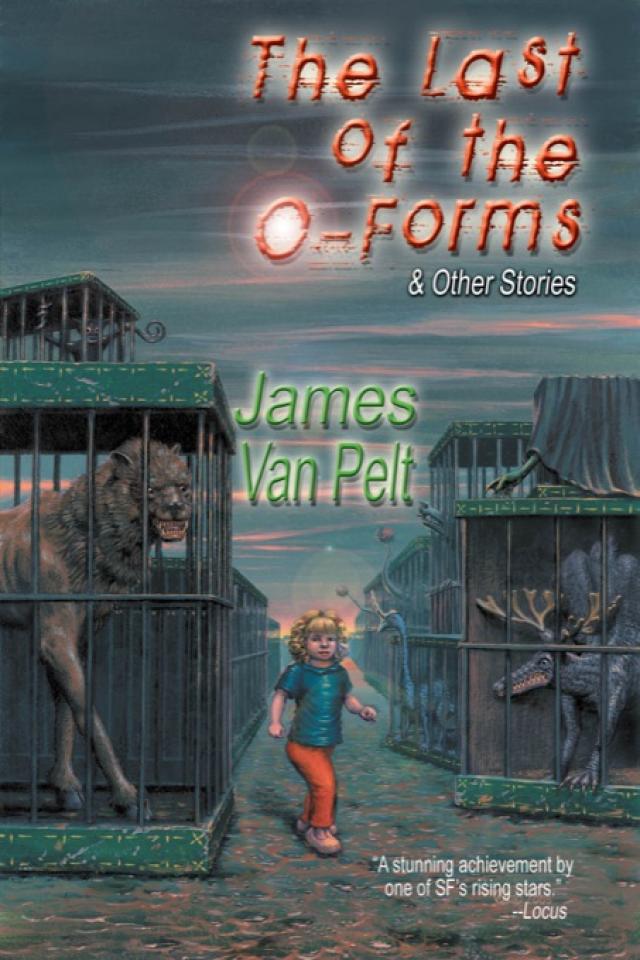
A Fairwood Press Book
August 2005
Copyright © 2005 by James Van Pelt
All Rights Reserved
No part of this book may be reproduced or transmitted in any form or
by any means, electronic or mechanical, including photocopying, recording,
or by any information storage and retrieval system, without
permission in writing from the publisher.
Fairwood Press
21528 104th Street Ct E
Bonney Lake WA 98391
www.fairwoodpress.com
Cover art © 2005 by Alan M. Clark
Cover design by Patrick Swenson
Introduction © 2005 by James Patrick Kelly
ISBN: 0-9746573-5-2
eISBN: 978-1-61824-976-0
First Fairwood Press Edition: August 2005
Printed in the United States of America
Digital edition by Baen Books
http://www.baen.com
To my three sons, Dylan, Samuel and Teague, who surprise me into joy every day, and to my three sisters, Sharon, Janet, and Ginger, whose brilliant trajectories light my sky. And to Tammy who reads everything and loves me anyway. You’re the best.
ACKNOWLEDGEMENTS
The stories in this anthology first appeared as follows:
“The Last of the O-Forms” first published in Asimov’s, 2002
“Perceptual Set” first published in Analog, 2002
“Once They Were Monarchs” first published in Alfred Hitchcock’s, 2000
“A Wow Finish” first published in Amazing Stories, 2004
“Friday, After the Game” first published in Analog, 2000
“The Invisible Empire” first published in The Children of Cthulhu, edited by John Pelan, 2002
“Its Hour Come Round” first published in Talebones, 2002
“The Pair-a-Deuce Comet Casino All-Sol Poker Championships” first published in Talebones, 2003
“The Stars Underfoot” first published in Realms of Fantasy, 2001
“The Long Way Home” first published in Asimov’s, 2003
“Nothing is Normal” first published in On Spec, 2002
“Do Good” first published in Polyphony, edited by Jay Lake & Debra Layne, 2002
“The Safety of the Herd” first published in Asimov’s, 2002
“The Sound of One Foot Dancing” first published in Alfred Hitchcock’s, 2001
“A Flock of Birds” first published in SCIFiction.com, 2002
INTRODUCTION
by James Patrick Kelly
What makes a short story memorable? Some might point to vivid characters, others might prefer a well-paced and possibly twisty plot. Hard SF types might insist on the primacy of the idea, or perhaps the elegance of the worldbuilding. Of course, all of these are important. However, for me what matters most is whether a story has something to say. Understand that I do not mean to denigrate pure storytelling. But often when a writer is truly passionate about his subject, that passion energizes the characters, plot and setting in discernable — although mysterious — ways. After I’ve read a memorable story, I imagine that the writer spent all those weeks, or even months, laboring to get a vision out of his head and onto the page because he had to, not because he’d signed a contract and was up against the deadline or because he just happened to have finished one story and it was time to start a new one.
After you have read some of these memorable stories, I think you will agree that Jim Van Pelt has something important to say. But let’s come back to that, shall we?
By the way, excuse me if I call Mr. Van Pelt Jim from now on. Some wag once warned that you should avoid meeting your favorite writer since he will almost certainly disappoint you. That may well be true in many cases, but I am here to tell you that my friend Jim is the sweetest and most unassuming writer of talent I have ever met. Not only is he a nimble conversationalist, he is also a great listener. Maybe this comes from all those years in the trenches as a gifted high school English teacher; just this year his school in Colorado recognized him with its teacher of the year award. In any event if you spot Jim across the room, don’t hang back. You’re in for a treat!
Meanwhile, here’s my problem. I need to introduce you to Jim’s stories without spoiling them for you. Now if only you would promise to read “The Last of the O-Forms” first, I could point out how wonderfully creepy the ending is. Or else I might discuss what it might mean for humanity when Carson identifies the species of the flock in “A Flock of Birds.” Or perhaps I might revel in the irony of what happens to that nasty little bully Bates when Müller opens his mouth in “Once They Were Monarchs.”
But then you’d know far too much, so I must necessarily tread lightly here. To avoid giving away all the best bits, I’m going to limit myself to mentioning just a couple stories. For a start, here is one reader’s take on Jim’s most memorable character, plot, idea and world.
My favorite character in this collection is Vice Principal Welch, the protagonist of “Do Good,” who may be at the end of a long — possibly too long — career at Lincoln High. He’s having a crisis of confidence as his retirement looms. You know this guy; he’s the one whose office you get sent to if you cut too many classes or are caught smoking out by the dumpster behind the cafeteria. Welch is convinced that students and faculty regard him as a kind of authoritarian pariah. In fact, just to drive the point home, Jim doesn’t even give Welch a first name or much of a home life. He is either Welch, or Vice-Principal Welch. What he does at school defines him as a character.
But Welch is way too hard on himself, because in his own way he truly cares about his community of students and faculty. For example, for years he has been opening student lockers after hours with his master key and has been taping $5 and $10 dollar bills to the doors with the admonition “DO GOOD.” Like so many of us, he is blind to how others see him, which is where the fantastic enters the story. Welch has been seeing ghosts at school, although Jim puts a clever spin on this conceit. The ghosts are not necessarily people who have passed away but rather those who have passed out of the halls of Lincoln High and Welch’s life. And at the end ….
Oops. Almost gave that one away.
There’s some excellent worldbuilding in “Perceptual Set,” although I also enjoyed this story for its plucky cartographer protagonist Janet. Jim does a convincing job writing from a woman’s point of view here, an accomplishment not all male writers can claim. In fact, the story begins with a witty conversation between two women, Janet and her friend Margo, who are trying to assess the personalities of the men in the crew of their mining ship by the way these men eat cheesecake. Jim effortlessly introduces romantic comedy tropes into a hard SF problem-solver. Janet is aboard a mining ship which has been diverted to examine the Gargoyle, a spherical asteroid which seems to have a face carved onto it. Can it be a natural phenomenon, or is it an alien artifact? Before too long it’s clear that Janet and Alec, whom we first see in the cheesecake scene and who has previously saved Janet’s life, will have to explore the Gargoyle.
Of course, things do not go entirely according to plan after they land and before long Janet finds herself …
Never mind. We’re almost done here. You can read it for yourself soon enough.
Jim is a talented writer who you are catching in the midst of a very promising career indeed. The Best of the Year nods have begun to roll in over the past few years for him and of course the title story was a Nebula finalist in 2004. I expect it won’t be his only nomination; people are paying attention now, as well they should. The stories collected herein are in the mainstream of our genre — or I should say genres, since you’ll be meeting up with ghosts and time travelers, spacemen and dragons. There are stops along the way in the late nineteenth century, 1942, 2005 and the far future. And some of these stories are in dialogue with classics by such genre giants as H. P. Lovecraft, Walter Miller Jr. and Ray Bradbury. Always Ray Bradbury. Jim tells a funny story on himself:
“I remember telling my mom once that I was going to be Ray Bradbury when I grew up. This was when I was really young, like seven or eight or six. I was really disappointed a couple of years later when I found out that Ray Bradbury was a person, not a job title. I wanted to be Ray Bradbury like some kids want to be firemen, like some kids want to be policemen.”
I mentioned early on that I wanted to come back to that quality which sets Jim apart from lesser writers: the man has something to say. On occasion what he has to say is not easy to hear. Jim has a definite apocalyptic streak; things aren’t going very well for homo sapiens in some of these stories. However, I don’t read them as expressions of an innate pessimism so much as they are cautionary tales. Because even in their darkest hour, many of Jim’s most memorable characters cling to a scrap of honor, or make a final gallant gesture. Many of them remain touchingly kind in the face of overwhelming adversity. They accept their fate without being crushed by it.
In “The Long Way Home” the apocalypse does happen — don’t worry, it’s over early and the plot goes on from there. Toward the end of this inspiring story, Matsui, a professor of astronomy, muses over the debate between recovering what was lost in the cataclysm and striking out to make new discoveries. He has been on the losing side in that argument and his career is now over. Nevertheless, Jim brings him to a lyrical moment:
“…when Matsui reached the faculty housing, he didn’t stop. He kept going until he reached the bluff that overlooked the sea. Condensation
“Much later, he returned to his cottage and his books. He was right. Chesnutt replaced him on the committees, but Matsui wasn’t unhappy. He remembered his hands on the rail, the moon like a distant searchlight, and the grander story that he was a part of.”
My friends, turn the page. It’s time for you to take part in that grander story.
THE LAST OF THE O-FORMS
Beyond the big rig’s open window, the Mississippi River lands rolled darkly by. Boggy areas caught the moon low on the horizon like a silver coin, flickering through black-treed hummocks, or strained by split rail fence, mile after mile. The air smelled damp and dead-fish mossy, heavy as a wet towel, but it was better than the animal enclosures on a hot afternoon when the sun pounded the awnings and the exhibits huddled in weak shade. Traveling at night was the way to go. Trevin counted the distance in minutes. They’d blow through Roxie soon, then hit Hamburg, McNair and Harriston in quick secession. In Fayette there was a nice diner where they could get breakfast, but it meant turning off the highway and they’d hit the worst of Vicksburg’s morning traffic if they stopped. No, the thing to do was to keep driving, driving to the next town where he could save the show.
He reached across the seat to the grocery sack between him and Caprice. She was asleep, her baby-blonde head resting against the door, her small hands holding a Greek edition of the Odyssey open on her lap. If she was awake she could glance at the map and tell him exactly how many miles they had left to Mayersville, how long to the minute at this speed it would take, and how much diesel, to the ounce they’d have left in their tanks. Her little-girl eyes would pin him to the wall. “Why can’t you figure this out on your own?” they’d ask. He thought about hiding her phone book so she’d have nothing to sit on and couldn’t look out the window. That would show her. She might look two years old, but she was really twelve and had the soul of a middle-aged tax attorney.
At the sack’s bottom, beneath an empty donut box, he found the beef jerky. It tasted mostly of pepper, but underneath it had a tingly, metallic flavor he tried not to think about. Who knew what it might have been made from? He doubted there were any original-form cows, the o-cows, left to slaughter.
After a long curve, a city limit sign loomed out of the dark. Trevin stepped on the brakes, then geared down. Roxie cops were infamous for speed traps, and there wasn’t enough bribe money in the kitty to make a ticket go away. In his rearview mirror, the other truck and a car with Hardy the handyman, and his crew of roustabouts closed ranks.
Roxie’s traffic signal blinked yellow over an empty intersection, while the closed shops stood mute under a handful of streetlights. After the four-block long downtown, another mile of beat up houses and trailers lined the road, where broken washing machines and pickups on cinder blocks dotted moonlit front yards. Something barked at him from behind a chain link fence. Trevin slowed for a closer look. Professional curiosity. It looked like an o-dog under a porch light, an original form animal, an old one if his stiff-gaited walk was an indicator. Weren’t many of those left anymore. Not since the mutagen hit. Trevin wondered if the owners keeping an o-dog in the backyard had troubles with their neighbors, if there was jealousy.
A toddler voice said, “If we don’t clear $2,600 in Mayersville, we’ll have to sell a truck, Daddy.”
“Don’t call me Daddy, ever.” He took a long curve silently. Two-laned highways often had no shoulder, and concentration was required to keep safe. “I didn’t know you were awake. Besides, a thousand will do it.”
Caprice closed her book. In the darkness of the cab, Trevin couldn’t see her eyes, but he knew they were polar-ice blue. She said, “A thousand for diesel, sure, but we’re weeks behind on payroll. The roustabouts won’t stand for another delay, not after what you promised in Gulfport. The extension on the quarterly taxes are past, and I can’t keep the feds off like the other creditors by pledging extra payments for a couple months. We’ve got food for most of the animals for ten days or so, but we have to buy fresh meat for the tigerzelle and the crocomouse or they’ll die. We stay afloat with $2,600, but just barely.”
Trevin scowled. It had been years since he’d found her little-girl voice and little-girl pronunciation to be cute, and almost everything she said was sarcastic or critical. It was like living with a pint-sized advocate for his own self doubt. “So we need a house of. . .” He wrinkled his forehead. “$2,600 divided by four-and-a-half bucks. . .”
“Five hundred and seventy-eight. That’ll leave you an extra dollar for a cup of coffee,” Caprice said. “We haven’t had a take that big since Ferriday last fall, and that was because Oktoberfest in Natchez closed early. Thank god for Louisiana liquor laws. We ought to admit the show’s washed up, cut the inventory loose, sell the gear and pay off the help.”
She turned on the goosenecked reading light that arced from the dashboard and opened her book.
“If we can hold on until Rosedale. . .” He remembered Rosedale when they last came through, seven years ago. The city had recruited him. Sent letters and e-mails. They met him in New Orleans with a committee, including a brunette beauty who squeezed his leg under the table when they went out to dinner.
“We can’t,” Caprice said.
Trevin recalled the hand on his leg feeling good and warm. He’d almost jumped from the table, his face flushed. “The soybean festival draws them in. Everything’s made out of soybeans. Soybean pie. Soybean beer. Soybean ice cream.” He chuckled. “We cleaned up there. I got to ride down Main Street with the Rosedale Soybean Queen.”
“We’re dead. Take your pulse.” She didn’t look up.
The Rosedale Soybean Queen had been friendly too, and oh so grateful that he’d brought the zoo to town. He wondered if she still lived there. He could look her up. “Yeah, if we make the soybean festival, we’ll do fine. One good show and we’re sailing again. I’ll repaint the trucks. Folks love us when we come into town, music playing. World’s greatest, traveling novelty zoo. You remember when Newsweek did that story? God, that was a day.” He glanced out the window again. The moon rested on the horizon now, pacing them, big as a beachball, like a burnished hubcap rolling with them in the night, rolling up the Mississippi twenty miles to the west. He could smell it flowing to the sea. How could she doubt that they would make it big? I’ll show her, he thought. Wipe that smirk off her little-girl face. I’ll show her in Mayersville and then Rosedale. Money’ll be falling off the tables. We’ll have to store it in sacks. She’ll see. Grinning, he dug deep for another piece of beef jerky, and he didn’t think at all what it tasted like this time.
Trevin pulled the truck into Mayersville at half past ten, keeping his eyes peeled for their posters and flyers. He’d sent a box of them up two weeks earlier, and if the boy he’d hired had done his job, they should have been plastered everywhere, but he only saw one, and it was torn nearly in half. There were several banners welcoming softball teams to the South-Central Spring Time Regional Softball Tourney, and the hotels sported NO VACANCY signs, so the crowds were there. He turned the music on, and it blared from the loudspeakers on top the truck. Zoo’s in town, he thought. Come see the zoo! But other than a couple geezers sitting in front of the barbershop, who watched them cooly as they passed, no one seemed to note their arrival.


