

The eastern dwarfs part.., p.1
The Eastern Dwarfs: Part Three - The Mountaintop, page 1


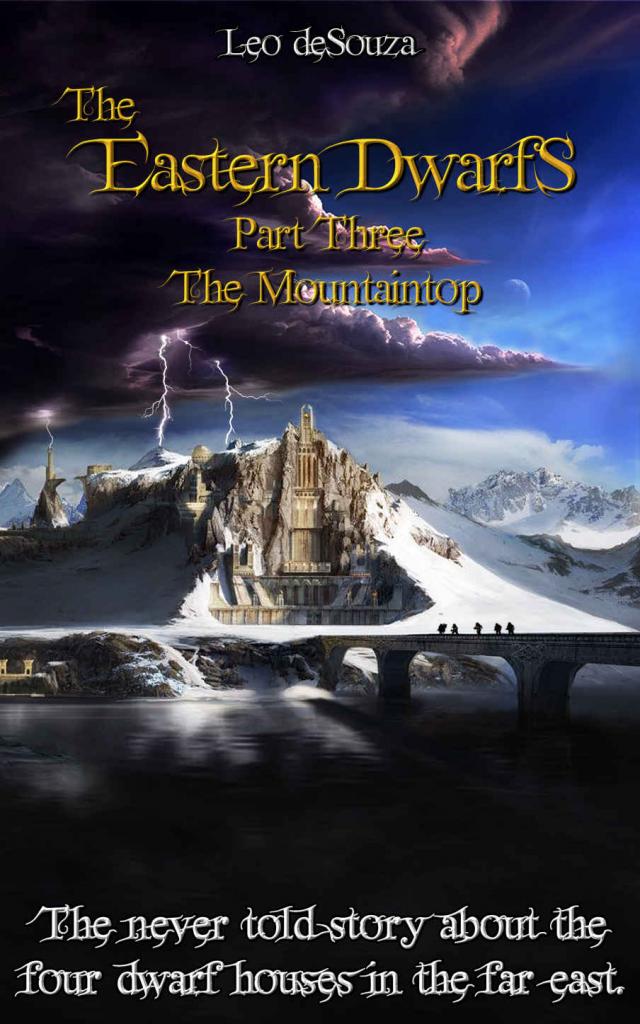
The Eastern Dwarfs
Part Three: The Mountaintop
by
Leo deSouza
Copyright © 2016
Check out the official website for promotions, free sample chapters and illustrations.
www.theeasterndwarfs.com
notes.
Copyright © 2016 by Leo deSouza. All rights reserved. This book or any portion thereof may not be reproduced or used in any manner whatsoever without the written express permission of the publisher, except for the use of brief quotations in a book review.
Translated from the original in Portuguese language. The archaic personal pronoun “ye” is used for the nominative case to denote a peculiar form of addressing among the dwarfs (but only among them), but this is not to be seen as an attempt at sophisticated grammar.
The term ‘undead’ is used in this book to designate characters who are portrayed as deceased ones who have come to life again.
Second edition revised by Deodato Santos.
Introduction.
The Eastern Dwarfs is a trilogy novel about the four dwarf houses of the east. The books will immerse the reader in a classic imaginary world we already love, while bringing fresh content for a completely new saga. New characters, landscapes and an entire plot telling the story about how the dwarfs of the east dealt with an unknown threat. A charming adventure for readers of all ages.
Table of contents:
notes.
Introduction.
The campestral dwarf.
The city of the damned.
Old friends.
Clues.
Old foes.
The disciple of Darkness.
Revelations.
A storm is forming.
The walking dead.
Preparations.
Departures.
The catacombs.
Shades, flames and flesh.
The battle of Trevinka.
Brutal measures.
The chamber of kings.
The secret weapon.
The scourge of the East.
Good bye, my friends.
End notes.
The campestral dwarf.
Four dwarfs were now travelling along the way that led from the Steel Fist domain to that of the CoalLocks, on the ice. It was deep winter, and using a mountainside road would be impossible in those lands. But Olaf, Torag, Rurur and Princess Torra were not on any mountain; they were riding a sled, pulled by four sturdy rams, gliding smoothly on the frozen surface of the Orokar lake, a huge mass of water enclosed in a deep valley.
While they were all surrounded by the immensity of this landscape, travelling in silence and immersed in their own thoughts, Rurur was remembering about his own past life, about his childhood and the events that made it possible for him to be now involved in this big plot. It was as if he was telling a story to himself, deep in his mind, and this is how it went.
Back when Rurur was still a little brat, a long time ago, he lived with his parents, not inside the RockFoot Fortress but in the fields near to it. He was from an unusual dwarf family as, while these folks were traditionally linked to mining and forging, Rurur and his kin were farmers, and he too could be called so since those times, for he was always present helping his parents in the labor of planting and harvesting.
He was the youngest of the children, and the other ones had left to live with their uncle in the east side of the Red Mountains Range some time ago. Rurur and his parents lived in a humble house in the open field, but differently from the men’s houses that were settled in that region, it was not made of wood but of stones, boulder after boulder placed one above the other, forming a nicely built hut, simple and poor yet cozy and ample enough for a couple of poor dwarfs and their young son.
One day, Rurur was working in the fields alongside his family; he was plowing the earth the best he could, using a small hoe his father had given him, adapted with a shorter handle so the small dwarf could make proper use of it. The sun was high and the heat was punishing the sturdy dwarf farmer. Rurur’s father stopped guiding a plow that was pulled by a cow, the only animal they had, old but still a good one.
“I think it’s enough for now, we worked all the morning, it’s time for us to have a meal,” said the dwarf as he wiped the sweat from his forehead.
Young Rurur dropped the hoe on the ground and jumped, then ran towards their house. “Time to eat!” he exclaimed while darting through the field, but then he stopped and looked back to speak again. “Don’t forget to bring Fubsy to a shade, father! She must be very tired now!” he spoke referring to the cow; then with no delay the small dwarf reached the house after lifting dust in the air while passing in a hurry over the plowed field.
His father brought the animal to stand under the shadow of a tree that was beside the house and entered too, being followed by his wife, Rurur’s mother. Father and son sat on chairs around a stone table while the housewife began to prepare the meal, and she had the most joyful of smiles while doing this, for that was a great pleasure for her.
From inside a pocket, the father took a souvenir, a miniature of the RockFoot Fortress, sculptured in crude rock; he put it on the table, calling his son’s attention.
“What’s this, father?” Rurur asked so excited that his mother looked back to check the reason for such a shout.
“This is the RockFoot House, the castle of our folk, impenetrable, and full of riches and wealth,” the father replied.
“How much richness, father?” Rurur asked, still fascinated with the little object.
“Enough for buying many fields, and many work tools, and much seed,” the dwarf replied.
“Fine! Then it would buy a lot of food too!” Rurur said.
His father smiled slightly, as well as his mother.
“Would ye spend all that richness to buy food?” asked the old man.
“Of course!” Rurur replied. “Why buy tools and lands for producing food, when ye can buy the food directly?”
The dwarf laughed loudly. “It’s true, my son, but listen to me, for I’ll now teach you a very important lesson. Nothing comes without work, even the food ye could buy was planted or raised by someone else. There must be someone working, otherwise there would be no food to eat.”
Little Rurur looked away from the souvenir for a moment, now staring wide-eyed at his father. “Oooh! I see, father! One cannot eat coins.”
“Exactly, my son. Besides, richness grows greed and turns folks into selfish nasty ones… well, not always… but mostly. While good food is always a reason for making friends and being joyful,” said the father.
“All right, I want to be a cook, then. Someone will pay me for cooking, and if they get pleased enough with the meal, they’ll pay me well so I can buy food for myself!” Rurur spoke.
“Ha! That’s right!” the dwarf said. “Now take it, it’s yours,” he said, and passed the souvenir to Rurur.
“Do ye think someday we’ll live inside the House?” the small dwarf asked.
Father and mother looked at each other, as if both had the same thing in mind.
“Maybe, my son,” he replied.
As time passed, the smell of the meal spread in the air, making everyone’s belly rumble, and there was no delay between it being ready and being served at the table, not that much of a meal, but still enough for the three dwarfs. The eating was satisfying, and at its end everyone was satiated; no food was left in the bowls, except for just a few morsels on Rurur’s plate.
“Will ye not eat it all, Rurur?” his father asked.
“Leave him, he’s already satisfied,” said the mother.
“That’s the kind of food that cannot be kept for later, it will get deteriorated soon,” the father replied.
Rurur looked at the remains of the food on his plate.He was for sure not hungry anymore, but after all he decided to take it.
“Ye don’t need to eat if ye don’t want, Rurur,” said his mother.
“It’s all right, mother, I know it’s never right to waste food,” said the little dwarf. Then he ate the leftovers, leaving the plate empty.
“Good!” said his father, caressing his hair. “This will be an earnest dwarf when he is grown up.”
“When will I get a beard like yours, father?” Rurur asked.
“Oh, that’s something ye must wait for, it will show up, at the right time,” the father answered. “Now, why don’t ye take the pack of food to the old miner there in his house? He must be waiting for it.”
“All right,” replied Rurur, raising from the chair and going to the kitchen; there he took a pack rolled up in a dishcloth, and left running through the door.
“I don’t like when ye force him to eat this way,” the mother said to the father, after Rurur left.
“He must learn to value food, there’s not much here to be wasted,” replied the old dwarf.
“I know”, she said. “And what about the work in the Fortress?”
The old dwarf looked down, as if that matter somehow displeased him. “I’ve heard work is about to begin, though I’m wondering if my arms and legs are still strong enough to lift boulders and hit the rocks with mattocks.”
“Right,” she replied. “Anyway, we still have some time to see how the harvest will turn out, maybe this year the wind will bring us some wealth. Besides, there’s still a source of food for us, something that could last abouth an entire month.”
Rurur did not take much time to reach his destination; running freely under the sunlight, he reached another house, one even more humble and precarious than his own. There lived a very old dwarf, a former miner who used to dwell inside the RockFoot fortress, but he was now retired, living alone, for the weight of too many years had fallen over him. Disease had twisted his arms, and his legs were lame; the old dwarf could not even leave his home without aid. Yet he was a joyful person, and talking with him was something that Rurur used to enjoy, for he always told many stories. A really old person, an elder, so to say.
“Get in!” a voice sounded from inside the house after the little dwarf knocked on the door.
Rurur entered, making the door hinges creak. “Hi, old miner, I brought your lunch!”
“Oh, I know, my dear, every day ye do it, and I’ll thank you every time! Though I think this is a task that ye won’t need to undertake for much longer.”
Rurur approached the old dwarf who was resting, half laying on a kind of slanted bed. He placed the pack on a small side table and opened it, revealing the food within it and spreading its smell in the air.
“Smells good as always, the food from your gracious mother,” the old dwarf spoke, and he began to eat with a spoon.
“Why do ye say I’ll not need to bring you food for long?” young Rurur asked.
“Oh, this is because… well… because I believe ye and your relatives are about to move to the fortress, right?”
“I’m not sure; my father never says when we’ll move.”
“That’s because he’s wise enough to know that our plans are always subject to be undone by fate.”
“What’s it like? I mean, inside there?” Rurur asked.
“The Stronghold? Oooh… it’s marvelous… there are many halls, and many galleries, a big place with many tables, only used in special events, where hundreds of dwarfs could sit to eat and drink. And there are the King’s quarters too,” the old dwarf explained, motioning his hands while looking into space, as if imagining everything.
That made Rurur imagine it all too. “Yes, the King,” he said. “He could give us some coins, in exchange for work, I mean.”
“Humm… he would for sure pay fairly his dedicated servants. But as I said, it’s up to your father to decide.”
While the elder was eating, Rurur was looking around, checking every corner of that old home, full of spider webs and dust. There were some shelves and books, and some old furniture too, and on the walls portraits of some persons.
“These are my parents, in case ye want to know,” said the elder after taking the spoon to his mouth and noticing Rurur’s curiosity.
“Are they gone?” the little one asked.
“Yes, they are, long ago.”
“I see ye are quite lonely now.”
The elder chuckled, “That’s right, but not just because my parents are long gone. I’ve been solitary all my life.”
“Ye have no friends? No one comes to visit you?”
“Ye are my friend! At least I consider you so, and there are your parents too, but none besides you folks. So yes, I’m mostly a lonely one. There was once a gecko, that pale kind of fellow that walks on the walls; I asked him to stay, but I think he has left.”
Some more moments passed and the meal was over, the pack was empty. Rurur took it and prepared to leave.
“I have no words to thank you for what ye and your parents are doing for me. I hope good luck will someday hit you all. Tell your parents I’m sending them my thanks,” said the elder.
“I will,” Rurur replied, leaving towards the door.
“And oh!” the elder exclaimed. “Tell your father, ask him, tell him I would like to have some help in stretching my legs one of these days, I think I’m getting welded to this bed!”
Rurur just nodded. He left the house running after closing the door and went directly home. When he arrived, he found his parents already on the fields, working again with the plow, now under the afternoon sun, and he joined them in the task.
In the next day, the family woke up early as always, to get to work again. The cow was tied to the plow by Rurur himself who asked his father to allow him to do it as he had already learnt how to, after observing his parents doing it so many times. Then came another hard morning of work under the sun, and this time Rurur was the one responsible for guiding the cow while plowing the earth.
“Go ahead, Fubsy! Hip, hip, hiiip…” he called as he stirred the animal, and from time to time he stopped to caress the cow, a habit that after some time had made both the dwarf and the animal come to like each other.
Meanwhile his parents were not far away, hoeing the land.
“We don’t have even half the fields done yet, and the rainy season is almost here,” said Rurur’s mother to her husband.
“I know,” the old dwarf replied. “But there’s nothing we can do but continue the work.”
“I checked the honey bottles earlier today. It’s all lost, full of ants and other insects, we have lost all the bottles,” she said.
The old dwarf did not reply; he just kept working. Later when it was noon the family got back inside their home; meat and grains were already set in the kitchen since the housewife had prepared them before leaving to work outside, so all she had to do was to put them in the pot on the stove and sit, waiting for the meal to boil.
Again, they ate, and the food was enough, but this time Rurur had no leftovers on his plate, and again he left after the lunch towards the house of the old miner.
When he arrived there carrying the food pack, he hastened to knock on the door. “Old miner! It’s me, Rurur!”
But no answer came. Again Rurur knocked and then just stood there, waiting for the elder to call him inside. Looking back for a moment he saw the fields, the fields of golden grass shining under the sun, and bird flocks flying over them. As he did not hear any voice, he decided to push the door, and found out that it was not locked.
Leaving the bright sunlight behind, he entered the dark house of the elder, and it became even darker when he closed the door behind him. The ambience was strangely quiet; laying on his slanted bed was the old miner, and the first thought Rurur had was that he was sleeping.
So the young dwarf did as always, quietly opening the food pack on the small side table and sitting down, trying not to make much noise. There he stayed for some moments, waiting for the old miner to wake up but. As he did not, Rurur decided to stir him; it was when his hand touched the old dwarf that he noticed how cold he was.
“Hey old one, wake up!” Rurur said. He looked around, as always curious about the old house, rose up from the chair and checked the old books on the shelves. Then he decided to leave, finding it better not to wake up the old dwarf.
That was Rurur’s first contact with death, even if he did not come to understand it at that time. It was his father who came to bury the old miner after Rurur told him what had happened, and it was a simple burial for someone whose friends were all gone or had simply forgotten about the old dwarf alone in his house.
The next weeks proved hard. The weather was changing fast, and the first heavy clouds of the rainy season could already be seen around. Rurur’s parents hurried to finish the plantation, but it was becoming obvious that they would not do it in time. Besides, another big problem was showing; their food reserve was ending faster than they had planned, the meals became even poorer, and Rurur got used to leaving the table without being totally satisfied.
The days passed, and the work became harder while the food was becoming more and more scarce; the members of the family became thin, and joy left their faces.
Then one day, after waking up Rurur found his home full of meat being packed by his parents; it took years for him to finally realize how so much meat had suddenly appeared, and the explanations his parents gave him were not enough even for a small kid like him to believe. But he noticed instantly that the cow was missing on that same day, when he got to the fields and had to help his father to pull the plow by themselves. Not only did he come to know even more difficult days of work as no animal was there to help anymore, but he also felt sad about the missing cow, for they somehow were friends.


