

Well always have venice, p.1
We'll Always Have Venice, page 1


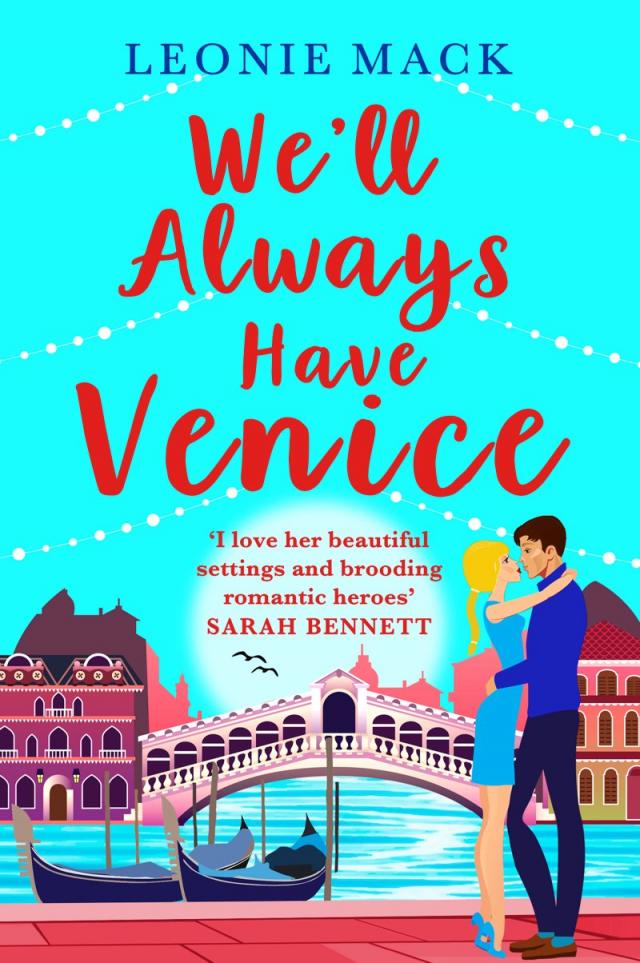
WE’LL ALWAYS HAVE VENICE
LEONIE MACK
For Sam, the original and best ‘friends to lovers’ romance of mine
‘…the last few eventful years, fraught with change to the face of the whole earth, have been more fatal in their influence on Venice than the five hundred that preceded them…’
JOHN RUSKIN, THE STONES OF VENICE, VOLUME II, CH. I, SEC. II
CONTENTS
Author's Note:
Prologue
Chapter 1
Chapter 2
Chapter 3
Chapter 4
Chapter 5
Chapter 6
Chapter 7
Chapter 8
Chapter 9
Chapter 10
Chapter 11
Chapter 12
Chapter 13
Chapter 14
Chapter 15
Chapter 16
Chapter 17
Chapter 18
Chapter 19
Chapter 20
Chapter 21
Chapter 22
Chapter 23
Chapter 24
Chapter 25
Chapter 26
Chapter 27
Chapter 28
Chapter 29
Chapter 30
Chapter 31
Chapter 32
Chapter 33
Chapter 34
Chapter 35
Epilogue
Acknowledgments
More from Leonie Mack
About the Author
About Boldwood Books
AUTHOR'S NOTE:
Readers may notice a deviation from the usual Italian spelling in many words used throughout the book. I have taken pains to reflect the language spoken in Venice by the people who call the city their ancestral home. The Veneto dialect (or dialects, as they vary by area within Veneto) retains elements from the time before Venice was conquered by the Hapsburgs in the late eighteenth century and was its own Republic, covering parts of Italy and Croatia. What used to be a distinct language has now changed and mixed with standard Italian over time. It is not taught in schools and there is no official spelling, but it remains a source of regional pride. In case readers do wonder at the strange spelling, the explanation is that I wanted to bring you some words with the distinct flavour of Venice.
PROLOGUE
‘Saffron, will you marry me?’
Norah froze. This wasn’t happening in reality, right? A relative stranger asking her mother to marry him. On Christmas Day, during the gift giving. No way.
She must have been back in the hospital, on a cocktail of medications, imagining the middle-aged man on his knee in her sister’s living room. A twinge of pain shot down her bad leg on cue.
‘Neal, I – I’m so happy! I’d love to marry you!’
Unfortunately, the passionate smooch Saffron smacked on Neal’s lips, complete with kissy noises, was not a hallucination.
Norah met her sister’s equally horrified gaze over the tops of their bobbing heads. If Didi was seeing this too, it had to be real. With a whump, the feelings hit her all at once: doubt, fear, annoyance and, worst of all, jealousy.
Saffron, who’d rarely kept a boyfriend for longer than a phone contract, was slipping a diamond onto her finger, while Norah had committed everything to Andrej and all she had left was the taste of disappointment, still sour after six months.
Should she be happy for Saffron? Could she fake it? Was she a terrible daughter for doubting Neal would last, despite the diamond? She dreaded the prospect of attending a wedding. She hadn’t been formally engaged to Andrej, but they’d both pictured it in their futures – until she’d faced the challenge of learning to walk again.
He’d been gone before she’d even woken up from surgery. Maybe Saffron and Neal did have a chance. What did Norah know?
But who the heck was Neal and how well did Saffron know him after a whirlwind romance on a cruise? He was mild-mannered and polite, and he’d bought an enormous rock for a woman who’d previously only worn amber and crystals. And he apparently did public displays of affection. Ew.
Her sister looked green. Didi was the sister who’d always had everything together. She had a good job she loved and owned her own flat in London, while Norah had half a PhD in Marine Biology and a pair of titanium rods screwed into her spine. But even Didi looked shaken by this Christmas development in their lives.
The lovers finally pulled apart and Saffron turned to wink at Didi. Oh, God, no. Norah cringed, but Saffron had another unwelcome wink for her younger daughter. ‘I think I’m just about ready for marriage, at sixty-three!’ she said gleefully.
‘Congratulations, Mum,’ Didi managed, her voice gravelly.
Saffron patted her on the knee. ‘Someone needs to show you how it’s done, sweetheart,’ she said.
Norah choked, watching Didi’s pallor change from green to white. She knew Didi hated the hints about getting a boyfriend and Saffron had no right to judge, after the example she’d set her daughters. It was one of the reasons Norah had been so happy with Andrej: she’d pictured them together forever, in contrast to her mother’s revolving door of boyfriends.
She stood, her brain whirring into gear as she grabbed her cane. She’d drag Didi into the kitchen on the pretext of doing the dishes. Then she remembered that Didi had been slaving away all afternoon in the kitchen.
She glanced at Didi’s guest – an Italian artist called Piero, who appeared to have invited himself. Whatever the weird vibes between him and Didi, he could at least make himself useful.
‘I’m going to do the dishes,’ Norah announced. She caught Piero’s eye and tipped her head in Didi’s direction.
He caught on quickly. ‘I have a… long walk back to my hotel. I… got a little lost on the way. Perhaps you can show me back to the main road, Didi?’
Norah reached the relative safety of the kitchen and released her breath as slowly as she could. She set her cane against the wall and rolled up her sleeves. She didn’t want to deal with the soap opera in the living room today.
She was sick of the shocks, the loneliness and the helplessness. She needed to step out on her own and work out how to deal with her new life, without her mother’s drama and even without the safety net of her sister’s care. She needed to accept that the old Norah, the one who was going to marry Andrej and share a glittering career of rational scientific inquiry, was gone. She would try to get to know the new Norah.
For that, she needed a change of scenery. She just had to find somewhere to go.
1
FIVE MONTHS LATER…
It was the first day of the rest of her life and she was going to a bloody wedding.
Norah stood in her finery – the only dress she’d brought in her luggage for her internship – and waited for her new boss. She was here to bury herself in work, to study the unique ecosystem of the Venice lagoon and to forget about the disaster of her personal life, but even here, in the long foyer, the ‘portego’ of a Venetian palazzo, the past year haunted her.
The eyes of a maiden in a tapestry on the wall – yes, there was an actual mediaeval tapestry on the wall – followed her as she wandered the tiled portego, clutching her cane. The Greek marble bust seemed to look through her with his sightless eyes. The cherubs in the corners of an enormous tarnished mirror were whispering behind their hands about her and wiggling their little bottoms. They hung from the frame precariously, as though, any minute now, she’d hear a crack and a little figure would fall onto the black-and-white tiles.
A grand but worn marble staircase led to the upper floors, including Norah’s tiny studio apartment underneath the aging beams of the roof – her home for the summer. The apartment was cramped and the ceiling was low, but at least it didn’t have creepy décor that appeared to watch her every move.
Worst of all was the damn bird.
It was a bas-relief phoenix in an elaborate marble portico over the door. A phoenix. Of course there was a bloody phoenix. And she knew it would haunt her for the next ten weeks, making her think that she might still make something of her life, that Norah York could rise from the ashes of hurt and failure and face her future. Norah Phoenix York, to copy precisely from her birth certificate.
She’d always thought Saffron must have been high when she’d filled out the forms registering her birth. Now it felt as though her mother had planned all of this, giving her a ridiculous middle name in a conspiracy to make her believe there would always be hope for the future.
She wasn’t ready for hope. Bitterness had been her good friend this past year. And this ‘new start’ was a poorly paid internship at an environmental NGO, not the prestigious PhD programme she’d left behind. But at least she was out of London, out of the clutches of her loved-up sister and her mother, the bridezilla.
Instead, she stood in a Venetian palazzo, the ancestral home of Emanuela Delfini, world-renowned biologist, philanthropist and sustainability campaigner – who obviously struggled with interior decorating.
She scowled at the phoenix. Its beak and the tips of its wings looked as though they’d once been gilded, but there was only a patina remaining, a ghost of gold. Perhaps this phoenix was approaching five hundred years old and was about to go up in a puff of smoke. Good luck to it in its next life.
A dark portrait of a menacing-looking woman with a stiff lace collar was watching her, now, as though she were whispering, ‘For the crime of being young and naïve and thinking you are in love, you are cursed to attend wed
‘Buongiorno, cara.’ Her host Emanuela – or ‘Manu’, as she’d told Norah to call her – swept into the portego. She clasped Norah’s shoulders and kissed her on both cheeks, which seemed a little familiar after less than a day, especially in combination with the ‘cara’, which she thought meant ‘dear’ or something that sounded similarly patronising to Norah’s English ears. But at least Manu was friendlier than her house.
Manu had neat dark hair clipped back at the nape of her neck with a tortoiseshell clasp. She was as elegant as her aristocratic background and her forty-something years and just looking at her made Norah stand up straighter. She wore a flowing dress, simple, but stylish with an asymmetrical neckline and three-quarter sleeves.
Norah patted her hair, rolled up as neatly as she could in some kind of chignon. She’d never had the patience for her long hair, but Andrej had liked it – a feminine touch, he’d said. Hindsight made her wonder if he’d meant that she was too much of a tomboy, but she reminded herself crossly that wondering wasn’t doing her any favours now.
She smoothed the A-line of her frock. Manu had said nothing about a wedding in the stack of materials she’d emailed in preparation for Norah’s stay.
‘You look perfect,’ Manu assured her. ‘Although…’ She glanced critically at Norah’s shoes. Norah had put on the pretty slingbacks she’d inherited from Didi even though the low heel made her feel wobbly. Looking at Manu’s fabric slippers made from thick embroidered silk, she wished she’d stuck with her comfy espadrilles.
‘Oh, it’ll be all right,’ said Manu with a dismissive wave. ‘Come. Let’s go catch our boat.’
‘What kind of wedding is it, anyway?’ Norah asked as they made their way down the stone steps to the ground floor. Manu had assured her she was invited, but had said little else. Norah hoped there would at least be decent food.
‘You’ll see,’ she said with a twinkle in her eye.
Manu swung the door open and Norah jumped. She couldn’t be certain whether it was because of the suddenness of the movement or the creepy bronze door knocker that looked like an angry demi-god in mid-yawn.
They stepped out into the cool, shaded alley at the back of the house. There was bright sunshine somewhere high above them, but it didn’t penetrate the alley at this time of the morning. Manu set a brisk pace through the labyrinth of Santa Croce, past mask workshops, under an archway bearing a skull and crossbones and around so many blind corners, they would have collided with at least six tourists if the hour had been any later.
Before Norah realised how far they’d come, they’d reached the Rialto Bridge. Manu steered to the right, avoiding the little stands selling all manner of tat, and they walked along the stone balustrade and over the Grand Canal.
The air was still fresh with dawn, although the sun came up early in mid-May. The canal shone golden in the long rays, sending glittering ripples over the palazzi along the canal. The buildings were red and pink and terracotta, with white detailing and awnings in bright red or green. Boats bobbed gently, although there was little breeze.
Norah was struck by the immensity of the sky. Cottony clouds hung lazily over the city, but it was otherwise wide and blue and stretched in all directions, as though Venice sat on clouds, rather than sandbanks and ancient tree-trunks.
It was a stunning setting for a wedding. The thought made Norah scowl.
From the Rialto Bridge, it didn’t take long to reach the heart of the city, the Piazza San Marco. Norah’s steps faltered when she walked out from under the arches into the famous square, but it had nothing to do with her cane or her damaged nerves. It was the sudden shock of being here, in Venice.
She’d tried to tell herself she was excited about her work: the lagoon, the unique geographical and environmental challenges. But it was impossible to think about algae when she was confronted with the overpowering golden grandeur of the Basilica di San Marco and the countless arches, hewn from bright white stone.
She could stare at it all day, watching the figures and creatures on the façade come to life.
‘Are you coming, Norah? The basilica won’t leave without you, but our boat might.’
She shook herself and hurried to catch up, feeling sluggish in comparison to her lively hostess. They bustled through the smaller square, the piazzetta, past the pale façade of the Doge’s Palace, to where a crowd was gathered at the edge of the lagoon. But the crowd was nothing in comparison to the flotilla of boats dotted across the basin. There were hundreds of them, from tiny two-man craft to larger vessels with rowing crews of twenty or more, all wearing matching striped shirts and holding their long oars. Aside from the sound of jovial voices, the basin was silent. No motors, only hundreds of oarsmen.
A gilded barge was docked in front of the crowd, decked with long, thin flags in red and gold, and in the bow stood a band in mediaeval costumes of red velvet, holding bugles.
Norah recovered from her confusion quickly enough to snap a few pictures. She didn’t often regret deleting all of her social media accounts after the accident, but she would have enjoyed posting pictures of this event. Was this maritime fanfare normal for a Venetian wedding?
A priest in a black cassock and a purple silk stole greeted Manu with kisses on the cheek, as did a man in a grey suit and a sash in the colours of the Italian flag. He looked a little old to be the groom, but what did Norah know?
‘Where’s the bride?’ Norah asked when Manu returned to her side. Manu gave her a smile that suggested she was enjoying a joke at Norah’s expense, which didn’t help Norah’s mood.
She trailed Manu to another barge moored nearby, with no gilding, no trumpeters and no red velvet. It had the shape of a gondola, with a raised prong on either end, one of them bearing a viciously jagged metal comb, but it was much larger. Four wooden dining chairs stood at the stern, looking rickety and out of place behind the team of rowers. The boat bobbed and tipped in the waves, but the rowers stood in place, their feet planted.
Manu stepped on gracefully and took her seat while Norah shuffled closer with a deep breath. It could have been worse for her first time in a boat since the accident. They would be slowly bobbing across the canal, not roaring off. She could swallow her nerves in front of her boss. The phoenix was right: she had no choice but to face her fears.
Norah stepped out – only for the boat to rock at precisely that moment, and her foot slipped. Stuck with one foot in the boat and the other on the pier, she threw her hands out for anything that would stop her falling. The nearest object was a rower.
She grabbed fistfuls of his shirt and hung on as the boat tipped and swayed. For a second, she hung out over the water, staring into the murky turquoise of the lagoon.
She dimly heard Manu’s cry of alarm, but it was an indication of Norah’s mental state that all she could muster at the prospect of a drenching in the lagoon was a cynical groan. She hated weddings and it seemed the feeling was mutual.
2
The rower Norah was holding on to was surprisingly solid. He staggered, but remained upright so she could claw her way up until she had both feet on the deck. She let go of his shirt hesitantly and plonked her backside into the seat.
That was when she remembered her cane. She cursed and glanced around for it, expecting to see it sinking into the lagoon, but, small mercies, the thing could float. It bobbed innocuously a foot or two away from the boat.


