

The indigo blade, p.1
The Indigo Blade, page 1


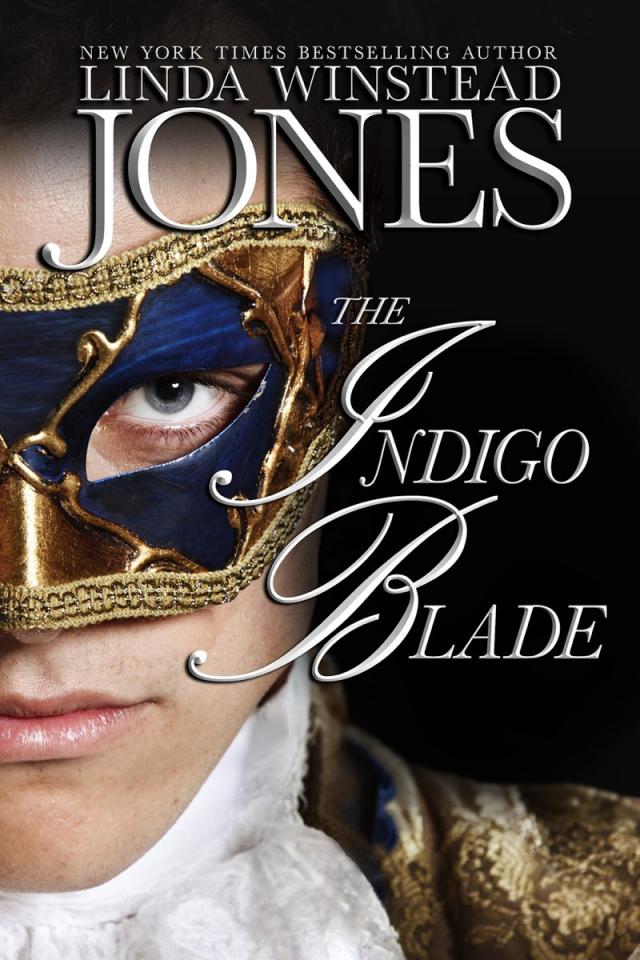
The Indigo Blade
LINDA WINSTEAD JONES
Copyright © 1999 by Linda Winstead Jones
All rights reserved.
No part of this book may be reproduced in any form or by any electronic or mechanical means, including information storage and retrieval systems, without written permission from the author, except for the use of brief quotations in a book review.
Cover Design by Elizabeth Wallace
designwithin.carbonmade.com
Created with Vellum
Contents
Prologue
Chapter 1
Chapter 2
Chapter 3
Chapter 4
Chapter 5
Chapter 6
Chapter 7
Chapter 8
Chapter 9
Chapter 10
Chapter 11
Chapter 12
Chapter 13
Chapter 14
Chapter 15
Chapter 16
Chapter 17
Chapter 18
Chapter 19
Chapter 20
Chapter 21
Chapter 22
Chapter 23
Chapter 24
Chapter 25
Chapter 26
Chapter 27
Epilogue
About Linda
Also by Linda Winstead Jones
Prologue
1774
The prisoner would be delivered into Chadwick's hands well before dark, and in a matter of days the troublemaker would serve as an example to the damned rebels who were making this job so bloody difficult.
Captain Bradford Thurman considered himself to be a good soldier. He thought himself better than most, to be honest. But he preferred fighting the French to playing nursemaid to a bunch of ungrateful colonials. Where would they be without the British Army? Suffering at the hands of savages or fighting off French settlers, that's where.
Bradford glanced over his shoulder to check on the prisoner and the four guards who flanked the unfortunate colonial. He wasn't much of a troublemaker at the moment, thanks to the beating he'd received just that morning. An unkempt head hung so that a fall of greasy hair shielded the rebel's face. His shoulders were slumped; he knew he was traveling to his death. The insolent colonial would think twice before arguing with a soldier in the British Army again, if he had the opportunity in his few remaining hours on this earth.
The prisoner had committed a third act of sedition. Twenty lashes on the first offense hadn't dissuaded him, nor had the fifty that had followed a few months later. This third transgression had sealed his fate. Tomorrow the dissident would hang.
The damned colonials were like children, to Bradford's logical thinking. Rowdy, whiny children who didn’t know a good thing when they had it. Recently, a goodly amount of excellent tea had been wasted in a fit of pique by grown men not-so-cleverly disguised as natives. If that wasn’t a childish act, what was?
Perhaps when they saw one of their own swinging on a gallows they’d think twice about the preposterous concept of independence.
The January afternoon was nippy; the damp chill penetrated Bradford's uniform in a most unpleasant way. South Carolina was certainly not as cold as the northern colonies, but the humid air made the chill all but unbearable. The road they traveled was narrow and lined with a thick growth of trees, bare-branched hardwoods and evergreens growing together and intertwining their boughs so that in spite of the blue sky above, Bradford felt as though he passed through a long, winding tunnel. Wilderness, that’s all this blasted country was. Mile after mile of trees and water and more trees. How he longed for London.
The overturned wagon came into view on the other side of a sharp bend in the path. Bradford cursed beneath his breath as he lifted a hand to still the soldiers to his rear. An old man with unruly gray hair and clothing that resembled a collection of sacks knelt by the wagon, his back to the soldiers as he muttered loudly.
"Make way," Bradford ordered. The wagon, a number of scattered baskets, the old man, and the skirted body he knelt over blocked the path completely.
The man jumped up, obviously surprised, and as he spun his stooped body around, the left sleeve of his crude garment swung free. He raised his one hand in greeting. "Praise be. The Lord has answered my prayers and sent these kind soldiers to help."
"We've not come to assist you, old man," Bradford said sternly. "Clear this road immediately. We must pass."
The codger appeared to be puzzled for a moment, wrinkling his nose and peering up through narrowed eyes that were topped by dark eyebrows stark on a too-pale face. The man's skin was, in fact, more gray than was normal for a healthy man of any age, and was blotchy in several places. Good heavens, the fellow was probably diseased.
"I see," the old man muttered in a gratingly coarse voice. "I'd better get busy, then."
"Rebecca," he said, turning his attention to the woman on the ground. "Open your eyes now, your poor old grandfather needs you." He knelt beside her again, lowering his body with obvious effort, and gently patted her face. "Wake up, dear."
The old man looked back at the squad of soldiers. "I don't think she's badly hurt," he said, as if they might have a care for the injured woman. "There’s no blood, but she's got a lump on her head the size of an egg."
The woman the geezer so fondly called Rebecca stirred and turned her head so that a long strand of dark hair fell into her face. What a homely one she was! Long face, long nose, large mouth. But as she rolled onto her back she revealed an admirable, shapely figure.
"That’s right, Rebecca, we must move the wagon so these fine soldiers can pass."
There was no way a one-armed old man and a wounded girl would be able to right that wagon and move it to the side of the road, so Bradford grudgingly ordered two of his troopers to dismount and assist. The other two moved closer to the prisoner, in case the rebel was foolish enough to think his reduced guard offered a chance of escape.
Bradford dismounted himself, eager to get moving again and to deliver the prisoner to Charles Town and Victor Chadwick.
The old man tried valiantly to assist the soldiers in righting the wagon, while the dazed girl sat forlornly in the middle of the road. She rubbed the side of her head, moaned softly, and played with a strand of hair that fell onto her full breasts.
"Out of the way," Bradford ordered as he moved the one-armed man aside to take his place. He had no desire to rub elbows with a diseased peasant. The old-timer mumbled his thanks, then asked gruffly after his granddaughter. Bradford gave all his strength and attention to the chore at hand, heaving until his muscles strained and an unpleasant sweat broke out beneath his heavy uniform. It was hard work, but he had the help of his soldiers. With a final mighty surge of effort, the wagon was righted.
"Thank you, sir, thank you," the old man said. Bradford turned to find the man and his granddaughter, who’d come to her feet and was amazingly tall, standing very near—and pointing a variety of weapons in his direction. The old man held a dagger with a wooden grip and a long, thin, well-honed blade, and the young woman had a .67-caliber pistol in each of her large, roughened hands. The miscreants were close, the weapons were steady, and Bradford decided it would not be prudent to reach for his own.
"Common wayside bandits," he spat. "You're fools if you think you can take on soldiers of the British Army and get away with it. Threaten me if you like, but you're headed for disaster. My troopers will take care of you."
"These troopers?" With a wave of his hand the old man gestured with his dagger to the wide-eyed men who flanked their captain.
"Those troopers," Bradford said grandly, pointing to the men guarding the rebel who was traveling to his death.
The old man turned his head slowly, seemingly without a care. "What troopers would that be? Surely you don't mean those two unfortunate lads."
Bradford reluctantly turned his head and looked to the spot where his troopers and the prisoner had been waiting patiently and securely moments earlier. His soldiers had dismounted, been stripped of their weapons, and had been quite efficiently bound and gagged. They sat, wide-eyed, with their backs against the trunk of a small tree. The prisoner was gone.
"How dare you..." Before he could finish his sentence they came from the woods without warning, five gray-haired old men dressed as the thief before him was, in baggy and torn clothing and soft moccasins. They came with ropes and strips of cloth, and in a matter of minutes he found himself and the remainder of his contingent stripped of weapons and securely bound.
The one-armed man knelt before him; that dagger danced wickedly, cutting the air and coming awfully close to Bradford's heart.
"Perhaps I should do to you what you had planned for the young man you were transporting to Charles Town. What was his fate to be? Hanging? Firing squad?"
Suddenly Bradford was afraid. These weren't ordinary bandits, and it wasn't chance that had brought him and his troopers to this meeting. These were hot-headed rebels, madmen, revolutionaries.
"I was simply delivering my prisoner to Victor Chadwick, who is an important member of the Governor's Council. What Mr. Chadwick had planned for him, I wouldn't know." Bradford lied, praying as he had never prayed before that he lied well.
The man smiled, revealing blackened teeth. "Is that right?"
Bradford nodded.
"I want you to deliver a message for me," the man whispered. At those words Bradford felt a surge of relief. He would survive this encounter. After all, he couldn’t del iver a message if he were dead.
"Certainly."
The old-timer swung his arm and the dagger forward, swiftly and with great power. The sharp-edged metal was embedded in the road not two inches from Bradford's crotch. The shaking began, an uncontrollable, deep trembling that started in his legs and traveled quickly up and through his entire body.
"Tell Victor to watch his back." Colorless eyes flashed, strong and powerful in a white-gray and oddly weathered face. "Tell him not to sleep too deeply at night, nor relax his vigilance when he thinks himself among friends, nor trust that his King and his soldiers will keep him safe."
Bradford nodded.
"Tell him," the old man whispered, "the Indigo Blade is coming."
Chapter One
"Why did I have to be the woman?" Deep in the forest, in the shelter of the trees, Beck stripped off the dark wig and revealed his own cinnamon-colored hair, which he ruffled with long, thin fingers.
Max smiled as he freed his left arm and whisked off his own coarse gray wig. With a gentlemanly flourish he whipped a linen handkerchief from a deep pocket in his tattered jacket and began to wipe the rice powder and lampblack from his face, knowing full well it would take a good scrubbing to rid himself completely of the simple disguise.
Beneath the rags of a beggar his heart pumped madly with the excitement of the encounter. He didn't even feel the cold anymore. "Because you're the only one of us who can still get away with shaving once a week. Dalton and Garrick have those unfashionable little beards they refuse to part with, Lewis and John would make dreadfully ugly females—"
"And I don't?"
"—and Fletcher simply flat-out refused," Max finished. "You did a splendid job. Why, I do believe that captain was growing sweet on you before you pulled those flintlocks on him."
Beck snorted as he unbuttoned his dress and reached inside for his "breasts," hand-sized sacks of grain joined by a ribbon that dangled from his neck.
Max was almost ashamed of the elation he experienced. However, it was a thrill he couldn't deny, and it washed over him not because they'd saved a man from the gallows, and certainly not because the job had been well planned and executed—he’d expected nothing less—but for a different reason.
For all his talk of leaving the perils of his former life behind, there was still a strong appeal to the immediate presence of danger. That, together with the knowledge that he was meting out a justice that was rare and precious in this world, gave him a tangible thrill. He felt more alive at this moment than he had in months.
"Hey, gorgeous." John’s familiar gruff voice reached them before the sound of footsteps. "How about a little kiss?"
Beck spun around. "That’s not funny."
"No, it’s not," Garrick said crisply as he followed. "But you must remember that John has dallied with many a woman uglier than you."
"Just that one. Well, and maybe that other one," John mumbled.
They continued the lighthearted teasing as Beck quickly shed the dress and stored it in a sack along with the "breasts" and wig. Garrick and John removed their wild gray wigs and tattered clothing, and revealed their own more-dignified garb and well-groomed dark heads of hair. Garrick brushed the powder from his goatee and mustache, and briskly swept his hands over his fine jacket as if to shed entirely the persona he'd taken on for this mission.
By the time they'd completely cast off every shred of the disguises they'd donned for the British soldiers, the rest of their crew was approaching. Fletcher was in the lead, gloomy as always. Dalton and Lewis followed close behind, arguing in low voices.
"How did it go?" Max directed his somber question to Fletcher.
Fletcher snatched off his wig and combed back his own unruly black curls with one hand. "They’d damn near beat him to death." When he was angry, as he was now, his Irish accent became more prominent. "He’s just a lad, I tell you. A mere child, and they would’ve hanged him without a second thought."
They were all silent now, as they listened. His euphoria past, Max studied the men who surrounded him. They'd seen injustice in the past, been touched by it and survived. Outwardly they were all composed, but he knew that beneath that composure their hearts beat as his did, fast and furiously with anger at the inequity.
"You saw him off?" he continued.
It was Lewis who answered. "We saw him safely on board the schooner. He’ll be well-tended and safe from the likes of Victor Chadwick, once he arrives in Williamsburg and is delivered into the hands of a sympathetic ally."
Max nodded in approval. How had this begun? He was barely settled in his new home—a home he'd fought long and hard for—when he’d heard the rumor. A rumor that had quickly been proven as fact. A number of silk-and-satin-clad Charles Town loyalists had sat at a finely laid table and discussed the news with as much fire and enthusiasm as they'd given comments on the moistness of the bird they ate. A man was on his way to the gallows for speaking his mind and inciting a crowd to do the same. To Max's way of thinking, it wasn't right. In fact, it was damned unfair.
"We can't go back," Garrick said. His low but steady voice was clear as a bell here in the solitude of the woods. "We can't stop."
"For once Garrick's right," John mumbled.
"This is just the beginning," Fletcher said as he stepped away from the crowd. "Tonight we made ourselves a part of it."
"Do you propose that we continue?" Max directed his question to them all, six friends, shipmates and fellow soldiers. They’d been to hell and back together in the past seven years, survived tribulations that had proven the destruction of lesser men. This was supposed to have been their reward. A new country, a new home, peace at last.
But there was no peace here. Max wondered if he’d ever truly have peace, if he’d recognize the much-sought-after tranquility if it ever visited him. Most likely not, since he’d known no true peace in his lifetime.
"We could form a militia," Dalton said sensibly. "War is coming, we all know it. With our skills we could put together an army that would send those redcoats running home with their tails between their legs."
"There are only seven of us," Lewis said in an unusually solemn voice. "What can seven men do?"
Max smiled. He already knew what he was going to do. He’d thrown that fact into the face of a frightened soldier a short time ago. In his heart he was already committed, but he hadn't counted on having his comrades with him. If they would agree to join him, together they could cause quite a flurry among the smug loyalists and the King's men in Charles Town.
"More of the same?" he suggested. "I was at a dinner party when I learned about the lad who was to hang. The tidbit of conversation was thrown out so casually and debated so briefly, I wonder if Chadwick even remembers that he mentioned it. We have the money to fit into this aristocratic, loyalist circle, and the information we obtain would be invaluable."
"We have the money," Fletcher said, "and Max has the bloodline."
"And the voice," Dalton added.
Beck piped up. "And the education. No one will ever guess that you aren't one of their own."
They waited for him to respond. Six men watched him expectantly.
"You all have money and plans," he said. "I won't hold any one of you to an endeavor you don’t believe in with all your heart." Max protested, gave them every chance to withdraw—but damn it, he wanted them with him.
Dalton grinned. "I've waited this long to start my own shipping business. I can wait a while longer."
The rest agreed, with reservation but no hesitation.
"It won't be easy," Max said, prepared to once again offer them a way out if they wished it.
It was Fletcher who answered first, speaking for them all. "Who among us has had an easy life?" He thrust his hand out. "No matter where the winds take us, in our hearts we will forever be the League of the Indigo Blade. I for one can't walk away from this fight."


