

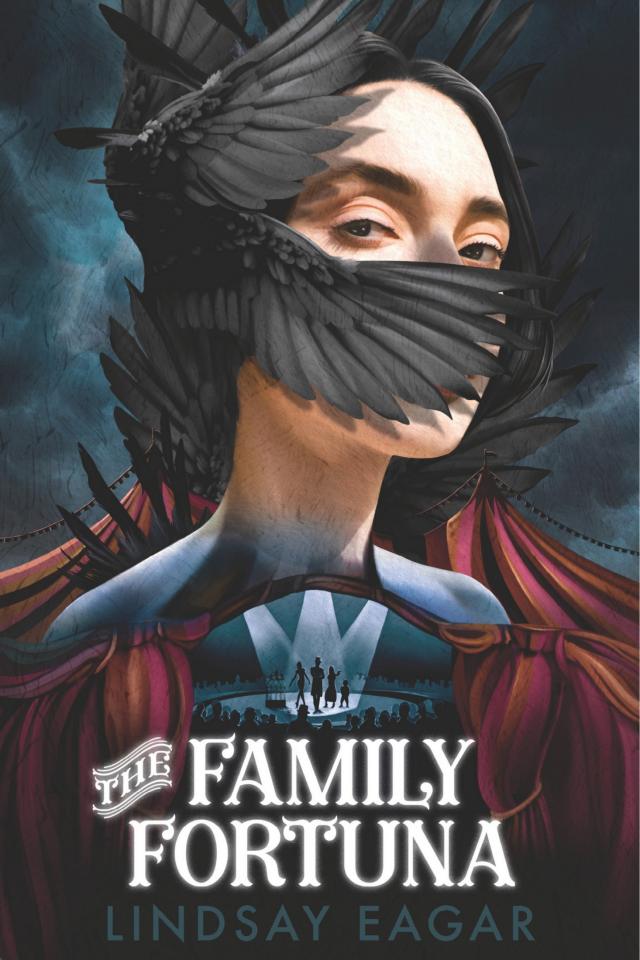
The family fortuna, p.1
The Family Fortuna, page 1


Contents
A History
The Aviary Extravaganza
San Antonio
Kootchie-Kootchie-Koo
Fernando
Birthday Boy
Fireworks
Last Call
Off to the Races
A Talk and a Walk
The Boy
Diagnosis
Family Wagon
Valley of the Peculiar
Le Cirque Americana
Big Red
A Professional
The Unfurling
A History: Ren
Iron Hot
Ask, and It Shall Be Given You
Seek, and Ye Shall Find
A History: Luna
Ugly Duckling
Crucified
Caged
Favors
Out of the Nest
A Ringmaster’s Wife
Old Boot
Moon
Stranger in a Strange Land
An Offer
A History
Drinks with the Devil
A New World
Commission
Birds of a Feather
Winged Things
Knock, and It Shall Be Opened Unto You
A History (Sixteen Years Ago)
Copyright
“A VITA, MY KITTEN,” MY FATHER WOULD SAY, twirling a licorice root in that damned bone-white smile of his, “any girl can be beautiful. But it takes a special girl to be as ugly as you.”
On sold-out nights he waxed magnanimous, the heat from hundreds of mouth-breathing patrons making his head swell beyond its usual juglike proportions. Despite its size, there was room for little in those meaty swirls of brain — my mama was allotted a tiny corner, as were my siblings and I, though we all knew our father’s love for us ran only as deep as puddles. Compared to his beloved circus, we were inconsequential.
So when he pried his gaze away from the lusty white lights of the midway to look at my face and purr, “Yes, my angel, what a monster you are!” I swilled his words, drunk on his rare attention.
Every time he said this, it was like hearing it for the first time . . .
I was only a winkling, three or four years old. The sons of our grunts, the migrant workers my father paid in pennies and bitch beer, paraded a group of local kids through our village of parked wagons and took turns boosting one another up to peek through my window.
“Monster,” they whispered, terrified, delighted.
“I saw her eat a live piglet once,” one of the sons curated, the red Texan dirt smeared across his cheeks like a burn. “Held it by the tail and dangled it over her mouth, then chomped its head clean off.”
When I glanced up, they shrieked and ran, laughing and rolling in the yucca.
My father insisted he punished the boys, yelled at the grunts to keep a tighter leash on their little bastards, but that’s cow pie.
He saw the way those boys gawked at me, and a thrill shot through his stomach.
An opportunity.
Alone in the wagon, I climbed onto my sister’s vanity and stared at the girl in the mirror. I lit a lamp, I looked, and I saw —
I saw the freckles of blood, dried into blackened scabs where barbed feathers grew from my shoulders and back. Mama plucked them out of me on Sundays like I was roast chicken dinner. A fresh garden of feathers had already started nosing up through my skin, which meant that tonight when I curled up in bed, my skin would itch like I had the scabies.
I saw the teeth that burst from my oddly formed mouth — two rows of black triangular razors, fragile as glass. A bearded lizard’s smile.
I saw a pair of eyes that blinked when I blinked — no pupils, no color, not even when the sunshine hit them. Just holes, deep and dark as abandoned gold mines, hauntingly empty, like you might trip and fall into them if you stared too long.
I saw my beak.
Home was the Family Fortuna, traveling circus and midway, the pinnacle of tented spectacle in the southwestern states of the land of the free. And my father was Papa Fortuna, owner, ringmaster, and asshole extraordinaire.
Being raised in a circus was a very particular kind of life. By the time I could toddle, I’d seen stranger things than most adults could fathom.
Our needle man, for instance, who pushed wires and nails into his pasty, spongy flesh as though he were a pincushion. He was Uncle Myron to us even though we did not share blood. Papa expected his offspring to embrace all our fellow comrades in exhibition as family, nothing less.
Or the woman we hired in South Bend who grew snarls of hair on her face, her chest, and the tops of her knuckles — we called her La Loba and took money from customers who wanted to hear her howl and scratch for her long-dead lover.
Or Graciela, our adored grotesque, seven feet tall and heavy as a train car, who let her audiences watch while she ate a cake large enough to bury a pharaoh inside, then swirled around to a Strauss waltz, wiggling her cloudlike backside.
There were many other sights both dazzling and disturbing, sights that would make a priest’s skin crawl.
But nothing was as unsettling as that little girl in the mirror. I’d glanced at my own reflection plenty of times with a toddler’s fascination, but I had never truly looked until that day.
I looked not with my own peepers but through the eyes of those boys who had ogled me. I looked, and I saw a monster.
It would be weeks before I had a nightmare about anything but myself.
Later that same evening, the screams and cackles of the boys still percussing in my ears, my father squatted on the porch steps of our wagon and pulled me onto his knee. He tucked a dahlia behind my ear the way I’d seen him do to his dancing girls from the kootchie tent.
“Gorgeous women make the world go ’round, my sweet,” he said. “People will pay good money to see a pair of pretty ankles, pretty thighs, a flash of tit . . . anything a girl is willing to show for a buck. But you, Avita — in our line of work, you’re worth a thousand whores.”
And so my father spoiled me with presents and drowned me in compliments. He flattered my glossy black hair, my porcelain hands, my quiet nature, my non-hideous features, all to make me forget that my ugliness was his profit.
I was the baby of the Fortunas.
Luna, the oldest, was as tall and svelte as a flamingo, singularly stunning, with pale hair that she kept in a sharp bob swish-swishing along her jawline like those Parisian minxes in the magazines my father ordered for her. Some blondes slant golden, but Luna’s hair was electric white against the glow of her waxen skin.
My father liked to say that the night he’d planted Luna into our mother, he’d drunk from a glass of water that had sat out all night on a table in a pool of moonlight. “Nine months later, out sprang our baby girl, moon tufts on her head,” he’d brag, placing an arm across Luna’s shoulders. Luna, who saved all her human affection for her audiences, remained statuesque, immovable.
My sister’s hair fell across half her face in a curtain, and she glanced up at her crowds this way, sizing them up with one hooded, kohl-lined eye. This was how she viewed everyone — with only half of her — and she allowed only half of herself to be viewed. Her shows ended with her mostly nude, but even I, her own sibling, did not know much else about her.
She spent most of her daylight hours dozing in the wagon we shared. At night, however, inside the Tent of Wonder, my sister came alive with glitter and charm. Luna was the duchess of the kootchie tent, the red-hot queen of the circus nightlife. Other parents would be ashamed to have their daughter work as a glorified stripper, but my father himself sized Luna up for the Tent of Wonder when she turned twelve and her breasts became too big to fit inside the clown costumes.
As a child, my sister dreamed of walking the ropes. But Family Fortuna ropewalkers needed itty-bitty compact bullet bodies, and Luna’s hips swept out like a guitar. “A body for enticing men to empty their wallets,” my father told her, “not for high-wiring.” And that was that.
When Papa was ringleading and Mama was busy showing her blue-ribbon piglets to prospective buyers, I would slip into the Tent of Wonder to watch my sister, watch her halt the respiratory systems of every male under the canvas, watch her gyrate her silk-clad body, bells jingling, tassels dangling. My fascination with her was familial pride but also curiosity. I made a study of the way she performed with the hint of a smile, which suggested she had all the mysteries of the universe laced under her corset and she’d share them with her audience . . . for the right price.
My big brother, Lorenzo — we called him Ren — was two feet shorter than I was. He was born with dwarfism, and when he emerged from my mother, bowlegged and big-noggined, my father danced a celebratory jig.
“What’s a proper circus without a half-pint running around the ring?” he said, and dreamed up things for my brother to do: flaming gauntlets of fireworks for Ren to leapfrog over; hoops of silver metal for Ren to dive through dressed as a poodle; massive tigers for Ren to ride like a sultan, a creamy cape flowing behind him in the dust.
But Ren turned out to have a curve in his spine and a bubble in his lung, so my father folded up Ren’s would-be spangles as mournfully as if his son were being measured for a casket and cut his imaginary losses. “He’s useless to me, an utter failure!” he would cry, even when Mama hissed, “Shhh! Not so loud! He can hear you, Arturo!” But of course my father already knew that; he always expected everyone to listen when he spoke.
So instead of soaking up the sound of applause, my bro ther carved out a special position for himself, the only desk job in the Family Fortuna — he did the books. Accounting; ticket sales; permits for our acts, which varied depending on the county; venue reservations; purchase of illegal animals from black-market pet shops; wages — Ren handled it all, and it suited him much better than the spotlight ever would have.
My father made him an office from the boards of an old outhouse, gutted and cleaned, with wheels slapped on it so the horses could tug it along in our caravan. That was where my brother was happiest — in his upright, coffinlike box, running numbers as he tapped his pencil against his spectacles, sitting on stacks of books that he devoured quicker than my father was willing to buy them. Pulp paperbacks were two for a dime at every general store we encountered, and Ren ate them up like raisins.
Yes, Papa was disappointed to lose the chance to announce one of his own kiddos in the ring, but he cheered up as soon as I was born.
We knew nothing but the Family Fortuna, my siblings and I — we were nursed on talcum powder and sawdust, raised with spiels on our tongues and grime from five different states under our fingernails. We belonged to the circus first and foremost and to our parents second. Children of the road, children of starlight and tumbleweeds. Children of this odd world made of waxed canvas and spun sugar. Each of us a treasure to anyone with an eye for profit, and my father saw me as his crown jewel.
“One day, you’ll be your very own attraction,” he vowed as I grew. “You’ll have your own tent, your own dressing room —”
“My own costumes?” I cut in.
“Racks of costumes,” was his honey-dipped assurance, “and adoring fans.”
“Fans,” I repeated in a faraway voice. “I can really have my own show, Papa?” I pictured satin and sequins, yards of fabric sewn into a slinky dress that barely covered me. I pictured music that rose and fell like the ocean, and lights propped along the edge of the stage like cockleshells, and an idolizing storm of applause.
My father looked at me and pictured screaming.
“Not until you’re ready, my dove. Then you’ll be famous from Texas to Tacoma.” He smiled like the devil, dollar signs in his eyes.
“From Texas to Tacoma,” I chanted, and scrambled into his arms.
“My million-dollar gal,” he cooed, happy to let me tuck my head beneath his chin. “They won’t believe their eyes.”
In moments like these, he wasn’t Arturo Fortuna, grand architect of the tents. He was my old man, the same person who had wiped my rump clean and spoon-fed me pears mashed in milk. The same one who still humored me with smooches for my skinned knees and sang me to sleep with the queerest of lullabies. How could I be blamed for trusting him?
The greatest showman on earth — how could I not believe him?
If only I had known what kind of ring he was cooking up for me.
“LADIES AND GENTLEMEN!”
A ringmaster’s instrument is his voice, and oh, how my father delighted in playing his instrument. He began bellowing announcements and pronouncements before he’d even rubbed his eyes clean of sleep crust in the hazy dawn, and he didn’t stop talking until he was hoarse as a soprano in menopause. His opening lines boomed through the tent, touching every flap and tuck of the canvas with a gentleman’s stroke.
“Bienvenidos! Bienvenue! Willkommen! Benvenuto! And any other greetings you desire! I welcome you to the most marvelous sight a human can behold, a flabbergasting feast for your eyes! Welcome to the Family Fortuna’s Spectacular Aviary Extravaganza!”
I took a deep breath and rolled it out of me, long and lazy, like a spent lover trying to cool down her loins. Almost showtime.
The best time.
Papa twisted his mustache, which he smeared with pig lard to keep it as pointy as nails. The brim of his hat was perfectly slanted to show just a hint of the scarlet lining. A pop of color — enough to entice, enough to dazzle.
And his coat, his relished funereal black tailcoat with the gold piping along the sleeves and breast, it performed as passionately as Arturo did, the only clothing he owned that didn’t seem intimidated to be worn by him. Once my father slipped while hiking and cut open his shin on a rock; he was measurably less careful about repairing his own flesh than he was about sewing up a torn seam in his worshipful tailcoat.
“But this is no ordinary bird show, and this is no ordinary bird!”
The audience was many-headed, and when it inhaled, I could hear the bristling of excitement in its lungs. They were nestled right in the palm of Papa’s greed-slicked hand, and by God, he knew it.
My father had introduced me in the ring hundreds of times, and yet even I was not totally immune to the crests and valleys of his tone, the way he wove gold into his phrases. Sometimes I found myself lulled, resting the crown of my head against the steel bars of my cage as if I were just another dusty slack-jaw undone by the magic of the ring.
With a showing every weeknight and two on Saturdays, I had his pitch memorized. I knew when he tired of his speech, when it got soggy and overchewed in his mouth, and he would dip into one of Ren’s dictionaries, spinning his sonic kaleidoscope and changing spectacular to magnificent or glorious or any number of words he’d collected over the years like loose change beneath the bleachers.
I knew when he could feel the crowd slipping away from him like wriggling fish on the run, so he upped the stakes, baiting them with variations on the usual act, which I would then improvise at the last minute. I knew when he was simply in a flashy, boasty mood, adding extra polish to his consonants to make sure the people knew they were about to witness a goddamn miracle.
He was always as excited as they were to see the curtain lift.
We were partners in the ring, he and I; the audience was a rubber ball, and we batted it between his flowery words and my gratuitous performance before we jointly released the people back into the circus grounds, their heads dizzy with fearful exhilaration, my face already haunting the subterranean halls of their minds.
It was a full house tonight, the screws in the bleachers earning their keep. We hit standing room only less than five minutes after the tent flaps opened — always a point of pride for me, to know my crowds would rather make themselves a fire hazard than miss the spectacle of my performance.
People packed in, asses nestled nice and cozy, munching food from the midway. Men gnawed on turkey legs greased with chipotle paste and cloves, sucking the bones clean of gristle. Women shoveled handfuls of spiced popped corn into their mouths as if a famine was coming. Sticky children nibbled their spun sugar on paper sticks.
Mama always shook her head at our patrons, marveling at how the circus turned otherwise decent, mild-mannered prairie folk into feral dogs, and Papa would grin. “That’s why they love us. We let them be themselves.”
I slid a finger between the drapes of the velvet slipcover that hid my cage from the audience and pulled it back ever so slightly so I could peek out at the crowd.
“I caught her in the wet, sultry jungles down south” — Papa’s lies came out as rainbow-spun yarns, as glistening as shouted poetry — “where she made her home in the blackest of caves, feasting on unsuspecting songbirds with her terrible fangs.”
The audience tittered.
“Females of a delicate nature, avert your eyes! And keep your children quiet, no matter how frightened they are — screams only drive the creature further into a frenzy!” Another lie — we wanted them to scream. Papa loved to hear his money make noise.
Happy, screaming customers.
“She feeds off your fears, my dear ladies and gentlemen, but her favorite food is warm meat!”
This was the part of the show when Papa pointed to his left with a dramatic thrust of his hand, making a bat’s wing with his tailcoat.
Pedro the spotlight boy illuminated the chicken coop at the far side of the ring. A few hens clucked, flapping their feathers at the rude upset.
The audience gasped, and I practically salivated at the sound of their mounting hysteria.
They’d paid their two bits to see a spot of violence — to see brains splattered, to see something alive be torn apart, to see a creature bruised and ugly and possibly naked, a thing that deserved to be feared — and it was my job to show it to them.
“Shall we give her some bait?” Papa unlatched the coop; hens fell gracelessly to the dirt and ran in circles.
I saw only the silhouette of my father through the slipcover, but I knew he was glowing. Made of stars.


