

Sherlock holmes vs dracu.., p.1
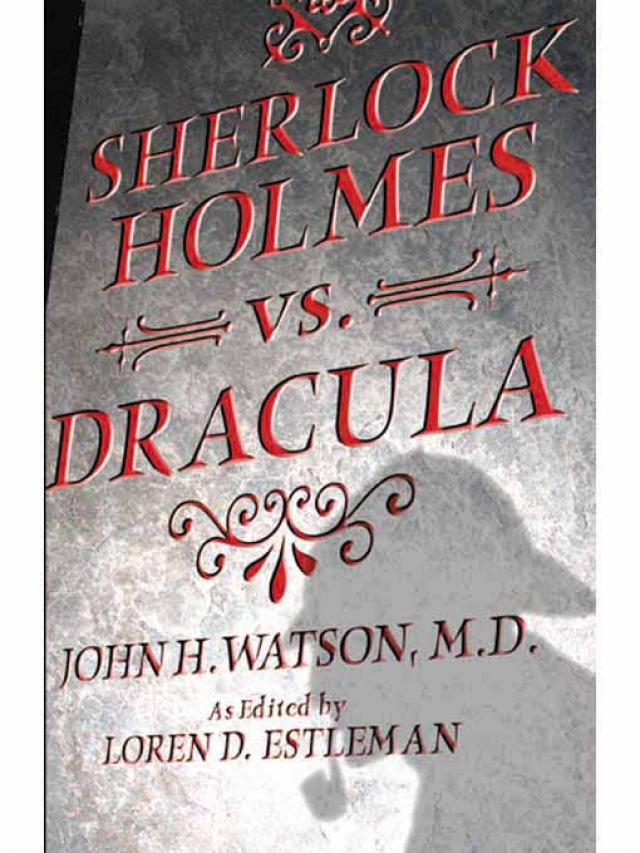
Sherlock Holmes vs. Dracula, page 1


CONTENTS
PREFACE
CHAPTER ONE The Death Ship
CHAPTER TWO The Riddle
CHAPTER THREE Sherlock Holmes Investigates
CHAPTER FOUR The Hampstead Horror
CHAPTER FIVE A Ghastly Death
CHAPTER SIX The Tale of the Count from Transylvania
CHAPTER SEVEN We Meet the Fiend
CHAPTER EIGHT The Hunt Begins
CHAPTER NINE Dracula Makes a Mistake
CHAPTER TEN A Horrible Revelation
CHAPTER ELEVEN Trail of the Vampire
CHAPTER TWELVE In Full Cry
CHAPTER THIRTEEN Confrontation
CHAPTER FOURTEEN End of the Adventure
CHAPTER FIFTEEN A New Mystery
To Sir Arthur Conan Doyle, creator of the Sherlock Holmes stories, and to Bram Stoker, author of Dracula, from whose fertile brains sprang the two most enduring characters in fiction, this volume is gratefully dedicated.
“This agency stands flat-footed upon the ground, and there it must remain. The world is big enough for us. No ghosts need apply.”
—SHERLOCK HOLMES, AS QUOTED IN “THE ADVENTURE OF THE SUSSEX VAMPIRE”
“How often have I said to you that when you have eliminated the impossible, whatever remains, however improbable, must be the truth?”
—SHERLOCK HOLMES, AS QUOTED IN “THE SIGN OF FOUR”
PREFACE
BEFORE I begin my narrative, I feel that it is my duty to set the reader straight upon a number of erroneous statements made recently regarding the events therein described. I refer in particular to a spurious monograph which has enjoyed a certain amount of popularity since it first appeared some four months ago, authored by an Irishman by the name of Bram Stoker, and entitled Dracula.
To begin with, the book, which purports to be a collection of letters and journals written by some of the principal figures involved, completely ignores the part which Sherlock Holmes (and, to a lesser extent, myself) played in bringing that affair to its successful conclusion among the snow-capped peaks of Transylvania. Although Holmes does not agree, it is my belief that Professor Van Helsing induced Stoker to deliberately falsify the facts where our line of investigation transected his, in order to build up his own reputation as a supernatural detective, and to invent entire episodes to explain the discrepancies. That I do not make these charges lightly will be borne out by what follows.
A case in point: As set down by Stoker, the professor’s friend Dr. John Seward claims that the “Bloofer Lady” (so she was named by the newspapers) was destroyed during the hours of daylight on September 29. In reality, it was on the night of the twenty-eighth, or, to be more precise, early on the morning of the twenty-ninth, that Lord Godalming pounded the sanctifying stake into her unclean breast, thus freeing her of the vampire’s curse. A further example of the author’s and Van Helsing’s duplicity takes place when the professor mentions that the Czarina Catherine left Doolittle’s Wharf in London bound for Varna, on the Black Sea, with the Count aboard on the afternoon of October fourth, when even a halfhearted perusal of the shipping schedules for that period will show that it was not until the following morning that the ship sailed and that its port of departure was Whitby, in Yorkshire, and not London. As to the reason for this alteration of the facts, and for the fanciful tale which Stoker dreamed up to cover his indiscretion, the only solution I can render is that this was merely another attempt to discredit any claim which Holmes or I might make regarding our breakneck pursuit of the vampire throughout the night of the fourth.
Lest I emerge from these pages a complete simpleton in the eyes of my readers, some explanation is necessary regarding the knowledge of vampire lore in England in 1890. Now that everyone who reads has become conversant with the meaning of such things as garlic and wooden stakes and the presence of tiny wounds upon the jugular, I suppose that my failure to recognise these apparent trifles for what they were will brand me obtuse. But the fact remains that, before the appearance of Stoker’s abomination, such things were as foreign to the average British subject as are the rites of tree worship as practised among some primitive tribes. I dare say that fewer than one in a hundred Londoners could have seen the truth, as Holmes did, when faced with a jumble of such seemingly unrelated oddities.
The account which follows is the correct one. I have double-checked the copious notes which I took at the time of the events I describe and am reasonably certain of their accuracy. In order that the reader who is interested in substantiating my narrative may do so without confusion, I have in this case abandoned my customary practice of substituting fictitious names in place of those of the actual participants, and have clouded none of the pertinent facts, so indignant am I at the injustice which some chroniclers will do in the name of art. To those who would defend Stoker, I refer them to the section in his book dealing with the Bloofer Lady, in which he is unable to decide whether the colour of her attire was black or white. It is a distinction which both he and Professor Van Helsing seem to have difficulty in determining.
John H. Watson, M.D.
London, England
September 15, 1897
SHERLOCK HOLMES VS. DRACULA
or
The Adventure of the Sanguinary Count
CHAPTER ONE
* * *
THE DEATH SHIP
I NEED hardly consult my notebook for 1890 to recall that it was in August of that year that my friend Mr. Sherlock Holmes, with some slight assistance by me, set out to unravel the single most terrible and bone-chilling mystery which it has been my privilege to relate. Those who are familiar with these somewhat incoherent accounts may remember that I have made much the same observation upon more than one occasion, most notably in the case of Miss Susan Cushing of Croydon and the grisly package she received through the mails, elsewhere recorded as “The Adventure of the Cardboard Box.” In my defence, I can only state that the affair I am about to set down is the only one in which I have Holmes’s complete agreement concerning the singular nature of the chain of events that led us, in spirit if not in body, from his comfortable quarters in Baker Street to the bleak, snow-swept landscape of one of the easternmost provinces of the European continent.
The heat wave which at the beginning of August had emptied London of all those fortunate souls who could afford to leave for the cooler temperatures of the country had just broken. My temper being of the sort that vanishes as the mercury climbs—despite a higher than average tolerance to such hardships gained through an extended sojourn in India—I had sought to make use of the break by taking the air and thus give my long-suffering wife a chance to forgive the unreasonable misanthrope with whom she had been living for the past few days. It was late morning, then, when I chanced to drop in upon my friend in his Bohemian lodgings and found him hard at work imparting information into one of those commonplace books upon which so many criminals would dearly love to lay their hands.
“You are right, Watson,” said Holmes, breaking a silence of some minutes which had settled in after greetings had been exchanged and I had ensconced myself in the chair opposite him. “Dr. Grimesby Roylott was indeed a murderer and a bully, who no doubt richly deserved his fate.”
“No doubt,” I echoed, and then realising with a start that he had just responded to my inmost thought, I came forward in my chair and stared at him in disbelief.
“My dear Holmes!” I cried. “This is too much! Am I to assume that you have transcended the bounds of reason and are now on a level with the palmsters and mind readers?”
He chuckled and leaned back, filling his cherry-wood pipe with shag from the toe end of the Persian slipper he kept always within reach. “Nothing so mysterious as that, I fear,” he said, between puffs. “There is no magic at 221B, unless one counts the ability to observe and make deductions based upon those observations.”
“But I have done nothing that could be observed!” said I. “I have been a fixture since I sat down!”
“No man is a fixture, Watson. He may think he is, and yet by a careful observation of his unconscious gestures, of his expression, and of the direction in which his eyes wander, a close reasoner would find rare instances in which he could not divine the mental processes of a man deep in thought. For example, as you were assuming your present seat, I noted that your attention was momentarily claimed by my little monograph on poisons, lying upon yonder table. It is open to the chapter which deals with vipers and their venom. Now, since our only brush with such a means of death occurred in the case of the swamp adder used by the villainous Dr. Roylott in the attempted murder of his stepdaughter—an imaginative account of which I believe you are planning to publish under the title ‘The Adventure of the Speckled Band’—it was not so difficult to surmise that your thoughts were turned in that direction. My suspicions along these lines became confirmed when I saw the look of disgust and revulsion which crossed your face at this point. When that expression turned to one of righteous anger, I was certain that I was on the right track. Whereupon I agreed with you that Dr. Roylott was a bounder of the worst sort and was pleased to see by your reaction that my reasoning was sound.”
“Holmes, Holmes.” I shook my head, smiling. “Again I must state that you do yourself a disservice by explaining your methods. The effect would be so much greater if you left your subjects in the dark.”
“And your chronicles of my little exploits would as a result be shelved alongside the fanciful works of Monsieur Verne and the Brothers Grimm. Bu t see what you think of this telegram. It arrived this morning during breakfast.”
I took the scrap of paper he proffered and read:
WOULD LIKE TO CONSULT YOU IN THE MATTER OF THE LEAD COLUMN IN THIS MORNING’S DAILYGRAPH.
THOMAS C. PARKER
WHITBY, YORKS.
“It appears to be a legitimate request for your services,” I said, handing back the wire.
“So it does.”
“Have you read the article he mentions?”
“I sent down for it after receiving the wire. The problem therein reported presents one or two interesting facets, and I think we should both profit from learning more of the particulars. I assume your practice will make no demands upon your time for the next hour or so?”
“None whatsoever. The heat wave has seen to it that most of my patients are out of the city.”
“Excellent!” said he, closing the scrapbook and returning it to its place upon the shelf beside the others. “For here, unless I am very much mistaken, is Mr. Parker’s tread upon the stair.”
No sooner had my friend finished speaking than there was a rap at the door. “Come in!” Holmes called.
Our visitor was a young man, six-and-twenty at the outside, with a beardless face nearly as narrow as Holmes’s but less sharp, and dominated by a pair of large and watery blue eyes. He wore a lightweight suit of a pale grey and a billycock hat, which he snatched off immediately upon entering; in so doing he revealed a prematurely bald head ringed by a fringe of hair the colour of rust. “Mr. Holmes, I think?” he said, looking at my friend.
“I am he,” Holmes acknowledged, rising and extending his hand for the visitor to take. “And you, I take it, are Mr. Thomas C. Parker of Whitby. Allow me to introduce my friend and colleague, Dr. Watson. Sit down, Mr. Parker, and bask in the warmth of London in the summertime.”
“You have read the item to which I referred in my wire?” asked Parker, assuming the seat which I had newly vacated.
Holmes nodded but said nothing.
“I am its author.”
“I am aware of that.”
“Indeed! And how?”
Sherlock Holmes, hands in the pockets of his old purple dressing-gown, smiled condescendingly down at his guest. “I knew you were a journalist from the moment you entered the room. The ink stains upon the insides of the index finger and thumb of your right hand, together with the bulge in your breast pocket, which I perceive to be created by a notebook residing there, told me that you spend much of your time writing. That you are seldom off your feet is borne out by the run-down appearance of your heels. Journalism is the only profession I can think of which combines such energy with the more placid activity of putting pen to paper. I thought it likely that you were the same journalist who had penned the rather interesting account to which you directed me. But all this is elementary. Pray tell us what is on your mind. It is obvious that your mission is not an unpleasant one personally, for your knock at the door was not the knock of a worried man.” Upon which cryptic statement my friend lounged into his big arm-chair and studied the man opposite him from beneath languidly drooping lids.
For some seconds Mr. Parker eyed my friend with the sort of professional interest shared only by the scribblers who work for the daily journals and chroniclers such as myself. Presently, however, his expression became businesslike. “Mr. Holmes, I have been authorised by my editors to extend to you a fee in the name of The Dailygraph in return for providing us with the solution to the mystery which took place in Whitby harbour at midnight last night.”
My friend made an impatient gesture with his left hand, as if to flick away a persistent fly which was causing him bother. “We shall discuss such things as my fee later. For now, I wish to hear a summary of the facts as you know them in your own words, independent of the restraining hand of some over-cautious editor.”
The journalist nodded agreement and began his singular narrative, which I will endeavour to set down exactly as he delivered it. It ran as follows:
“Until yesterday evening,” he informed us, “the weather in Whitby since the beginning of August has been much like that which you are now enjoying in London. Just before midnight, however, and with a suddenness that is not normally experienced upon the coast, the air became so oppressively still that even the most ignorant of city-dwellers could be naught but certain that a storm was approaching.
“There is a great flat reef in Whitby harbour which has spelled doom for many a vessel whose master was unaware of its presence. With this in mind, the Royal Navy has installed a searchlight atop the East Cliff for the purpose of guiding harbouring craft through the narrow alley that affords the only safe passage from the open sea into the dock area. Last night I was assigned by my editor to accompany the workers who were labouring to put the light into operating order and report upon the project’s worth for the benefit of the shipping companies whose paid advertisements are The Dailygraph’s main staple. This promised to be a boring as well as an uncomfortable task, and so I was not in the most receptive of moods when I arrived on the cliff’s summit just as the bell in the church tower was striking the hour of twelve.
“The final chime had scarcely begun to fade when the storm struck in all its terrible fury. The wind howled like a pack of ravenous wolves and rain lashed the cliff with the force of an explosion. My father was a correspondent during the Franco-Prussian War, Mr. Holmes, and from what I know of his experiences, a hail of lead from Napoleon’s Gatling guns was no more terrible a sight than the spectacle of all that water pounding at the wall of the cliff as if it were trying to bring it crashing down into the harbour. The workers had all they could do to hold their footing as they strained to swing the big searchlight into position so that it could do some good. At one point I even lent my own shoulder to the task, and suffered a severely pulled muscle as a result of my exertions. I am not exaggerating when I tell you that a great sigh was heaved by all concerned when the light was lit and its bold yellow beam shone out through the rain and the darkness.
“In the next moment, however, that sigh was strangled in our throats when we saw what that beam revealed.
“Ghastly yellow in the circle of light, a foreign schooner with all its sails set was racing inexorably towards the murderous reef!”
“Foreign, you say?” Holmes interrupted. “What were her colours?”
“She flew none, but her hull was unmistakably Russian in design.”
“I see. Pray go on with your narrative.”
“The supreme folly of the captain and crew in failing to furl the sails at the first sign of a squall was, I am certain, uppermost in everyone’s mind at that point, for now there was no force on earth that would prevent that fragile wooden hull from being dashed to splinters against that natural obstacle and all its hands from being flung into the merciless sea. We braced ourselves for the ear-splitting crash we believed was inevitable. And then a curious thing happened.
“Just when all seemed lost, the wind, which until now had been raging in an easterly direction, suddenly and abruptly shifted to the northeast, and the schooner glided into the harbour with the ease of a book being slid into its allotted space upon a shelf. This occurrence was so unlike the disaster we had been expecting that I doubt any of us believed what our eyes had told us. It seemed to all of us upon the East Cliff then that perhaps there was something to that biblical quotation about the Lord looking after fools and drunkards. I hope I am not boring you with all these details, Mr. Holmes, for I am trying to impress upon you what it was like to witness this event.”
“On the contrary, it is a most lucid and informative account. What occurred then?”
“It seems that it was a night for disillusionment,” continued our guest sadly. “Once again our feelings of joy were premature, for, as the schooner slid past, the searchlight fell upon a horrendous sight: that of a corpse lashed to the helm, its drooping head swinging to and fro with each motion of the ship. So spine-chilling was this unexpected vision that we forgot to swing the light, and the vessel with its grotesque cargo slid from view into the blackness of the night. By the time we recovered enough to act, there was a wrenching sound, followed by a crash, and presently the light revealed what I think most of us already suspected—that the schooner had run itself aground atop the accumulation of sand near the southeast corner of Tate Hill Pier. The second noise, of course, had been caused by a large section of the top-hamper dropping heavily to the deck.


