

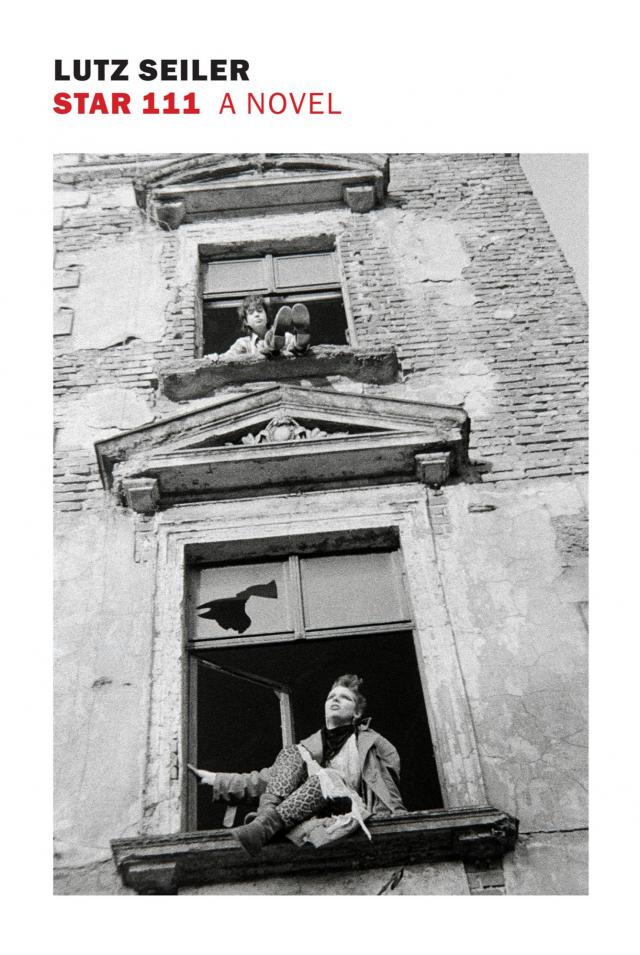
Star 111, p.14
Star 111, page 14


Every Monday (and whatever the weather), Inge and Walter walked to Montabaur, to the central employment agency. That way they saved the bus fare. Later, they were told that refugees, emigrants, and evacuees were allowed to use public transportation free of charge. “But in any case, we like to walk,” Inge wrote Carl, “and the landscape is really very pretty.” Since leaving, they saved every cent, “for later, for the next step.” Carl did not understand why, at this point (their old way of life destroyed without a new one being ready), their next step had to be kept a secret. What did they have planned now? Evidently something it was too early to reveal.
Carl was familiar with his parents’ phase-it-in, tentative approach to life, but the violence (suddenness, recklessness) of their escape had almost overshadowed it (just as your ears are deafened immediately after an explosion and your hearing returns only haltingly, thought Carl, and the comparison seemed fitting). Phase it in was a favorite expression of his mother, eclipsed only by operative—it had seeped into daily usage from the vocabulary of her specialist language (not secretarial, but specialist): “We’ll phase it in, Carl, and then be fully operative.”
Carl had grown up with this language. To his mother, who came from the east Thuringian countryside, it had been the language of the city, of modernity and progress, elevated and aspirational. Commanding it indicated . . . Carl lost his train of thought. He fingered Inge’s letter, the thin, slender sheets of paper with a delicate, pale yellow flower pattern along the bottom edge.
His parents had opened a bank account, in which they had already “scrimped and saved a modest sum.” Inge used this expression, which reminded Carl of his grandmother’s stories about the years right after the war. First you had to leave behind everything you owned just so you could start scrimping and saving what little was left? Did it really have to be that way? Was that the necessary condition?
His father repaired the wiring of the large menorah in the Talibs’ entrance hall (the candelabra weighed almost twenty kilos) and adjusted the carburetor in Ahmed Talib’s car. Since he was working on the car, he also bled the brakes and changed the oil. Walter was astounded that this 1986 Opel Omega A hadn’t yet been serviced once—care and maintenance, Dr. Talib didn’t have the slightest idea. They don’t know much about it in Syria, Walter thought. Walter’s favorite thing was lying under the car. A lot had simply been neglected in this Opel, Inge wrote Carl. Inge never passed up an opportunity to be proud of Walter, and of Carl too, naturally, as when “her men” spent an entire Sunday together “working” in the garage. Carl pictured in his mind—his father’s commentary, his patience (with regard to the Zhiguli), and his whispering over the open hood with the motor running: he listened and spoke to the engine, he touched it, knocked gently on this or that spot, he was an engine-whisperer . . . Strange, but that’s what we were, Carl thought, father and son in the sound of the engine, in the sound of certainty, the big Bischoff and the little Bischoff, tightly enclosed in the old life (absurdly, the thought of two people in aspic flitted through his head).
No doubt his father missed the garage, his own tools, the Zhiguli, and maybe even Carl. The garage was in Gera, in the east Thuringian Elster Valley. The Zhiguli was on Ryke Strasse in Berlin and behind the small back courtyard copse, Carl was squatting in a Berlin cellar apartment, the place he had chosen in order to transform his precarious mundane life into a purely poetic existence. Gold out of shit, thought Carl.
No, he didn’t think that way. Because everything around him expressed the future. The sight of his three worn mattresses on the floor, bound together with rope, the broken black-and-white television at the head of his bed and the soot-covered sheets hanging at the window and the coal box near the oven: it may have all been shabby and squalid, but it was full of promise, all these decrepit things (and the half-dilapidated building) all expressed the future. Disintegration was promise, not death, just life, that was the paradox of the time.
•
Then, in early March, a telephone call from Gelnhausen. For Mr. Bischoff at the Talibs. Walter was invited to a job interview. An appointment had to be made immediately, as if there really was no more time to lose, even Saturday afternoon wouldn’t be bad.
The company CTZ (Computer Technology Zollnay) was located on the outskirts of Gelnhausen, high above the town, in a large, white mansion straight out of the American South. It had not only the antique columns, but also a balcony supported on the shoulders of half-naked Amazons, elegantly bowed under the burden, gazing dully into the Kinzig valley.
Only years later did Walter admit his doubts and in doing so evoke an image of this Southern mansion: in the entryway, on the wide, softly creaking staircase with the soft, burgundy runner, he was suddenly seized, almost overwhelmed by a feeling of almost boundless inferiority. It was the first time in his life that he had experienced it in this way and out of the blue, the ugly old word massa came to mind. “In any event, our future looked black and then, for an instant, I saw myself as if I were a black person too, a dejected and graying one, over fifty, simply too old to be a useful slave.” He admitted this was absurd and he felt uncomfortable that such a thought had even occurred to him, not to mention his talking about it, and that perhaps the cause of his reaction didn’t come from that moment on the stairs, but rather from something that had happened to him in the weeks prior, a kind of transformation, a wearing away and thinning out of his self in the time he was alone, in the camp in Büsum on the North Sea coast . . .
First, they had been taken to accommodation right on the water, a large bunker on the drill ground of an infantry barracks. Forty people, who had to be relocated after a few days because of an insect infestation. Not so bad, actually. From Walter’s point of view—he had decided to be extremely patient (“Some difficulties simply cannot be avoided,” was written in the green and orange colored copy of the Guide for Migrants from the GDR that each of them had been given in Giessen)—there had only been a few moths.
They marched along a kind of trail on a dyke, led by people from the company responsible for their care. It was seriously cold, but the path was beautiful at low and high tides with gleaming mudflats and a soundless sea. On the way, there were the usual jokes about the accordion case on his back.
They marched inland about five kilometers to a large gymnasium—freshly renovated and well prepared: the entire area was partitioned into small spaces with cupboards and cots, three or four Easterners in each. The hall filled quickly and, ultimately, there were forty or fifty of these cubbyholes lined up next to each other like rabbit hutches, divided by very narrow passageways in which there were always one or two people pacing nervously and brazenly staring at others’ beds.
Walter’s problem was the accordion because it didn’t fit in his locker or under his camp bed—there simply wasn’t room for it, so he kept it on the foot of his bed. At night, he stretched his legs over the case, to keep it safe. He could have slept like that, looking up at the basketball hoop over his head, but the hall was just too loud and too stuffy, even though a few of the windows were always open.
Disturbances broke out after just a few days; a woman in the next cubbyhole was attacked because her child sang half the night—now the girl screamed every night. At the harbor newsstand, Walter bought newspapers and read the job listings. Once a week, he took the bus to the employment agency. On the bus, there were others from the sports hall who were making an effort, but all told, it seemed pointless. “No one could tell us why we’d been shipped there, to the mudflats, or what we were supposed to do there.” Nor was there anything about the area in the migrant guide. Everyone wanted to go to Hamburg or at least to Bremen. Word had it that in Bremerhaven, migrants were housed in hotel ships and in the former red-light district or even in empty apartments seized by the city.
When the weather permitted, Walter sat outside behind the hall and played his accordion. “Straight Jacket!” one of the attendants (or guards) called to him and raised his arm. He’d recognized the song. That was the nicest incident in his time on the coast, Walter said once. Only fifty meters away, there was a small waterway that the people from the company called the harbor stream. On the other side of the harbor stream, there was a kind of storehouse and a row of detached houses. When the light went on in the living rooms (before they drew the curtains and let down the shades), Walter could see the silhouettes of the locals, their evening gestures, self-assured. That’s how it set in and then grew, secretly, day by day, that crippling feeling of being inferior, weak, and worthless.
There were two or three drinkers’ cubbies, where they played cards or threw dice; the game was called Liar’s Dice. Every night, the rattle of the dice—a trying sound. They used the blue plastic cups that every migrant was given as a toothbrush mug along with a few other things for their daily needs, basic cosmetics, in Inge’s words. The game: two dice and the attempt to lie well (more precisely, to bluff). A one and a two were a mex and only mexes had to be revealed, otherwise you could lie: “Mex!” Mex meant victory, several minutes of yelling and a round of schnapps or beer. After ten or twenty rounds, it sometimes happened that one of the players couldn’t find his way out of the hall and in his distress pissed between the beds. The stench was dreadful, so the company providing the housing banned alcohol and began inspecting the cubbies of the “East Swine” for bottles. After one employee was injured (hit on the head with a bottle), his colleagues refused to enter the refugee hall (“that pigsty”).
“It’s worse here than in the East,” the players agreed, and it was their East German protest that produced a relaxation of the rules, at least for Christmas and New Year’s Eve—with disastrous results. The hall was cleared a few days later. A hundred migrants were transferred by bus to Giessen, back to the central refugee transit camp.
•
The entrance to the CTZ offices was at the back of the mansion, but the staircase on which Walter suddenly saw himself as if a black person (“dejected and graying”) led to the sunny side of the mansion, directly to a large room with a balcony and honey-yellow walls.
Zollnay, the head of CTZ, was standing behind his desk. He wore a wide-brimmed hat and a thin dustcoat that reached almost to his ankles. He was short and broad-shouldered with a round face. For a moment, he looked like he was ready for a duel but then he offered Walter his hand: he was the boss, there was no doubt.
To the left of his desk sat a man who was introduced as the managing director and to his right was a woman from the personnel department. The personnel department for the southern region had skipped over Walter’s unfavorable origin (the East) and come across rare and, yes, valuable qualifications. A man from East Germany who knew five computer languages—what on earth?
“Our facility with all its standards here in the Imperial Palatinate . . .” Thus began Zollnay’s recruitment speech.
Walter looked at the floor: gleaming, dark, wide-planked parquet flooring.
He was to start work immediately.
•
Something significant had happened again and Inge wrote Carl that they knew exactly what they wanted and this was the next step on their way.
Walter Bischoff was hired as a teacher. In CTZ terminology, he was now a trainer. As a trainer, Walter taught computer programming languages with mysterious names like Pascal, C++, and Cobol. He would be traveling from one large company to another all over the West, up and down the country, the boss had said.
In comparable job postings in Computer Week, which Walter had read in preparation for his interview with CTZ, the salary was 7,000 deutschmarks a month. CTZ had offered him a starting salary of 5,000 deutschmarks and Walter had agreed immediately. It didn’t seem proper to him to negotiate over such sums. “His income is enormous,” Inge wrote Carl, and Carl had to agree that the amount was incredible. So, what everyone had always suspected was true: the West was prosperity and gold.
In the end, the enormous salary didn’t change their spartan lifestyle in the slightest. Their thrift remained, and even increased as they readily gave in to certain fears (homelessness, hunger, general ruin) that hadn’t played any role at all during their “emigration.” Perhaps these fears had been suspended in favor of their utterly irrational decision. Carl was the only one who started calculating (and hoping). Occasionally, the exchange rate on the black market was ten to one. That meant that his father was earning 50,000 East German marks a month. A fraction of that would be enough, Carl thought, to cover a few years in Berlin, repairs on the Zhiguli—maybe even to buy a different used model. He’d seen some stunning Mazdas with large, shiny hoods and surprisingly broad fronts . . . For a moment, the thought of getting rid of the Zhiguli filled him with shame—he knew he could never do it. As if I were getting rid of my father, Carl thought.
•
Again, a new life began. Two weeks after the conversation in the White Villa (that was actually what it was called in town), the Bischoffs moved into a furnished apartment in the CTZ boss’s private house. “Only my mother lives in the house now,” Zollnay had said. For some reason he was insisting they move in and change their registration to the Garten Strasse address in Gelnhausen-Roth without delay. The phrase “net cold rent” sounded unpleasant. “We’d prefer the rent warm,” Carl’s father, who was unfamiliar with the term for the cost of rent not including utilities or maintenance charges, told his boss.
The apartment consisted of two small rooms on the attic floor and a dirty, glass-walled storage room, which was actually a sunroom left unfinished. Inge and Walter: they’d both noticed the rusted beams over the bedroom window. The entire house seemed incomplete. The balcony was ringed by a balustrade of still unplastered aerated concrete, covered with moss and an algae-like plant. It smelled musty but that didn’t seem critical; after all, it was the first time in months that the Bischoffs could put aside their rucksacks for a while.
“It’s a relief,” Inge wrote to Carl. Unfortunately, their rooms were not a self-contained apartment, but Zollnay had said that something could surely be done at some point.
Each time they entered the building, the door to the apartment beneath them would open (as in an old comedy film) and the boss’s mother would step out and, smiling, would stretch out her arms and say, “Countrymen, my dear countrymen!” That was the usual opening to her monologues about her son, the benefactor, who had connections in the highest circles (she mentioned “the chancellor”) and as a result, everything would work out for them, for Inge and Walter. She was a strong, stocky person, with apron strings tied in front of her stomach.
The Bischoffs’ apartment faced the road that connected Gelnhausen with the smaller towns in the direction of Hanau and Frankfurt. Their view onto the valley: the railway embankment and the Kinzig river, which curved at that point, adjacent to a marsh, then diffuse land up to the highway with its rumbling day and night, and sometimes a mountain would appear on the horizon. Was that the Spessart range?
From their balcony, Inge could read the town limit sign: “Lieblos 1 km.” The towns in the area had such names: Lieblos (Loveless), Bösgesäss (Badrump), Altenhasslau (Oldhatemild), but there were also Linsengericht (Lentildish) and Meerholz (Seawood).
Inge, at any rate, was ready to warm up to the view and the field past the road. To the left there were a few gardens, in which small livestock was kept, “but with very careless and slipshod fencing.” Once a loose chicken was run over. Inge wrote Carl a very detailed account with a level of compassion and grief that was completely out of proportion to what else was happening to his parents, to him (their son), and in the rest of the world. Carl’s own explanation was that his mother, with her Thuringian background, was a friend to all chickens, broadly speaking, their godmother, as it were. He could picture it: his mother crossing the road and feeding the chickens with the remains of her breakfast, breadcrumbs and eggshells, to which chickens, as everyone knows, are nearly addicted. She would talk to them—“Countrymen, my dear countrymen!”—and the hens would peck and nod, nod and peck, non-stop. They expressed their agreement in the direct, excessive, silent-film type manner that only chickens are capable of, which made Inge giggle.
•
Mornings, Walter would walk to the Southern mansion along Herzbach Weg, three kilometers uphill. There, the trainers gathered in a large room with several desks to prepare their classes. He didn’t have his own desk, but then no one did at CTZ. His route to the mansion passed a large American army base, the Coleman Kaserne. Earlier, during the Second World War, it had been called the Herzbach Kaserne. When he passed it, Walter’s eyes would sweep over the reddish-brown sandstone relief of Nibelung figures that protruded distinctly from the facade and, on some days, wanted to speak with him—about his future plans, future battles, about conquering the world.
Because it was the custom in Thuringia, Bischoff greeted the soldiers he saw, mostly near the main entrance. “An armored division,” the boss’s mother had said. The young GIs, who weren’t used to anyone greeting them, looked at him, astonished.
“Hi, man!”
It was all incredible, but it happened. Walter didn’t own a briefcase yet. He used his hunter’s rucksack from Gera and he was the only one who arrived at the mansion on foot.
In April, after three weeks of preparation (the short man in the hat and dustcoat called it his “familiarization period”), Walter Bischoff drove a company Mercedes to Hamburg and taught his first class. The car was a black 1974 Mercedes 280E that required an additional bottle of motor oil every three hundred kilometers. Walter had bought himself a map and drawn in his route, first to the hotel. Outer Alster, Inner Alster, the center of Hamburg was a madness of one-way streets—all of them full of Western cars: for a second, that was Walter’s impression. Although he was sitting in a Mercedes, he still had his Zhiguli point of view. His West was deeply rooted in the East, simply too deep, Walter thought, as he started another circle along the Alster.


