Death of a spy, p.1
Death of a Spy, page 1


This book is a work of fiction. Names, characters, places, and incidents are the product of the author’s imagination or are used fictitiously. Any resemblance to actual events, locales, or persons, living or dead, is coincidental.
Copyright © 2024 by M. C. Beaton
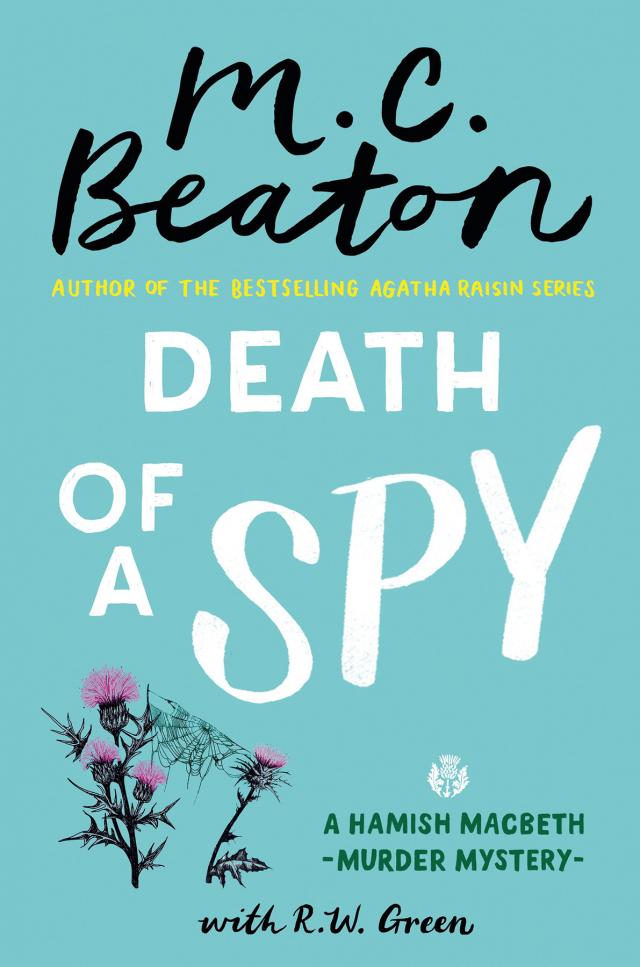
Cover design and hand lettering by Emily Courdelle, with illustrations derived from Shutterstock.
Cover copyright © 2024 by Hachette Book Group, Inc.
Hachette Book Group supports the right to free expression and the value of copyright. The purpose of copyright is to encourage writers and artists to produce the creative works that enrich our culture.
The scanning, uploading, and distribution of this book without permission is a theft of the author’s intellectual property. If you would like permission to use material from the book (other than for review purposes), please contact permissions@hbgusa.com. Thank you for your support of the author’s rights.
Grand Central Publishing
Hachette Book Group
1290 Avenue of the Americas, New York, NY 10104
grandcentralpublishing.com
twitter.com/grandcentralpub
First U.S. Edition: February 2024
Also published in Great Britain by Constable
Grand Central Publishing is a division of Hachette Book Group, Inc. The Grand Central Publishing name and logo is a registered trademark of Hachette Book Group, Inc.
The publisher is not responsible for websites (or their content) that are not owned by the publisher.
The Hachette Speakers Bureau provides a wide range of authors for speaking events. To find out more, go to hachettespeakersbureau.com or email HachetteSpeakers@hbgusa.com.
Grand Central Publishing books may be purchased in bulk for business, educational, or promotional use. For information, please contact your local bookseller or the Hachette Book Group Special Markets Department at special.markets@hbgusa.com.
Library of Congress Cataloging-in-Publication Data has been applied for.
ISBNs: 978-1-5387-4330-0 (hardcover), 978-1-5387-6659-0 (large type), 978-1-5387-4332-4 (ebook)
E3-20231222-JV-NF-ORI
Contents
Cover
Title Page
Copyright
Foreword by R. W. Green
Chapter One
Chapter Two
Chapter Three
Chapter Four
Chapter Five
Chapter Six
Chapter Seven
Chapter Eight
Chapter Nine
Chapter Ten
Discover More
About the Authors
The Hamish Macbeth series
Explore book giveaways, sneak peeks, deals, and more.
Tap here to learn more.
Foreword by R. W. Green
Those of you who know Hamish Macbeth and who know a bit about Lochdubh, the village where he lives in Sutherland, in the far northwest of the Scottish Highlands, will also know what the Lochdubh residents think of their local police officer. He’s a lazy, work-shy layabout who’d rather be scrounging cups of coffee at the Tommel Castle Hotel or the Italian restaurant in the village than concentrating on the ever-growing list of important matters with which he should be dealing. How can we all sleep safe in our beds with only this dunderheid standing between us and the hordes of lawless scunners rampaging around the Highlands? Well, that’s what some of them think.
But does that sound like the Hamish you know? Why would any of the good folk of Lochdubh have such a low opinion of him? Why brand him as lazy? Basically, that all comes down to the wonderful M. C. Beaton—Marion. When she first created her Highland policeman around forty years ago, Marion decided that he should be an outsider rather than a Lochdubh native. Having lived in Sutherland for a while, but having been born and brought up way down south in Glasgow, Marion knew that making him an outsider would give him a little extra work to do in winning over the people who lived on his patch. She decided, therefore, that he was born outside Sutherland in Cromarty, which is to the southeast, and raised in Rogart, which is in the east of Sutherland, about as far away from the fictional Lochdubh on the west coast as you can get without leaving the county.
Marion also knew that it takes a special kind of fortitude to live and work in a place as remote, and with such an unforgiving climate, as Sutherland. She maintained that Sutherlanders can, justifiably, set themselves apart from the rest of the UK population. They have to work hard and, when that work is outdoors, often in harsh conditions. That leads them to reserve judgment on newcomers until they’ve seen if they have what it takes—and that could take a lifetime. Whether the interloper has come from London, Edinburgh, Glasgow or closer to home, like Hamish, outsiders can remain outsiders until their dying day.
As an outsider in Lochdubh, Hamish was not only different, but was seen to be doing things differently. His relaxed, laid-back manner rankled with some, and the fact that he lived at the police station in what they saw as a “free” house, as well as driving around in a “free” car, made his attitude seem all the more lackadaisical. From there, Marion was able to instill a little jealousy and even a pinch of resentment toward Hamish among some of the Lochdubh residents.
What they failed to realize, of course, was that being a rural police officer is far more work than it might seem. Unlike UK city cops, who clock off at their station and change out of their uniforms to travel home anonymously (although they’re still required to intervene should they come across some kind of incident) to neighborhoods where most of those living nearby will have no idea what they do for a living, police officers in rural areas are almost constantly on duty. Everyone knows who they are, where they live and how to contact them should the need arise. They are a vital part of the local community.
Hamish, therefore, works long hours. He also looks after his pets, Lugs and Sonsie, while also tending to his chickens in their garden shed and a few sheep up on the hillside. Choosing to cope with all that doesn’t sound like the behavior of a lazy man, does it? Despite all his hard work, Hamish will never either expect or receive credit for his efforts from some in Lochdubh. They see a public servant as public property paid for from the public purse and, with a healthy dose of Highland thrift, they expect to get their taxpayer money’s worth.
Being under-appreciated is not something that troubles Hamish in the slightest. Part of the perception of him being lazy stems from his lack of ambition. He will happily allow others further up the police chain of command to take credit for his efforts as long as he is allowed to continue leading a quiet life in Lochdubh. In the village, he can use guile and a little rule bending to remain in control of his own destiny—the last thing he wants is a promotion that would mean leaving the area he has come to love so much.
That is the Hamish Marion introduced me to. She seemed to know him so well that I had to ask her if he was based on someone she knew—surely he hadn’t come entirely from her imagination? She had a little twinkle in her eye when she told me that neither Hamish nor any of the other characters in Lochdubh were created entirely in her own head. As a former journalist, Marion always liked to have the TV news playing somewhere in the background. She watched people on TV and, like all good journalists, she was an excellent observer. She observed people she met, even those simply passing by on the street, and identified different physical attributes, different habits and different personality traits, committing them to memory, drawing on that jumble of mental images when she built a new character.
That’s the long-winded analysis. The way she explained it was simply that she remembered bits and pieces about people and used them as and when she needed. I learned a huge amount from Marion and regard it as an enormous honor that she was happy for me to carry her characters forward into new adventures, adding a few new faces here and there when the need arose.
New faces are actually what Sutherland desperately needs. It is a vast area with an enormous coastline and scenery that ranges from beautifully bleak moorland to majestic mountain ranges. In all, it covers over 2,000 square miles yet has a population of only 13,500. Compare that to Greater London, which covers just 607 square miles but has a population of more than 9.6 million. Sutherland also has an aging population. Young people grow up and move away for career opportunities in the big cities, meaning that there are fewer young families in the region every year. Schools in Sutherland operate at 29 percent capacity and the population decline is predicted to continue. That adds to the remoteness of the area. A recent survey defined remoteness by how easy it is for those living in a specific area to access a population center of 10,000 people within thirty minutes. Apart from its far southeastern corner, Sutherland was judged the most remote place in the UK, including the Scottish islands.
At this point, we’re in danger of confusing fiction and reality. Marion made Lochdubh seem like a very real place by creating its setting, as she did its population, from bits and pieces of other places around Sutherland. You should go there and see for yourself. If you’re like me, you won’t be able to avoid the disappointment of not seeing signposts for the fictional Strathbane, Lochdubh or Braikie when you’re driving around but there are plenty of other places that you will recognize from Hamish’s travels. Poor Hamish is forever caught in a quandary—all he wants is to stay at home in Lochdubh, yet to do so he has to hunt down ne’er-do-wells all over the country!
In Death of a Spy, Hamish has to hit the road once again, but only once he’s solved the problem of the Anstey Bridge Disaster. I hope you enjoy this visit t o Hamish Macbeth country as much as I did!
Rod Green, 2024
CHAPTER ONE
Every man at the bottom of his heart believes that he is a born detective.
John Buchan, The Power-House
He watched the headlights sweep through swathes of darkness as he guided the car along the coast road. On this stretch there were no houses for miles around, no streetlights, and tonight the moon wouldn’t put in an appearance until well after midnight. To his right the hillside climbed steeply up toward the craggy peaks and chill waters of the many tarns nestled in the crumpled mountain skirts of the 3,000-foot Beinn Bhàn. To his left, the inky waters of the Inner Sound stretched five miles to the island of Raasay, where the hills shielded him from the even more distant lights of Portree on the Isle of Skye.
Tonight, the black night was his friend and the intrusion of his headlights made him feel almost guilty. Disturbing the still silence of the dark was not his intention, but it was a necessary transgression. He knew a spot where he could pull off the road just before Applecross Sands and enjoy an uninterrupted view of the clear, cloudless night sky. Glancing down at the binoculars and small telescope in the passenger footwell, he smiled, wondering how many stars he would be able to identify among the thousands he would see. With no competition from human-made, terrestrial light sources, the sky would be a blaze of stars.
His eyes flicked back to the route ahead and he gasped in alarm. There was a body lying in the road! He slammed on the brakes and the tires bit into the surface for a moment before the frantic drumming of the anti-lock brakes brought the car to a halt. He peered out through the windscreen and could clearly see a man lying a few feet in front, illuminated in his headlight beams. Beyond the fallen man stood another car, a silver Audi, facing him on the narrow, single-track road, its headlights extinguished and the driver’s door open wide.
Flinging open his own door, he rushed over to the prostrate figure, oblivious to a momentary flash of bright light from the darkness up on the hill. He crouched beside the body.
“Are you hurt?” he called, looking for injuries. “Can you hear me?”
Then the body moved, the head turning to stare up at him with vaguely familiar, half-remembered eyes.
“What…?” he breathed, then heard a footstep behind him. He turned in time to see a baseball bat chopping through the air toward his head. He tried to dodge but the blow caught him on the neck and he collapsed on the ground. The powerful figure wielding the bat took another swing and knocked him senseless.
The man who had been on the ground was quickly on his feet, rolling the barely conscious driver onto a tarpaulin sheet and dragging him out of the way while the batsman swiftly jumped into his victim’s car, maneuvering it to the edge of the road. There, the headlights picked out a short stretch of boulder-strewn scrub that fell away toward the edge of a cliff. Leaving the engine running, he leapt out, sprinting over to the Audi and starting it up. With his partner directing him, he positioned the Audi with its rear bumper touching that of the other car. They then bundled the injured driver, tracks of blood now smearing his face and neck, back behind the wheel of his car and slammed the door. A moment later, they had the Audi’s engine revving before it shot backward, launching the injured man’s car toward the cliff.
The Audi shuddered to a halt at the roadside while its occupants watched the other car lurch and buck, crashing over boulders hidden in the heather, its headlight beams soaring skyward before plunging back to earth. The car slowed, seemingly desperate to cling to the safety of the slope, and stopped when its front wheels dropped over the precipice, grounding its underside. It perched there for a moment before the weight of its engine and the crumbling of the cliff edge sent it somersaulting out of sight.
The two killers remained sitting in the Audi when another man appeared from the hillside, jogging past them, lighting his way with a flashlight pointed at the ground. He approached the cliff edge and peered over. On the rocks below, the car lay upside down like a dying turtle, its doors closed, only its wheels above water. The submerged headlights spread an eerie yellow glow around the front of the vehicle for a few moments before they finally faded and died. Satisfied that their job was done, he folded the tarpaulin, taking care that no blood spilled onto the road, and slipped it inside a large, black bin liner. He then stowed it in the boot of the Audi before climbing into the back seat. Not a word was spoken as they sped off into the night.
“This will be some kind o’ joke, is it no’?” Sergeant Hamish Macbeth stared Superintendent Daviot straight in the eye. “Have you gone completely doolally?”
“Sergeant Macbeth!” Daviot barked. “You will not use that tone with me! As your senior officer, you will address me with the respect my rank demands!”
“Aye, right,” Hamish said, his stare never wavering. “So have you gone completely doolally, sir?”
Daviot pursed his lips in anger but had no time to respond before Macbeth charged ahead.
“You can’t seriously expect me to police my beat wi’ somebody looking like that!” he growled, pointing at the third man in the superintendent’s office. The man was wearing a pale blue shirt with a silver star badge above the left breast pocket and sergeant’s chevrons on the sleeves. Above the chevrons were neat octagonal shoulder patches with the words “Chicago Police” embracing a representation of the city’s seal. “The folk around Lochdubh will never take me seriously ever again.”
“Macbeth, I expect you to follow orders!” Daviot fumed. “I expect you to…”
“Maybe I could jump in at this point, sir,” said Chicago Police Sergeant James Bland with a calm, pacifying smile. “Hamish, you know I’ve been to Lochdubh, so I know a little about your people there and I don’t want to make any waves.”
Hamish looked at Bland. The man had always been a mystery—part golfing gambler, part stock-market investor, part globetrotting playboy, and now part cop. What else was he into? Why was he now standing beside him in front of Daviot’s desk? Why was he back in Scotland?
“How about this?” Bland detached the metal star from his shirt. “I’m happy to wear something less conspicuous—maybe one of your Police Scotland black shirts—I’ll just pin my star to it to help explain who I am and why I’m here.”
“And just why are you here?” Hamish narrowed his eyes, delivering the question like a challenge.
“Officially, Sergeant Bland is here as part of an exchange scheme, learning about the policing methods employed in Scotland,” Daviot explained, holding out a document with a Police Scotland letterhead. “Our orders are that he is to be afforded every hospitality and that he is to accompany you as you go about your normal day-to-day duties.”
“And unofficially?” Hamish asked, having scanned the document.
“Actually, Hamish,” Bland said, still smiling, his American drawl far more relaxed than Daviot’s nervous, tense delivery, “the unofficial part’s pretty official, too.”
He offered Hamish a document with a UK Government Home Office heading. Hamish read the text, skipping the preamble to focus on what he immediately recognized as the heart of the matter.
“It says here that you’re working ‘covertly’ and I’m to give you ‘every possible assistance in pursuit of the investigation.’” Hamish glowered at Bland. “What investigation?”
“You recognize this?” Bland took back the Home Office document, exchanging it for another piece of paper. It was a printout of a computer spreadsheet showing columns of numbers and, at the bottom of the first column, three names—Vadoit, Serdonna and Ralbi.
“Aye, I mind o’ this,” Hamish said with a resigned sigh. He now knew exactly why Bland was back in Scotland. “Four people died on account o’ this,” he added, shaking the spreadsheet. “It damn near got me killed as well!”
“Then you have a vested interest in finding out what it was all about,” Bland reasoned.
“I know fine what it was all about!” Hamish could feel another flush of anger spreading from the back of his neck. He could also feel himself being corralled into a situation that was about as far from the simple, peaceful life he enjoyed in Lochdubh as you could get. He felt the problems of the world outside his Highland haven weighing heavy on his shoulders and slumped into a chair, running a hand through his fiery red hair, steadying his temper with a heavy sigh. “It was about secrets, traitors and spies. A coded list o’ names and payments—spies paying for secrets from traitors—and the names Daviot, Anderson and Blair as anagrams at the bottom.”