

For the love of my enemy, p.1
For the Love of My Enemy, page 1


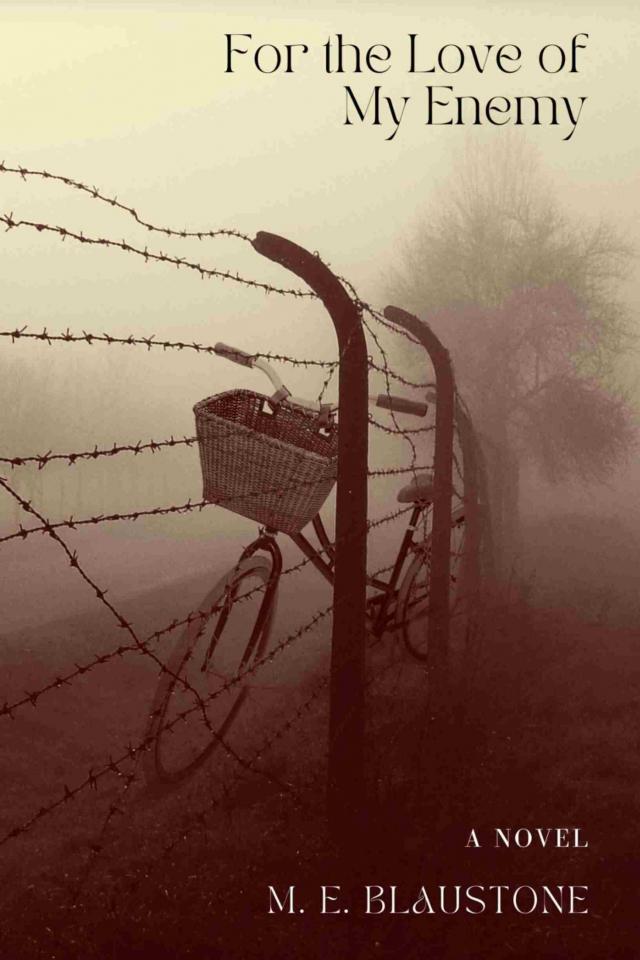
For the Love of My Enemy
For the Love of My Enemy
M. E. Blaustone
Two Sisters Press
Contents
1
2
3
4
5
6
7
8
9
10
11
12
13
14
15
16
17
18
19
20
21
22
23
24
25
26
27
28
29
30
31
32
33
34
35
36
37
38
Photos of Camp Windsor
photo insert
photo insert
Author’s Note
To Christopher, the love of my life
Acknowledgments
My head literally swims when I think of the many people who inspired and encouraged me to write For the Love of My Enemy. Seriously, it makes me dizzy. And so, I will, to the best of my ability, attempt to do justice to the following.
First out of the box, I’d like to thank my friend and mentor, Francine Rivers. Francine didn’t know me when I first reached out to her five years ago to ask if she would meet up with me so that I could ask her some questions about writing novels. Graciously, she did just that. She sat with me for hours on different occasions in a coffee shop, telling me her stories and then listening to me ramble on about mine. She was the second person to read for me (after my husband, Chris). Then email after email…she was there for me. Her encouraging words and belief that I actually could write was everything I needed to take my first baby steps. She will forever be one of my all-time favorite authors and favorite humans on the planet.
I wouldn’t have been able to even begin writing this novel without Steven Lehman and the Windsor Historical Society. From my very first meeting with Steve, he became a tremendous resource of historical information on Camp Windsor, as well as the town of Windsor. I’m truly grateful for his kindness and support. If I could choose one word to describe the Windsor Historical Society and what it’s like to walk through the museum doors, the first word that comes to mind is magical.
To everyone who read for me, however I referred to you. Whether the Alphas or Betas… You know who you are. You are the ones who faithfully, patiently, and graciously read through my unedited manuscript. You gave me your unfettered critique and advice. You didn’t hold back. Thank you, from the bottom of my heart. You are precious to me.
To Chantelle Bogue, who designed the gorgeous, ethereal bicycle graphic for my book cover. Chantelle, you are a goddess of design. Whenever I would sit at my computer to write, I would look at that picture and be transported back in time. It became my muse, and I would think to myself, Adina rode that bicycle… I’m just sure of it.
Lastly, to my husband, Christopher…the man I call The Love of My Life. He’s my loudest cheerleader, and my biggest fan. My rock. Thank you, my Love, for allowing me to read to you late at night. The story came to life as I did. This one is definitely for you.
Author's Note
From 1942 through 1945, more than 425,000 Axis prisoners were shipped to the United States. They were detained in 686 camps located across the US. One hundred seventy-five branch camps served 511 smaller area camps. Most were located in the South and Southwest, with some in the Great Plains and Midwest.
Publisher’s Note
Many of the German POWs, like some you’ll meet in this story, vehemently opposed Hitler and the Nazi regime and were conscripted into the German military. Those who tried to resist or claim conscientious objector status were sent to military prisons or concentration camps for the crime of “pacifism.” While the evil of the Nazis should never be understated or excused, we feel it is also important to remember that fascist leaders target anyone who disagrees with them, even if that person looks like one of their own. As the world is racked by war yet again, we urge readers to use discernment and not judge an individual solely by the government under which they happened to be born.
The following story is a work of fiction. Though Camp Windsor was a real place, names, characters, and incidents are products of the author's imagination, and are not to be construed as real. Any resemblance to actual events, organizations, or persons living or dead, is entirely coincidental.
1
Going Home, October 2011
Death was the last thing on Adina Ableman’s mind.
It was true, she was dying. Her doctor confirmed it, and her body screamed of it every waking moment of every day. But she refused to give the idea of it any thought. Not today. The eighty-five-year-old woman sat quietly with her eyes closed in the back seat of a Ford Expedition. Her daughter, Talia, or Tali as Adina lovingly called her, sat next to her, nervously looking out the window. Highway 101 sped by in a blur of rain mixed with color and fog.
Adina woke the morning of their departure in pain. This wasn’t anything new for her. She had been diagnosed with cancer many years prior. First in her breast in her late fifties. She conquered that battle, only to have to fight it again when it came back with a vengeance in her colon. She was then seventy-nine years old. Two surgeries and two rounds of chemotherapy gave her three more years. She wasn’t completely cancer free, but with the aid of medication, she was well enough for a temporary truce. Yet cancer isn’t fair. It doesn’t play by the rules.
Six months ago, Adina’s oncologist met with her to inform her that her war was over. She would need to surrender this one. Nothing more could be done for her, and there was no more mercy to be had.
Talia pleaded with her mother to cancel the trip. Adina would have none of it.
Their flight from Pittsburgh to Oakland had been delayed several hours due to bad weather. It was the end of October, and the East Coast was already experiencing its share of early winter. The two spent several hours waiting in the airport for the weather to clear. The physical toll this took on Adina was evident, yet she never complained.
After twenty hours of waiting and air travel, they finally arrived in the Bay Area.
Fifty-nine years had passed since Adina last saw her hometown of Windsor, California. When she married her husband, Joseph Ableman, in 1949, she didn’t intend on leaving the only home she’d ever known. She figured that she and Joe would put down their own roots in the small community. But in 1950, the opportunity of a high-paying job and a new life in Pennsylvania presented itself. With Joe having family in Pittsburgh, he strongly felt it was an opportunity they couldn’t pass up. Adina wasn’t so sure that she believed the same, but she believed in Joseph. He was her rock, her stability in more ways than one. Because of her trust and growing love for him, they made the move to the other side of the United States. Sadly, Adina’s father, Henry, died of a massive heart attack just two years later. She made one last trip back to Windsor in 1952 to bury her father and close his affairs. There was nothing left for her in the small town after that. She hadn’t been back since.
Adina wished she and Talia were traveling under better circumstances, such as visiting friends who were still living. She wished her body were whole and in less pain, at least for her daughter’s sake.
Adina never talked much about her upbringing, though there were times when she’d speak of the lovely landscape of Sonoma County. The vineyard-covered hills and valleys, prune farms, and the Pacific Ocean, or “the coast,” as she referred to it. She reminisced about the colors of the vineyard leaves in autumn, and how the hills seemed to roll in fiery tones of red, brown, and gold. The colors shined so bright in the sunlight it would hurt her eyes to look at them, yet they were just too beautiful to look away.
She remembered the unique smells of the area: eucalyptus, bay leaf, and summer jasmine, as well as cedar and oak trees. And the smell of the Pacific Ocean—how it would drift over the western hillsides when the offshore breezes blew. Certain fragrances would trigger specific memories for Adina. When Joseph was still alive, he and Tali found amusement in Adina’s ability to remember an event in detail, simply by taking in a sudden aroma. Bread baking in an oven, for instance. Or the burning of autumn leaves. Now and again, Adina would inhale, and she would remember.
There were those memories she spoke of openly, such as the death of her mother, Luisa, when Adina was twelve years old. Adina remembered her as the most beautiful angel of a woman she had ever seen, with a heart to match. It was obvious why her father fell madly in love with Luisa. She had a rare beauty that some described as exotic. Dark, wavy hair the color of molasses. Adina’s hair, now thin and silvery gray, was once the same delicious color. Her mother’s eyes, as Adina recalled them, were a sunny brown. They would sparkle like the sun shining off the river on a summer day. Adina’s eyes were a perfect combination of her mother’s brown and her father’s blue. Some people called them hazel blue and some hazel green, depending on the weather, or the clothing she wore that day.
Luisa carried herself in such a way that she often appeared taller than her five-foot-five stature and slight frame. She was bold, confident, and respected. Yet it wasn’t only her mother’s outward beauty that distinguished her. Luisa Robbins was a genuinely good soul. She tirelessly gave of herself to anyone, at any time. Whether it was her deep, selfless love and care for Adina and Henry or tending to Henry’s weekly patients, she was always the servant. Luisa had been Henry’s righthand nurse for many years, working alongside him since the day they were first married. Even after they moved to the United States from Lithuania, she continued to be the one and only nurse in their small-town practice. And though her life and light were extinguished when Adina was very young, Adina would forever miss her.
Grief-stricken after the death of his wife, Dr. Henry Robbins poured himself into his work. He didn’t have the time or the energy to be emotionally available for Adina during her tender teenage years. She had to grow up faster than any twelve-year-old should ever have to, and she did it alone, without any brothers or sisters, and without her dear, sweet mother.
It was then that Adina decided to become a nurse. She was young and didn’t quite see herself as the selfless giver her mother had been. It could have been that becoming a nurse was some selfish way of hanging onto her memory—a tangible connection of sorts to the great beyond. Nonetheless, she resolved to study hard to earn her nursing certificate. She would work to make her mother proud. Making her father proud would be a task that would prove to be much more difficult. At sixteen years old, Adina graduated high school and then was accepted into the Santa Rosa School of Nursing. The demand for nurses in the United States was high during the war—“that godforsaken war,” she called it. Medical professionals enlisted in droves to help the effort overseas. Because of this, many nursing schools lowered their requirements to become a licensed nurse. Adina achieved her certificate just before her eighteenth birthday. She then stepped into her mother’s role of nursing alongside her father.
It was that war that now brought Adina and her daughter back to the small town of Windsor, more than sixty years later.
The SUV continued down Highway 101, and Talia’s eyebrows creased as she watched her mother resting.
“What is it, Tali? Why are you looking at me?” Adina said without opening her eyes.
“Geez, Mom. How’d you know I was looking at you?”
Adina chuckled. She turned her head to her daughter and opened her eyes. Neither age nor fatigue could obscure the beauty of her eyes. “Talia, I know you. I know you hated the idea of coming here. I know you’re worried about me.”
Tali laid her hand on Adina’s knee. “You’re right. I am worried about you. You’re much too fragile for a trip like this. Your doctors told you not to overexert yourself. No unnecessary risks, remember? What in the world could be important enough to fly across the US on a moment's notice?”
Three months ago, the Windsor Historical Society sent Adina a handwritten letter saying they’d received an important piece of history that she might be connected to. The director of the historical society wasn’t clear as to what the item was, only that the name Adina Luisa Robbins was written inside it. He also said it may have something to do with Camp Windsor. Adina hadn’t shared this with Talia.
“Mom, please,” Talia said, grabbing hold of Adina’s hand. “I’m trying to understand the urgency of this trip. I’ve taken time off work, set my life aside, even ignored common sense to get you on a plane.” Tears pooled in her eyes. “Your body’s failing. You’re weak. I’m afraid this trip may be the death of you, and I’m the one who agreed to it. Just the thought that I could lose precious time with you because we took this risk… It makes me sick to my stomach.” She squeezed her mother’s hand, her eyes tenderly pleading. “Please, Mama. I need you to be honest with me. No more hiding.”
She called her “Mama.” Adina knew her daughter only did that when she felt lost or afraid. She took hold of Talia’s hand. Her own fingers were aged and crooked, much smaller than Talia’s. The skin on top was mottled and thin as tissue paper. She looked up into Tali’s eyes. Eyes that looked more like her husband Joseph’s, filled with so much love and concern. So much questioning. Not unlike her own eyes, once, desperately seeking truth.
“Forgive me,” Adina said.
Tali raised her head, her eyes wide.
“I’m so sorry,” Adina whispered. “I never meant to hide from you. Truly, I never thought I was. I may have been quiet about things, but I never thought of it as hiding.”
She struggled for words. How would she be able to tell her daughter the story of who she was back then? Especially after she had buried it so deep for so long. She thought she’d forgotten. The camp. The ache deep within her heart.
“Your father wasn’t the first—” She paused and for a moment seemed to look through her daughter and to the memories she knew she needed to face. Reaching up, she gently cupped Tali’s cheek. Oh, how she loved her, and she knew she needed to tell her everything. She had buried the memory of that life and felt for sure that digging it up would disturb the preciousness of what once was. Like breaking the lock on a treasure chest filled with a love so pure, so true. Once opened, its contents would vaporize and float away. Yet it was that treasured love that brought her here, back to her once beloved hometown.
“I had another love before your father.”
Tali’s eyebrows raised.
“I thought I’d forgotten,” Adina continued. “I tried to forget. But how does one forget their first love?” She stared out the window through streaking beads of rain to the rolling green hills beyond. “I could never forget.”
2
June 1944
The early morning sunrise projected a cinema of pink and purple clouds pillowed above the eastern hillside. A thick coastal fog had rolled in the night before, leaving a layer of mist on everything that had all but burned off in the warmth of the morning sun.
Adina Robbins ran out the back door and down the porch steps. She buttoned up a light sweater and grabbed her bicycle as two P-51 Mustangs roared overhead. She was used to it. The United States Army had taken over the local Santa Rosa airport two years ago. Then last year, the Air Corps came in and turned it into a training site for fighter squadrons. Planes were a constant feature in the blue skies above Windsor.
“Adina Luisa,” her father called out. He stood in the front entrance of the clinic that sat at the corner of their property on Redwood Road. “I have one more delivery for you to take.” He held out a small, brown paper sack.
She glanced at her wristwatch, the one that once belonged to her mother. It was a quarter past seven in the morning. She wanted to get to the Groceteria before it was too late.
“Take this,” he said, handing her the bag. “Mrs. Walters telephoned as soon as I walked through the door this morning. She’s out of her ferrous sulfate.” Dr. Henry Robbins stood there looking as though he’d been up and working for hours. He wore a stark white lab coat with two fountain pens neatly tucked in the upper left pocket and a wound-up stethoscope protruding from the hip pocket. Under the lab coat, he wore his usual gray wool slacks, starched-collar white shirt, and bow tie. He had a thinning shock of black hair flecked with silver, which he Bryled and combed straight back. A thick, matching mustache above his lip connected to a well-groomed, graying beard. Round-rimmed wire glasses sat on a pronounced, bulb-tipped nose. “Take it to her first thing, Adina.”
Adina rolled her eyes, strapping the bag down on the storage rack behind the bicycle seat. Her front basket was already crammed full. The day-to-day tasks of working in a small-town doctor’s office weren’t exactly her idea of excitement. Taking temperatures, giving vitamin B injections, and helping to set the occasional broken bone didn’t quite live up to a young girl's dream of adventure. And then with the endless medicine deliveries. More than anything else, Adina wanted to serve in the Women’s Army Nursing Corps. Now there was adventure.
“Papa, what do you suppose you would do if you didn’t have me around?”
Papa’s left eyebrow raised to its usual position of questioning. “What exactly is that supposed to mean?”
She weighed her words. Why was it that her tongue knotted whenever he questioned her? Her answers were never perfect and never enough, but the words flew from her mouth with swift ease. “Even Jeanie Mae is joining the WAC, and her parents are allowing her to do it. At least she’ll contribute to this godforsaken war…even if I can’t.”


