

Crossing the bar, p.1
Crossing the Bar, page 1


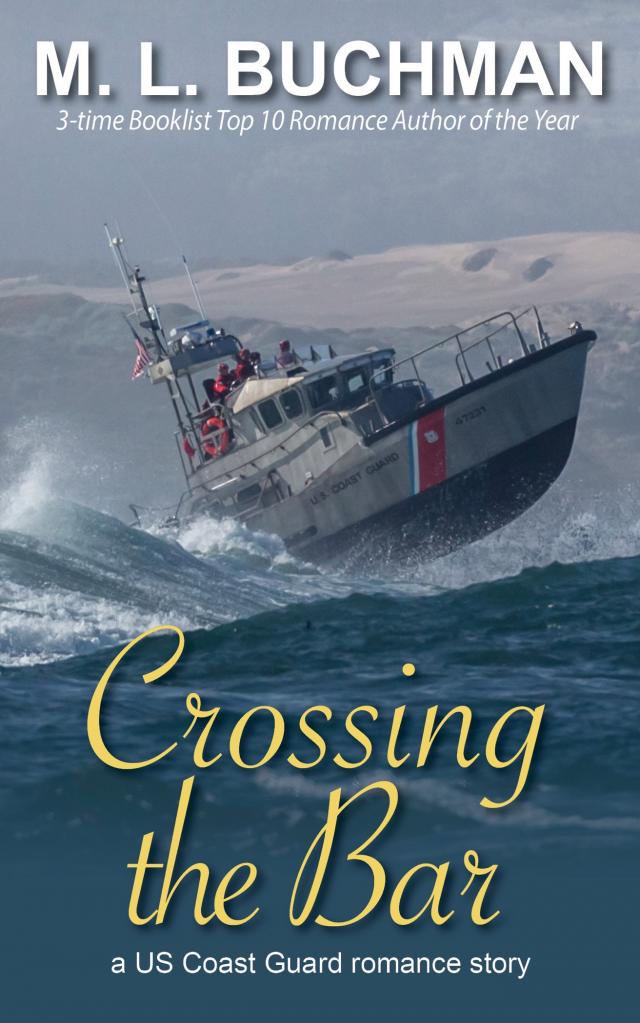
Crossing the Bar
A US Coast Guard romance
M. L. Buchman
Sign up for M. L. Buchman’s newsletter today
and receive:
Release News
Free Short Stories
a Free book
* * *
Do it today. Do it now.
http://free-book.mlbuchman.com
* * *
or
Subscribe to get every story a week early, and cheaper!
http://www.patreon.com/mlbuchman
1
“This is Carlos Torres and you’re listening to Crossing the Bar where I bring you the latest news of what ships are crossing the Columbia River Bar. Today I also have on the radio the newest Surfman of the US Coast Guard search-and-rescue team stationed nearby at Cape D, that’s Cape Disappointment, Washington. Actually, she’s the newest Surfwoman. But first, here’s what ships are crossing the bar today.”
Carlos sat in the small, circular tower that had always been the home of Crossing the Bar. His aunt had started it as a lark when she was between jobs, doing what she could to learn more about the ships she could watch entering the Columbia River from the window of her Astoria, Oregon late-Victorian home. Her podcast became an overnight phenomenon. At her listeners’ request, she began learning what the ships were carrying in their holds. She then added in their last port of call, their owners, and even tidbits of their history—like just how many different flags they’d sailed under.
When she added interviews her podcast had changed from a local success to become the second most popular shipping news show anywhere in the world, coming in second only to the BBC’s historic 150-year-old Shipping Forecast.
For months she’d been teasing him about taking over the show before she “withered at the microphone.” As if. Women like Aunt Roz lived forever—at least he hoped so. When he’d finally confessed to a little interest—she’d instantly flown to Japan and booked a three-week passage on a car carrier running a load of Subarus from Japan back to Portland, Oregon, her idea of a fun vacation—and left the show to him to try out.
If it had been his idea, he’d probably have called the show The Graveyard of the Pacific. Over two thousand wrecks littered the sea floor around the Columbia Bar—the massive undersea sandbars churning gigantic surf even on the quietest days. It was generally acknowledged as the most dangerous shipping waters in the world.
But it wasn’t his show, so he’d focus on doing Aunt Roz’s version. He’d sat here beside her enough times as a teen to know the drill, often gathering the data from the various sites for her: The Kiro, built in 1987 in the Yokohama, Japan yards, easily identified by the mismatched patch of blue paint on her starboard bow from her collision with a bridge abutment last fall—fault of a drunken captain, not a broken ship—currently underway from Shanghai with 4,432 TEU of containers of consumer products.
A TEU was short for a Twenty-foot Equivalent Unit shipping container. As forty-footer lengths were far more standard, it was a good information tidbit to throw in that the ship was actually most likely carrying 2,216 forty-foot containers—which was a mind-boggling amount of “stuff.” It was firmly in the Panamax class of ships that could fit through the original Panama Canal locks carrying up to 5,000 TEU. There was a larger class, the Neopanamax class, that could pass through the upgraded Canal locks with 14,000 TEU. Each time one of those loomed over the Columbia Bar, Carlos could only marvel at what was possible.
The Penny, built…
Using the MaritimeTraffic.com site, it was easy to see who was inbound and outbound—anyone could who cared. It was the stories behind the ships that kept the podcast so interesting. It’s what had originally hooked him. He remembered one poor ship his “Auntie Roz” had reported on that had been pirated four separate times in a single passage. In Indonesia, there’d been a smash-and-grab job clearing out the crew’s meager belongings. The second and third—while headed through the South China Sea—they’d had a quarter of their fuel oil siphoned off onto smaller, faster ships in hundred-thousand-gallon thefts. And the fourth pirating off Saipan had actually lasted three days before the pirates had become bored and simply left.
And yet the crews went to sea—a long and lonely life mostly seeking the money to send home to their families who they so rarely saw. Auntie Roz’s podcast had given this backbone of international trade a face, at least across the Columbia Bar.
He continued reading down the traffic list.
2
“That’s the shipping that’s expected to be Crossing the Bar today. Next, in my interview—”
Petty Officer Sarah Goodwin decided that the show host had a good voice, easy to listen to. She and Senior Chief Petty Officer McAllister had been sitting in the Cape D Guard station’s communications room, listening to the shipping report and generally slagging each other.
“—we’ll be talking to one of the newest of a very rare breed. The USCG Surfmen are the search-and-rescue experts at dozens of US ports.”
The Senior Chief had been chapping her ass all morning about Sarah’s pending interview on Crossing the Bar. That he was the one who’d tagged it onto her duty roster for the day hadn’t bothered him. Not even a little. His final instruction to “play nice” with the podcaster they both knew was a complete waste of breath.
Three older brother Coasties and a Coastie mom? Plus her career as a one-out-of-five woman in the service hadn’t taught her a thing about “nice.” Mom had been through the Guard when she was more like one-in-twenty and had always told Sarah that being twice as hard-ass as any male was the only way to sail.
“And now I’d like to introduce you to the Coast Guard’s newest surfwoman—”
She managed to get in the last word on the Senior Chief about playing nice.
“Seriously, Senior Chief?” Then flipped her own microphone live.
“—Petty Officer Sarah Goodwin. Hello, Sarah.”
“Hey, Carlos. Thanks for having me on your ’cast,” she offered in her sweetest voice while smiling at McAllister. “And it’s Surfman. Just because a guy stows extra gear between his legs, doesn’t mean he gets the title and I don’t. We both had to pass through the same school to earn it.”
McAllister rolled his eyes at her. If the man ever slouched, he’d have slouched in the chair in front of the console with utter resignation. Perfect.
She gave him the finger which earned her a smile. Any school with someone like “Mac” McAllister as an instructor made her damn proud to simply have survived, never mind passed.
“Surfman Sarah,” the podcaster acknowledged without a stumble. Give him a point for that. “Or are you going to be updating the Coast Guard service so that all the guys will be called Surfwomen as well?”
And just that fast she went cold despite the warm office on the temperate September day. Actors versus Actresses. Heroes versus heroines. Waitresses. Stewardesses. That had been the world Mom had fought so hard against. Sarah was so damn sick of it. Her big brothers had been relentless on pushing that button, which had only made her dig in harder. Most of her hand-to-hand combat skills hadn’t come from Coast Guard boot camp—they’d come from brawling with her brothers. Now they were scattered across the country by their different posts in the Guard, which was just as well.
McAllister must have seen something in her face, because his look went serious and he tapped his ear to remind her that she was on a live podcast. Crossing the Bar had a daily following in the tens of thousands and had always been supportive of the Coast Guard.
She managed to suppress the growl, but not the tone as she replied to Mr. Jerk Carlos Torres. “I’d never expect the men to meet the high standard such a title would require.”
“And what would those extra qualifications be, Surfman Sarah?” Torres didn’t have a clue how close he was to dying on the air. “Must be something pretty amazing. After all, it is an amazing list of skills to make Surfman, isn’t it?”
It was. She found herself answering him out of habit—so many people didn’t know about the training so she’d had lots of practice—explaining just what it took to get here. The familiar litany brought her back from the edge.
Join up, boot camp, Seaman, boat operations…
Somewhere along the way make Petty Officer Third Class. Schools. Choosing your rating.
Boatswain’s Mate.
Lots more schools. And a serious amount of time doing “striker” on-the-job training. One of the proudest days of her life had been achieving her BM1—Boatswain’s Mate 1st Class.
“No one outside the ‘wet’ military really understands what that means. The BM rating means that you have to know everything from winching strength on a cable to a crewman’s capabilities, weather, sea, boats—the list goes on. Then you add to that. By becoming a coxswain, it doesn’t just mean that you steer the boat. When the weather is busting sixty knots and breaking-wave-hell twenty meters over some poor sucker’s head, it’s your call on how to save them.”
“And you’re now passed or certified or whatever to do all that?” She became aware that the interviewer had been coaxing her along, feeding her questions. When had he taken control and she lost it?
McAllister was gone—apparently deciding she wasn’t about to disgrace the Guard. Fool.
“Yes. That’s what being awarded a Surfman Badge means.”
The interviewer gave a low whistle of surprise that almost sounded impressed. “Damn, woman.”
And there it was again. There had to be a way that she could whup that out of at least one male’s head.
Then she had an idea.
A nasty idea.
It definitely wouldn’t involve playing nice.
3
Carlos glanced up at the sky and decided that he shouldn’t be in too much trouble. September in the Pacific Northwest was changeable in mood, but tended toward the more pleasant. It wasn’t until October that the weather really flipped. Today was sixty degrees and maybe fifteen miles-an-hour of wind—thirteenish knots he corrected himself. Sailors always thought in nautical miles for reasons passing understanding.
Then he looked down at the dock again and was less sure. The weather here at the Cape Disappointment Coast Guard station in Ilwaco, Washington on the far bank of the wide Columbia River was blowing up stormy right from the gate.
A Senior Chief Petty Officer McAllister, with the sense of humor of a lead brick, had come to fetch him from security.
“Always glad to have a visit from Crossing the Bar,” he grumbled a greeting. “Of course your aunt never went out of her way to antagonize my best new Surfman.”
Carlos opened his mouth…
McAllister looked really unhappy about something.
…so Carlos closed his mouth again.
He’d thought that he and Surfman Sarah Goodwin were just having a little friendly banter for the show. In fact, they’d gone on long enough that he’d had to end the show and just keep recording. He’d briefly muted his own connection to Surfman Sarah to promise the podcast listeners that he’d be continuing the interview in future episodes. He’d gotten enough material to make it a five-part series.
Then at the end of the interview, Petty Officer Sarah Goodwin BM1 had asked if he’d like to go out on a training cruise the next day. He knew that Aunt Roz got out on the cargo ships whenever she could. If he was ever going to be serious about taking over the show, he figured he’d have to do the same. And on his first day she’d offered him the chance to try it out.
Also, as a one-up on his aunt, she’d never gone out on the search-and-rescue surf boats. She’d been out with the bar pilots’ transport tugs as they motored out to vessels to guide them back over the bar. She’d also had a local helo pilot who exchanged free sightseeing ads on the show for giving her a quick ride out onto the occasional incoming vessel.
But to get out on the working craft of the US Coast Guard, the 47-foot Motor Lifeboat, better known as the 47-MLB, that was a definite coup. He’d planned on getting major mileage out of that at the next family dinner.
Or so he’d thought as he blithely accepted Surfman Sarah’s offer.
Aunt Roz’s and Dad’s brother had been a US Coast Guard helicopter mechanic for thirty years here by the Columbia—still was. And three of his four daughters had married Coasties. (The fourth, Maggie, a total reprobate and the most fun of the lot, had become a helicopter mechanic for a group of firefighters and married one of the team’s civilian helo pilots. Total outcast at family gatherings. He hung with her whenever he could.) But what with all the brothers-in-law’s training, he knew how to read a ticked-off Coastie.
And when that Coastie was a Senior Chief Petty Officer, Carlos knew the wind was going to be blowing cold no matter what the weather.
The Senior Chief turned to look at him.
Carlos didn’t recall coming to a stop at the head of the pier.
“Go on down, boy. Last boat in the line. You earned it.” This time the Senior’s grimace might have been a mocking smile. He slapped Carlos hard enough on the shoulder that it was a miracle he wasn’t catapulted out to sea as some part of a Man Overboard (and don’t bother rescuing him) Drill. He and the Senior were the same height, and Carlos liked keeping fit, but he had nothing on the man for raw power.
Turning the slam’s momentum into a forward stumble, he headed down the pier. There were five of the boats tied up: two to the left, then three to the right—all parked stern-in along narrow floating docks. Another group of three more were moored on another leg of the long pier. Each crew he passed looked down at him from their boats and then made some snide comment he could never quite hear. But he heard the laughter trailing behind him.
The long path of shame.
It was like the long walk to the principal’s office, one he’d worn well over the years. “Directionless.” “Inattentive.” “Joker.” (Prankster actually, but he tried not to correct Dr. Bream too often. Pointing out during his first visit with the man that he’d been named for a fish—but a pretty one, good eating too—hadn’t earned him as much good will as you might think.) He’d pulled any number of stunts over the years: reprogramming the school bells to ring at odd times and changing out the recording of the national anthem for morning announcements with Louie Louie by the Notre Dame Marching Band—the best version in his humble opinion.
Carlos managed to get As when he cared: English, History, Journalism. Cs when he didn’t: just about everything else except track-and-field. No college. He’d wanted to get a little “down and dirty.” Which had turned out to be less fun than it sounded over the last five years. He’d done some paid blogging, a little sports writing, local cable TV, made it to the news desk. And got bored out of his gourd.
A local broadcast station—a good local in Seattle—offered him a test at a weekend anchor slot.
We think you’ve got what it takes. We want you to bring it to our market.
He sat in as a “guest co-anchor” for a pair of evening and late-night news slots.
He’d quit the cable station the next day. But instead of turning his car north for Seattle, he’d turned west and ended up in Aunt Roz’s Victorian-tower broadcast studio. Quite how or why that had happened still eluded him.
And high school. It had been a long time since Carlos had thought about that long walk down the echoing concrete hallway between all the sports trophies he’d helped win and all the academic awards that he hadn’t.
“Shake it off, dude.” Though he kept his voice low as another round of titters followed him along. “Yeah, just keep that up, guys. Who knew that full-grown Coasties ‘tittered’? Definitely going into the next podcast.” He felt better for that decision.
The last boat down the line didn’t have a tittering crew watching him go by. They were busy preparing to go to sea.
A pair of guys in full float gear were checking over their equipment. They were dressed in bright red, head-to-toe float suits with the hoods tugged back. Another guy with a clipboard and a toolbelt was conferring with them.
And up on the open bridge, there was a woman standing there like she was a Greek goddess. At least that was his first impression. The sun, still low to the east, was dazzling behind her. She had her feet planted wide and her arms crossed in front of her. She rolled so easily with the rocking of the boat that it seemed she was the one who stayed still and the rest of the world bobbed and dipped around her center. He couldn’t see anything else about her because she also wore one of the bulky float suits. Maybe her hair was made of purest gold, maybe that was just the sun—it was hard to tell.
“Mr. Torres. So glad you could join us.” Just like on the radio, Petty Office Sarah Goodwin had a low, warm voice that sounded deceptively friendly. In fact, if not for the Senior Chief’s warning, he’d have thought it was. Now he could hear the chill sweeping south from Alaska. Or perhaps the Arctic Ocean. Deep chill. He wasn’t just in the deep end of the pool; the bottom had gone missing while he wasn’t watching.
The 47-MLB was just that, forty-seven feet of custom-designed purebred Motor Lifeboat. He’d done what research he could last night. It was all aluminum. No air-filled bladders that made the smaller 42-foot Near Shore Lifeboat look like a Zodiac on steroids with rubber-bladder sides. Five feet of length was only the smallest of the differences. The 47-MLB had an open bridge exposed to the weather and an enclosed bridge that stayed watertight even if the boat became fully submerged. There was even a watertight survivor compartment complete with medical gear and a stretcher if they had to do a helicopter evacuation. Twin Detroit diesel engines could practically make the boat fly.


