

Betrayal, p.1
Betrayal, page 1


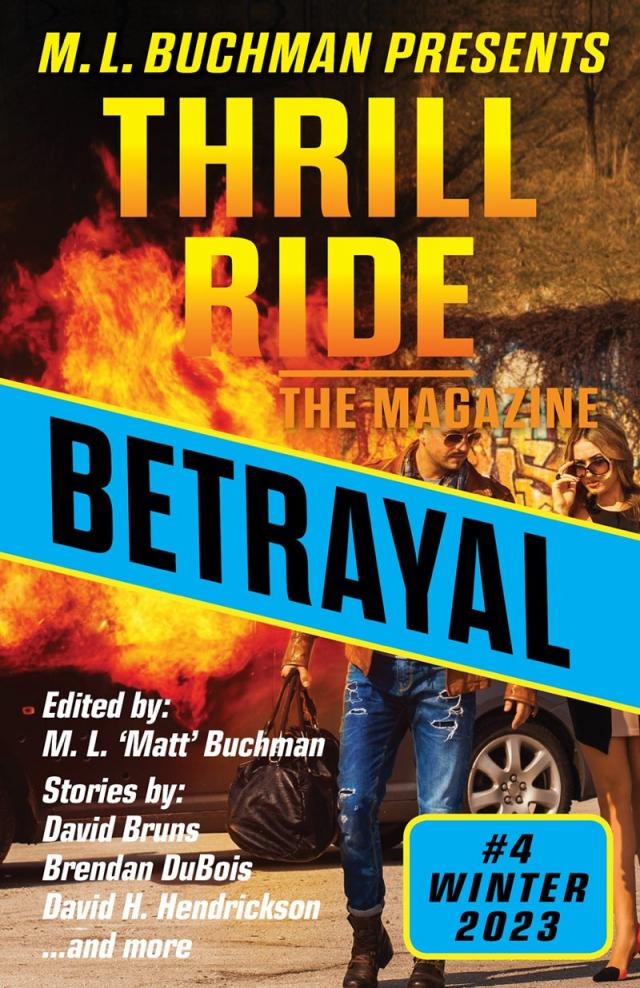
BETRAYAL
Issue #4 (Winter 2023)
Thrill Ride - the Magazine
EDITED BY M. L. BUCHMAN
Contents
Betrayal
Too Many Idiots, Too Few Boats
David H. Hendrickson
It’s the Least I Can Do
KT Bartlett
Rotten Apple
Diana Deverell
Water Sabotage
R.W. Wallace
The Tegan Doctrine
Kelly Washington
Right Hand
Blaze Ward
Left Hand
M. L. Buchman
Flight Risk
E. Chris Ambrose
Tipping the Porter
Kim May
Sins of the Past
Marcelle Dubé
The Number
David Bruns
The Waiting Room
B. A. Paul
Rules of Retreat
Brendan DuBois
Epilogue of a Year
About the Editor
Your Next Great Read
Read Even More!
Betrayal
M. L. BUCHMAN
noun: violation of a person’s trust or confidence, of a moral standard, etc.
– Merriam-Webster
The dictionary offers a much simpler definition with only one other meaning: revelation of something hidden or secret.
I chose betrayal as my final theme for the first year for several reasons.
As I mentioned back in the introduction to the first issue, it is the flip side of the Honor theme. I thought one side might push writers to challenge a focus on the positive and the other to focus on the negative.
Do we fight back against betrayal or do we give in? How do we decide where the break-point lies?
I have only been deeply betrayed a few times in my life, but they have stuck with me ever since. It is one of the lines I drew in the sand during my high school years that I’ve never found a good reason to change.
A friend promised one amount, but when it came time to pay he offered me a tenth of what he owed me. The sum was relatively trivial, but I was so angry that I offered up a challenge: “Pay me what we originally agreed or else.”
He laughed in my face and asked, “Or else what?”
Having no good answer, I went home and stewed on this. My father finally asked what was wrong and I explained. His response? “You’ll have to decide what you’re willing to accept or not.” Then left me to continue stewing.
Ultimately I remained civil, but it was the last day we were friends.
In relating this tale to a more recent friend, he said, “My, you’re awfully black-and-white about betrayal, aren’t you?” I am. That is how I chose to handle betrayal.
But then I became a writer.
And in writing, one thing you learn is that everything, and I mean everything, is the fodder of story. Every thought, emotion, feeling, bias, preference, whimsy, denial, adventure, experience, love, hate, guffaw…all of it.
It takes a certain bravery to mine these fields that lie within us. And I don’t know what personal depths the writers in this volume delved into to create these stories. For me, this was an incredibly personal set of tales.
And I like to think that in doing so, and in writing the ending I did to the story I chose to include here, that I have somehow grown a small way beyond my internally black-and-white line of betrayal. A line thankfully uncrossed in the last few decades that I hope no one ever tests me on again.
If the tales in this volume allow you a small view into yourself, led by these writers and the incredible stories they chose to tell—or if they simply make you enjoy the time spent reading—then we’ve done our jobs.
The Stories
What better way to plunge into a heavy topic like betrayal than with the laugh-aloud tale from David H. Hendrickson “Too Many Idiots, Too Few Boats.”
K. T. Bartlett looks at betrayal and chooses her own response, “It’s the Least I Can Do.”
“Rotten Apple” wonders at how we ourselves can be changed when we face a betrayal head-on.
In a walk into the past of WWII Norway, we witness the heavy price of betrayal in “Water Sabotage.”
And in a tale of tomorrow, if “The Tegan Doctrine” even counts as a betrayal and if so, by whom.
Blaze gave us the obligatory (and splendid) car chase, one of the few in the first four volumes (much to my surprise). And in doing so rivets us to the “Right Hand” seat.
Then he challenged me to delve into his world and write his other main character’s point of view. I gave it my best shot in “Left Hand.”
“Fight Risk” investigates betrayal at many levels, in the depths of the Ukraine War. E. Chris Ambrose was one of the few to take on a current world crisis, and did it masterfully. I was sold the moment I understood the topic, as I’m an aviation buff who also mourned the day that plane was destroyed.
“Tipping the Porter” leads us to dark days in America’s past as Kim May once again explores a gritty slice of the world.
Like “Run Charlie Run” in the prior issue, “Sins of the Past” plunges us into the frozen north. We’ve moved from Alaska to the Yukon, where murder is on the run.
“The Number” dips into the world of professional assassins, who then are forced to decide just what is and isn’t professional on such a job.
There were two stories I truly wanted to include as the closer to the magazine’s launch year. The first plants us in “The Waiting Room” and sticks us there hard in this great story by B. A. Paul.
And then Brendan DuBois put paid on the Betrayal issue and the first year of Thrill Ride – the Magazine with his deeply thought-provoking “Rules of Retreat.”
Too Many Idiots, Too Few Boats
David H. Hendrickson
About David H. Hendrickson
David H. Hendrickson’s first novel, Cracking the Ice, was praised by Booklist as “a gripping account of a courageous young man rising above evil.” He has since published six additional novels, including Offside, which has been adopted for high school student required reading.
His short fiction has appeared in Best American Mystery Stories, Ellery Queen’s Mystery Magazine, and frequently in Pulphouse, Mystery, Crime, and Mayhem, Heart's Kiss, Fiction River, and other anthologies.
He is a multi-finalist for the Derringer Award, and was honored with the 2018 Derringer for Best Long Story. He has released four short story collections, one each in the genres of Humor, Mystery/Crime, Romance, and Fantasy.
Hendrickson has published over fifteen hundred works of nonfiction, most notably his first book for writers, How to Get Your Book into Schools and Double Your Income with Volume Sales, and also Travis Roy: Quadriplegia and a Life of Purpose. He has been honored with the Joe Concannon Hockey East Media Award and the Murray Kramer Scarlet Quill Award.
Visit him online at www.hendricksonwriter.com. Sign up for his newsletter and get a free book!
Why I wrote this story
For me, the character always comes first. So I didn’t start writing this story thinking about betrayal. I didn’t even start thinking about writing a thriller. I began with an attempt to create a larger-than-life character, that is, as much as one can achieve Jack Reacher-like creations in just a single short story. Then I looked to see where that character might take me.
Jimmy Calderone certainly took me on a thrill-ride, set up by a cold-hearted betrayal. I found myself on the edge of my seat even as I typed away in the safe confines of my writing office. My heart pounded, my mouth went dry, and my stomach lurched as Jimmy ventured out onto the stormy sea.
Too Many Idiots, Too Few Boats
DAVID H. HENDRICKSON
Until the hurricane threatened to hit Key West like a Mike Tyson roundhouse hook to the temple, Jimmy Calderone was living the good life. Twenty-eight, single, his long blond locks flowing down to his shoulders, and without a care in the world. He worked as a featured street performer in Key West’s world-renowned Mallory Square, juggling everything from flaming torches to razor-sharp swords (at least they appeared razor sharp), all while riding on a ten-foot-high unicycle. He performed contortionist tricks, extricating himself from rings bound tightly around his arms and legs. And he did it all while cracking jokes that kept the audience laughing and more importantly, stuffing fives, tens, and even twenties in the black hat set up for tips.
He showed off his chiseled physique, deep brown tan, and washboard abs by performing bare-chested. It was part of his act. He’d flirt shamelessly and to great comic effect with obviously married women standing next to their husbands. And he got more than a few phone numbers or suggested places to rendezvous from single women stuffed in his tip hat or spoken aloud with seductive grins after the show.
Often, he followed through on the offers. As a lifelong resident of Key West, he considered it his civic duty to keep the female tourists satisfied and coming back for more.
Life was good. His mother had even stopped asking when he’d get a real job.
But if Hurricane Ernesto lived up to its billing, tonight’s performances would be Jimmy’s last for a very long time.
Dealing with hurricanes was a part of life in Florida. Ignoring hurricane warnings was also part of Florida life, at least for a gigantic majority of the population. There was always a new storm brewing, and TV meteorologists didn’t manufacture spikes in their ratings by saying, “Don’t worry about this one. It won’t amount to anything.”
So when meteorologists began talking a bout Hurricane Ernesto being a big one—and this time they really meant it—veterans of that nonsense rolled their eyes and let the gullible schmucks stock up on toilet paper and canned goods. Even when official evacuation orders came out, the vets kept rolling their eyes and living their lives.
Jimmy Calderone did plenty of eye-rolling himself, but it was at the idiots who’d put themselves in danger and then expect others to risk their lives rescuing them. One of those others was him.
He didn’t advertise it because it was bad for his carefree image, bad for the show. But Mr. Not-A-Worry-in-the-World also had a very serious side as the lead volunteer member of the Key West Emergency Task Force.
“You need me to stick around and help pick up the pieces?” he’d asked Sherriff Nate Hawkins two days earlier, calling on his private cell phone number. Nate had been a close friend for almost a decade. African American, average height and build. Handsome, with a charming personality. “Or do I head for the hinterlands,” Jimmy added, “and give you one fewer sorry butt to worry about?”
“I hate to put you in harm’s way…” Nate said.
“But that’s your job,” Jimmy said. “And I live on Harm’s Way Boulevard. Got it. I’ll stick around. Call me if I can help.”
Two days later, Jimmy called first. He had a logistics question but never got to ask it.
“I can’t believe you just called,” Nate said in a somber tone that made Jimmy think someone had died.
“What’s wrong? The storm hasn’t even hit landfall yet.”
“Jimmy, this is spooky.”
“Spooky? How?”
“There’s a mission, but… it’s hopeless. A suicide mission.” Nate sighed. “The mayor suggested I send you, but I refused. I’m not going to sacrifice you. I just got off the phone with him. But then you called.”
“What’s the mission?”
“I can’t.”
“What’s the damned mission?”
Nate drew in a deep breath through his nose. Jimmy could all but see his friend shaking his head.
“There’s a fishing boat miles out to sea. The captain, his mate, and four tourists. Buster’s Revenge, captained by Buster Johnson.”
“I know Buster. Worked for him back in the day. Go ahead.”
Jimmy had worked several fishing boats while still in high school and then continued until he perfected his street performer act enough to survive on the tips. He’d thought he might never get the smell of fish out of his nostrils and the salt off his skin.
Buster had pushed the envelope more than once going out in rough weather. If there was a buck to be made, especially a premium offered by a headstrong customer, he was game. And he always made it back.
But with a hurricane on the horizon?
“I don’t know the details,” Nate said, “but the boat is dead in the water. Probably a fried electrical system. Apparently, the tourists are a bunch of thrill seekers. Adrenaline junkies. The type that chase tornados and climb into shark cages. I’m guessing they offered Buster enough of a bonus that he couldn’t turn them down. He thought he could dart out there and get back easily in time. Never expected Murphy’s Law would kick him in the nuts with an electrical outage, or whatever the problem is, the one time he couldn’t afford it.”
“What about the Coast Guard?”
“They’re swamped with other rescue efforts. Not enough personnel and boats of their own. Or as my contact said, ‘Too many idiots, too few boats.’ They’ll get to these clowns as soon as they can, but it’ll be too late. We’ll be at gale force winds soon and that means twenty-foot waves. Without power, that boat is going down. Even with power, Buster cut it too close. Those six idiots are going to a watery grave.”
Jimmy swore softly but was confused. “What did the mayor suggest I do? Swim out there? I don’t have a boat.”
“At first, he wanted you to use one of ours in the Marine Unit,” Nate said. “But ours aren’t built for this kind of rescue. And even if they were, two are already in the shop and I’m using the rest to try to keep this city from blowing up. There are already multiple cases of looting boarded-up stores. The lunatics are coming out of the woodwork and I don’t need to tell you that even on good days there are already more of them than sane people in this city.”
“There’s nothing you can do? Those six people are just going to die?”
“I can’t let you make it seven,” Nate said.
Again, Jimmy could all but see Nate shaking his head.
“How can I make it seven if there is no boat?” Jimmy said, barely holding himself back from exploding. “What am I missing?”
“You could steal the mayor’s yacht.”
Jimmy blinked and then blinked again. “What?”
“It’s an appalling idea,” Nate admitted. “Ethically bankrupt. It was bad enough that he was prepared to sacrifice you with one of our units. But this twist just makes it sick and perverted. That’s why I refused to call you about it.”
“What?” Jimmy asked again.
“If you succeed, then the mayor will say that he allowed you to commandeer the boat for the emergency rescue. You’ll both be heroes, sharing the stage at the photo ops,” Nate said. “But if you fail—and this is most certainly a suicide mission that not even you can pull off—then he’ll betray you. Say you stole the boat, albeit with noble intentions, and we’ll have seven watery graves and two sunk boats.”
Jimmy took it all in. The mayor had always been effusive in his praise for Jimmy’s volunteer work with the Emergency Task Force. Said the next drink was on him. Had seemed genuine. As if they were best buds. But it had all been glad-handing.
Now, Jimmy was nothing but chum for the shark of Hurricane Ernesto and the mayor’s self-interest.
“Let me guess,” Jimmy said, his eyes narrowed. “If I go down with the boat and it’s considered stolen, the mayor cashes in on the insurance policy.”
“You didn’t hear it from me.”
“Guess I’ll have to disappoint the two-faced bastard.”
Nate dropped him off shortly after noontime in an unmarked car two blocks from the marina. He’d spent the entire time begging Jimmy to reconsider, but it had been a waste of time.
Jimmy wasn’t letting those people die.
Slamming the car door behind him, he sprinted the two blocks to the marina, then along the horizontal wooden planking that led to row after row of slips. Boat owners making belated preparations for the storm—loosening the bow lines, sealing off the windows, doors and hatches—looked up wide-eyed, their frayed nerves further startled by the pumping of his arms and legs, but then hurriedly returned to their tasks. Finally, Jimmy turned right onto the mayor’s row and gasping, raced up to slip fifty-one.
He jumped directly onto the cockpit floor of the Conch Paradise, a luxurious Tiara Coupe 44. He shoved the key into the cabin door lock.
“Hey, what are you doing over there?” called out a reedy voice from the next slip.
A rail-thin, white-haired man wearing an aqua-colored Miami Dolphins baseball-style cap emerged from the cabin of the cruiser to Jimmy’s left.
Jimmy figured that saying he was stealing the mayor’s boat was not the right answer. Come to think of it, though, it would make a damned good addition to his act. The tourists would never believe it, of course, but his sub-conscious, which often dealt with stress this way, began putting the bit together.
He’d be juggling six flaming torches atop his ten-foot-high unicycle and he’d begin the bit with, “This reminds me of the time I stole the mayor’s boat.”
He’d wait for what should be at least a smattering of laughs, then add, “Allegedly.” Perhaps he could then ask audience members if they knew what the statute of limitations was on stealing a mayor’s boat.


