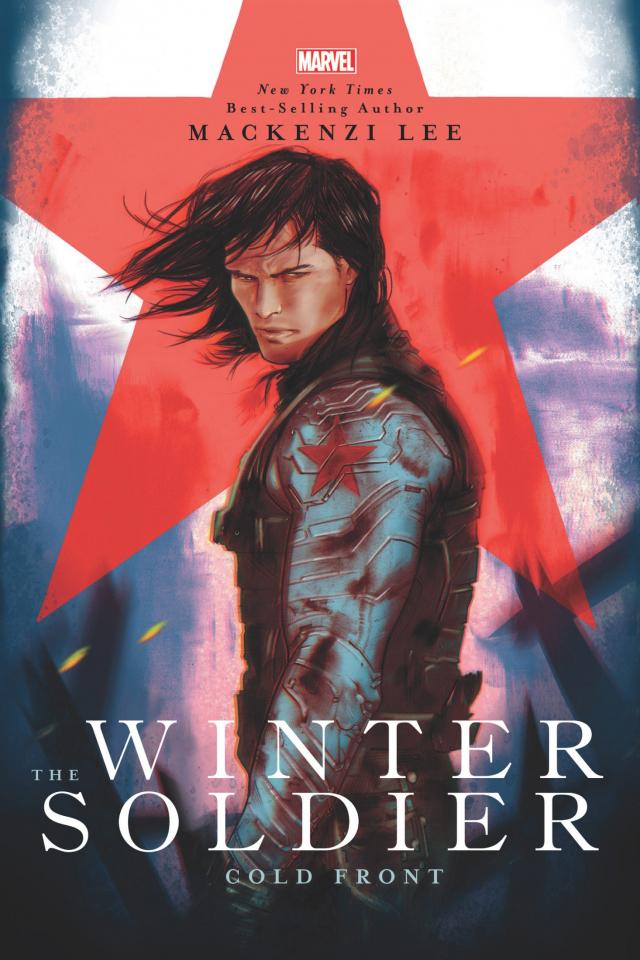
Winter soldier, p.1
Winter Soldier, page 1


© 2022 MARVEL
All rights reserved. Published by Marvel Press, an imprint of Buena Vista Books, Inc. No part of this book may be reproduced or transmitted in any form or by any means, electronic or mechanical, including photocopying, recording, or by any information storage and retrieval system, without written permission from the publisher. For information address Marvel Press, 77 West 66th Street, New York, New York 10023.
First Edition, February 2023
Designed by Kurt Hartman
Library of Congress Control Number: 2022938443
Hardcover ISBN 978-1-368-02227-9
eBook ISBN 978-1-368-09227-2
Visit www.HyperionTeens.com
and www.Marvel.com
Contents
Title Page
Copyright Page
Dedication
Prologue
Chapter 1: 1954
Chapter 2: 1954
Chapter 3: 1941
Chapter 4: 1941
Chapter 5: 1954
Chapter 6: 1954
Chapter 7: 1941
Chapter 8: 1941
Chapter 9: 1954
Chapter 10: 1941
Chapter 11: 1941
Chapter 12: 1941
Chapter 13: 1954
Chapter 14: 1954
Chapter 15: 1941
Chapter 16: 1954
Chapter 17: 1954
Chapter 18: 1941
Chapter 19: 1941
Chapter 20: 1941
Chapter 21: 1954
Chapter 22: 1941
Chapter 23: 1941
Chapter 24: 1954
Chapter 25: 1954
About the Author
For Mom, Dad, Zach, McKelle, Q, and Kenai
The Living Room Residency 2020–2022
And Chief—my favorite Soviet sleeper agent
When you wake, the only thing you remember is dying.
The crack of the ice as your body struck it, louder than antiaircraft fire. The cold that drove all the breath from your lungs. The water that flooded them when you gasped in shock. You had fallen hard but landed weightless, the world going white around you as you floated, too cold to swim, too cold to breathe. Too cold to do anything but die.
You don’t know how, but you were certain you were dying. It had always been different before—though you can’t remember what exactly that “before” looked like. Before, you had flirted with death like a drunk at a bar, reckless and giddy but with no intention of following it home. You had stood on the knife’s edge. Sucked last chance after last chance to the bone. They had been endless. Until they weren’t.
But you aren’t dead, are you? So then, what is this?
Your eyes are crusted shut, and when you crack them open, the light burns. Spectral clouds dot the corners of your vision, fog gathered and made flesh. Here are the ghosts coming to collect you. You can’t recall their names. But surely you had a mother and a father once. Perhaps it’s them, beckoning you over the threshold with hands outstretched. Maybe a friend who didn’t survive childhood—doesn’t everyone have one of those? The first time you learned that people really die, and the thing to fear is not the loss but the losing. Maybe the ghosts are soldiers. You remember soldiers. Maybe it’s them, your band of brothers, gone into the deep, frigid water before you, now waiting on the other side.
The ghosts wear white caps, and their faces are covered. You can’t see their eyes, just the light overhead reflected in them. It refracts through the glass bottles hanging above you, long tubes snaking down from them like kite tails before disappearing under your skin.
You can feel their contents draining into you, and your body seizes against the added weight. Your chest constricts, a spasm like those raised by the cold. Suddenly you’re back in the water.
You’re afraid, but you don’t know why.
You want to fight, but you don’t know what.
You’re not sure you could, even if you tried. Your limbs don’t feel like your own. Your whole body is a foreign landscape, treacherous in its strangeness. There is pain in places that don’t exist. Weakness in muscles that never relax. The water is gone, but the cold remains.
“What is your name?” a ghost asks.
You can’t see your legs, but you try to move them. It’s like trying to break through a shell of thick ice.
“Do you understand me?” the ghost asks, and you do. You understand him, but you still can’t move your legs. You try your arms, but only one of them obeys. Your fist closes and opens and closes again.
Is it yours?
A fist. A hand. You try to look, but something holds your head in place, and the light is still in your eyes. You want to stand—you always thought you’d die on your feet, rising to meet the bullet. But here you are, drowning in light and full of water, with nothing but a hand that isn’t yours.
“What is your name?” the ghost asks again, and you know the answer.
Don’t say it, you think, and you clench your jaw until you feel the pain. Your whole body trembles with the effort it takes not to answer, to keep your head above the current when it would be so much easier to give in and let yourself sink.
“Almost finished,” the ghost says, and you feel the soothing press of fingers against your forehead, pushing back your hair. Someone else had done that, once. Someone else had touched your hair with tenderness, but when you reach for the memory, there’s only empty air. You can feel the absence of whoever once occupied that space inside you. It steals your breath, the enormity of that chasm. Your heartbeat stutters, the tremor echoing in a rising electronic beep.
“Tell me your name,” the ghost says.
The ice cracks under you. The water funnels in, frothing and studded with glacial ice, and you can’t fight it. You can’t swim. You can’t wait on a tide that will never turn, and it’s not just water as far as you can see. It’s farther. It’s all that’s left.
Through a mouthful of cold water, you gasp your reply, gagging up each word like it’s a sharp-edged fractal of frost. “I don’t know.”
“Good,” the ghost replies. “Good, that’s perfect.”
The agent flinches when Rostova rips the hood from his head. The room is dim, but the agent has spent the last few days in darkness, blindfolded as he was shuttled between basements and transport trucks and freezing concrete cells. Even the sickly-yellow glow of the single overhead bulb must feel like a spotlight, bright enough to make him recoil. Either that, or he had been anticipating a blow.
The bare bulb overhead flickers, and all the shadows in the room jump like static on a television screen. The chair the man is chained to is bolted to the floor, so that when he starts to rock, wheezing with fear, it doesn’t move with him. The metal cuffs dig into the raw skin at his wrists, his old wounds already weeping. His lips are chapped and crusted with badges of blood. Fresh streaks coat his teeth and run from his broken nose into his mouth. One eye is swollen so big it looks like a halved grapefruit has been shoved under his skin.
Rostova steps back, surveying the agent without blinking as he drools and sobs. She had been a sniper on the Eastern Front and had spent the bloodiest days of the war lying motionless, covered in pine branches and buried in snow, her breaths shallow and her heartbeat slow until the moment she squeezed the trigger. Now stillness and silence remain her weapons. Only the battlefield has changed.
When Rostova doesn’t move, the agent starts to blubber in Russian, the blood and snot in his throat clotting his words. No one stays silent for long after weeks of isolation and waiting, no company but their own grisly imaginations. By the time they reach this room, a few seconds of Rostova’s stillness are enough to send them tumbling, unprompted, into confessions.
“Alexander Fedorov,” Rostova says suddenly, and a strangled gurgle of surprise slips from the agent. He looks up at her, and she smiles, showing her teeth. “Can I call you Alex?” she asks in bright Russian. “Or Sasha? Does anyone call you Sasha? And yes, I know”—she waves a hand at an objection he hasn’t raised—“Alexander isn’t your real name, but why not keep up appearances? You’ve come this far.”
Fedorov digs his feet into the tile floor, trying to push himself back in a chair that won’t be moved. “Who are you?” he asks, his voice pitched. “KGB?”
Rostova’s smile widens. “No, no, we’re much worse.”
Fedorov’s foot catches the drain in the floor, and he recoils from whatever slippery mess is still trapped there from the last man who had been chained to this chair. “I’m n-no one,” he stammers, staring at the ground. “I don’t know what I’m doing here. I’m a student. I don’t know anything—you have the wrong man.”
“Now, we both know that’s not true.” Rostova tugs at one of her gloves, pulling it off a finger at a time. “You work for MI5, don’t you?” She flicks her eyes to Fedorov, but he is still staring determinedly down. “You’ve been in Russia a long time, but every mask slips eventually. Your mother—she was Russian. Your father was a British soldier. They kept in touch after he went back to England, and when you were old enough, he recruited you into his clandestine activities. You don’t have to pretend,” she says when Fedorov shakes his head. “He told us himself. Before we shot him. Well, not us. The KGB. And remember—we’re worse.” She finishes peeling off the first glove and takes a step forward, letting the fingertips drag across Fedorov’s greasy hair. “You should be so proud, Sasha. You’ve lasted much longer than he did.”
A sob shudders free from Fedorov. Rostova bends at the waist, peering into his face. “Yo u have an assignment, don’t you? That’s exciting! Your first assignment! You’ve been waiting for—what?—almost a year undercover. Do you want to tell me about it? Or where you were traveling?” Fedorov is trembling, the sweat and blood on his neck beading and sliding off. In the silence, each drop hits the tile with a plink, like the pulled pin of a grenade. Rostova drops into a crouch before him, twisting her head as she forces her face into his line of sight. “It must be such a hard secret to keep. You didn’t even tell your girlfriend—wait, fiancée, isn’t it now? You proposed on Prechistenskaya Naberezhnaya this past New Year’s. Near the river. Didn’t you?” Fedorov says nothing. Rostova stares at him, that eerie stillness settling through her again. “Didn’t you?” she repeats, her voice sharp enough to shave with.
Fedorov’s teeth rattle as he shakes, but he doesn’t say anything.
Rostova grabs him with her still-gloved hand, pinching his face as she shoves him up and backward. His neck wrenches as she slams him upright in the chair, the back of his head smacking the headrest. “Sasha, if we’re going to be friends,” she says, her tone a disconcerting combination of bright and dangerous, “you’re going to have to look at me.” She straddles him, her weight on his knees, then twists his face to hers. “Is it the eye?” She rams her elbow against his windpipe as she leans forward, giving him a clear view of the patch she wears over her right eye. “I know, it’s confusing. Some people don’t know where to look.”
Fedorov’s face gleams with a mixture of blood and spittle and tears. “I don’t know anything. I’m just a student.” The words come out pinched by Rostova’s grip. “I read economics. I was born in Leningrad. My father was—”
“I have a question for you, Sasha.” Rostova lets his face go and instead loops her arms around his neck, still sitting on his lap so their faces are very close together. “In all your time in my country, did you ever hear about something called the Winter Soldier Project?”
Fedorov blinks, momentarily disoriented by this conversational pivot. “It…” He swallows hard, struggling not to look away from Rostova’s face. “It doesn’t exist.”
“That’s what you heard?”
Any color left in Federov’s cheeks drains. “It’s a story.”
“Tell it to me.” She pushes a strand of hair off his forehead. “I love stories.”
“The Winter Soldier…” He looks again to the door, then back to Rostova. His breath hitches. “He’s an assassin. Mindless and cruel. Unfailingly loyal to the Soviet Union and impossible to sway. Impossible to fight.”
Rostova gives a theatrical shiver. “You didn’t tell me it was a scary story.”
“He’s a Super-Soldier. Like Captain America.”
“Not quite.” Rostova holds up a finger. “That part is just a myth. Our soldier did not need any chemical enhancements to make him deadly.”
“He doesn’t exist,” Fedorov whispers.
“A ghost story, then.” Rostova slides off his lap, retrieving her dropped glove from the floor and pulling it back on as she surveys Fedorov. “I’m impressed, Sasha. I assumed the Winter Soldier Project would be above your pay grade. MI5 is farther along than we thought. Were they paying you? MI5, I mean. Don’t believe any of their do it for the experience garbage. Never”—she points a finger at him—“work for free, Sasha. I’m telling you that as a friend. Nothing looks that good on a CV.” She grins at him. One of her molars is gold.
Fedorov takes a sloppy breath. “I don’t have anything to do with the Winter Soldier Project.”
“I know that. Don’t you think I know that, Sasha?” She laughs. “They didn’t tell me you were funny. Next you’re going to tell me you thought we were alone this whole time.”
Fedorov looks wildly around the room. A shadow near the door shifts, and he snaps backward against the chair, cowering. The manacles around his wrists rattle, a sound like coins dropping through a pay-phone slot.
Rostova glances over her shoulder, following his gaze. “Oh, I’m so sorry, I forgot to introduce you.” She slaps her forehead, then steps back, giving Fedorov his first unobstructed view of the figure leaning against the room’s only door. “Alexander Fedorov,” Rostova says, with a grand flourish. “This is the Winter Soldier.”
The soldier steps forward.
Fedorov thrashes in his chair, kicking hard like he might be able to push himself away. A thread of blood from the reopened scabs on his wrist drips between his fingers and puddles along the rim of the clogged drain.
“Quite a ghost story, isn’t he?” Rostova says, and the Soldier feels her thump him on the shoulder, close-fisted, so that it rattles his body armor. Somehow, she is always stronger than the impact-resistant fibers they tell him are woven into his vest. “Should I leave you two to talk more about your new assignment and all the many things you don’t know?” Rostova asks, looking from the Soldier to Fedorov, who’s still squirming. He mewls like a frightened kitten but goes abruptly silent when the Soldier rests one hand on the back of Fedorov’s chair. The cybernetic fingers shine, even in the poor light.
Behind the Soldier, Rostova is already heading for the door. “We thought we’d let you in on one more Soviet secret, Sasha.” She turns on the threshold, leaning lazily into the room with one hand hooked around the handle. “Otherwise you won’t have anything left to take to the grave.”
When V emerges from the interrogation room, Rostova is waiting for him, rolling a toothpick between her teeth. She pulls back her sleeve, making a show of checking her slim wristwatch. “Twelve and a half minutes.” She taps the face with her nail, like she’s testing a sheet of ice before stepping onto it. “Disappointing, Agent Vronsky. I was hoping you’d get it done in under ten. If it is done.”
“It’s done.”
“He really didn’t know much, did he? What a waste.” She pushes herself off the wall, and he follows her into the room behind the cell; it’s narrow with a long counter stacked with electronic equipment. A squat television screen in one corner displays a live feed from the interrogation room, the picture green-tinted and fuzzed with static.
Rostova picks up a set of earmuff headphones and plugs them into the recorder, pressing rewind until the tape screeches. “Any cleanup?” she asks, glancing at the screen. “Did he piss himself? He looked ready to, and all I did was take off my glove.” V shakes his head. Rostova swipes off her fur hat so she can press the headphones to her ear. Her dark hair, threaded with white, is cut into a choppy, cropped style that is shorter than V’s. His own hair has grown long—it brushes his chin. He’s certain it’s the longest he’s ever worn it. Every time it sweeps the back of his neck, his body registers the strangeness.
Rostova looks up from the slowly spinning reels of the tape deck to where he’s standing in the doorway, then flaps her hat at him. “Don’t stare at me like that. It makes me itchy.”
“He didn’t have a name for his new contact yet,” V says.
Rostova rewinds the tape showily, like he drowned out the audio. “How are you so sure? They were pulling his teeth out in Moscow for two weeks, and you think just because he didn’t give it up to you in thirteen minutes—”
“Twelve and a half.”
“—he didn’t have a name?”
“I know when a man is telling the truth.”
“Really? You’re a lie detector now?” She traces the shape of his bionic arm in the air with her finger. “Does that thing make pancakes as well? Pick up radio signals? Actually, that could be useful. Remind me to mention that to Karpov.” She punches a button on the recorder, then drops backward into the rickety swivel chair pushed up to the counter. When he doesn’t say anything, she continues, with one ear of the headset still clamped against her shoulder, “I wonder what that would cost, to give you some kind of antenna. You could feed every man, woman, and child in Russia three square meals for the price of that tech hanging off your shoulder, so what’s a few million rubles more?” She folds her hands behind her head and stretches. “It’s just as Marx would have wanted it.”
“Who?”
“Shush!” Something on the recording catches her attention and she puts up a hand to silence him. She stares forward, listening hard, then shivers. “You’re really scary, you know that?” she says, her gaze flicking to him. He doesn’t say anything as she returns to the tape. The room is silent except for the tinny audio piping through the headphones.