The distance between us, p.1
The Distance Between Us, page 1


Praise for Maggie O’Farrell’s
THE DISTANCE BETWEEN US
“O’Farrell is gifted and ambitious…this book marks a stretching of her talent in its geographic reach—the Hong Kong scenes are confidently written—its range of nationalities and ages, and its command of narrative technique.”
—The Guardian
“Beautifully done…absorbing, romantic.”
—The Daily Telegraph
“Spooky and tender, with a dizzying twist.”
—Daily Mail
“Brilliant…. [O’Farrell’s] strongest yet.”
—Time Out
“A well-paced read that slowly and tantalizingly unravels a web of mysteries, tragedies and intrigue, keeping you hooked.”
—Eve
“Superb…. Richly imaginative and unashamedly romantic, [O’Farrell] has made a space for herself somewhere between Daphne du Maurier, the Brontë sisters and Frances Hodgson Burnett.”
—The Independent (London)
“An intriguing plot, sympathetic characterization and beautifully observed, sophisticated writing all make for a hugely satisfying read.”
—Booksellers’ Choice
“O’Farrell writes with lyrical precision about sex, fear, and sibling rivalry…a graceful and hypnotic novel.”
—The Observer (London)
“O’Farrell has a magical talent…. Powerful and mesmerizing.”
—The Independent on Sunday
“O’Farrell has a gift for storytelling that makes the reader long for her next effort.”
—The Times (London)
Maggie O’Farrell
THE DISTANCE BETWEEN US
Maggie O’Farrell was born in Northern Ireland in 1972. Her novels include The Marriage Portrait, Hamnet (winner of the National Book Critics Circle Award), After You’d Gone, The Vanishing Act of Esme Lennox, The Hand That First Held Mine (winner of the Costa Novel Award), and Instructions for a Heatwave. She has also written a memoir, I Am, I Am, I Am: Seventeen Brushes with Death. She lives in Edinburgh.
BOOKS BY MAGGIE O’FARRELL
Fiction
After You’d Gone
My Lover’s Lover
The Distance Between Us
The Vanishing Act of Esme Lennox
The Hand That First Held Mine
Instructions for a Heatwave
This Must Be the Place
Hamnet
The Marriage Portrait
Nonfiction
I Am, I Am, I Am
FIRST VINTAGE BOOKS EDITION 2024
Copyright © 2004 by Maggie O’Farrell
All rights reserved. Published in the United States by Vintage Books, a division of Penguin Random House LLC, New York. Originally published in hardcover in Great Britain by Headline Review, an imprint of Headline Books Publishing, a Hachette UK Company, London, in 2004.
Vintage and colophon are registered trademarks of Penguin Random House LLC.
This is a work of fiction. Names, characters, places, and incidents either are the product of the author’s imagination or are used fictitiously. Any resemblance to actual persons, living or dead, events, or locales is entirely coincidental.
The Library of Congress has cataloged the Vintage Books edition as follows:
Names: O’Farrell, Maggie, [date] author.
Title: The distance between us / Maggie O’Farrell.
Description: First Vintage Books edition. | New York : Vintage Books, 2024.
Identifiers: LCCN 2023035564 (print) | LCCN 2023035565 (ebook)
Subjects: LCSH: London (England)—Fiction. | Sisters—Fiction. | LCGFT: Domestic fiction. | Romance fiction. | Novels.
Classification: LCC PR6065.F36 D57 2024 (print) | LCC PR6065.F36 (ebook) | DDC 823/.914—dc23
LC record available at https://lccn.loc.gov/2023035564
LC ebook record available at https://lccn.loc.gov/2023035565
Vintage Books Trade Paperback ISBN 9780593687963
Ebook ISBN 9780593687970
Cover design by Madeline Partner
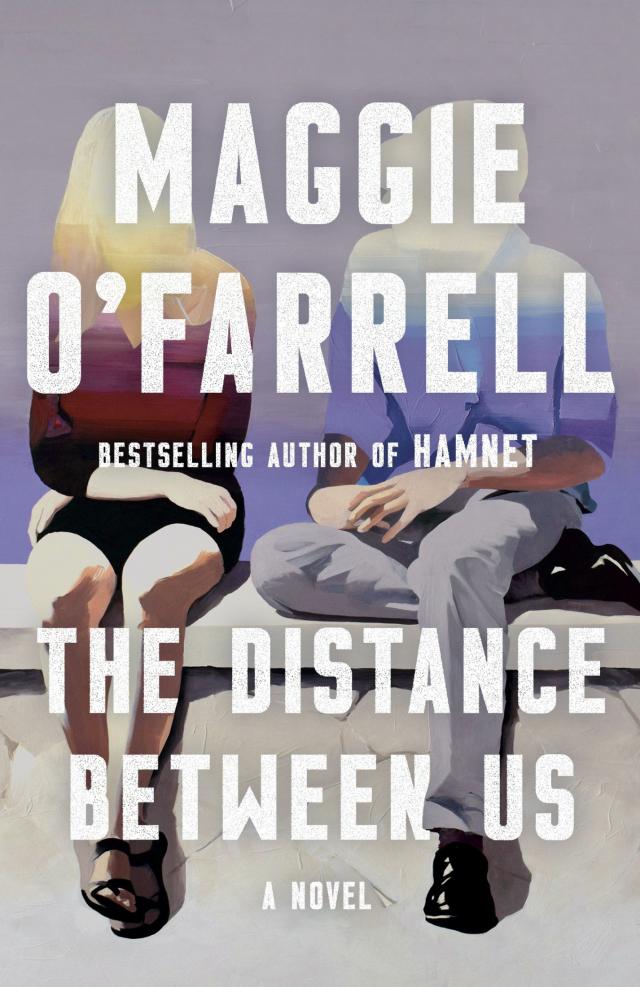
Cover painting: Couple at the Seaside by Jarek Puczel
vintagebooks.com
ep_prh_6.3_146171367_c0_r0
Contents
Cover
About the Author
Books by Maggie O’Farrell
Title Page
Copyright
Dedication
Epigraph
Part | One
Part | Two
Part | Three
Part | Four
Acknowledgements
_146171367_
for Will
I do know that lives can change overnight, though it usually takes much longer than that to comprehend what has happened, to sense that we have changed direction
Jay McInerney
I came to these places…to claim kin with them, to be guided by them
Geoff Dyer
She was my liegeman, my alter ego, my double; we could not do without one another
Simone de Beauvoir,
on her Sister
PART | ONE
He wakes to find himself splayed like a starfish across the bed, his mind running at full tilt. On the other side of the room, the fan turns towards him then turns away, as if offended. Somewhere beside him, the pages of a book flutter, reel and divide. The apartment is filled with an inky light and flashes of neon scissor the ceiling. Late evening.
“Shit,” he says, and raises his head with a jerk. Something soft yet integral between his shoulder blades stretches and tears like wet paper. Swearing and reaching round to feel for the point of pain, Jake stumbles to his feet and skates in his socks over the wooden tiles to the bathroom.
His face in the mirror is a shock. The creases and pleats of the bedsheet have left reddened lines over his cheek and temple, giving his skin a peculiar, raw look. His hair stands up as if he’s been electrocuted, and appears to have grown. How had he managed to fall asleep? He’d been reading, head propped up on his hands, and the last thing he remembered was the man in his book descending a rope ladder into a disused well. Jake glances at his watch. Ten past ten. He’s already late.
A moth blunders into his face, then ricochets into the mirror, the faint powder on its wings leaving a mottled mark, a ghost of itself, on the glass. Jake stands back for a moment, watching it, tracking its course through the air, then snaps his cupped palms at it. Misses. The moth, sensing danger, spirals upwards towards the light but Jake aims again and this time he gets it, its delicate, confused body knocking at the cage of his hands.
He nudges the lever with his elbow and pushes at the window. The roar of the street, nineteen floors below, rises up to meet him. Jake leans out over the strings of washing and, opening his hands, tosses the moth upwards. It falls for a second, turning over, disoriented, then recovers and, catching a hot thermal draught from an air-conditioning unit down below, flitters into invisibility.
Jake slams the window shut. He rattles through the flat, collecting wallet, keys, jacket, pulling on his shoes, left in a heap by the door. The lift takes an age to come and when it does, it stinks of sweat and stale air. In the entrance hall, the janitor is sitting on a stool beside the door. Above him are the frilled red and gold decorations of Chinese New Year—a fat-cheeked child with tar-black hair rides astride a pink pig.
“Gung hei fat choi,” Jake says, as he passes.
The man’s face cracks into a gap-toothed grin. “Gung hei fat choi, Jik-ah!” He slaps Jake on the shoulder, making his skin prickle and sting like sunburn.
Outside, taxis splinter the light of the road’s puddles and an underground train shakes the pavement. Jake tilts his head to look up at the building tops. The year is turning from ox to tiger. When he was a child, he used to imagine the year at the stroke of midnight as a strange mutant creature, caught in half-metamorphosis.
He moves away from his building, almost crashing into a diminutive elderly woman pushing at the handle of a cart laden with collapsed cardboard boxes. Jake sidesteps her and heads south, past the basketball courts, a small red kerbside shrine with a bouquet of spent joss sticks, past men sitting in a yum chai shop, mah-jong tiles clicking on the tables between them, past serried rows of draped motorbikes, intricate webs of bamboo scaffolding, past restaurant tanks where doomed fish are stretching out their gills, searching for oxygen in the cloudy water.
But Jake doesn’t see any of this. He is looking up at the darkening clouds, humming as he walks, his thin-soled sneakers moving over the pavement. The air swings with incense, firecracker smoke, and the amniotic salinity of the harbour.
* * *
—
The bus isn’t coming. Stella pulls her scarf closer round her throat and stands on tiptoe to gaze down the line of traffic. Cars, cars, taxis, motorbikes, the odd cyclist, cars, more cars. But no bus. She looks up at the screen that is supposed to tell her how long she has to wait. It’s blank.
She separates her coat sleeve from her glove to check her watch. She’s on an afternoon shift today and she’s going to be late if she waits any longer. Stella stands for a moment, thinking. Is it better to stay and wait for a bus that will come eventu
With a brief glance over her shoulder to make sure the bus still isn’t coming, Stella sets off. The street is cold, unusually cold for this time of year, the ground sharp, gilded with frost that cracks underfoot. The sky is an uncertain grey, crazy-paved with leafless branches.
She’s back in London for several weeks—no more than that, she hopes—working on a late-night radio show. She has a flat here, a bedsit on the edge of Kennington, but usually rents it out while she goes off to different places. A month in Paris, a stint in Moscow, half a year in Helsinki. She’s not sure where she’ll go next—Rome, maybe, Madrid, Copenhagen. Stella doesn’t like staying in one place.
She marches north, towards the Thames, her breath steaming, her body inappropriately warm inside the layers of clothing. As she takes her first steps on Waterloo Bridge, the city begins to split in two, the river opening out to her. The bridge was built entirely by women, she read somewhere once, during the Second World War. It’s deserted today. Cars swoop past, heading north, but on both sides the pavements stretch out, empty.
* * *
—
At the crossroads, Jake leaps on to the backboard of a rattling tram just as it’s pulling away. The downstairs, murky and dim, is crammed—people filling the seats and clinging to the ceiling rails. An old man in a vest and faded trousers is nearest Jake, a birdcage held on his lap. From its pendulum perch, the bird regards Jake sideways with the tiny black beads of its eyes. The heads of the two Westerners on the tram sway above those of the Chinese.
Jake thunders up the wooden stairs. He takes the seat right at the front, leaning his head out of the window, facing into the speeding breeze, and watches the cluttered, neon-scribbled buildings of Wanchai slide into the slick concrete-and-mirror edifice of the huge shopping complex.
Jake’s hair is dark and his skin can turn to almost the same shade as his friend Hing Tai’s if he stays in the sun long enough, but his eyes are the colour of deep water. He has a British passport, a British mother and, somewhere, a British father. But Jake has never seen Britain, or his father, and has never been anywhere near Europe.
* * *
—
Stella sees a solitary figure, far away, at the other end of the bridge, heading towards her. A man. Shrunk down by distance. She could raise her hand and encircle him with a finger and thumb. As if pulled towards each other by a string, they walk and walk and walk. He becomes more defined: tall, hulking, wearing a green jacket.
Stella looks out over the river, where the huge wheel is sequined with lights and people small as insects swarm along the South Bank. She swings the beam of her vision back to the bridge, to where she’s heading, and the shock is so great she almost stumbles. She has to grip the wall with her hand to stop herself falling and her heart trips and stutters, as if unsure how to continue.
Stella stares down at the brown, twisting water of the river, then back at the man. He is closer again and Stella wonders if he will just carry on getting bigger and bigger until he is looming over her, vast and terrible as a brockenspectre. He is looking straight at her now, his hands jammed into his pockets.
She cannot believe it, she really cannot. He has that swollen, white-pink skin, the same dense fuzz of red hair, and the eyes pitted deep into the flesh of the face.
It’s as if time has buckled back on itself, as if the years have swallowed themselves. Stella can feel the clammy give that skin would have beneath her grip, and the peculiar, damp animal smell of his hair. The man is coming towards her now, close, so close she could touch him, and a scream hovers somewhere at the base of her throat.
“You all right, doll?”
Her gloved fingers tighten on the rail. He is Scottish. Just as she had known he would be. Stella nods, still looking at the river, its surface muscled like the backs of serpents.
“You sure?” He is standing just out of view. Stella can’t breathe, seems unable to stretch open her lungs for air. “You don’t look it.”
She nods again. She doesn’t want him to hear her speak, to hear her voice. She has to get away. Without looking at him, she starts to move off, pulling herself along by the railing. She has to pass quite close to him and she can feel the movement of his breath on her hair as he says, “If you’re sure, then,” and it makes her shake, makes her flesh shrink around her. “Bye for now,” he says.
Stella swivels her head to see him go. That same lumbering gait, his feet splayed, the massive shoulders hunched. He turns round once. Pauses for a second. Then carries on. ’Bye for now.
Two trucks thunder past in quick succession, making the air churn. She breaks into a stumbling run, her coat flapping and tugging behind her, the city buildings veering ahead. A sharp, dragging ache has started up in her chest, as if something with teeth and claws is trying to fight its way out of her. She trips, her palms and knees meeting the pavement, and before she scrambles up, she looks behind her.
He’s vanished. The bridge stretches away from her, domed, curving and deserted.
She drags herself to her feet. Grit and dirt smudge her palms. Her hair is wet with tears and sticks to her face in the cutting February wind. She looks up and down the street, unsure of what she is seeking.
Coming towards her on the other side of the road, she sees the lighted oblong of a taxi sign. She darts into the traffic, one arm raised above her head. A car screeches and swerves. “Please stop,” she mutters to herself, her eyes fixed on the light speeding towards her, “please.”
The taxi slows and pulls up. Stella runs towards it, opens the door and climbs inside.
* * *
—
Jake clatters down the stairs as the tram does its double-corner-swing into Central. He likes feeling the swooping, shuttling change of direction beneath him, likes to be standing for that bit when you have to brace yourself against the contrary motion. He drops down to the road in front of the weighty, jagged structure of the bank and cuts through, under the black glass of the building where empty escalators are humming, churning round, transporting nobody up and down.
He toils up the steep incline of Lan Kwai Fong, threading his way through the already thick crowd. The cobbled road is lined with bars and clubs, all filled with Westerners who work in the legal offices, newspapers, schools, radio stations, IT departments of Hong Kong Island, and return each night by ferry to their flats on Lamma or Lantau, stopping off here to tank down some alcohol and meet their friends. Jake never usually comes here, but Mel and her crowd like it.
Jake often thinks of Hong Kong as a kind of overflow pipe for Europe. The people who come here have left their homes and their families for a reason, and not usually one they ever disclose. They’re all in varying degrees of separation, or running away from something, or in search of an elusive element that might complete them. Or at least hoping the feeling that something is missing from their lives won’t pursue them over the ocean. If you go far enough you might never catch up with yourself.
At the top of the hill, Jake turns left into the Iso-Bar. It is filled with icy, over-conditioned air and hordes of people, drinks in hand, packed close together. He scans the crowds, searching for Mel. Suddenly she is there, right in front of him. Their eyes haven’t yet met but she is printing a kiss on his face in lipstick and turning her head towards her friends. “I told you he’d be late, didn’t I? Didn’t I say he’d be late?” Her face swims before him in the murky gloom. She has her light, fine, almost colourless hair pulled into a ponytail high on the back of her head and her hands are fastened behind his back.
“I’m sorry, I fell asleep,” Jake yells over the music. “I don’t know how. One minute I was reading and the next I—”