

Alias uncle hugo, p.12
Alias Uncle Hugo, page 12
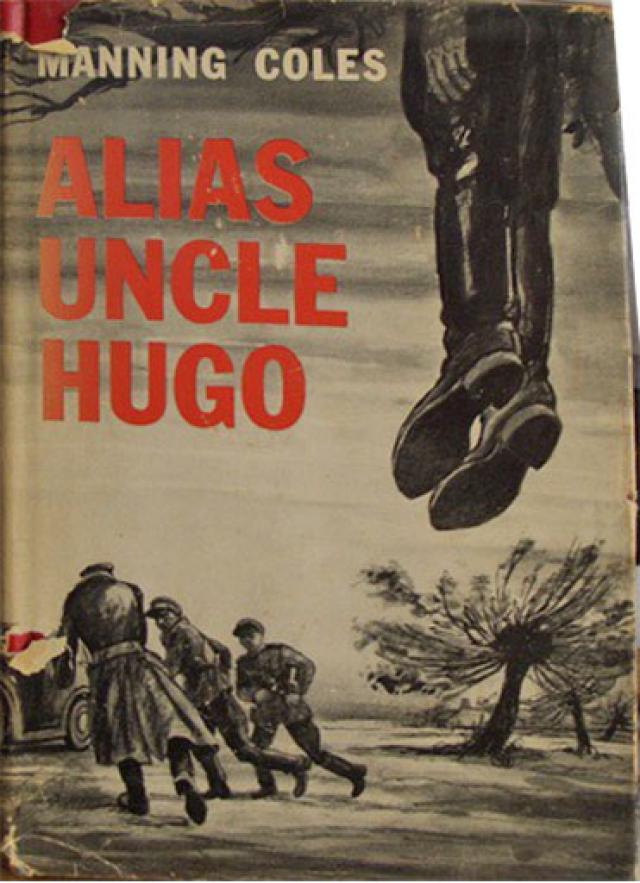


“Only the old watchman and he walks about with a lantern. It’s easy to dodge him.”
Hambledon reflected that if boys were not caged up more effectively than this it was absurd to expect them to stay in their rooms all night. No boy would.
“Are you the only ones who get out?”
“I think so. The others—they know it wouldn’t be allowed so they don’t think of doing it. Nikolai, Dmitri and Eugene were like that, too, till I talked to them.”
Hambledon’s memory reproduced the voice of the Director of Studies saying: “Kaspar, in my opinion, is a born leader.”
“Well?”
“So we took to roaming round the grounds—look here, do light a cigarette, won’t you? You don’t look nearly so savage when you’re smoking.”
“Get on with the story!”
“Yes, Uncle Hugo. We found a place behind a clump of bushes against the wall where there’s a sort of passage under the wall. Do you call it a culvert? I’m not quite sure what a culvert is, actually. It used to be where the drains ran out into a ditch but they don’t use it now.”
“I should hope not,” said Hambledon.
“So we’ve been slipping out that way at nights, oh, for weeks. Ever since soon after I came here. But, Uncle Hugo, after you told me to keep out of trouble I didn’t go again, not till last night, I didn’t, honestly, Uncle Hugo!”
“Then why go last night?”
“Because Dmitri, Nikolai and Eugene wanted to know why I suddenly wouldn’t go. That’s what I meant just now when I said it wasn’t so simple as you think. You see, if you suddenly leave off doing something you’ve always been keen on doing, people want to know why. Don’t they?”
“There is that,” admitted Hambledon. “But couldn’t you think up a reason for not going any more?”
Kaspar shifted uneasily. “That wasn’t so simple, either, actually. These Russians, you know, don’t seem to think along the same lines as we do, if you know what I mean. They don’t do things for the same reasons as we do. Haven’t you noticed that?” Hambledon nodded.
“They would stop going out because they were afraid of being caught, or because one of the other fellows had seen them and would tell on them. They’re taught to tell on each other, actually, it’s a sort of civic virtue.”
“Kaspar.”
“Yes, Uncle Hugo?”
“Do you think you could make a determined effort to stop saying ‘actually’ in every sentence?”
“Oh, do I? I’m so sorry. I don’t know I do it, you know.”
“Carry on,” said Hambledon, taking out his cigarettes and lighting one, an action which Kaspar noticed with relief but without comment.
“It’s no use telling the Russians you’ve suddenly got religious convictions because they don’t have them. It’s no use saying you don’t think it’s fair to the others. It’s no use saying anything, they’d only think I was funking after last time and I can’t have—”
“After last time?” said Hambledon sharply.
“Oh, Uncle Hugo, how you do catch one up! If one stops doing anything there’s always a last time, isn’t there?”
“What happened on the last time you went out before last night?”
“Nothing special,” said Kaspar stubbornly.
“Which night was it?”
“Can’t remember.”
“All right. Let’s go back to the school and I’ll ask Nikolai, Dmitri and Eugene.”
Kaspar turned scarlet with fury. “How dare you! Because I have to let you pretend to be my uncle! When we get out of here to somewhere civilized you’ll have to call me ‘Sir’! Remember that, please!”
Hambledon threw back his head and laughed till the tears came. “Sorry, Your Majesty,” he spluttered.
Kaspar’s anger subsided and a slow grin spread across his face.
“You know, anybody’d think you were a schoolmaster,” he remarked.
“I was, once. A long time ago. Well now, having thoroughly insulted each other, let’s get back to the story.”
“Actu—sorry. I really don’t know why I’m jibbing like this except—well—I don’t like to talk about it. I don’t even care to think about it, actually.”
Hambledon let the word pass and asked gently: “What did you do that night?” A look of surprise crossed Kaspar’s face and Tommy hastily changed the question to: “What did you see?”
“Some M.V.D. men hanging a dead man. On one of those trees over there. You knew about it, did you?”
“No. I guessed, that’s all.”
“We found a boat,” said Kaspar, talking faster and faster, “so we paddled across the river. We’d just got up near the trees when a car came along and stopped and some men got out so we scooted behind those bushes. The car had come from the factory, we thought that was queer. We thought somebody’d been stealing something and was going to hide it, they were carrying something. Then they got nearer and it was a man. One of the M.V.D. men climbed up a tree with a rope and the other two held the man up and the man in the tree did something—he tied the rope, of course—and then the other two let go and he dangled.” Kaspar gulped. “I was sick. You know,” he added as one expert to another, “it’s very difficult to be sick quietly.”
“It is, isn’t it?”
“Well, then the M.V.D. men stood about and one said he’d got a bright idea. He—”
“For heaven’s sake,” said Hambledon, “how far away were you?”
“Oh. About as far as that stone.”
Twenty yards or so. “Go on,” said Hambledon.
“He said now they’d got the car why didn’t they go back to the factory and load up with—I didn’t know the word but Nikolai told me it was binder twine. His father’s a farmer. Then they’d swap it for half a pig from that farm over there,” said Kaspar, pointing across the river. “Then one of the others said they’d be shot for that, taking pork into the office, and the first one said, ‘Not the office, you fool. My little hut down by the river.’ So they went back to the car and turned and went back to the works. Oh, the man said the farmer’d cook it for them, too. We hung around and they weren’t in the factory long. They drove away again and went off up the turning to the farm and we went home.”
“I see,” began Hambledon.
“So you do see, don’t you, how difficult it was to refuse to go again after I’d been sick and the others weren’t? Nikolai and Eugene said he was dead before they’d hung him up and Dmitri went and waggled his foot and said he was nearly cold then. They’d seen lots of dead men but I never have as it happens. I couldn’t admit that so I said I’d seen a woman burnt alive and she squalled like a dozen tomcats. It wasn’t true,” said Kaspar, turning his incredibly blue eyes on Hambledon, “but one must keep one’s end up, mustn’t one?”
Hambledon blinked. “Oh, by the way, how did you know the M.V.D. men?”
“Everybody knows them. People point them out to each other. It was broad moonlight that night, if you remember.”
“And last night’s expedition?”
“Eugene knew where their hut is, the gardener told him. We didn’t see why brutes like that should have pork after what they’d done because I expect they’d killed that man, hadn’t they?”
“Actually,” said Hambledon and Kaspar laughed aloud. “In point of fact,” amended Tommy, “I believe he committed suicide. About last night?”
“Nothing in it,” said Kaspar. “We went to the hut, got the door open, found the pork in a tin box and took it away. There wasn’t an awful lot, not nearly half a pig. We were hungry so we ate a lot of it and threw the rest in the river, coming home. It was rather fat and we felt a bit queer after it and Dmitri said that rhubarb had a medicinal effect and would do us good. I didn’t know what it was, the word he used I mean, but when he showed me I knew, of course. There’s some in the garden of that burnt house along there, so we pulled some sticks and ate them. We knew better than to eat the leaves,” he added proudly. “They’re poisonous, aren’t they? Dmitri’s father is a doctor. Then we came in and went to bed. But not for long,” said Kaspar, and sighed.
“We’d better go back,” said Hambledon, and got up. “Come on, Kaspar. I think the sooner I get you out of Poltava the better.”
Kaspar put his arm through Hambledon’s. “In point of fact,” he said primly, “I am inclined to agree with you.”
11
hambledon was fairly well pleased with his progress so far. He had arrived at Poltava, routed Dadyan, established himself at the factory and won Mantov’s confidence, got the upper hand of the M.V.D. leader Filline and been accepted as Kaspar’s devoted uncle. So far, so good, now to get away out of the country and take the boy with him. Not only out of the country but right out of the sphere of Russian influence, beyond the Iron Curtain, a journey of nearly a thousand miles in a straight line as the aeroplane flies to the nearest point, Vienna. It was no use going south, that would only take him to the shores of the Black Sea with no means of crossing it to Istamboul. Vienna, then. There were three means of transport: train, road and air. The railways were practically impossible, so strict is the Russian system of controls, permits to travel and continual inspection of papers en route. Hambledon had learned a great deal about rail travel in Russia on his journey to Poltava and then he had been upon official business. No, trains were out of the question.
Road travel was not much easier. It was impossible to buy a car for private motoring even if he had the money, and his job at the Poltava factory did not require the use of an official one. He considered changing his job for one which did require a car, but the prospect was obscure to put it mildly. Besides, it would certainly mean his leaving Poltava. It would therefore be necessary to steal a car. Tommy had no moral objection to car-stealing and probably it could be done, but there was sure to be a permit system for obtaining petrol. And, probably, passes to show one’s right to take a particular journey. Perhaps Filline had some in the M.V.D. office, Hambledon filed that idea for further consideration. Money would be needed for a journey like that and he had very little money. His pay was not large since food and accommodation were provided for him; Varkin had advanced him his first month’s salary but it did not amount to much. Finally, there was the boy; so difficult to explain away, so easily recognizable.
If Kaspar could be made to appear to have something the matter with him which was only curable by some specialist in Berlin. Nonsense. Hambledon was not a doctor to know what was required; Kaspar could not be expected to keep up any pretence well enough to deceive a genuine doctor and finally, if he were really believed to be ill, he would be sent to a Russian hospital. Nonsense.
By air, then, and Hambledon could not himself fly any aeroplane. He would have not only to steal the aircraft but also to coerce the pilot. Persons who have someone else’s revolver chilling the backs of their necks are readily persuadable as a rule, but a thousand miles is a long run and pilots are usually alert and energetic young men. Imagine trying to fly a thousand miles with one eye on the map, the other on the country below if it were visible and—er—a third on the pilot? Besides, he did not know the country over which they were going to fly. A compass course. Yes, but how was he to know when he had arrived in safety? What was to stop the pilot agreeing cheerfully to everything he said and then landing the aircraft within Soviet territory—or faking engine trouble—the pilot would know perfectly well that one does not shoot the pilot of an aircraft one cannot fly oneself any more than one shoots the driver of a fast-moving car. Bluff, and a thin bluff at that.
“Oh dear, oh dear,” said Tommy to himself, “I have bitten off something this time. If there is a possible scheme, will it kindly present itself?”
It would be a help to have somebody as well as Kaspar in the aircraft with him if only to intimidate the pilot while Hambledon conned the route, but he could trust no one. As the British Major of Intelligence had told him in the jail in Berlin, we had nobody in Poltava.
In the meantime, the neighbourhood seemed to be suffering the onset of an attack of jitters. There was not any ascertainable reason for it but there was nervousness in the air and it was spreading. Mantov, the factory Director, had spoken to Hambledon about it.
“Something is going to happen,” he said. “I feel it as one feels the imminence of thunder.”
“You are overworking,” said Hambledon. “You are too conscientious, you’re letting the work get on your nerves. You want a holiday.”
“Heaven knows I do but I shan’t get one. No, Comrade Britz, it’s more than that. I have lost the confidence of my workers. We were, considering all things, a fairly happy family in the factory and my workers knew they could talk to me openly, either in the shops or at my house after hours. Now they never address a word to me and if I try to talk to them they hardly answer. If they’re talking to each other they stop when I come along.”
Hambledon frowned, for he liked the man. “Do you think there’s some story going round?” he said. “You know what workers are like, and not only workers if it comes to that! Some incident misinterpreted, some remark misunderstood—”
“That’s always liable to happen in any community, but until recently they would have come to me and said: ‘Comrade Mantov, we have heard—’ so-and-so. No, it’s more than that,” repeated Mantov drearily.
“Someone starting a whispering campaign?”
Mantov nodded.
“Any idea who it is?” continued Hambledon.
Mantov looked at him. “I have no sort of proof.”
“There never is in these cases. Tell me, among so many people who are looking worried, is there anyone who looks pleased? Not openly, of course, but when he thinks himself unobserved?”
“You are very acute, Comrade. Probably, but I have not seen it. That is one drawback of being the Director, you know, people see one coming.”
“I’ll keep my eyes open on your behalf,” said Tommy.
“Oh, they see you coming, too.”
A sudden light dawned upon Hambledon. “Is it on my account, do you think, all this mistrust?”
Mantov hesitated. “No one has said so, but I think it may be. I hate to say it, Comrade Britz, since if I may say so I regard you as a friend. It is probably your background. It is no secret that your identity card was endorsed by Andrei Varkin, who is already high in the M.V.D. and likely to rise higher. Forgive me, he is probably a friend of yours, I don’t mean anything personal. No doubt he is a charming man. Also, it is plain that you have Filline in your pocket and he is the M.V.D. to us. You must know that everyone fears the M.V.D., that is what you are for, is it not, to be feared?”
“I am not, myself, a member of the M.V.D.,” said Hambledon steadily. “I give you my word of honour for that.”
Mantov sighed with relief. “I could not think you were, you are not that type,” he said frankly. “But you must admit that it’s no wonder people think you are.”
“I suppose not.”
“And they ask themselves for what purpose is an M.V.D. man planted in our factory?”
“Quite. What shall we do about it? Put a notice on the factory notice board? ‘Comrade Britz disclaims the honour of any connection with the M.V.D.’?”
Mantov did not smile. “Perhaps some occasion will arise for making it plain,” he said. “There is also a certain amount of trouble in the town.”
“What? Well, that can’t be on my account, I’m hardly ever in the place.”
“When a hawk hangs over a farm all the chickens scatter.”
“Oh. Oh dear. I don’t know what I can do about it, do you? Let’s hope it dies down, shall we?”
When the factory closed for the day Hambledon rang up Filline.
“Haven’t seen anything of you for a long time. Come and have dinner with me in my rooms tonight, will you? My landlady can cook.”
Filline overflowed with thanks and came. The dinner was not particularly good but Tommy preferred to entertain Filline at home rather than visit the M.V.D. office himself or be seen with the man in one of Poltava’s restaurants. They talked of indifferent matters while the woman was coming in and out with dishes of soup, a stew of unidentifiable ingredients and cheese. Filline was quite amusing about some of his film experiences and Tommy gave him a good mark for not referring to the fighting round Stalingrad. Finally the woman cleared the table and left them with glasses and a bottle of Crimean wine.
Hambledon refilled his guest’s glass and asked how his parish was behaving.
“Quite well, Comrade, thank you,” said Filline slowly. His forehead wrinkled and he added: “At least, I think so.”
“What? I thought you knew the inmost secrets of every heart.”
“Not quite, Comrade Britz. I know more than they think I do, which is always something.”
“It is indeed. Will you have a cigar? Or a cigarette?”
“Cigarette, thank you very much. No, the town’s apparently quiet enough.”
“ ‘Apparently,’ Comrade?”
“Yes. I have not, myself, noticed anything but the local chief of police, who, of course, makes regular reports to me, says that everybody’s got the wind up.”
“Really?” said Hambledon in a surprised voice. “What on earth about? American atomic bombs?”
“No, Comrade, no. Merely some local uneasiness. Nothing much, you know, only a lot of little things that do not make sense. For example: the Mayor is a widower with five daughters looking after him, aged—what—sixteen to twenty-eight, I suppose. One of them is quite pretty,” said Filline reminiscently. “Well, he has packed them all off to an aunt in Moscow, he says their health requires a change. I daresay it does, but why send all five off at once and leave himself with one frowsy old servant to cook for him?”
“Unreasonable,” agreed Hambledon.
“People have been selling things. I myself was offered a very nice emerald ring, heaven knows to whom it belonged originally. I did buy a silver cigarette box through so many intermediaries that I don’t know who was selling it. And so on.”
“What does it all add up to?”


