

Mr campions falcon, p.1
Mr Campion's Falcon, page 1


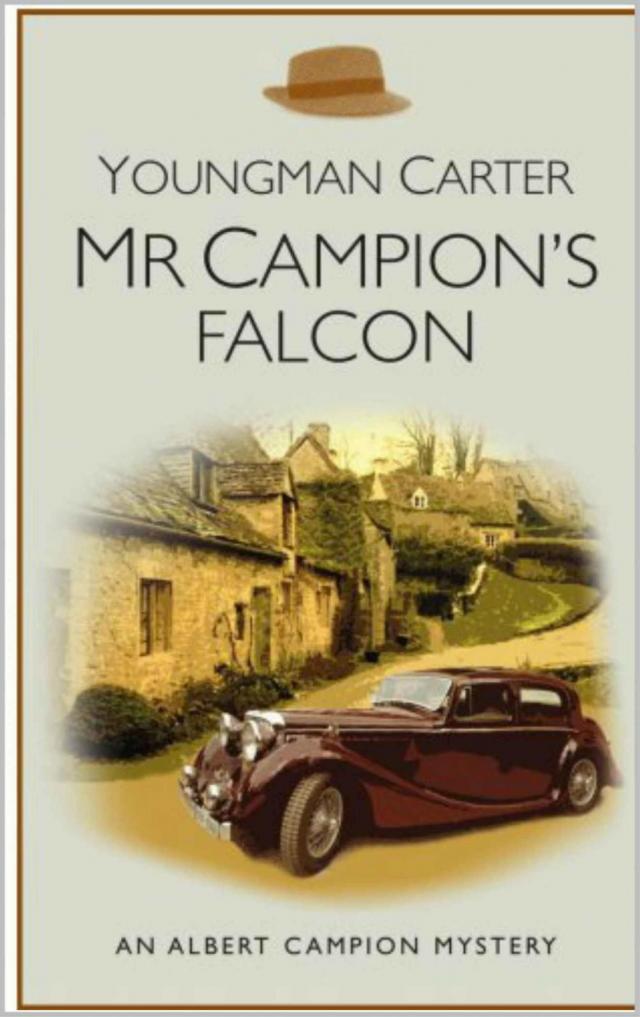
At the Drover’s Arms, an upmarket Cotswolds inn, a resident dies of natural causes and the body is identified as that of Matthew James Matthew, a retired engineer and enthusiastic amateur archaeologist with no immediate family or friends and whose background is vague to say the least. Then the pompous and self-important innkeeper of the Drover’s Arms is found dead in very suspicious circumstances miles away, near an archaeological dig in in Suffolk. Can these two deaths be linked to the disappearance of the brilliant but unstable geologist Francis Makepeace? Margery Allingham’s famous and muchloved ‘Golden Age’ detective Albert Campion thinks so and he is rarely wrong when it comes to a mystery.
Albert Campion made his first appearance in Margery Allingham’s, The Crime at Black Dudley in 1929 and was rapidly accepted as one of the great fictional detectives of the 1930s, alongside Hercule Poirot, Miss Marple and Lord Peter Wimsey. Unlike his contemporaries, Albert Campion as a character was allowed to age and develop by his creator into the 1960s.
Artist and journalist PHILIP (‘Pip’) YOUNGMAN CARTER was born in Watford in 1904. He met his future wife Margery Allingham when both were aged 17. They were (secretly) engaged at 18 and they married in 1927, living first in London but then in the countryside of north-east Essex and from 1935 until their deaths, in D’Arcy House in the village of Tolleshunt D’Arcy. During World War II Youngman Carter served in the army in the Western Desert and the Middle East, rising to the rank of Lieutenant-Colonel. He was a founder and editor of Soldier Magazine and after the war became Features Editor of the Daily Express and then the editor of the Tatler. In 1957 he left Fleet Street to resume his career as an artist and illustrator as well as writing wine and travel books and some thirty short stories. He designed dust jackets for books by Graham Greene, Daphne du Maurier and Georges Simenon among many others as well as his wife’s, on whose novels he was an acknowledged collaborator. When Margery died in 1966, Youngman Carter completed the unfinished manuscript of her last novel Cargo of Eagles which was published posthumously. He then wrote two further novels featuring his wife’s famous detective, Mr Campion’s Farthing and Mr Campion’s Falcon, and started a third before he himself died in November 1969.
Also Published by Ostara Publishing
Mr Campion’s Farthing
Youngman Carter
Mr Campion’s Falcon
Ostara Publishing
First published, 1970.
© Trustees of the Margery Allingham Society, 2013
Ostara Publishing Edition 2013
ISBN 9781906288 990
A CIP reference is available from the British Library
Printed and Bound in the United Kingdom
Some of the words used and views expressed in this text, in common usage when originally published, could be considered offensive today. The Publishers have reproduced the text as published but would wish to emphasise that such words and terms in no way represent the views and opinions of the Publisher.
Ostara Publishing
13 King Coel Road
Colchester
CO3 9AG
www.ostarapublishing.co.uk
Ostara are delighted to reissue Youngman Carter’s brace of Campion novels with the permission and support of the Margery Allingham Society in the Society’s 25th Anniversary year. (www.margeryallingham.org.uk)
I am grateful to Mr Monja Danischewsky for the use of his profound knowledge of certain byways in the Cotswolds, and I regret that one village in particular, though familiar to many of us, cannot be found on a map. Apart from this, no reference is intended to any existing place, company or individual, nor to any recent discovery, whether archaeological, geological, geographical or gastronomic.
Contents
1. Miss Peregrine’s Progress
2. Vanishing Trick
3. Coastguards
4. Missing Link
5. The Trespasser
6. Encounter
7. The Oncer
8. Unfinished Business
9. Rendezvous
10. The Expert
11. Emergency Exit
12. Private Investigation
13. The Lampeter Report
14. The Pigeon-hole
15. The Messenger
16. Potter’s Field
17. Fisher’s Catch
18. Ultimatum
19. End of Mission
20. The Henchman
21. In Place of Valour
22. Telephone Exchange
23. The Ultimate Proof
24. East Vinecross
25. Dogs’ Dinner
26. Property on Loan
27. Heel Tap
1. Miss Peregrine’s Progress
Mr Max, whose staff called him ‘His Excellency’ behind his back, had not been given the title out of affection.
For his guests at the Drover’s Arms, the four-star country hostelry which epitomized Old England in the eyes of wealthy tourists, he was a host so smooth and efficient that nothing of his personality remained in their memory the moment their needs were satisfied.
To that extent he had ambassadorial quality, but there were other less obvious ingredients behind the façade and the dominant of these was curiosity. It was the mainspring which kept every cog moving. An unsolved problem, whether it was the extramural activities of a week-end party, the theft of a pepperpot or the identity of an unlikely visitor, brought him an exquisite discomfort. The riddle which obsessed him at the moment was near to torture.
His office, an unpretentious modern cubicle behind the reception desk, was equipped with a two-way mirror through which he could observe the hub of his world whilst remaining invisible.
The arc of vision included the oak staircase with its mercifully shallow treads, the doors to the Coffee Room, the Ostler’s Bar and the Refectory, the service corridor, a long table gay with international magazines for ever pristine, a landscape attributed to Constable, a set of coloured stipple prints by Morland and, most important of all, the entrance.
He was watching this now, a sleek black cat in pin-stripe trousers, totally absorbed in his private mystery.
Presently a girl would come through the bright rectangle, a little piece of the jigsaw to be twisted and memorized until he found where it fitted.
The minutes, articulated by an octagonal coaching clock facing the reception desk, dragged on, heightening the tension, and his reflexes twitched, forcing him to shift his weight from a leg which was suddenly numb.
Half-past three. Later than he had calculated.
He was not the only watcher. In the far corner beside the bow window beyond his line of vision a man in flagging grey mohair, gross as a laughing buddha, was concealing his face behind a newspaper. When the barrier was lowered a pair of tinted glasses gave the impression that the owner might be nearly blind, but the eyes, bolstered in flabby fat, were shrewd enough.
The August sun patterned the floor with squares of gold, turning each new arrival into a silhouette, so that Mr Max had to wait until the girl paused half-way to the desk before he was absolutely certain. She was not quite as he had pictured, but there could be no mistake.
She was carrying a small overnight case, and her black moiré silk tailor-made coat was two years out of date. Borrowed, he decided, but originally from the boutique of a good house. She was not wealthy, then, but the background was promising.
Nineteen? Twenty-three? It was impossible to guess. Attractive to a man with enough courage: probably intelligent. He added the final item to the debit side with regret.
He glided to the counter, cutting off the official receptionist on his way, and reached it precisely as the girl pulled off a bright orange bandanna scarf and shook out the unfashionably short chestnut curls on the top of her head.
‘My name is Peregrine,’ she said. ‘You rang me. I came as quickly as I could.’
Mr Max flexed his lips. It was not a smile but a formality conveying recognition and impersonal welcome.
‘Of course. About Mr Matthews. It was very sudden – very unfortunate. The staff and I would like to offer you our sincere regrets. We were all extremely distressed – shocked, if I may say so. I have reserved a room for two nights, or for longer should you wish. If you would care to see it …’
To her eyes he seemed nearer an automaton than a man. His body, if flesh and blood existed below the shining collar and dovegrey tie, had been designed to fit the jacket and the oval face with its peak of straight hair had less reality than a tailor’s dummy. The voice, classless and apparently pre-recorded, flowed on.
‘… a very pleasant outlook over the garden. The Chaucer Room. Mr Matthews always reserved the Milton suite, but we thought you might prefer something smaller.’
He paused for her agreement and produced a sheet of hotel notepaper from a folio.
‘In case it is of service I have prepared a short list of people you may wish to contact. The Coroner’s Office, for example.’
A slim gold pen indicated the name.
‘Do I have to see him?’ said Miss Peregrine. ‘I thought a doctor had been attending Mr Matthews?’
It was not going to be quite as easy as Mr Max had supposed. The girl was completely controlled, as unemotional as any other overnight guest. The fact that she was attractive might mean offers of help from the most unlikely quarters. He had hoped for a suppressed tear, a chink through which he could pry into her thoughts. He was still deferential but a trace of authority crept into his voice.
&nbs p; ‘I’m afraid so. Any sudden death is a matter for the Coroner. In this case Dr Penn, who had advised Mr Matthews occasionally, was away and his deputy apparently could not find the case history. The question, as I expect you know, has now been satisfactorily answered. There will be no inquest, no difficulties of that sort.
‘The officer – his name is Leatherdale by the way – removed some personal possessions from Mr Matthews’s room, a briefcase and so on. Proof of identity. No doubt, if you are going to assume other responsibilities you will wish to recover them?’
He raised his eyes without moving his head.
‘I hope you are going to take charge? You see, we know of no other friends or relations and we would be glad to leave everything in your hands if it is at all possible.’
‘Oh yes,’ said Miss Peregrine. ‘I’m taking charge.’
‘I’m extremely relieved. Mr Matthews was one of our very regular guests. My staff were happy to serve him and in a way you could say that he made his home here. One would not like to think of him without a friend at such a time.’
Again the pencil moved delicately over the page.
‘I have added the name of the undertaker who has made all the necessary arrangements. In case you don’t know our little town – it is really no more than a village street full of antique shops – I shall be glad to direct you.
‘Dr Penn, who is back now, lives almost next door. He’s been most helpful. Mr Russell, of Russell and Clarke, is our only solicitor, but no doubt you have your own. The Vicar is Mr Telkamp. I understand Mr Matthews was Church of England.’
‘I – I think so. Does it matter?’
Her hesitation might be a sign of weakness. He glanced as high as her chin, but it revealed nothing.
‘Probably not, madam. No doubt the Vicar agrees with you, for the funeral is arranged for three o’clock tomorrow. The florist on your list is Miss Margrave, just at the foot of the hill. If there is anything else …?’
She shook her head.
‘You seem to have thought of everything.’
For the first time he was unable to keep his voice as impersonal as he wished.
‘You knew the late Mr Matthews very well?’
‘Oh yes. He was going to live at Brett quite near the school in a house which belonged to me. I was furnishing it for him and he was coming to stay with us until the place was ready. I suppose you found my address on the heavy luggage? Some of it has already arrived.’
Mr Max risked a smile which was meant to be engaging.
‘Your name has been known to me for some time, Miss Peregrine. Mr Matthews gave it to me for forwarding his mail on several occasions – in fact it is the only address we have on our files. I felt I was justified in getting in touch with you when the tragedy occurred. The police, that is, the Coroner’s officer, advised that I should do so. There seemed to be no one else to whom I could mention the matter.’
‘It was very thoughtful of you. They rang me just before you called. They didn’t seem to know a great deal, so perhaps you can tell me what really happened.’
Deliberately, he lowered his voice to a murmur, so that she had to bend towards him.
‘We found Mr Matthews, asleep, as the maid thought, at about half-past ten in the morning. This was on Wednesday, the day before yesterday. He was an early riser by habit – a seven-thirty call – but it was some time before we realized he had passed away. I called Dr Penn, but it was the young man, Dr Lee, the new junior partner, who arrived, though there was nothing to be done. Dr Penn when he returned yesterday was able to prevent any unpleasantness. He had treated Mr Matthews for a heart condition I believe. He was quite satisfied about the cause of death – in fact, he told me he had been expecting it.
‘The question which arose, among others of course, was about Mr Matthews’s effects: his car for example is still garaged here. As a hotelier – an innkeeper is the legal term – I have certain responsibilities to my guests. You see, although he was no stranger to us at the Drover we really know nothing of his background so to speak. He arrived on Monday, intending to stay for three nights. He kept an account at the bank here, but Mr Morgan the manager – his name is on your list – knows as little as I do. Naturally I never inquired until this tragic occurrence. I assumed, if you’ll forgive me, that he had recently retired … an engineer, perhaps? He seemed a very practical gentleman?’
‘An archaeologist,’ said Miss Peregrine. ‘At least, that was his main interest.’ She picked up the typescript. ‘Well now, you’ve really been very useful. Just have my case sent up. I’m sure the room will be splendid. Just for tonight, please. I’ll try to see as many of these people as possible this afternoon.’
He looked after her retreating back with such intensity that the glowing space of the doorway made his eyes dazzle. So far he had learned precisely as much as Miss Peregrine had intended, which was as tantalizing as an itch in an inaccessible spot. She had not even signed the register. He carried the overnight case up to the Chaucer Room himself, placed it at the foot of the halftester bed and eyed it speculatively. It was, he discovered, locked.
The single street of Great Burdon, called in the guide-books ‘a jewel in the diadem of the Cotswolds’, was very much as Mr Max had described it. From the T-junction of roads where the Drover stands beside a small green it runs gently downhill to the bridge and the church, veers left and climbs again to the edge of Burdon Woods. Behind the golden ochre of Cotswold stone, the best of English domestic architecture from Tudor to Georgian, every other window displays antiques at inflated prices and visitors touring between Oxford and the Shakespeare country fall easy victims to the expertise of salesmen twice armed with guile and charm.
In high summer after the last customer in the Drover’s panelled refectory has paid his luncheon bill and the world seems kindly, sales resistance is low and trade is excellent.
Judged by results, Miss Peregrine had a satisfactory afternoon. Dr Penn, a deliberate and cautious Scot, unbent more easily than was his habit. He angled delicately to discover the precise relationship between the girl and his patient and decided that it was irreproachable.
‘Of course I’d only known him for a short time – two years,’ she explained frankly. ‘We had interests in common – archaeology, and so on. He stayed with us – my father and myself – several times, and he should have come down yesterday to make final arrangements for moving to Brett. I think it was my cottage that really attracted him. Mother left it to me and I’ve been trying to let it for some time. I look after my father who’s a housemaster at the School. It’s a nice cottage, rather remote but very convenient for the ship.’
‘An amateur sailor man, was he now? He did not tell me that.’
‘The ship,’ said Miss Peregrine, ‘is Roman. You may not have heard of it, though some of the papers wrote about it. It was discovered two years ago at the edge of the playing-fields where the Brett river used to run before it changed course. The digging is still going on. It’s late Roman, fourth century A.D., Carthaginian in design they say, about one hundred feet long and probably carried quite a lot of cargo. The mud seems to have preserved it because it dried out quite soon after the ship sank. Very exciting. Mr Matthews was coming down to help.’
Dr Penn sighed.
‘The poor man. He missed his treat which is sad. He’d been a great worker in his day and his body was tired. I told him he’d have to be easy with himself. I hadn’t the heart to go further and nor had he, as it fell out.’
He considered her cannily from beneath shaggy brows, hesitated on the verge of a question and changed his mind.
‘I’m glad he’s got a friend to put his affairs in order. You’ll find its a thankless task, but that’s the way of things. He has no relatives you are aware of? No business associates?’
‘He’d lived abroad most of his life, I think. He never mentioned a family and the police – the coroner, that is – obviously couldn’t discover any. That’s why they phoned me.’
‘Very sensible. Leatherdale – you’d best see him as soon as you can – is an intelligent fellow but not over-fond of work. He’ll be relieved to see you, I don’t doubt.’


