Wings of the raven, p.1
Wings of the Raven, page 1


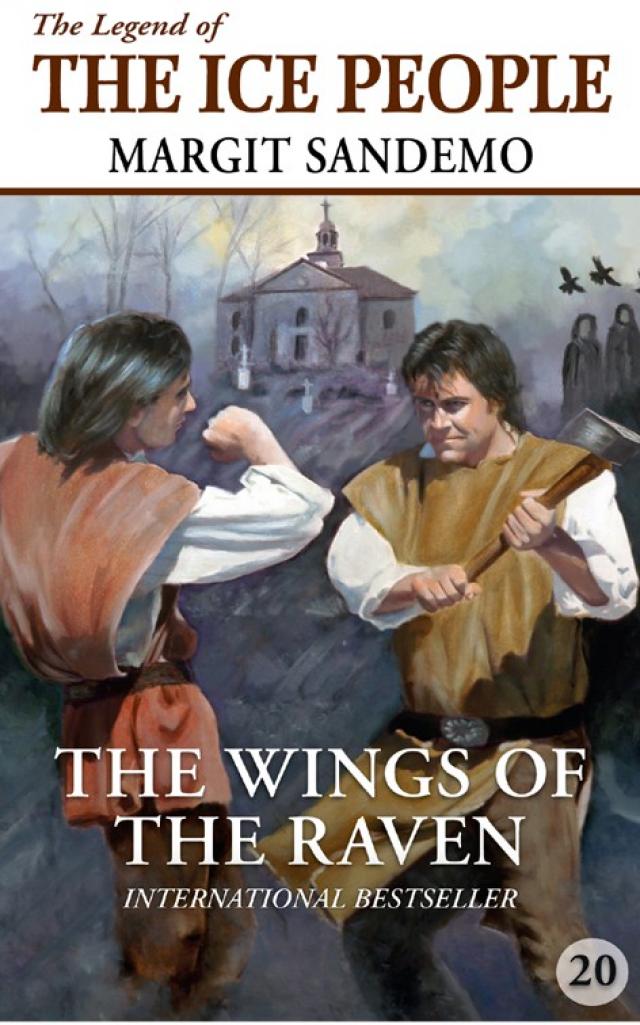
The Wings of the Raven
The Legend of the Ice People 20 - The Wings of the Raven
© Margit Sandemo 1984
© eBook in English: Jentas A/S, 2018
Series: The Legend of The Ice People
Title: The Wings of the Raven
Title number: 20
Original title: Korpens vingar
Translator: Nina Sokol
© Translation: Jentas A/S
ISBN: 978-87-7107-558-8
This book is sold subject to the condition that it shall not, by way of trade or otherwise, be lent, resold, hired out, or otherwise circulated without the publisher’s prior consent in any form of binding or cover other than that in which it is published and without a similar condition, including this condition, being imposed on the subsequent purchase.
All contracts and agreements regarding the work, translation, editing, and layout are owned by Jentas A/S.
Acknowledgement
The legend of the Ice People is dedicated with love and gratitude to the memory of my dear late husband Asbjorn Sandemo, who made my life a fairy tale.
Margit Sandemo
The Ice People - Reviews
‘Margit Sandemo is, simply, quite wonderful.’
- The Guardian
‘Full of convincing characters, well estabished in time and place, and enlightening ... will get your eyes popping, and quite possibly groins twitching ... these are graphic novels without pictures ... I want to know what happens next.’
- The Times
‘A mixure of myth and legend interwoven with historical events, this is imaginative creation that involves the reader from the first page to the last.’
- Historical Novels Review
‘Loved by the masses, the prolific Margit Sandemo has written over 172 novels to date and is Scandinavia s most widely read author...’
- Scanorama magazine
The Legend of the Ice People
The legend of the Ice People begins many centuries ago with Tengel the Evil. He was ruthless and greedy, and there was only one way to get everything that he wanted: he had to make a pact with the devil. He travelled far into the wilderness and summoned the devil with a magic potion that he had brewed in a pot. Tengel the Evil gained unlimited wealth and power but in exchange, he cursed his own family. One of his descendants in every generation would serve the Devil with evil deeds. When it was done, Tengel buried the pot. If anyone found it, the curse would be broken.
So the curse was passed down through Tengel’s descendants, the Ice People. One person in every generation was born with yellow cat’s eyes, a sign of the curse, and magical powers which they used to serve the Devil. One day the most powerful of all the cursed Ice People would be born.
This is what the legend says. Nobody knows whether it is true, but in the 16th century, a cursed child of the Ice People was born. He tried to turn evil into good, which is why they called him Tengel the Good. This legend is about his family. Actually, it is mostly about the women in his family – the women who held the fate of the Ice People in their hands.
Chapter 1
The two men who disappeared without a trace in the year 1793 in the village of Stregesti in Siebenbürgen were not the first ones. On the contrary! Like whispers in the wind, legends were told about such people, who vanished never to be seen again.
But thanks to one of the descendants of the Ice People those two became the very last to disappear.
The special talents of those of the Ice People who were “touched” enabled them to contact many shadowy creatures that ordinary people were unable to perceive. But none of the Ice People had ever experienced anything as frightening as what occurred in Stregesti.
It was a strange forest. It was as though it had been there for fifty thousand years and had fallen into a deep slumber, awaiting the sound of the trumpets on Judgment Day to awaken it.
Everything in the forest was completely overgrown. The ground, rocks and stumps were covered with moss and creeping plants, and the tree trunks were completely swathed in ivy, making the entire landscape look as if it were blanketed in a green, rolling, softly waving shroud.
“Shroud” seems a menacing word: unfortunately that description was very suitable in this instance ...
The mossy branches of the trees drooped sleepily in this primeval forest. There were no singing birds here. Not even the modest nightingale dared break the silence with its beautiful voice.
The forest stood in Siebenbürgen, Austria-Hungary’s easternmost outpost. This wild mountain country fostered the most incredible myths and legends, horror stories about vampires and werewolves and other forces of darkness so terrible that it was only with great reluctance that visitors ever ventured into the deep, secretive valleys.
The population was a hotchpotch of Wallachians, Magyar Szeklers, Saxons and Romanians, including the remnants of other peoples who in times past had immigrated as Goths, Huns, Gepids and central Asian Avars. But the Romanians made up the majority, together with the Magyars, better known as Hungarians.
The Romanians themselves called the land the Ardeal, the Hungarians called it Erdély and still others Transylvania. But its official German name, given it by its current rulers, the Habsburgs, was Siebenbürgen, in reference to its seven major cities.
The ancient forest surrounded a small, out-of-the way mountain village called Stregesti. It would be hard to tell how this village got its name, since so many different groups of people had travelled through the country, but one thing was for sure: the Italian word strega means “witch”.
The two strangers had lost their way in Siebenbürgen under strange circumstances. They were a French nobleman and his nephew, fleeing the revolution in their homeland that had now entered its fourth year. Many members of the aristocracy had become acquainted with the guillotine, but this gentleman, Baron de Conte, had been fortunate enough to escape it together with his nephew, Yves.
Perhaps the guillotine would have been a better alternative after all?
At first they had been so terrified of ending up in the hands of the French mob that they had not dared to speak to anyone, hiding themselves in forests and mountains as they fled. And for that reason they were unaware of the fact that they had crossed the French border.
The French Revolution had thrown all of Europe into turmoil. So the two noblemen just went on travelling farther and farther in the hope of reaching a more peaceful region. Eventually they became aware that they had entered foreign regions, but their nerves were so frayed they still could not trust anyone.
And that was when they strayed into Siebenbürgen ...
Well, it was most certainly quiet here! Nowhere could be more calm or peaceful than these silent, mysterious valleys.
It was easy to take the wrong road when coming down from the Mures Pass on the way to one of the big cities in eastern Siebenbürgen. The baron and his nephew, not knowing the area at all, made the same mistake as other travellers before them. Suddenly they were in the Transylvanian Carpathians ...
For two days they rode through valley after valley, each one deeper and wilder than the last. Every so often they would reach a small village, but the language barrier was too great and they could not explain their intention: to find a bigger, more civilized city, no matter which one. For they wanted to settle down in this country, far away from revolution and fear, but not out in the wilderness!
Then the day came when yet again they chose the wrong road and entered a deep gorge, a chasm, where the sun only barely reached the valley floor. It was a pass, situated high in the mountains, and when they emerged from it they found themselves in the bewitched forest.
They reined in their horses.
Slowly they inhaled the atmosphere of the warm, humid afternoon. The branches of the trees skimmed the tops of their heads, branches so gnarled and heavy they seemed a thousand years old. The moss hanging from them was slimy with age and stale air. There was no sound to be heard anywhere; only a dense silence reigned.
It was as though the forest was holding its breath because of the arrival of the two men.
“Let’s ride on,” the baron murmured. “I’m hungry and the road must lead somewhere.”
It did. After they had been riding for half an hour the valley suddenly opened at their feet and a small village came into view.
The valley was like a hollow between the mountains. It didn’t look as though there were any roads leading out of it. The baron shuddered. He had a feeling that they had reached the end of the road in more ways than one.
The village houses were densely clustered, as though they were huddling together from fear of something. From the brooding mountains surrounding them? Or something else?
“The road does go farther on,” Yves pointed out. “Look, it bends round and disappears behind that big cliff at the other end of the valley.”
“Yes,” the baron said despairingly. “But it doesn’t look much used.”
Yves had to agree with him. They could barely see the tracks of the wheels that must have ploughed up the road once, though that could, of course, have been because their view was so distant.
Yves felt ill at ease and mumbled: “It looks as if this terrible forest also continues on the other side of the village.”
“Around the whole valley,” the baron said. “I’m afraid we will have to go back along the sam
e road we came on, which is not particularly enticing because it has been a while since we encountered a crossroads. However, as we’re here we may as well ride down and get a bite to eat and a place to stay for the night. It is always easier to start a journey with renewed energy in the morning.”
Yves agreed and they rode carefully down the narrow, winding road, which was really nothing more than a path.
They were stately men, the baron and his nephew, with their sharp hawks’ noses and black eyes. They had led rather idle lives in France, as morally lax as large portions of the aristocracy. They had been blasé and arrogant in their behaviour, but the journey through Europe had been full of hardships and had hardened them, almost making real men out of them. They had managed to smuggle out great riches so that they were never in want of anything, or ought not to have been. But what good was wealth in this deserted, mountainous country? They still carried most of their fortune on their persons, having sewn it into their belts, because at first they had not dared to approach other people. They had lived off the food that they had been far-sighted enough to bring with them.
But their supplies had run out a long time ago, and the day’s long ride had really taken its toll on their bodies. They were both growing irritable from hunger and fatigue, not least because the ceaseless riding was not leading them any closer to the towns they wanted to reach. The atmosphere of the forest they had just left had settled on their shoulders like a damp cape.
They stopped again at the next vantage point, this time considerably closer to the village in the bottom of the valley.
They looked up at the sky to follow the circular flight of two ravens. The birds had taken off from a big cliff face, projecting gloomily from the other side of the village. They flew silently through the air, drawing closer and closer to the two men as they circled them.
The two Frenchmen looked at the huge black birds with fascination.
Finally one of the ravens flew so close they could look straight into its twinkling, pitch-black eye. Then, with a rush of their sweeping, shining wings, the two birds were done with their scouting expedition and returned to their nests, which must be situated somewhere on the wooded cliff.
The two men exchanged brief glances and went on.
“The village looks completely deserted,” Yves noted.
“It’s late in the afternoon. They have probably all gone to vespers.”
There was a small church in the middle of the cluster of houses. It did not resemble the Catholic churches they were familiar with in France. This country was orthodox, as far as they could tell.
Now they had reached the bottom of the valley and the ground levelled out. They rode slowly, almost reluctantly and hesitantly.
That forest, thought Yves, a bachelor of around thirty, that forest really could discourage a person completely.
His uncle was only ten years older. He, too, was an inveterate bachelor. Both of them had had reputations as incurable womanizers in their home country, and it was something they had both been proud of. But now everything that related to their homeland seemed distant in both time and space.
And they knew that they could never return.
“I know there is a large city somewhere in this confounded country,” the baron said. “It’s called Cluj or Klausenburg and it’s the capital of Siebenbürgen. There is another town called Sibiu, and they speak both German and Hungarian in both towns. At least we are able to speak a little German. I just can’t understand why we haven’t reached a big town yet! How long must we go on wandering these plains and valleys in the middle of nowhere where the population consists of a bunch of nonentities who don’t even understand gestures?”
The baron did not stop to consider the fact that he himself was very much to blame for the lack of communication, thanks to his condescending behaviour towards all the people he encountered.
Take, for example, the man they had just met near the crossroads. He had immediately realized that these two haughty, arrogant gentlemen must be going in the wrong direction, away from the cities. But that was their business. If they wished to ride in the wilderness, it was entirely up to them, the farmer thought to himself, as he calmly continued on his way. He was by no means a hard man, but nobody likes to be shouted at as though he were a dog.
That was why the baron and Yves were now on their way to the little cluster of unadorned houses with blackened, undulating tiled roofs. Since none of the houses had any windows facing the road, the whole place seemed dead at first. In wonder, they rode slowly along the little street until the far end of the valley was suddenly before them.
“Look!” Yves said. “That road that looked so overgrown from a distance is a real road!”
“Yes, upon my word! It looks as if it disappears behind the cliffs, so perhaps we can go straight on from here tomorrow. Of course, we’ll have to ask someone how to get to Klausenburg.”
“Cluj,” Yves corrected him.
“Yes, of course. The natives here surely won’t understand a civilized language like German. Well, now the sun has set behind the hill, I’ll be damned how macabre this godforsaken valley suddenly seems! Have we come to a deserted village? That’s all we need!”
Yves was thoughtful. “There is something that worries me. The Austro-Hungarian Empire doesn’t go on forever. We must be careful not to end up in some wild, barbarian country!”
“You’re right!” the baron nodded. “We discussed it with that very cultivated man in Budapest. He was the one who directed us here, since Budapest has also been affected by all the unrest in the wake of the revolution. And he said that the Turkish Empire starts just to the south and east of Siebenbürgen. We must be careful not to get involved with the Turks, because they are not to be trifled with.”
“Look over there! There are some people!”
They had reached a small, paved square. It was clear that this was where the locals gathered after a hard day’s work. And there was an inn, which was exactly what they needed. Their spirits rose.
As the hooves of the two Frenchmen’s horses clopped on the cobblestones, all conversation ceased. All faces turned towards the two new arrivals.
The baron and Yves had seen many colourful traditional costumes on their journey through Europe, but everyone here was gloomily dressed. Black on black, with a dash of brown and a few earthy colours here and there on waistcoats and shirts. The wives were so swathed in black that only their severe, worn faces were visible beneath their many layers of scarves. The faces and bodies of the men looked like petrified wood.
They could see only a handful of men. Most of the people in the square were women.
The two French noblemen brought their horses to a halt and ran their eyes over the crowd. Silence hung heavily over the square as the two parties scrutinized one another. Twilight had fallen surprisingly fast.
“You, there.” The baron imperiously addressed a man whom he judged to be the innkeeper because he was wearing a large apron about his stout body. “Come here!”
Reluctantly, the man obeyed him.
“Do you speak German?” the baron roared, in the belief that the only way you could get through to such people was by speaking to them in a commanding tone.
The innkeeper shrugged his shoulders. Since no one else responded, the baron concluded that only the local language was spoken here. So he would have to make do with gesticulating forcefully. To get board and lodging. Just for a single night.
It seemed that his gestures were understood and that they could get a room and food.
But Yves did not care for the snide little smile he glimpsed on the face of one of the men standing nearby.
“Can you tell us how far it is to Klausenburg?” the baron asked.
“Cluj,” Yves corrected him.
“Yes, of course, Cluj.”
The baron repeated the name of the town in a quizzical tone as he flung his arms about.
The farmers looked at one another and remained silent.