

Brutalities, p.1
Brutalities, page 1
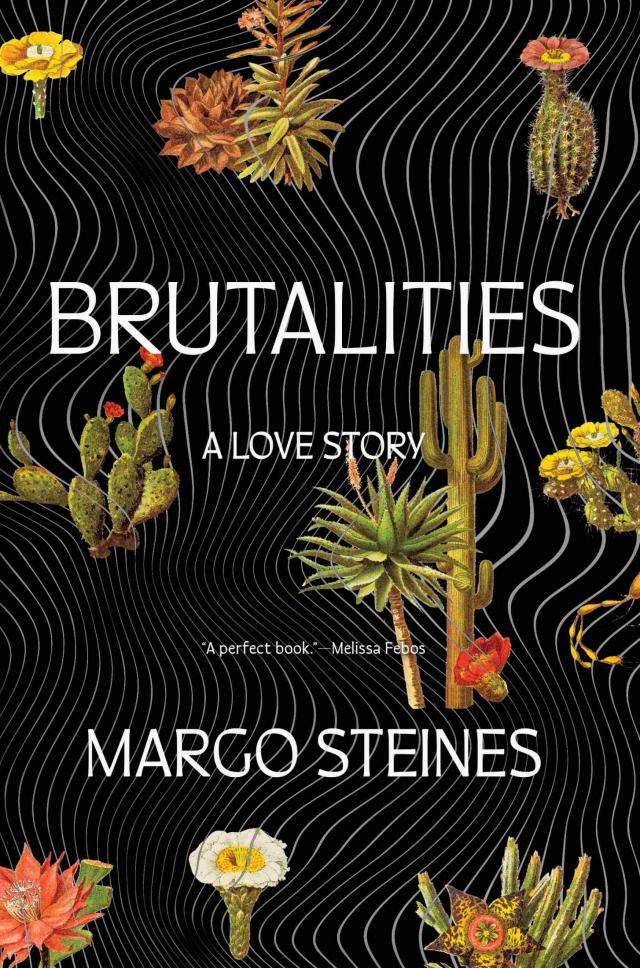


BRUTALITIES
a love story
MARGO STEINES
For N
Author’s Note
This book deals with many distressing topics that may be difficult to read about. They were difficult in the living, too. Because I have no way of predicting who might be traumatized by which parts, I cannot offer a meaningfully specific content warning beyond saying this is a difficult book. It is always a good idea to care for your emotional state; please consider this note a reminder to do so.
Two true things:
I wrote this book with tremendous care to tell the truth to the best of my ability. There are no composite characters or events. I changed some names and I compressed time to tell a story that spans years.
The human memory is not a recording device. My memory and experience are as fallible and subjective as anyone’s, meaning they are subject to the influences of time, trauma, drugs, and other mind-altering forces. If you find yourself in the pages of this book and your experience differs from mine—you may be as correct as I am. Such is the nature of memory.
“Do you not see how necessary a World of Pains and troubles is to school an Intelligence and make it a soul? A Place where the heart must feel and suffer in a thousand diverse ways!”
—JOHN KEATS, Selected Letters
Contents
EVERYTHING IS CONTAGIOUS
BRUTALITIES (I)
WHAT TO EXPECT WHEN YOU’RE EXPECTING TO POSSIBLY DIE
SICK GAINZ (I)
YOUR BODY IS A BULL’S EYE
A VERY BRUTAL GAME
THE FAST SLOWDOWN
WORKING
DEPRECIATIONS
SCALES OF HARDNESS
WADDLE LIKE A CAGE FIGHTER
IN THE CLINCH (I)
SKIN HUNGER
BRUTALITIES (II)
CAN I SHELTER YOU?
IN THE CLINCH (II)
A CLEAN, WELL-LIGHTED PLACE
SICK GAINZ (II)
A BODY THAT’S BEEN TROUBLED
EPILOGUE
Acknowledgments
BRUTALITIES
EVERYTHING IS CONTAGIOUS
TUCSON, APRIL 2020, 95°
QUARANTINE WEEK 6, GESTATIONAL WEEK 23
A pile of failed paper cranes is accumulating in my lap. They are shiny gold and marked by wrong folds, off angles, hesitant bend marks. I had thought, when I ordered the sheaf of yellow gold paper on the internet, that I would become excellent at origami and I would make a paper crane for each day I was quarantined. I thought I would end up with a fun pile of glinting birds, and it would be like meditating. I thought I would find some peace. Instead, I have burned through much of my paper with only this pile of crumples to show for it.
I am thirty-seven, pregnant, in love, and effectively locked in my apartment. In April the temperature nears the record high in Tucson, the southern Arizona desert town that has become my home. I did not intend to land in the Southwest—I was just stopping by for a few years to earn a graduate degree before heading back to Hawai’i, where I had settled. And yet, now I live here, nestled between the Catalina, Tortolita, Santa Rita, and Rincon mountain ranges, on a dusty alluvial plain tucked into great expanses of red voters and stabby cacti and desert creatures that hiss and howl at night.
On my couch sits my reason for staying here. His hair, nearly black, curls around his ears as he squints to read something on his phone screen. N: strong and gentle and wise, the person I spent so many years of my life stumbling around looking for. Our baby will be born at the end of the summer, into three-digit temperatures and monsoon rains.
My apartment is a collection of white objects nesting inside more white: white sheetrock living room, bedroom, and bathroom containing white modular shelves, white appliances, white table, white chairs. I keep the gauzy white curtains pulled tight against the Arizona sun at all times of the day. I keep the surfaces as clean as possible. I fold and crumple the golden cranes. Inside this small, tidy world, I can maintain order.
N works as a coach and trainer for athletes. I watch a muscle on the back of his arm rise as he shifts around on the couch. So much of the story of his life is visible in his body, a solid mass of strength and damage, a collection of experiences and reactions and corrections. A football lineman, a gymnast, a fighter. When he moves, body parts I didn’t used to know about rise and ripple: rear deltoids, latissimus dorsi, trapezius. He is a father, a son, a man, a boy. The parts of him I love most fiercely are the soft ones that balance all his strength: his gentleness, his open heart, his eyes that make and keep contact.
In the apartment we sit with our limbs tangled up, a bowl of berries balanced between us on my knee. I never liked sharing anything until I met him—always preferred my own space, my own bowl, my own chair. Now, I like everything being both of ours. I like sanding down the rough spots of my rigidity, my stubbornness, my ways of being that have ossified over three and a half decades of holding carefully together the boundaries of my heart. Inside our apartment, I feel safe and loved.
Outside, though: disintegration. It is the middle of April and the COVID-19 pandemic is raging. We watch the death rates rising on the news, buy face masks on Amazon, and drop our clothes at the door for decontamination after we go for walks. It’s fair to say we are freaked out—me much more than N, who is cooler under the pressures of the unknown. I have spent at least twenty-two hours of each of the last seventy days inside the six hundred square feet of the apartment. I have let many days pass without once stepping outside.
I spend numb hours scrolling through the news, and in every article it sounds like death is imminent, like we are all one bad doorknob touch away from drowning in our own lungs on dry land. My body has just come out of a rough year and feels so vulnerable to infection, infiltration, and compromise that I do not trust its ability to fend off even a regular cold, let alone this new and frightening respiratory virus. My pregnancy feels like a one-time gift, precious and precarious, and protecting it feels more important than anything else I might do. Hence the cranes.
N goes out into the world every day. He goes to work training clients in their private home gyms despite the shelter-in-place order in our state and most of the country. He goes to the grocery store, where he dutifully wears a face mask and fills bags with my favorite treats, the things that make me happy and healthy: greens and root vegetables, sweet potatoes and garlic, different kinds of berries, organic eggs. Dark chocolate and nuts, glistening slabs of grass-fed beef, bubbly waters, slippery oils, crunchy cucumbers. Sweet potato chips and sugar-free coconut milk ice cream. There are more reasons than ever, now, to take care of my body. I have not once been inside a store in the seventy days I have been in quarantine. He has brought and paid for everything I have eaten, waiting in the long lines, navigating the anxious vibrations of the stores, carrying everything up the stairs, cooking me meals from what he has gathered.
Contrary to my fears and expectations, my body is well. It makes me nervous to say so, because the well-being of my body has been so uncertain—since forever, but particularly in the last few years. My body has felt weak and vulnerable, even when it has been growing stronger. But I’ll say it anyway: my body is well and strong. Inside this body a small seed of a person is growing, suspended in amniotic fluid. South of my heart: a baby. Our baby.
I wonder if it is better that our baby will never have known a world of high-touch surfaces and carelessly shared meals, if the new normal of masks and distance will not feel like loss to them because they will never have known anything else. On the news I watch as New York—my city, my birthplace, my first home—loses itself, loses everything that makes it what it is and that has made me what I am, and I feel a deep ache that our baby might never know the New York of warm bagels eaten on the subway out of crumpled paper bags, the New York of the Russian baths and La MaMa, halal carts and yellow cabs, hot knishes and greasy Dominican chicken, bodega bacon-egg-and-cheeses but with oat-milk lattes because we stopped drinking bodega coffee a long time ago, paper copies of the Village Voice, the fucked-up L train, the smell of schwag weed in the park. Not all those losses are from the virus—not even most of them. Maybe not any of them. It’s been a long time coming, this orderly folding in of what once was vivid and ungovernable. I haven’t lived back east in nearly ten years. But still, it feels hard, to be so fully of a place that has receded into myth and memory.
Our baby stirs inside me as I drink the one daily cup of black coffee I permit myself. The morning light glints off my pile of half-cranes. I know our baby is safe right now, within me. I have more control now over their well-being than I ever will again, and even though shit is weird, it is also simple.
BRUTALITIES (I)
When I was twenty I got my entire back tattooed, the first pain I paid cash for. Every week, I went to the oldest tattoo shop in Manhattan and sat in a padded leather chair that smelled of iodine. I smashed my face into the upholstery and hunkered down for several hours of paying attention only to what the pain felt like. I did not listen to music or chat with the tattooer or ask for breaks. It took sixty hours over half a year.
Later, when I was thirty, I paid a woman to strap me to a leather cot and hit me with a stick. Stripped of context and ritual, everything in S/M sounds ridiculous. Without any of the euphemistic and oddly formal jargon S/M people are often attached to, the mechanics of the acts sound counterintuitive and depressing. I wanted to get hit with a stick, but I needed it to feel sexual, because I didn’t understand any other context for such a desire. The woman was about my age and
made more money than I did. I knew this because I used to do her job.
When I was even younger, still a teenager, I was paid many thousands of dollars to hit men with similar sticks and whips, to punch them in their faces, to kick them between their legs with all the force I could muster. But by thirty I was an adult with a regular job, so I paid the woman three hundred dollars to hit me with the stick for an hour. The more I think about it, the less sense it makes. But it was the only thing that felt clear to me: corporeal tests of how much my body could endure. The sexualizing felt important, but it was just a foil for something deeper and more shameful, of which I had only a fleeting understanding.
In the late nineties, before tattoos and getting hit with sticks had occurred to me, I met Dean. In the back of his metal shop in his building in Bedford-Stuyvesant, he had an old forklift. Its transmission did not work properly and it was largely useless for the task of transporting metal around the shop. He had bought it at the city auction in the Bronx where you could get worn-out generators and school busses with rusted engines, the sort of mechanical refuse no one wanted to deal with, worth more as scrap. The-raise-and lower function of the forks worked fine. He hung a chain fall from the forklift and used it to dangle girls like me, girls who felt lucky to be there, up off the ground with rope.
When I first met Dean, I was so young that I had never yet been with a man who did not live in his childhood home—I had never yet been with a man. His building was fantastical, empty of anything practical, full of giant machines that loomed like figures in the corners of the shop. The floor in the loft above the shop was espresso-colored hardwood, the shower head industrial and so powerful I had to kneel under it. He was terribly serious. I didn’t see him smile or laugh once until I had known him for weeks, until he had done things to me I didn’t yet know the names for.
I adored him almost immediately, but I didn’t understand why. It was not a warm love feeling. It was more like hunger. My feelings for him made no sense: we hardly spoke to each other, and I felt incredibly anxious and off-kilter when I was around him. He was so much older than me that we did not share cultural references. Also, he hurt me. My feelings, and my body. He hurt every soft part of me. I left his loft splattered with quickly blackening bruises in the places my clothes covered. Five-finger handprints around my biceps, clicking jawbone, wide bruises and thin red stripes across my ass and thighs. I always dropped everything when he called me. I mopped those espresso-colored floors for him after he fucked me and if he would have asked me for a kidney, I would have found a way to give one to him. He knew this. I was not, it was clear, the first of his acolytes. But I was young and unspoiled, desperately eager to please, and I asked nothing of him, not even to talk. I said yes to everything, so we fit easily, because he was a solid object and I was water and there was nothing I could not shape myself around.
The problem with habitual pain is that you quickly become habituated to it. What at first feels shocking and world-altering becomes routine. When Dean told me to strip and to stand in the corner to wait for the camel whip, I did it. The first time, the hurt of it was so intense that I lost myself. The whip was from Palestine, he told me. It was long and thin and cruel. A camel must be really big, I thought when I first saw the whip. I was still half a child, and I thought a child’s thoughts. I stood in the corner. Sweat beaded down my ribs and the insides of my thighs. But when it happened, everything changed. One moment I was a person with thoughts and a body and anxieties; I was wondering if I looked ridiculous, standing naked and barefoot facing the wall, I was wondering if my body looked right, if I should have put my hair in a ponytail, if we were going to fuck first or after or at all. I was wondering if I should have been doing something else, thinking something else, if I should have been trying to flirt instead of just obeying like an automaton and then he said Hold still, which he didn’t have to say because I hadn’t moved in fifteen minutes. And then everything was gone except one thing, it was only the hot electric agony stretching from him through the camel whip to the flesh of my ass, there were no words or thoughts, just a high-frequency cracking feeling; something in my core felt caved in and I was falling into where it had collapsed. He was gone and I was too; the feeling was the entire world. I was not in pain—I had become pain.
I did not move.
He stopped after not too many strikes. Later—years later—he told me he had been afraid, that my refusal to say no had frightened him. That no one had ever not said no before. I took this to mean I was special.
________________
Later, when I was in my twenties, we lived together in a rambling farmhouse in upstate New York, five hours northwest of the city. There were wildflowers growing by the side of the road, large mossy yellow fronds, pink bell shapes bobbling on thin stems, lacy off-white disks that crumpled in the heat. When we first moved to the farm, I cleaned and baked every day. I fed the animals and filled the enamel pitcher with wildflowers, placed it in the center of the sagging wooden table with the carved legs. I imagined that if I acted like the kind of woman who would be treated gently, I would become her, shedding the soiled skin of everything that had already passed between us, stepping into a new life where the air would be warm with sugar and baker’s yeast, the touches soft and painless, the tones calm and even. My desire for tenderness was a poorly kept secret, and I understood gentleness, love, and care to be things I had to earn. I was afraid I was undeserving and it frightened me to desire softness, so I bought lots of antique tea towels and I took plates of roasted pork out to him while he was working in his shop, trying to play the role I wanted to be cast in. If I squinted, I could almost see a future: me pregnant, him kind, both of us utterly changed.
At the farm, we had a dog, and the dog developed a problem in his hip. One morning I watched from the loft as Dean pulled him carefully up onto the white linen couch and tucked a down pillow under his haunches. Dean held our dog’s face in his big mean hands and stroked the dog’s jowls. I couldn’t see Dean’s face, but I was sure he was crying, those silent tears his sort of men so rarely allow themselves. Max, he said to the dog, over and over again. Max, Max, Max. I could hear him choking on the tears. Max, Max, Max. I love you. I love you, I love you. The dog was in pain and we knew it and it broke something open, some new channel that hadn’t existed between us before. Taking care of the dog was the kindest thing we ever did together. Dean built the dog an enclosure where he could be outside without hurting himself. He fed him expensive meat and wrapped him in a Pendleton blanket at night. I started to think maybe we could be different, that the man who liked to hit me with his belt had given way to a new man, one whose heart was growing, one who was so broken up over the dog’s pain that he could not think of anything else. He was calm, sweet, reasonable. He had feelings just like mine. I stopped baking every day. I forgot about best behavior.
And then it happened again, so fast I lost my breath before his hands even touched my neck. I could always remember the catalytic piece of nonsense, the exact thing that, if I could have swallowed it back down and made it unsaid, would have made everything calm again. This time it was about plastic packing boxes. Sometimes it was about the bumper of a truck, or the mail delivery, or a tone of voice. Once anger sparked, neither of us could control ourselves, we were both picked up by the gale-force swirling of fury between us. My voice became high and accusatory, his eyes went wild, mine streamed tears. He bellowed and I screamed. Once it started, I knew what would eventually happen, and the worst part of me genuinely wanted to see how far it would go, how hard and long he would squeeze his hands around my neck and shake me: until I went black and dizzy and silent? I knew he would not strike me in a furious state. He never did. I knew if he ever hit me out of pure anger I would leave and not come back. At least I thought I knew that. But it was moot, because he didn’t, not ever, not once. He hit me only in bed, where the sexualizing rarefied and exonerated the violence, where I could never know if he had saved up all his rage for those moments, or if it was altogether different.


